I Had a 2-Year-Old Problem. I Solved It in 10 Minutes
The complete framework at a glance — save this.
I Had a 2-Year-Old Problem. I Solved It in 10 Minutes

The complete framework at a glance — save this.
Here is the exact 5-step framework I used — and how you can apply it to any problem in your life.
“I keep telling myself I’ll read more. I buy the books. They sit on the shelf. That was two years ago. I still haven’t read a single one.”
Sound familiar? Maybe it’s not books for you. Maybe it’s the morning walk you’ve been postponing for months. The side project you keep meaning to start. The conversation you keep putting off.
We all have that one thing we’ve been meaning to do. And every week, we don’t do it. We tell ourselves we just need more motivation, more discipline, more willpower.
That assumption is wrong. And it is exactly why the problem never gets solved.
Let me show you a better way — a 5-step framework that takes 10 minutes and works on any problem: technical or human, professional or personal.

Slide 1: The hook — 2 years. Zero books.
The Framework

Slide 2: 5 questions. Any problem.
This is not a productivity hack. It is a structured thinking process. Five questions, asked in order, applied honestly. That’s it.
Question 1: What is the REAL problem?
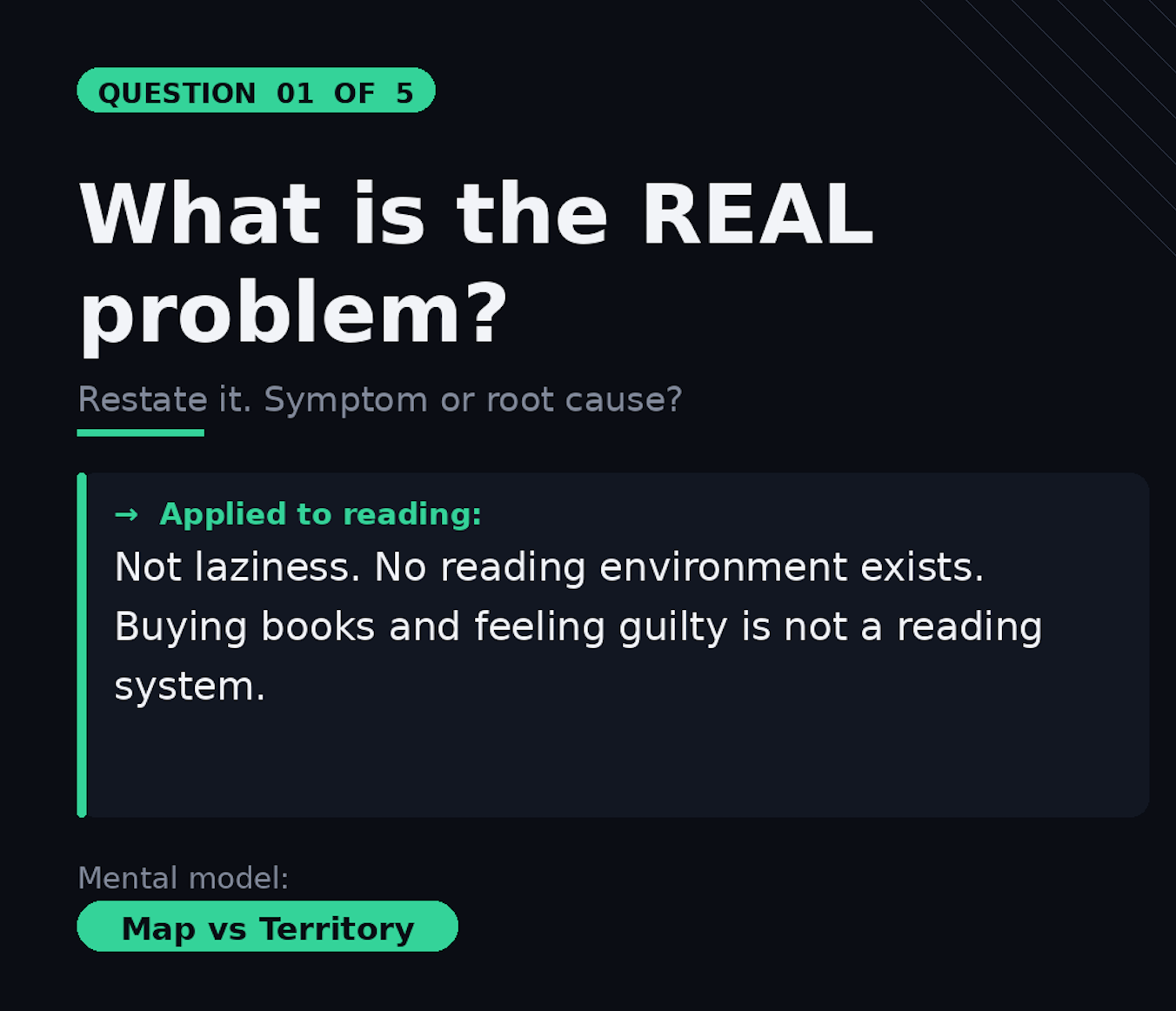
Slide 3: Identify the real problem, not the symptom.
Most people never solve their problems because they are solving the wrong problem. They treat the symptom, not the root cause.
When I looked at my reading problem honestly, I kept saying: “I don’t have time” or “I’m too tired at night.”
But when I restated the problem clearly, something shifted:
The real problem is not laziness. There is no trigger. There is no environment designed to make reading happen. Going to bed with a good intention is not a system.
The tool: Restate the problem in your own words. Ask why five times. Separate the symptom from the root cause.
Question 2: What KIND of problem is this?

Slide 4: Classify the problem type correctly.
Once you’ve identified the real problem, classify it. This matters because different types of problems require completely different solutions.
The main categories:
- People problem — conflict, communication, relationship dynamics
- Habit or behaviour problem — something you want to do but don’t
- Identity problem — you don’t see yourself as the person who does X
- Technical problem — a system, process, or tool is broken
- Decision problem — multiple paths, unclear which to pick
- Ethical problem — competing values, loyalty, moral weight
My reading problem was an identity-friction problem. I didn’t see myself as “a reader.” And the friction to pick up a book felt higher than the friction to open my phone.
I had been trying to solve an identity problem with motivation tactics. No wonder it wasn’t working.
Question 3: What am I assuming?

Slide 5: Surface the hidden assumption.
Every stuck situation has a hidden assumption underneath it — so embedded you don’t even notice it’s there.
My assumption:
“Reading requires a long, quiet, uninterrupted hour. I need to be in the right headspace. I need the right environment.”
This assumption was invisible to me for two years. And it was completely wrong.
10 pages a day = approximately 12 books a year.
10 pages. That’s 15 minutes. That’s the time I spend scrolling before bed. The assumption to break: I don’t need a perfect reading hour. I need 10 pages.
Question 4: What are 3 paths forward?

Slide 6: Never stop at one solution.
Never stop at one solution. The first solution that comes to mind is almost always the most obvious one — and usually not the best one.
Force yourself to find at least three options:
- Option A: Book on the nightstand instead of the phone. Read 10 pages before sleep.
- Option B: Read for 10 minutes immediately after morning coffee. Attach it to something you already do every day.
- Option C: Audiobooks during commute or morning walk. Redefine what reading means — words in your brain count.
Three options immediately opens the problem up. Option B and C didn’t even exist in my thinking before I forced myself to find three paths.
Question 5: What pattern did I just learn?

Slide 7: Extract the reusable pattern.
This is the most important step — and the one almost everyone skips.
After solving the problem, extract the pattern in one sentence. This turns solving one problem into a skill that makes every future problem easier.
This is an identity-friction problem. The move is always: make it tiny, make it visible, remove every decision. You don’t need discipline. You need design.
This pattern now lives in my thinking. The next time I face a stuck habit — any habit — I already know the move. The compounding has begun.
— — —
The 5 Lenses: Use These When You Get Stuck
Sometimes you run the 5 questions and still feel stuck. That’s when you reach for a lens — a mental model that reframes the problem from a completely different angle.
Lens 1: Inversion

Slide 8: Inversion — ask what makes it worse, then avoid that.
Instead of asking “how do I read more?”, ask: “what has guaranteed I never read?” No visible book. Phone on the nightstand. No specific time. Eliminate those conditions first.
Lens 2: First Principles

Slide 9: First Principles — strip assumptions, rebuild from facts.
Strip everything down. What is reading, actually? Words going into your brain. That can happen in 5 minutes, in a car, on a walk, in the kitchen. Not just in a quiet study at 9pm.
Lens 3: Pre-mortem

Slide 10: Pre-mortem — imagine it failed, then design against failure.
Picture yourself on Day 8. You’ve stopped reading again. Why? The book was boring. Life got busy. You missed one night and gave up entirely. Now design against those failure modes before they happen.
Lens 4: Second-order Thinking

Slide 11: Second-order — after it works, then what?
You read 10 pages a day for 30 days. Then what? You finish a book. Your thinking gets sharper. Your identity shifts. The goal is not the book. It’s who you become while reading it.
Lens 5: Reversibility Test
Is this a one-way door or a two-way door? Putting a book on your pillow is reversible. You can stop anytime. Most things you agonise over are two-way doors. Just try it. Adjust later.
— — —
The Pattern Filed

Slide 12: The lesson — save this, apply it today.
Three reminders that sit above my desk. I read them every morning:
Slow down at the start. Speed up at the end.
Most problems are people problems wearing a costume.
“Our deployment keeps failing” looks like a technical problem. Strip it down — two engineers who disagree and neither will say it out loud. People problem wearing a technical costume.
“The project is delayed” looks like a planning problem. Strip it down — someone said yes when they meant no because they were afraid to push back. People problem wearing a schedule costume.
“I can’t stick to my reading habit” looks like a discipline problem. Strip it down — you don’t see yourself as a reader. Your identity hasn’t shifted yet. People problem — and in this case, the person is you.
“My team’s productivity is low” looks like a process problem. Strip it down — your best engineer feels unrecognised and is quietly disengaging. People problem wearing a workflow costume.
If you cannot teach it, you have not learned it.
Two years. Zero books. One framework. Ten minutes.
The problem was never motivation. Never discipline. Never who I am.
It was design. And design can always be changed.
Save this framework. Apply it today.
메타데이터
- post_id
- bc548fb3380a
- slug
- i-had-a-2-year-old-problem-i-solved-it-in-10-minutes-bc548fb3380a
- url
- https://medium.com/@nagarajugajula100/i-had-a-2-year-old-problem-i-solved-it-in-10-minutes-bc548fb3380a
- canonical_url
- https://medium.com/@nagarajugajula100/i-had-a-2-year-old-problem-i-solved-it-in-10-minutes-bc548fb3380a
- author_url
- https://medium.com/@nagarajugajula100
- status
- ok
- fetched_at
- 2026-06-09 15:37:30