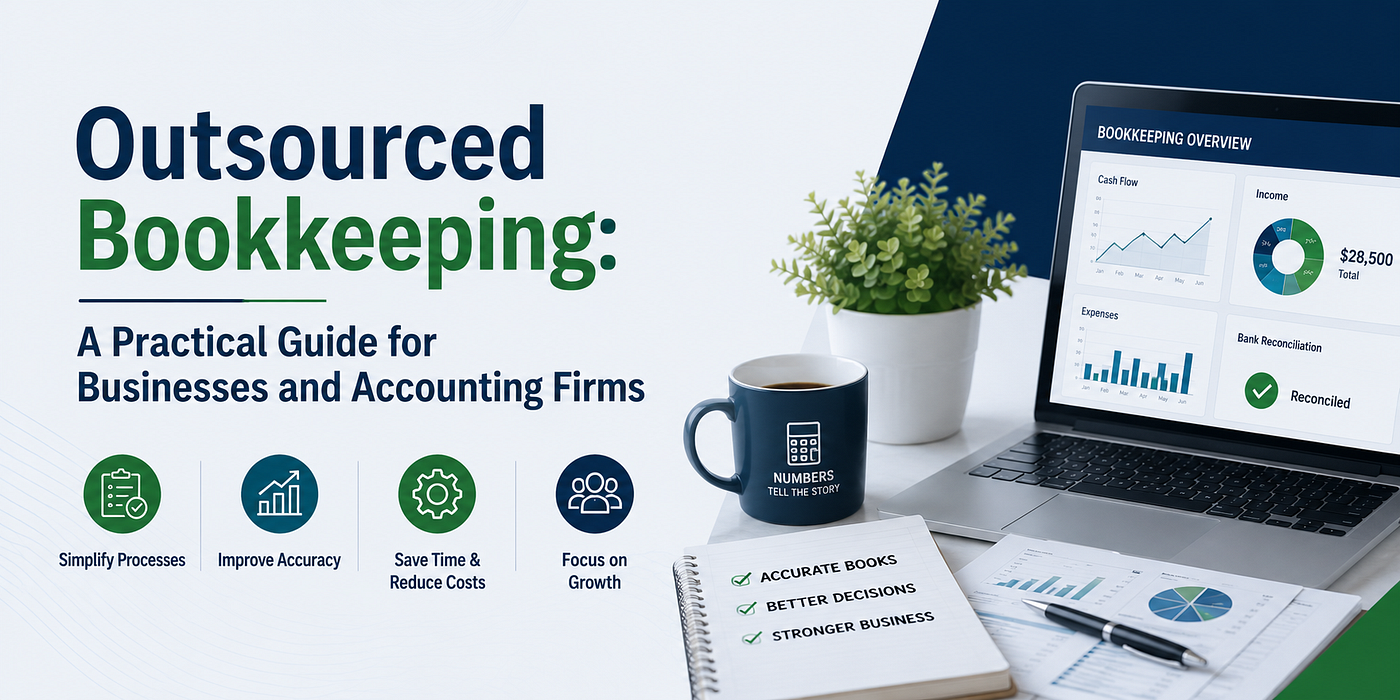
Outsourced Bookkeeping: A Practical Guide for Businesses and Accounting Firms
Bookkeeping is one of those functions that quietly determines whether a business runs smoothly or constantly firefights during tax time…
Outsourced Bookkeeping: A Practical Guide for Businesses and Accounting Firms
Bookkeeping is one of those functions that quietly determines whether a business runs smoothly or constantly firefights during tax time. Yet it’s also one of the easiest functions to delegate. That’s why so many accounting firms, SMEs, and e-commerce brands now choose to **outsource bookkeeping services** rather than hire and manage an in-house bookkeeper.
Here’s a clear look at what outsourced bookkeeping actually covers, the problems it solves, and how to evaluate a provider properly.
What Does Outsourced Bookkeeping Actually Include?
Outsourced bookkeeping goes beyond simply “someone else doing data entry.” A proper engagement typically covers:
- Daily, weekly, or monthly transaction recording
- Bank and credit card reconciliations
- Accounts payable and accounts receivable management
- Employee expense tracking
- Inventory management for product-based businesses
- Management reporting — cash flow statements, forecasts, budget-vs-actual variance, and KPIs
Unlike a single freelance bookkeeper, an outsourced bookkeeping service usually comes with a small team structure — a dedicated bookkeeper plus a reviewer — so errors get caught before they reach your reports.
Why Businesses Choose to Outsource Rather Than Hire
The Hiring Problem
Finding a skilled, reliable, in-house bookkeeper — especially post-2022 — has become genuinely difficult in many markets. Recruitment delays, salary inflation, and turnover all add friction that outsourcing sidesteps entirely.
The Cost Problem
An in-house bookkeeper’s true cost isn’t just salary. It includes software licenses, training, leave cover, and management time. Businesses that shift to outsourced bookkeeping services frequently cut these costs by up to 60%.
The Consistency Problem
When a single in-house bookkeeper goes on leave or leaves the company, books fall behind immediately. Outsourced teams build redundancy into the process, so work continues without interruption.
The Scale Problem
Growing businesses often have unpredictable bookkeeping volume — busy during EOFY, quieter otherwise. Outsourcing lets you scale support up or down instead of over- or under-staffing internally.
Who Benefits Most from Outsourced Bookkeeping?
- Accounting and bookkeeping firms, CPAs, and BAS agents needing extra hands during peak periods
- SMEs and startups that don’t yet need (or can’t afford) a full-time bookkeeper
- E-commerce and multi-entity businesses with high transaction volume across channels
- CFOs and finance teams who want reconciled, review-ready books without managing the process themselves
- Business consultants overseeing bookkeeping across several client accounts
What a Good Bookkeeping Engagement Looks Like
A well-run outsourced bookkeeping process generally follows five stages:
- Discovery and scope definition — understanding transaction volume, reporting needs, and current software
- System access and workflow setup — secure access is granted and workflows are aligned to your standards
- Dedicated bookkeeper allocation — a specific person (not a rotating pool) is assigned to your account
- Ongoing execution — daily, weekly, or monthly bookkeeping tasks completed on schedule
- Review, reporting, and continuous improvement — regular reporting with room to refine the process over time
Questions to Ask Before Choosing a Bookkeeping Partner
- Do they support your existing software (Xero, QuickBooks, MYOB, Sage, or similar)?
- Is there a documented QA process, or does one person handle everything end-to-end?
- Can they take on catch-up or clean-up work for backlogged books?
- What security certifications do they hold (ISO 27001, ISO 9001, GDPR, HIPAA)?
- Do they offer flexible engagement models — part-time, full-time, or ad-hoc — matched to your actual workload?
Common Questions About Outsourced Bookkeeping
Is outsourced bookkeeping only useful for businesses with messy books? No — it works equally well for businesses with clean books that simply want to free up internal time, as well as those needing catch-up work on backlogged records.
How often are books updated in an outsourced arrangement? This is flexible and usually set during onboarding — daily, weekly, or monthly, depending on your transaction volume and reporting needs.
Do outsourced bookkeeping services work with accounting firms managing multiple clients? Yes. Many providers are structured specifically to support firms handling several client accounts at once, not just single businesses.
Final Thoughts
Outsourced bookkeeping isn’t about cutting corners — it’s about putting reconciliations, reporting, and daily transaction management in the hands of a team that’s set up to do it accurately and consistently. For firms and businesses in Australia, Hornbill’s outsourced bookkeeping services illustrate what a process-driven, security-certified approach to outsourcing looks like in practice.
If your books are falling behind or your internal resourcing is stretched, it’s worth evaluating whether an outsourced bookkeeping service could take that weight off your plate.
메타데이터
- post_id
- bc6af2abb59d
- slug
- outsourced-bookkeeping-a-practical-guide-for-businesses-and-accounting-firms-bc6af2abb59d
- url
- https://medium.com/@hornbillcorporate/outsourced-bookkeeping-a-practical-guide-for-businesses-and-accounting-firms-bc6af2abb59d
- canonical_url
- https://medium.com/@hornbillcorporate/outsourced-bookkeeping-a-practical-guide-for-businesses-and-accounting-firms-bc6af2abb59d
- author_url
- https://medium.com/@hornbillcorporate
- status
- ok
- fetched_at
- 2026-07-24 20:11:08