Covert Narcissism in the Ecology of Emotional Scarcity
The Quiet Famine That Turns Wounded People Into Emotional Predators — And Why Almost No One Sees It Coming
Covert Narcissism in the Ecology of Emotional Scarcity
The Quiet Famine That Turns Wounded People Into Emotional Predators — And Why Almost No One Sees It Coming

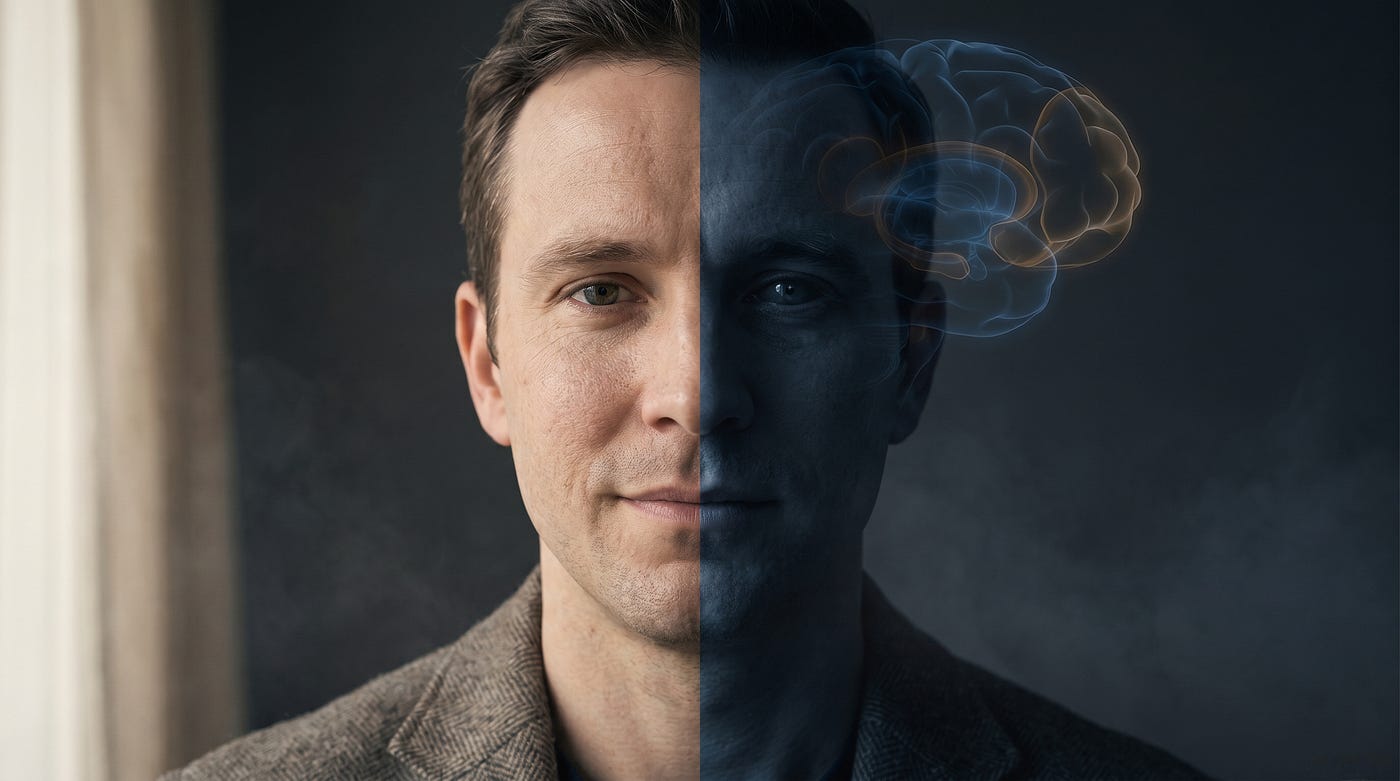
Image is generated via Nano Banana Pro.
There is a particular kind of hunger that doesn’t announce itself.
It doesn’t storm into a room demanding to be fed. It doesn’t shout, doesn’t posture, doesn’t flex. It sits quietly in the corner, radiating a kind of exhausted nobility, waiting for someone — anyone — to notice how much it has suffered, how unfairly it has been treated, how deeply, deeply misunderstood it has always been.
You will not recognize this hunger by its volume. You will recognize it by its aftermath: the strange fatigue you feel after spending an evening with someone who never raised their voice, never demanded anything outright, and yet somehow left you feeling like you owed them an apology for existing too loudly. You will recognize it in the slow erosion of your own confidence, in the way you started shrinking your opinions before you even finished forming them, in the low hum of guilt that seems to follow you home.
This is the terrain of covert narcissism — and to understand why it exists at all, why it thrives in some environments and withers in others, we have to stop treating it as a personality quirk or a diagnosis to whisper about, and start treating it as what it actually is: an adaptation. A survival strategy. A creature shaped, quite precisely, by the ecosystem it grew up starving in.
This article is an attempt to map that ecosystem — what I’m calling the ecology of emotional scarcity — and to trace, root by root, how a very specific kind of person grows out of very specific soil.
Part One: The Quiet Cousin of Grandiosity
When most people hear the word “narcissist,” they picture someone unmistakable. Loud. Charismatic. Obsessed with mirrors, literal and metaphorical. Someone who monopolizes conversations, name-drops with surgical precision, and radiates a kind of magnetic, exhausting self-belief. This is the grandiose or overt narcissist, and pop psychology has spent the last decade building an entire genre around him.
But there is another, quieter subtype — one that clinical researchers have been documenting for decades under names like “vulnerable narcissism,” “hypersensitive narcissism,” and “covert narcissism.” Where the grandiose narcissist expands to fill a room, the covert narcissist contracts, curls inward, and performs a kind of exquisite, theatrical modesty that is, underneath, made of exactly the same material: an unstable, fragile sense of self that depends entirely on external validation to feel real.
Psychological researchers have described people high in covert narcissism as hypersensitive, anxious, timid, and insecure — yet capable of surprising close observers with sudden flashes of grandiosity, entitlement, and rage when that fragile self-image is threatened. It is a walking contradiction: shy on the surface, imperial underneath. The mousy coworker who never asks for credit but seethes for a week when someone else gets promoted. The self-effacing friend who insists they’re “not that important” while subtly steering every conversation back to their own suffering. The partner who never criticizes you outright but somehow makes you feel, through sighs and silences and slow withdrawals of warmth, that you have failed them in some unspeakable way.
Clinically, both subtypes are believed to sit under the umbrella of pathological narcissism, sharing a common core: a deep-seated need for admiration, a fragile and contingent self-esteem, and — crucially — a diminished capacity for genuine empathy. What differs is the coping strategy. The grandiose narcissist manages inner emptiness through inflation: bragging, dominance, spectacle. The covert narcissist manages the exact same emptiness through deflation: martyrdom, self-pity, passive control, and a kind of moral high ground built entirely out of victimhood.
Some researchers have found that covert narcissism correlates with markedly higher neuroticism than its grandiose cousin — more anxiety, more emotional volatility, more shame sensitivity. This matters enormously for how the covert narcissist actually behaves in relationships, because it means their core emotional experience isn’t triumphant superiority. It’s dread. It’s the constant, low-frequency terror of being exposed as ordinary, as flawed, as not enough — a terror so unbearable that an entire personality gets built around avoiding it.
That terror doesn’t come from nowhere. It grows out of a specific kind of soil. And to understand that soil, we need to talk about scarcity — not financial scarcity, but something colder and less visible: the scarcity of emotional resources in the environments where a self is first assembled.
Part Two: What an “Ecology of Emotional Scarcity” Actually Means
Ecologists have a simple, elegant idea: organisms don’t develop their traits in a vacuum. A cactus doesn’t “choose” to store water in thick, spiny tissue out of some aesthetic preference. It develops that way because it evolved in an environment where water was unreliable, and the organisms that survived long enough to reproduce were the ones that hoarded, conserved, and protected whatever moisture came their way. Scarcity doesn’t just limit an organism — it shapes it, cell by cell, generation by generation.
Human emotional development works on a strikingly similar logic, just on a much faster and more personal timescale — often just one childhood, sometimes reinforced across a whole family lineage.
An “ecology of emotional scarcity” is any relational environment — a household, a marriage, a culture, even an entire society — where genuine attention, warmth, validation, and emotional safety are chronically unreliable, rationed, or conditional. It’s not necessarily an environment of overt cruelty. Often it’s far subtler than that: a home where love was real but inconsistent, where a child had to perform, achieve, or perfectly regulate their emotions to receive affection; a family where one parent’s moods dictated the emotional weather for everyone else; a culture that prizes productivity and stoicism over vulnerability and connection.
In an ecology like this, a developing psyche faces the same brutal calculus a drought-adapted plant faces: how do I make sure I get what little is available, and how do I protect myself from the pain of not getting it?
Two broad survival strategies tend to emerge from this calculus, and they map almost perfectly onto the overt/covert narcissism split.
Strategy one: become impossible to ignore. Take up maximum space. Perform confidence so loudly and so constantly that admiration becomes, in effect, mandatory. This is the grandiose adaptation — a kind of emotional maximalism born from scarcity.
Strategy two: become indispensable through suffering, through self-sacrifice, through moral superiority, through the subtle manipulation of guilt. If you can’t compete for attention through spectacle, you compete for it through sympathy, through being the person whose needs are always somehow more urgent, more tragic, more deserving of accommodation — while never quite admitting that’s what you’re doing, even to yourself. This is the covert adaptation.
Both strategies are, at their root, responses to the same underlying condition: a nervous system that learned, early and thoroughly, that emotional resources are not something you can trust to simply be there. They must be extracted, managed, monitored, and fought for — quietly, if necessary, but fought for nonetheless.
This is the crucial reframe this article wants to offer: covert narcissism is not simply a character flaw or a moral failing that appears at random. It is what emotional scarcity, filtered through a specific temperament and a specific set of early relational lessons, tends to produce. It is an adaptation to famine wearing the camouflage of humility.
Part Three: What Scarcity Does to a Developing Brain
Here is where the research gets genuinely unsettling, because it turns out that scarcity doesn’t just shape behavior — it reshapes cognition itself, and not in ways that make people more compassionate toward others in the same condition.
Behavioral scientists studying scarcity — originally in economic contexts, later extended into emotional and social domains — have found something counterintuitive: when people operate under conditions of scarcity, their capacity for empathy toward others’ suffering measurably declines. Neuroscience research using pain-empathy paradigms has demonstrated that inducing a scarcity mindset dampens the brain’s empathic response to watching another person in pain. Scarcity, in other words, doesn’t just deplete resources. It narrows the aperture of moral attention. It makes the suffering of others feel like a luxury you cannot afford to fully register, because you are too busy monitoring the threat to your own supply.
Now transpose that finding onto emotional development. A child raised in a household where warmth, attention, and validation are scarce isn’t just deprived of comfort. Their entire cognitive architecture around give-and-take gets warped by that deprivation. They learn — not consciously, not as a decision, but as a deep procedural habit — that emotional resources are zero-sum. That someone else’s need might come at the cost of their own. That vigilance, self-focus, and strategic emotional management aren’t optional extras; they’re survival requirements.
This is a large part of why covert narcissists so often present as deeply, achingly sensitive people, and in a sense, they are. Researchers studying vulnerable narcissism have consistently found it correlates with heightened emotional reactivity, greater insecurity in attachment, and profound difficulty regulating negative emotion — especially shame. The oversensitivity isn’t performance. It’s real. What’s compromised isn’t the capacity to feel — it’s the capacity to extend that same quality of attention outward, to hold someone else’s pain as being just as real and urgent as their own, without immediately looping the conversation back to their own wound.
There’s a particularly telling body of research on shame and vulnerable narcissism that helps explain the covert part of covert narcissism specifically. Studies have found that vulnerable, hypersensitive narcissism is strongly predicted by what psychologists call “characterological shame” — not shame about a specific action (“I did something bad”) but shame about one’s fundamental self (“I am bad, I am unlovable, I am fundamentally deficient”). This distinction matters enormously. Behavioral shame can be repaired through apology and changed behavior. Characterological shame cannot — because there’s no discrete act to fix. There is only the self, perpetually on trial, perpetually one exposure away from being revealed as irredeemable.
People carrying this kind of shame develop what researchers call “shame withdrawal” as a primary coping strategy: rather than confronting the shame directly, they hide, minimize, deflect, and — crucially — manage other people’s perceptions so carefully that the shame never gets triggered in the first place. This single mechanism explains an enormous amount of covert narcissistic behavior: the inability to accept feedback without collapsing or counter-attacking, the compulsive self-effacement that somehow always circles back to being about them, the passive-aggression that lets them express anger without ever risking the vulnerability of a direct confrontation they might lose.
Scarcity trains the nervous system to treat connection as a resource to be defended, not a gift to be shared. And a nervous system trained that way doesn’t stop defending just because it eventually finds itself in an environment of relative abundance. It keeps hoarding. It keeps monitoring. It keeps score.
Part Four: The Root System — Where the Famine Begins
If covert narcissism is an adaptation to scarcity, the obvious next question is: scarcity of what, exactly, and administered by whom?
The clinical literature converges on a surprisingly consistent answer, one that traces back to the mid-twentieth-century psychoanalyst Heinz Kohut, whose work on the development of the self remains foundational to how clinicians understand narcissistic pathology today. Kohut proposed that healthy self-esteem develops through what he called “empathic mirroring” — the experience, repeated thousands of times across childhood, of a caregiver accurately reflecting back a child’s feelings, needs, and worth. I see that you’re proud of what you built. I see that you’re scared. I see you, and what I see is good.
When that mirroring is chronically absent, distorted, or conditional — when a child’s emotional reality is ignored, dismissed, mocked, or only acknowledged when it’s convenient for the parent — the child doesn’t simply feel unseen in the moment. According to Kohut’s model, they fail to develop a stable, internal sense of their own worth. The self remains, in a real structural sense, unfinished — dependent for the rest of that person’s life on external sources to provide the validation that should have been internalized in the first place. This is the psychological origin point of what we now call “narcissistic supply”: not vanity, but a genuine, structural deficit, a hole where a foundation should be.
Here’s the part that surprises most people: contemporary research increasingly links this deficit not to indulgence, but to a lack of consistent warmth. There’s a persistent popular myth that narcissists are created by parents who spoiled them, told them they were special, gave them everything. The clinical reality documented across recent studies of adverse childhood experiences and narcissistic personality traits paints a more complicated, and frankly sadder, picture. It’s true that some grandiose narcissism correlates with excessive, unconditional praise disconnected from actual behavior — praise that teaches a child they’re superior rather than teaching them they’re loved. But covert narcissism in particular tracks closely with something else: emotional neglect. A home where a child’s inner life simply wasn’t a priority. Where physical needs might have been met perfectly well, but emotional needs — the need to be asked “how do you feel,” the need to have your fear taken seriously, the need to be comforted without having to perform your distress convincingly enough to earn it — were left unmet, again and again, until the child stopped registering them as needs at all.
There is an almost paradoxical relationship documented between childhood emotional neglect and covert narcissism, because on the surface these look like opposite outcomes. A child raised with chronic emotional neglect often grows into an adult defined by chronic self-abandonment — someone who over-gives, who struggles to identify their own needs, who apologizes reflexively. But researchers studying this territory have noted the two conditions frequently share a common root: both the emotionally neglected adult and the covert narcissist grew up learning that their authentic emotional experience was, in some fundamental way, inconvenient to the people who were supposed to care for it. One person resolves that lesson by disappearing entirely into service of others. The other resolves it by building an elaborate, hidden architecture designed to extract, indirectly, the validation that was never freely given.
There’s also compelling research on the role of hostile or controlling parenting born from the parents’ own emotional neglect — essentially, a multigenerational transmission of scarcity. A parent who was themselves starved of empathic attunement growing up frequently struggles to offer it to their own children, not from malice, but from genuine incapacity; you cannot mirror back an emotional experience you were never taught to recognize in the first place, in yourself or anyone else. Recent research out of clinical psychology programs has found that childhood emotional neglect predicts increased hostile and controlling parenting behavior in the next generation, along with a specific kind of “narcissistic distrust” toward one’s own children — a cynical, guarded posture that treats even a child’s normal needs as manipulative or excessive.
This is the ecological chain, link by link: an emotionally scarce environment produces an adult with an unfinished, contingent sense of self. That adult, without necessarily intending to, recreates conditions of emotional scarcity for the next generation, because they are parenting from a well that was never filled. And within that recreated scarcity, a child — particularly a sensitive, anxious, high-neuroticism child — learns to survive by developing the exact cluster of traits we now call covert narcissism: hypervigilant self-protection, indirect bids for validation, an exquisitely tuned radar for slights, and a deep, abiding conviction that their suffering is both unique and unrecognized.
It is worth pausing here to say something that deep dives into this topic too rarely say plainly: none of this excuses the harm covert narcissists cause to the people around them as adults. Understanding the root does not neutralize the damage of the branch. But understanding the ecology this pattern grows from is essential if we actually want to interrupt it — in ourselves, in our relationships, and across generations — rather than simply diagnosing and discarding people who are, in the end, expressing the exact deprivation they were raised inside.
Part Five: The Mask and the Wound
If you want to understand covert narcissism as a lived, felt experience rather than a diagnostic category, it helps to picture two layers occupying the same body.
The first layer is the mask: modest, self-deprecating, quietly virtuous, endlessly patient, subtly superior in its patience. This is the layer other people see. It is often genuinely likable — even admirable — at first contact. Covert narcissists frequently present as thoughtful, artistic, spiritually inclined, deeply “sensitive” people; the mask is not usually cartoonish or obviously manipulative, which is precisely why it’s so effective and so hard to name from the outside.
The second layer is the wound: a raw, chronically activated sense of insufficiency, monitored second-to-second for any sign that others perceive it too. This layer is rarely shown directly. Instead, it leaks — through disproportionate reactions to minor criticism, through a startling capacity for envy dressed up as mere “observation,” through a persistent undertone of resentment toward people who seem to have an easier time being loved.
The relationship between these two layers is what clinicians call, somewhat clinically, “narcissistic injury” — the intense psychological wound that occurs when the idealized self-image, however modestly it’s presented, gets threatened by something as small as being overlooked, mildly criticized, or simply not sufficiently praised. What makes this dynamic so difficult for the people around a covert narcissist is the wild disproportion between trigger and response. A mild, well-intentioned piece of feedback — “hey, could you double check this next time?” — can trigger hours or days of withdrawal, coldness, or a strange inversion where the covert narcissist somehow becomes the aggrieved party, requiring comfort and reassurance from the very person who offered the original feedback.
This is not, contrary to how it often feels to the person on the receiving end, a calculated strategy of manipulation in the Machiavellian sense — though its effects are functionally manipulative regardless of intent. It is closer to a reflexive immune response. The self, being fundamentally unstable and externally dependent, treats any perceived threat to its image with the same urgency a body treats a genuine infection: total mobilization, disproportionate to the actual size of the invader.
Psychodynamic thinkers have long described narcissism, at its core, as a defense against shame — an elaborate architecture built specifically to avoid ever consciously feeling the thing the person fears most: that they are, underneath it all, not enough, not lovable, not real in the way other people seem to be real. The tragedy embedded in this framework is that the defense mechanism actively prevents the very thing that could heal the wound. Genuine intimacy requires being seen accurately, flaws included, and surviving that exposure without collapsing. But the covert narcissist’s entire system is organized around preventing accurate exposure — curating which parts of the self get shown, deflecting attention from anything that might trigger the underlying shame, managing others’ perceptions with quiet, constant vigilance. So the wound never gets to heal through contact with reality. It just gets more elaborately protected, generation after interaction after relationship.
Part Six: The Behavioral Vocabulary of Covert Narcissism
To recognize this pattern in real life — in a partner, a parent, a boss, a friend, or honestly, in oneself — it helps to have language for its most common expressions. None of these behaviors, taken alone, proves anything. What matters is the pattern, the frequency, and the consistent function they serve: managing perception, avoiding vulnerability, and extracting validation without ever directly, honestly asking for it.
The martyr complex. A persistent narrative in which the covert narcissist is quietly, nobly suffering — overworked, underappreciated, endlessly giving to others who don’t reciprocate — regardless of the objective facts of the situation. The martyrdom is rarely presented as a complaint. It’s presented as a simple, sad observation about how the world works, one that conveniently positions them as morally superior to everyone around them.
Backhanded generosity. Gifts, favors, and help that come with an invisible price tag, cashed in later as evidence of how much they’ve sacrificed. “I dropped everything to help you move, but of course you’re too busy for me now” is a sentence built entirely out of resentment disguised as generosity.
The silent treatment and strategic withdrawal. Rather than voicing anger directly, the covert narcissist withdraws warmth — subtly at first, then more obviously — forcing the other person into a state of anxious uncertainty about what went wrong. This is one of the most well-documented tactics in the covert narcissist’s repertoire, precisely because it allows them to express punishment without ever risking a direct confrontation they might lose, or an admission of vulnerability they cannot tolerate making.
Victim-perpetrator inversion. Perhaps the single most disorienting pattern for partners and family members of covert narcissists: the ability to transform any conflict, no matter who initiated the harm, into a situation where the covert narcissist ends up being comforted, reassured, or apologized to. If you raise a legitimate grievance, you may find yourself, within minutes, consoling the very person who hurt you, because they’ve managed to signal — through tone, tears, or wounded silence — that your grievance has hurt them more than their original behavior hurt you.
Envy disguised as commentary. Subtle, seemingly casual remarks that puncture other people’s happiness or success — “must be nice to have that kind of time,” “I guess some people just get lucky” — delivered with just enough plausible deniability that calling it out sounds like an overreaction.
Chronic comparison and covert competition. An underlying, rarely voiced belief that they are more deserving, more talented, more deeply feeling than the people around them, expressed not through boasting but through subtle diminishment of others’ accomplishments, or through positioning their own struggles as uniquely profound.
Fragile boundaries around criticism. An inability to receive even mild, constructive feedback without a disproportionate emotional reaction — tears, withdrawal, counter-accusation, or a sudden and total reframing of themselves as the wronged party.
Gaslighting through vagueness. Unlike the overt narcissist’s blunt denial (“that never happened”), the covert narcissist’s gaslighting tends to be softer and harder to pin down — trailing off mid-explanation, sighing instead of answering, responding to direct questions with vague deflections that leave the other person unsure whether they’re remembering events correctly at all. Over time, this particular kind of manipulation is especially insidious precisely because it’s quiet, cumulative, and plausibly deniable at every single step — there’s rarely one dramatic moment you can point to and say “that’s when the gaslighting happened.” It’s death by a thousand ambiguous cuts, and the cumulative effect is a partner who genuinely stops trusting their own perception of reality.
What unites all of these behaviors is not cruelty for its own sake — though the effect on the people subjected to them is genuinely harmful and deserves to be named as such, without euphemism. What unites them is indirection. Every single one of these tactics achieves an emotional outcome — attention, sympathy, control, punishment, validation — while allowing the covert narcissist to avoid ever directly, vulnerably asking for what they actually want. Because asking directly would require risking a “no.” And risking a “no,” for a self this unstable, feels less like a minor social disappointment and more like an existential threat.
Part Seven: Supply Lines — How Extraction Works in a Scarce Ecosystem
Let’s return to the ecological metaphor, because it clarifies something important about why covert narcissists behave this way in relationships specifically, rather than just in the abstract.
Clinicians use the term “narcissistic supply” to describe the attention, admiration, sympathy, and validation that people with pathological narcissism require to regulate their unstable self-esteem. It’s a slightly unfortunate, clinical-sounding phrase for something that, on the ground, feels a lot more like a resource-extraction relationship than a normal human bond. And that’s the point: in an ecology of scarcity, relationships stop functioning as mutual exchanges of care and start functioning as supply lines.
For a covert narcissist, the supply they seek isn’t usually the loud, showy admiration a grandiose narcissist craves. It’s subtler: sympathy, reassurance, moral validation, the sense of being uniquely understood or uniquely wronged. This is precisely why covert narcissists so often gravitate toward — and are so often mistaken for — genuinely sensitive, emotionally intelligent people. The performance of depth and vulnerability is the supply-extraction mechanism. “I’ve been through so much” isn’t necessarily a lie. But when it functions primarily as a device to secure endless reassurance, comfort, and exemption from accountability, it stops operating as genuine vulnerability and starts operating as a resource claim.
This is where the well-documented cycle of love bombing and withdrawal becomes relevant, and it’s worth being precise about how it actually functions, because it’s often misunderstood as a purely calculated seduction technique. In the early stages of a relationship with a covert narcissist, partners frequently report an intense, almost overwhelming sense of being deeply seen and understood — long conversations that feel profound, an intimacy that seems to arrive faster and deeper than in any previous relationship. This isn’t necessarily manufactured cynically. In many cases, it reflects a genuine, desperate hunger for connection meeting, for the first time in a long time, someone who seems willing to provide it. The problem is what happens once that supply becomes available and, crucially, once the relationship matures to the point where the partner starts having normal, ordinary needs of their own.
Because the covert narcissist’s underlying model of relationships was built inside a scarce ecology, an ordinary partner’s ordinary needs — for attention, for the covert narcissist to occasionally ask about their day, for basic reciprocity — can register, at a nervous-system level, as a threat to supply. Not because the covert narcissist consciously believes their partner’s needs are wrong, but because scarcity-trained systems interpret any redirection of resources toward someone else’s needs as a direct reduction of their own. The result is a withdrawal — subtle, often unconscious, frequently rationalized (“I’m just stressed,” “I need space,” “you’re being too sensitive about this”) — that leaves the partner scrambling to understand what changed, and often, in the process, working harder and harder to re-earn the warmth of those early days.
This oscillation — abundance, then scarcity, then abundance again in response to the partner pulling away or threatening to leave — creates one of the most well-documented psychological hooks in unhealthy relationship dynamics: intermittent reinforcement. Behavioral psychology has understood since the mid-twentieth century that unpredictable rewards produce far stronger, far more persistent behavioral attachment than consistent ones. A partner who receives warmth predictably doesn’t develop the same anxious, hypervigilant attachment as a partner who receives warmth unpredictably, interspersed with withdrawal. The scarce ecology doesn’t just shape the covert narcissist. It gets exported, wholesale, into the relationship itself — recreating, for the partner, the exact same conditions of unreliable emotional supply that shaped the covert narcissist in the first place.
This is, in a real sense, how scarcity ecosystems propagate. Not through direct instruction, but through the recreation of the emotional weather patterns one has always known — patterns that feel, to a nervous system calibrated to them, disturbingly like home.
Part Eight: The Terrain of the Relationship — Living Inside the Scarcity
For anyone who has actually lived inside a close relationship with a covert narcissist — as a partner, an adult child, an employee, a close friend — the clinical vocabulary can feel almost clinically insufficient for what the experience actually costs. It’s worth naming, plainly, what tends to happen to a person who spends years inside this dynamic.
There is a specific, documented phenomenon sometimes called “cognitive dissonance” in the narcissistic-abuse literature: the gap between the version of the relationship presented to the outside world (loving, devoted, harmonious) and the version experienced privately (confusing, depleting, subtly punitive) grows so wide that the person on the receiving end starts doubting their own perception rather than the relationship itself. This isn’t a character flaw in the victim. It’s a predictable outcome of chronic exposure to inconsistent, ambiguous signals from someone whose approval you’ve been trained to seek.
Over time, this produces a recognizable psychological profile in the partners of covert narcissists: chronic self-doubt about one’s own emotional reactions (“am I overreacting?”), a persistent, low-grade guilt that seems disconnected from any specific wrongdoing, a gradual shrinking of one’s own needs and opinions to avoid triggering withdrawal or conflict, and — perhaps most corrosively — a slow erosion of the ability to trust one’s own read of other people’s intentions, long after the relationship ends.
There is also the specific and underappreciated toll of being a scapegoat in a covert narcissist’s relational system — a role that shows up frequently in families where one parent exhibits covert narcissistic patterns. In these family systems, the covert narcissist often maintains a carefully managed public reputation as reasonable, even saintly, while one specific family member absorbs the disproportionate blame for any tension in the household. The scapegoat becomes, in effect, the pressure valve for an emotional economy that cannot tolerate the parent’s own accountability. Other family members, observing the parent’s calm, wounded reasonableness alongside the scapegoat’s apparent instability or difficulty, often side unknowingly with the covert narcissist — reinforcing, generation after generation, the exact scarcity dynamics that produced the pattern in the first place.
None of this is offered to induce despair. It’s offered because naming a dynamic precisely is very often the first real step toward escaping it — and because so much of what makes covert narcissistic relationships so uniquely disorienting is precisely their resistance to being named. Overt abuse, at least, tends to leave evidence other people can recognize. Covert emotional extraction leaves behind mostly its residue: a person who can’t quite explain why they feel so tired, so guilty, so uncertain of their own mind, in a relationship where, on paper, nothing catastrophic seems to have happened at all.
Part Nine: The Culture That Feeds the Famine
It would be a mistake to treat covert narcissism purely as an individual or family-level phenomenon, because the ecology metaphor scales up. Entire cultures can operate as emotional-scarcity environments, and there’s substantial evidence that ours — particularly in hyperconnected, digitally mediated societies — has been intensifying certain scarcity conditions rather than relieving them.
Consider the loneliness data. Recent large-scale surveys have found a majority of adults reporting persistent feelings of stress connected to societal division, with more than half reporting feelings of isolation and being left out. Public health officials have gone as far as declaring loneliness and isolation an epidemic in its own right, with researchers noting associations between chronic loneliness and significantly elevated risks of serious physical illness — not just psychological distress. This is a population-level emotional ecosystem under genuine strain: fewer stable third places for casual, low-stakes connection, more geographically and digitally fragmented families, and — critically — a communication landscape optimized not for depth but for volume and speed.
Layer onto that ecosystem the specific incentive structure of social media, and you get something close to a laboratory for cultivating both grandiose and covert narcissistic traits at civilizational scale. Platforms are, almost by design, engines that reward visibility, curated self-presentation, and performance over authenticity — and research into social media use has increasingly documented correlations between heavy platform engagement and elevated subclinical narcissistic traits, particularly through behaviors oriented around image management and the pursuit of external validation via likes, comments, and followers. Crucially, this dynamic doesn’t only feed the loud, grandiose expression of narcissism through curated highlight reels. It also feeds the covert expression, through the performance of struggle, sensitivity, and moral suffering calibrated for maximum sympathetic engagement — an entire genre of online self-presentation built around being seen as uniquely, tragically misunderstood.
This is, in effect, a culture-wide version of the same scarcity dynamic playing out at the family level: an environment where genuine, unconditional attention is rationed and must increasingly be earned through performance, where the currency of connection has been quietly replaced by the currency of engagement, and where an entire generation is being raised inside an emotional economy that trains exactly the reflexes covert narcissism depends on — vigilant self-monitoring, strategic self-presentation, and a nagging, persistent sense that ordinary, unperformed selfhood simply isn’t enough to secure love.
None of this means social media causes covert narcissism in any simple, direct sense — the personality patterns we’re discussing predate the internet by millennia; ancient mythology gave us the very word “narcissus” for a reason. But it does mean the broader ecological conditions that cultivate scarcity-adapted personalities are not confined to unusual or dysfunctional individual families. They are, increasingly, ambient. Woven into the emotional weather of contemporary life itself.
Part Ten: Attachment, Scarcity, and the Dance That Keeps Recreating Itself
One of the most clarifying frameworks for understanding why covert narcissists so consistently end up in relationships with a particular kind of partner comes from attachment theory — the branch of developmental psychology concerned with how early bonds with caregivers shape lifelong patterns of connection and disconnection.
Research exploring the overlap between narcissism and attachment consistently finds that pathological narcissism, in both its overt and covert forms, correlates strongly with insecure attachment styles — particularly patterns marked by high anxiety about abandonment combined with high avoidance of genuine emotional dependence. This combination, sometimes called fearful-avoidant or disorganized attachment, produces a person who desperately wants closeness but experiences real vulnerability as intolerably dangerous — precisely the paradox at the heart of covert narcissism’s mask-and-wound structure described earlier.
Here’s where the ecological metaphor becomes genuinely useful for understanding relationship dynamics, rather than just individual pathology: insecure attachment styles have a well-documented tendency to seek each other out, largely because they recognize each other’s emotional weather as familiar, even when it’s painful. A person who grew up in their own version of emotional scarcity — perhaps developing an anxious attachment style, characterized by a persistent hunger for reassurance and a hypersensitivity to signs of rejection — is statistically far more likely to find a covert narcissist’s initial intensity compelling rather than alarming. The oscillating warmth-then-withdrawal pattern that would read as an immediate red flag to someone with a securely attached history instead reads, to an anxiously attached partner, as thrillingly, painfully familiar — a dynamic their nervous system has been unconsciously rehearsing since childhood.
This is not victim-blaming; it is, again, ecology. Two scarcity-adapted organisms recognizing each other’s terrain and, without either one intending it, recreating the exact conditions that produced them both. The covert narcissist finds a partner whose anxious attachment makes them unusually tolerant of inconsistency, unusually willing to keep trying to earn back withdrawn warmth rather than walking away from it. The anxiously attached partner finds, in the covert narcissist’s oscillating supply, a relationship that finally, viscerally feels like love — because it activates the exact same neurochemical and emotional patterns their original scarce environment trained them to associate with connection.
Securely attached individuals, by contrast — people who grew up with reasonably consistent, reasonably responsive caregiving — tend to find the covert narcissist’s dynamics not intriguing but simply exhausting, and they tend to exit these relationships earlier and with considerably less self-blame. Research on secure attachment has consistently found that securely attached people are both better able to make use of genuinely positive relational experiences and more resilient in the face of relational disappointment — they don’t need to override their own perception of a relationship’s dysfunction in order to stay in it. This single difference, more than almost any other factor, may explain why some people cycle repeatedly through relationships with covert narcissists across their lives, while others recognize the pattern within weeks and simply leave.
Understanding this dynamic isn’t meant to suggest attachment style is destiny. It’s meant to clarify the actual mechanism by which scarcity ecosystems perpetuate themselves across relationships and generations — not through some mystical “attraction to trauma,” but through the very concrete, very learnable fact that unfamiliar emotional weather, even when it’s healthier, often doesn’t feel like love to a nervous system that’s never experienced it before.
Part Eleven: Recognizing the Pattern Without Turning It Into a Weapon
Any serious discussion of covert narcissism has to grapple honestly with a real risk: the concept has become, in the last several years, one of the internet’s favorite diagnostic hammers, deployed liberally against exes, difficult coworkers, and anyone who has ever disappointed someone online. This isn’t a minor concern. Reducing every instance of human selfishness, insecurity, or bad behavior to “covert narcissism” doesn’t just misuse clinical language — it actively undermines the ability to recognize the real pattern when it matters most, because the term gets diluted into meaninglessness.
Genuine covert narcissism, as distinct from ordinary human self-centeredness or a single instance of bad behavior, is defined by consistency, pervasiveness, and — critically — a persistent inability or refusal to take real accountability without either collapsing into disproportionate shame or counter-attacking. A person can behave selfishly in a moment of stress and still be capable of hearing “that hurt me,” sitting with the discomfort of having caused harm, and adjusting. A covert narcissist’s defining feature is precisely the inability to do this consistently — the feedback itself becomes the threat, more urgent to neutralize than the original harm is to repair.
With that caveat firmly in place, some patterns are worth naming plainly, because recognizing them early can spare years of confusion:
A relationship in which you routinely feel guilty without being able to identify a clear, specific reason. A pattern in which raising a concern reliably ends with you comforting the other person. A persistent sense that your accomplishments or happiness are met with subtle deflation rather than genuine warmth. A dynamic in which apologies, when they happen at all, are immediately followed by a reversal — a reminder of everything you’ve done wrong, so the ledger never actually balances. A friend or partner whose account of their own suffering never seems to leave room for the possibility that other people, including you, might also be struggling. A person who is unfailingly generous in public and subtly punitive in private. A pattern of communication where directness is treated as an attack, but indirect punishment — withdrawal, sighing, moods — is treated as simply “how they are.”
None of these signs, alone, is proof of anything. Together, repeated over months and years, forming a consistent shape rather than isolated incidents — that’s the pattern worth taking seriously. And taking it seriously doesn’t require diagnosing anyone. It requires trusting your own accumulated, embodied experience of a relationship over the story that relationship keeps insisting on telling about itself.
Part Twelve: Breaking the Cycle — What Recovery Actually Requires
For anyone recognizing themselves in the partner side of this dynamic, it’s worth being direct about something the recovery literature consistently emphasizes: healing from a relationship with a covert narcissist rarely follows a straight line, and it rarely happens quickly, because what’s being repaired isn’t just a single relationship — it’s a person’s fundamental trust in their own perception.
Clinicians working in this space describe recovery as happening in recognizable, if non-linear, stages. An early stage of disorientation and grief — often surprisingly intense even when the relationship itself was, on paper, “not that bad,” precisely because the damage was cumulative and largely invisible rather than dramatic. A middle stage often marked by anger, sometimes for the first time, as the full pattern becomes visible in hindsight and the person starts to grasp how much of their own self-doubt was manufactured rather than earned. And a later stage — often the longest, and the one people are least prepared for — focused on the slow, unglamorous work of rebuilding an internal sense of worth that doesn’t depend on external reassurance, precisely because that dependency was the exact vulnerability the relationship exploited.
Practically, the recovery literature converges on a few consistent recommendations, worth stating plainly:
Establishing distance — often significant, sometimes total — is repeatedly identified as a prerequisite for clear thinking, not an optional extra. The fog of a covert narcissistic relationship is thick enough that most people cannot see its shape clearly while still standing inside it.
Working with a therapist experienced specifically in this pattern matters more than generic talk therapy, because the specific cognitive residue — chronic self-doubt, hypervigilance to others’ moods, difficulty trusting one’s own memory of events — requires targeted, informed support rather than generic reassurance.
Rebuilding a felt sense of one’s own needs as legitimate, rather than as demands requiring justification, tends to be described as the single most important — and most difficult — internal shift. Many people emerging from these relationships have to essentially relearn, often for the first time since childhood, what it feels like to want something without first calculating whether wanting it is acceptable.
And perhaps most importantly for interrupting the generational and relational transmission of this pattern: examining one’s own attachment history honestly, not to assign blame, but to understand why a particular kind of inconsistency once felt like home — and to consciously, deliberately practice tolerating the unfamiliar calm of genuinely secure, reliable connection long enough for it to start feeling like safety instead of boredom.
For anyone recognizing covert narcissistic patterns in themselves — and it’s worth saying explicitly that far more people carry pieces of this pattern than are ever formally diagnosed with anything, because it exists on a spectrum, and self-recognition is genuinely, if uncomfortably, a sign of health rather than pathology — the path forward looks different but shares a common center of gravity: learning to tolerate being seen accurately, including the parts that don’t look impressive or sympathetic, without collapsing into shame or armoring into defensiveness. This is, not coincidentally, exactly the experience that was missing in the original scarce ecology. It has to be built now, often through therapy, sometimes through unusually patient relationships, always through repeated practice — because a self that was never mirrored accurately in childhood doesn’t heal through insight alone. It heals through repeated, survived exposure to being known.
Part Thirteen: From Scarcity to Abundance — Is a Different Ecology Possible?
If scarcity produces this pattern with such reliability, the natural question is whether the reverse is also true — whether environments of genuine emotional abundance produce something structurally different, and whether it’s possible to deliberately cultivate that kind of environment, even starting from adulthood, even after decades inside a scarce one.
The attachment research offers cautious, genuine grounds for hope here. Attachment styles, contrary to older, more deterministic models, are now understood to be considerably more malleable across the lifespan than once believed — a concept sometimes called “earned security.” People who did not experience secure attachment in childhood can develop something functionally similar to it in adulthood, most reliably through sustained exposure to relationships — romantic, therapeutic, or platonic — that are genuinely, boringly, consistently reliable. Not thrilling. Not intense. Reliable. The nervous system, given enough repeated evidence that warmth doesn’t have to be earned through performance and doesn’t disappear unpredictably, gradually recalibrates its expectations. Slowly. Not through a single insight, but through hundreds of small, unremarkable moments of being shown up for.
This has implications far beyond individual healing. If emotional scarcity is genuinely ecological — produced and reproduced by environments, not just individual psychology — then the antidote has to be ecological too. It isn’t enough to tell people individually to “practice self-love” while leaving the surrounding conditions of scarcity untouched. Families that consciously prioritize consistent emotional attunement over performance-based conditional affection raise children with a measurably different baseline. Communities and “third places” that offer genuine, low-stakes, non-transactional belonging counteract some of the isolation that both loneliness research and narcissism research separately identify as risk factors. Even cultural conversations — like the growing, sometimes clumsy, popular fascination with attachment styles, emotional neglect, and narcissism itself — represent a kind of ecological intervention, however imperfect: naming a pattern is often the first precondition for a culture beginning to interrupt it, generation by generation.
There’s a specific, hopeful thread worth pulling on here. Kohut, the same theorist who identified the mirroring deficits underlying narcissistic pathology, also argued that empathic attunement isn’t a childhood-only need that either gets met or doesn’t — it’s a lifelong human requirement, one that continues to shape and reshape the self through every significant relationship a person has, at every age. This means the story doesn’t end where childhood ended. The specific mirror that was missing at seven years old cannot be retroactively supplied. But new mirrors — a therapist, a genuinely secure partner, a community that reflects back an accurate, generous account of who someone is — can still, even decades later, do real structural work. Not instantly. Not completely. But really.
Closing: What the Ecology Asks of Us
There is a temptation, writing about a topic like this, to end on either total condemnation or total absolution — to declare covert narcissists irredeemable predators, or to explain away every instance of manipulation and harm as merely the sad residue of childhood wounds nobody chose. Both framings are, in their own way, a failure of precision, and precision is exactly what this subject deserves and rarely receives.
The more accurate, more difficult truth sits between them. Covert narcissism causes real, well-documented harm to the people who live closest to it — harm that deserves to be named clearly, without the softening language of “well, they’re just wounded too” being used to excuse ongoing manipulation, gaslighting, or the quiet extraction of care from people who have every right to expect reciprocity in return. Boundaries, distance, and sometimes total separation are not cruelty. They are, frequently, the only sane response to a dynamic that will not change simply because its origin story is sympathetic.
And at the same time, the pattern itself — its persistence across generations, its correlation with specific, identifiable childhood conditions, its clear relationship to broader cultural and even economic conditions of scarcity — asks something larger of anyone paying close attention. It asks us to notice that personality is not simply a fixed, isolated fact about an individual, sprung fully formed from nowhere. It is an ecological outcome. It grows, like everything else that grows, out of the specific soil it was planted in — soil made of the attention it received or didn’t, the safety it was promised or wasn’t, the scarcity or abundance of the emotional resources available in the environment where a self first learned what love was supposed to feel like.
If we want fewer people to grow into this pattern, and fewer relationships wrecked by its quiet extraction, the actual leverage point isn’t better vigilance about spotting narcissists in the wild — though that vigilance matters, and this piece has tried to offer some of it. The leverage point is upstream: it’s in how consistently we mirror the children in our care, how honestly we examine our own inherited scarcity before passing it forward unexamined, and how deliberately we build — in our families, our friendships, our communities, even our digital lives — environments where warmth doesn’t have to be won through performance, where vulnerability doesn’t get quietly punished, and where enough genuine abundance exists that no one has to learn, at seven years old or forty-seven, that love is something you extract because it will never simply be given.
That is, in the end, the real ecological question underneath all of this. Not how do I identify the covert narcissist in my life — though that matters — but what kind of emotional climate am I contributing to, right now, in the relationships that are mine to shape? Because scarcity and abundance are not just things that happen to us. Somewhere down the line, in ways large and small, they are also things we grow.
메타데이터
- post_id
- bc6d68b4fec8
- slug
- covert-narcissism-in-the-ecology-of-emotional-scarcity-bc6d68b4fec8
- url
- https://medium.com/psyche-pedia/covert-narcissism-in-the-ecology-of-emotional-scarcity-bc6d68b4fec8
- canonical_url
- https://medium.com/psyche-pedia/covert-narcissism-in-the-ecology-of-emotional-scarcity-bc6d68b4fec8
- author_url
- https://medium.com/@waheedahmedofficial
- status
- ok
- fetched_at
- 2026-07-18 08:02:56