The Stench of Africa in China’s Guangzhou
“This na proper Lagos. You see this street, from beginning to end, e dey full before. Na Eze say make people no dey too commot now. If not…
The Stench of Africa in China’s Guangzhou
“This na proper Lagos. You see this street, from beginning to end, e dey full before. Na Eze say make people no dey too commot now. If not, for night like this, na full business dey happen here. You go see like 20,000 ashawo!” Big S bragged and obviously exaggerated.
“Chinese ashawo?” Dan asked.
“Chinese, Naija... anyone you dey find, you go see.”
It was about 2am in China where I had lived and schooled for the past two years. I lived in Suzhou, a city that takes pride in its canals, gardens, opera, and silk. It’s a beautiful city with a historic town surrounded by more modern glass and high districts. Besides Suzhou, I had been to Shanghai — a twenty minute speed-train ride away — a few times, and Sanya once for a vacation. I’d done a terrible job exploring China in these two years by any roamer’s standard. Because it’s the most convenient excuse, I blame the poor exploration on the pandemic, and its induced lockdowns.
The last place I travelled to, just before heading out of China, was Guangzhou. I had gotten a relatively cheap flight home from there, so it was basically terminal three of my five terminal — Suzhou to Shanghai to Guangzhou to Istanbul to Abuja — long trip. I and a friend, Dan, had sent our luggage to Guangzhou in advance. We sent it to Big S (not real name), a man Dan ran into and got to know through past businesses. After arriving Guangzhou Baiyun International Airport at almost midnight, we headed to a location Big S shared to get our luggage. With the central lock, the taxi driver ensured that his fare was received before letting us out of his car. I would later find out that this was a consequence of black passengers often splitting without paying their taxi fares when, like us that night, they didn’t use common ride hailing apps.
Right after I hopped off the taxi, I noticed how different Guangzhou was to the few places I’d been in China. Of course, it’s ludicrous to generalize that much. After all, it was just one street of an entire city and I would only spend two or so hours there. Still, I noticed how different it was. Different in the sense that it was far slum leaning on the slum-upscale spectrum. I had never been to a Chinese street that littered, stinky, and generally unpleasant. The street was poorly lit, lined with restaurants that seemed to specialize on barbecue and beer and four storey hotels declining without resistance. At the entrance to one hotel, right where we got off, two Nigerian men ate watermelons and conversed in a major Nigerian language. We greeted them and continued down the sour street (Big S was a few hundred meters away). There were several other black, mainly Nigerian, men hanging outside, seated in groups with a carton of beer and stack of roasted meat between them. I nodded a greeting to any of the men who caught my eyes. They nodded back. There was something about this street that chamfered my return to Nigeria smoothly; maybe it was that no one here reacted to my blackness.
I remembered Gordon Mathews, an author who has explored what I was experiencing and considered it to be a form of informal/low-end globalization. He referred to the Chungking Mansions, a place known for housing drug addicts, sex workers, struggling sales and business men, and lunatic asylum seekers from all over the world, in Hong Kong as the most globalized spot on the planet in one of his books. In another, he described Guangzhou as “a place where people from around the world (mainly small scale traders from Africa) go to make new lives, find themselves, or further their careers.”
One of such people is Big S. After meeting him and another of his friend, we sat together and had a Nigerian meal — one that was not as easy to find in Suzhou, a much less informally globalized city. As we ate, he commended Dan and I for daring to return to Nigeria. He shared how he’d never want to return , narrating that back in 2001, he arrived in China with no clothes to fight Beijing’s winter and only $40 in his pocket. He shared how he met other people like him who had come here in search of greener pasture and, together, they grew into influential goods source men. “When we came here, who knew China?” he said. His friend pointed right outside the restaurant window. “This is where I slept. No house, no papers (proper documentation), just hustling day by day.” They both shared how much better their new lives are now especially in comparison to their mates back in Nigeria.
After the meal, we walked to Big S’ house. He lived in one of the hotels. He walked with a confidence big enough to make his knocked knees less glaring. “This is proper Lagos,” he said to us in Nigerian pidgin. “Before, this entire street used to be crowded. But Eze advised people not to come out as much now. Otherwise, it would be very busy on a night like this. You’d see about 20,000 prostitutes.”
All we need to know about Eze is that he was someone the people on the streets respected. “Chinese prostitutes?” Dan asked.
“Chinese, Nigerian... you’ll find whichever you’re looking for.”
Every group of men that saw us walk by greeted him but with more than a nod like they did me. One group invited him to drink with them and he obliged. He introduced Dan and I to them as he drank a bottle of beer and smoked a cigarette, while I wondered how they could so comfortably sit and eat and smoke in the middle of the street grime. One man called him aside and they had a private talk. Then he gestured at Dan and I to come along with him. We walked off the street behind an abandoned house. “This house has seen things,” he said. Then he looked at us and added, “I hear say them cancel una flight.”
China is the safest place I’ve lived in. It’s somewhere I never feared being a victim to crime. But, in that moment, my imaginations began to run wild from fear. I thought this was an attempt to extort, with cancelled flights being a threat of action against non-cooperation.
“Really?” I asked. “Why?”
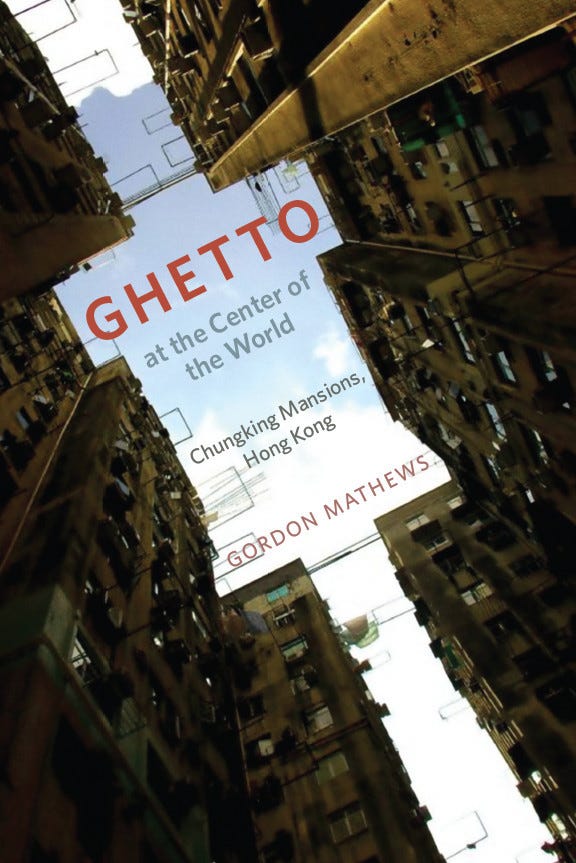

Gordon Mathew’s Book Covers (The University of Chicago Press Books)
I immediately interrogated that fear. I settled that it was a result of the depleting physical status of this street and of the social character of the people in them I had met. I associated it more with (the potential for) crime. It all reminded me of the caution one had to move with back home. It didn’t matter that Big S had done me some good, receiving and storing my luggage for days before ever meeting me and buying me a late dinner right after. There was just something about that street in Guangzhou… a stench, one I’d only previously perceived in Africa.
It turned out Big S was misinformed. He’d heard that a typhoon of some days earlier had grounded a lot of flights but wasn’t aware that airports were back fully back in operation. He got us a taxi and bid us farewell soon after.
Big S, his friend who previously had no accommodation nor proper residence permits, the group of men eating, smoking, drinking, and chatting in the midnight smell, the missing 20,000 prostitutes, the extra-cautious taxi driver, the dying hotels and restaurants, and the abandoned house that had ‘seen things’ all gave me a Chinese experience I had to share. A Chinese experience because it happened in China, but one that feels like an African experience. It leaves me with two questions; why does the poor physical and social trait of a street in Guangzhou remind me of Africa, and what can be done to African streets and cities to rid them of such association?
메타데이터
- post_id
- bc76ea8eaac8
- slug
- the-stench-of-africa-in-chinas-guangzhou-bc76ea8eaac8
- url
- https://medium.com/@themolash/the-stench-of-africa-in-chinas-guangzhou-bc76ea8eaac8
- canonical_url
- https://medium.com/@themolash/the-stench-of-africa-in-chinas-guangzhou-bc76ea8eaac8
- author_url
- https://medium.com/@themolash
- status
- ok
- fetched_at
- 2026-08-01 15:25:15