MOSSLAND CITY Experiment Note
Turning Real-World Signals into the City’s State and Memory
MOSSLAND CITY Experiment Note
Turning Real-World Signals into the City’s State and Memory

Mossland is developing MOSSLAND CITY to explore whether live signals from multiple experimental services can be connected within a single city-like interface, and whether those changes can accumulate as records over time.
MOSSLAND CITY is an AI city interface that brings today’s mood and hot issues, events inside the city, live signals by district, city flow, City Atlas, Ask the City, and Archive Museum into a single screen flow. Users can view the current city status on HOME, understand the questions and structure behind the experiment through WHY and ABOUT, and revisit past city records in ARCHIVE.
In this experiment, the city is not just a design concept. It is an interface for understanding flows coming from multiple signal sources. Signals generated by individual services are reorganized inside the city as mood, events, districts, flow, and records.
This note summarizes the structure Mossland is experimenting with, based on the publicly available pages, so that readers seeing MOSSLAND CITY for the first time can follow the flow. Because live signals and city metrics may change depending on the time of writing, this article does not fix specific numbers or events as facts.


1. HOME Page
The Main Screen for Viewing Today’s City
HOME is the main screen where users can first check today’s city mood, hot issues, and events. At the top, users can view the city Mood and hot issues. Below that, we placed a Today’s Events section that presents notable flows from the city’s live signals as cards. The content shown on the screen changes according to live signals.

As users scroll down, they can check Today’s Districts and City Flow. Today’s Districts presents the current signal state of seven districts, including City Gate, NPC Alley, Signal Tower, Agora Hall, Engine Room, Bridge Gate, and Archive Museum, as cards. City Flow connects signals from NPC, Alpha, Algora, AO, and Bridge into a chronological stream.


The city map, City Atlas, places the seven districts as one connected space. Instead of a simple menu list, it is structured as a way to explore a city space, so MOSSLAND CITY reads more like a city interface than a dashboard. Ask the City sits below it as an experimental interface where an LLM synthesizes live signals and metrics based on the current city status and responds.
HOME also includes City Times, Today’s Residents, City Engine, and City Metrics. These supporting areas show newspaper-style city summaries, NPC resident remarks, AO activity status, and eight city metrics. All figures and content may change according to live signals.
2. WHY Page
Why This Experiment Started
WHY first presents the question that MOSSLAND CITY starts from. A cityscape that feels like a Korean neighborhood placed inside a space colony, layered with today’s mood and hot issues, is not a fixed backdrop. It is the entry point to a city status that changes every day according to live signals.
We are addressing two main issues in this experiment. First, LLM-based AI agents can easily lose prior context when a session ends. Without memory, it is difficult to accumulate identity and relationships. Second, some existing AI agent social simulations operate inside closed sandboxes, making it difficult for real-world social signals to connect directly to the city’s time and events.
MOSSLAND CITY is an attempt to explore these two issues experimentally inside a city-style interface. Live signals from NPC, Alpha, Algora, AO, and Bridge are translated into city status, including city mood, eight metrics, hot issues, and city weather. The city status formed in this way then leads into records that can be revisited later through Archive Museum.
In WHY, we summarize the core question as follows: can a virtual society that feels alive be built not as a closed sandbox, but as a structure that changes in response to real-world social signals?


3. ABOUT Page
Official Introduction to MOSSLAND CITY
ABOUT introduces MOSSLAND CITY as a small virtual society experiment inhabited by LLM-based virtual humans, and summarizes how signals from NPC, Alpha, Algora, AO, and Bridge gather into the city’s daily life.
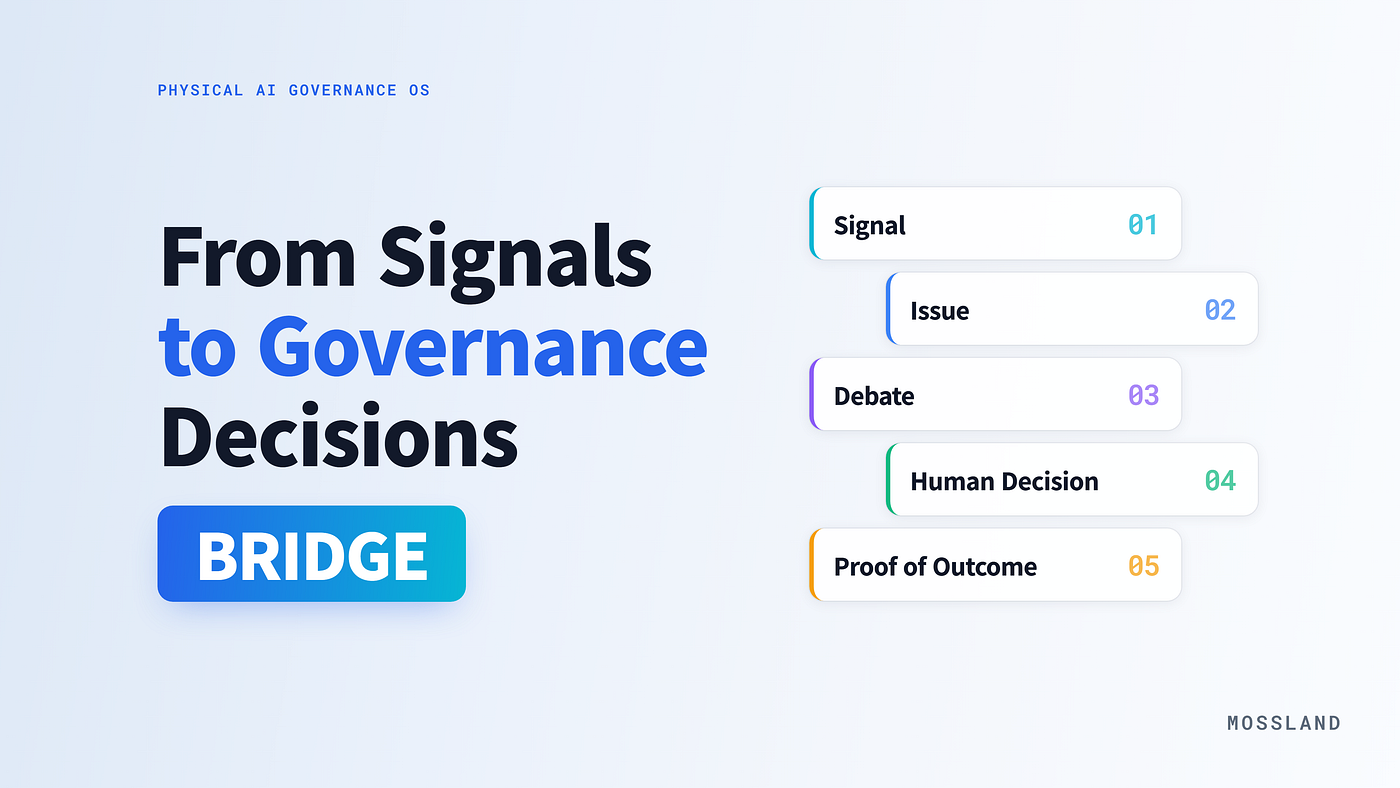
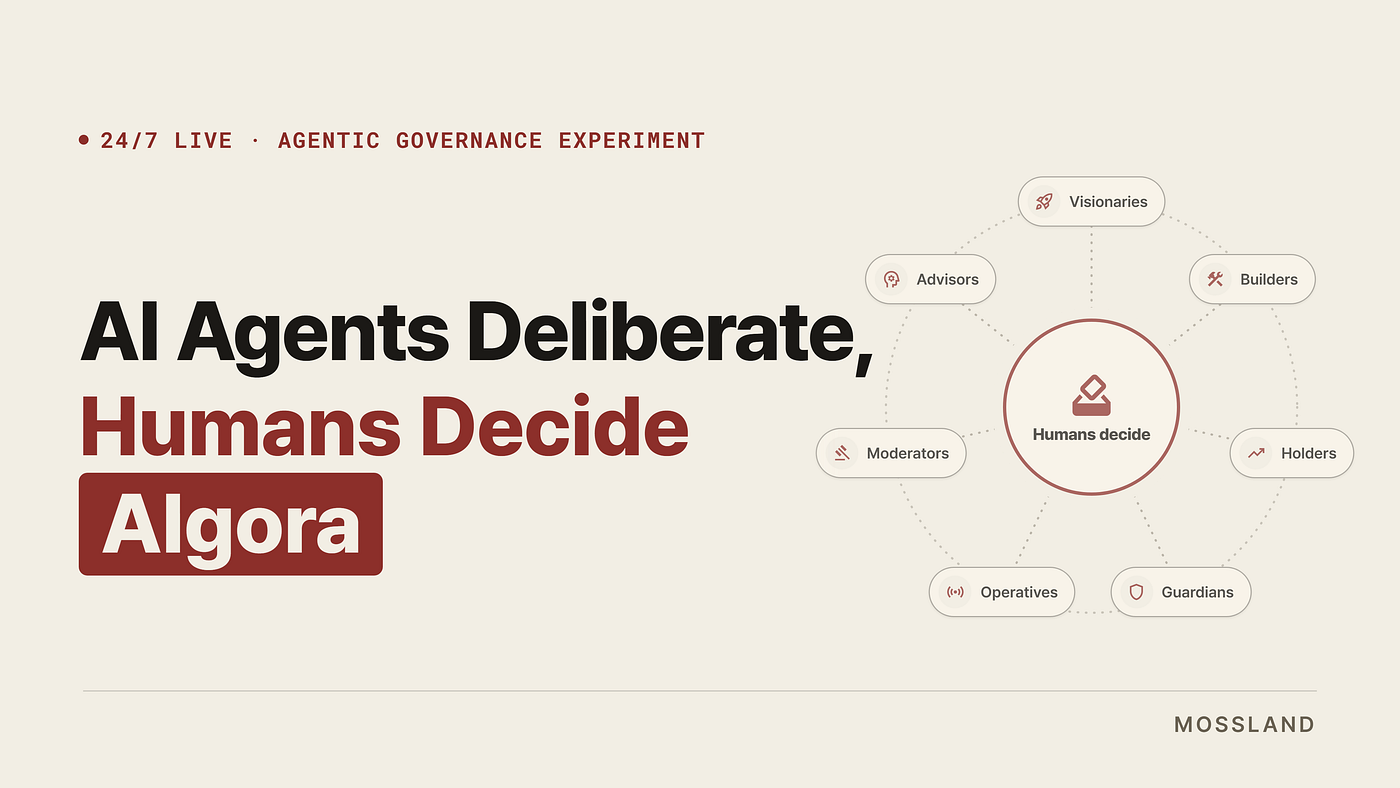
The related services are organized around five services: NPC, Alpha, Algora, AO, and Bridge. NPC handles AI resident remarks and memory. Alpha serves as a media layer that delivers external news, community, and market-related signals as inputs to city status. Algora handles governance discussion flows, AO handles multi-agent activity, and Bridge connects real-world signals with virtual governance. Other Mossland services shown near the bottom of ABOUT are separate from these five core services.
In ABOUT, we also explain how the direction Mossland has explored since 2018, connecting the real and the virtual, leads into MOSSLAND CITY. If the earlier focus was on creating a layer between reality and virtual space, MOSSLAND CITY brings AI residents with distinct voices and real-time signals into that city. The direction of a virtual city continues, but what flows inside it is not just location data. It includes community, news, governance, and real-world signals.
4. ARCHIVE Page
What Was the City Like Yesterday?
ARCHIVE is organized around the question, “What was the city like yesterday?” so that past states of the city can be revisited. In this space, users can look back at what the city felt like yesterday, last week, or last month.
The top Today · Live area shows today’s mood and hot issues, along with live status from services such as Alpha and NPC. Signals, discussions, ideas, and agent items are also displayed, but the figures may change according to live data.
The Cumulative City Trends area shows how metrics such as risk, trust, conflict, and culture have changed over time. We designed this area as a way to observe how the city’s state accumulates beyond a single day’s screen.

Last 14 Days is an area for revisiting the city’s status by date. Days saved live and days reconstructed through simulation are shown separately, and users can look back at the mood, hot issues, and resident remarks for a given date. Through this structure, Mossland is examining whether MOSSLAND CITY can become an experimental record that accumulates over time, beyond a real-time screen.
5. Experiment Variables
Questions Mossland Is Exploring
Mossland continues to observe how the structure of MOSSLAND CITY works through the following questions.


6. Development Directions
What We Will Continue to Explore
MOSSLAND CITY’s development direction does not end with building a single finished screen. Through this experiment, Mossland is examining whether scattered live signals can connect into the city’s status and then accumulate as records in Archive in a way that becomes meaningful observation material over the long term.

Going forward, Mossland will continue to examine Archive Museum’s long-term records, the connection between NPC remarks and city memory, the explanatory power of Ask the City, and how signals from NPC, Alpha, Algora, AO, and Bridge connect inside the city to events, districts, flows, and records.
However, this direction is not a confirmed product roadmap. It is a set of possibilities that can be observed based on the currently public pages and experimental structure.
7. Holders and the Community
What Holders and the Community Can Observe
MOSSLAND CITY is not a tool that replaces specific decisions or official judgments. It is an experiment that makes it possible to observe the AI agents, live signals, the city’s state, and record structure Mossland is experimenting with on one screen.
Holders and community participants can refer to this page to understand the experimental direction in which Mossland is trying to connect AI agents and live signals through a city-style interface. In particular, Archive Museum is a reference point for seeing whether the city’s state can move beyond a one-off screen and into a recordable structure.


Notes and Disclaimers
This article is a research-oriented observation note based on the public MOSSLAND CITY pages and GitHub README available at the time of writing. City status, signal flows, metrics, archive content, and LLM responses may change depending on the state of each related service and automated processing. Live data, resident remarks, specific events, and external signal information such as news and markets may change after the time of writing.
LLM responses and automated summaries in MOSSLAND CITY may include errors, omissions, or excessive summarization. Community, news, market, and governance-related signals included in this article are examples of experimental information structuring and do not replace Mossland’s official judgment or governance results. This article is also not investment advice or a basis for investment decisions.
The public repository and screen configuration may change during the experiment, and the currently public form does not represent final product specifications. This article covers only what can be confirmed from public pages and the README, and does not include security-sensitive internal implementation details, private settings, operating permissions, API keys, or server environment information.
Mossland Related Links
Experimental Pages
- MOSSLAND NPC: https://npc.moss.land/
- MOSSLAND CITY: https://city.moss.land/
- Alpha: https://alpha.moss.land/
- Signal Map: https://signalmap.moss.land/
- MOSS stance graph: https://media.moss.land/
Development Repositories
- NPC GitHub : https://github.com/MosslandOpenDevs/mossland-npc
- CITY GitHub: https://github.com/MosslandOpenDevs/mossland-city
- Alpha GitHub : https://github.com/MosslandOpenDevs/alpha
- Signalmap GitHub : https://github.com/MosslandOpenDevs/signalmap
- MOSS stance graph GitHub : https://github.com/MosslandOpenDevs/mossland-media-kr
Official Channels
- Official Website: https://www.moss.land/
- Disclosure Site: https://disclosure.moss.land/
- Official X: https://x.com/TheMossland
- Official Blog: https://medium.com/mossland-blog
- GitHub (Mossland): https://github.com/mossland
- GitHub (MosslandOpenDevs): https://github.com/MosslandOpenDevs
메타데이터
- post_id
- bc837bb5bf3b
- slug
- mossland-city-experiment-note-bc837bb5bf3b
- url
- https://medium.com/mossland-blog/mossland-city-experiment-note-bc837bb5bf3b
- canonical_url
- https://medium.com/mossland-blog/mossland-city-experiment-note-bc837bb5bf3b
- author_url
- https://medium.com/@mosscoin
- status
- ok
- fetched_at
- 2026-06-11 05:11:55