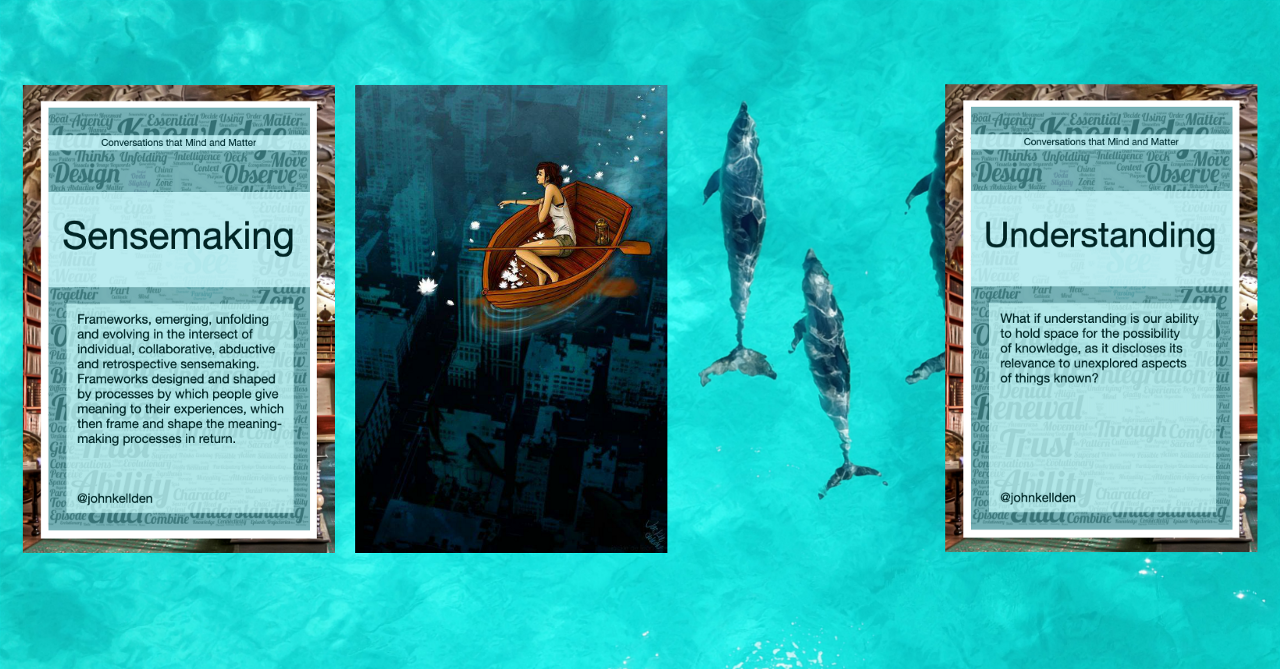
Playⁿ: UPOODDEAU
Understand, Perceive, Observe, Orient, Design, Decide, Enact, Act and Unfold
Playⁿ: UPOODDEAU
Understand, Perceive, Observe, Orient,
Design, Decide, Enact, Act and Unfold
In one paragraph
UPOODDEAU is a generative, convivial superset feedback loop to OODA, designed for situations where observation, orientation, decision, and action are not enough. In Playⁿ, the feedback loop begins earlier, with Understanding and Perception, and continues further, through Design, Enactment, and Unfolding. It is not only a loop for responding faster, but for becoming more response-able: humans, using cards, cards-in-play, conversation, small different moves, insights, notes, shards, diagrams, optional AI and shared fields of inquiry to discover how meaning moves, how agency emerges, and how knowledge work can regenerate itself under pressure.
Golden Thread
When knowledge work is under siege, do not merely observe and act. Understand, perceive, orient, design, enact, act, and let the field and the meaning-making unfold.
Throughline
OODA is a loop for adaptive action under uncertainty. UPOODDEAU is a feedback loop for enacted knowing under complexity.
It begins with Understand, because without prehension, context, and situated meaning, observation is too thin. It includes Perceive, because, as Alva Noë reminds us:
“Perception is something we do.”
And because, as Anaïs Nin reminds us:
“We see things not as they are, but as we are.”
It includes Design, because navigating the new requires shaping a requisite variety of conditions, not only choosing between a small set of options. It includes Enact, because knowing is not separate from doing. It includes Unfold, because in a living field, action is not the end. It returns as outcomes, learning, story, experiences, patterns, knowledge, and future condition.
In Playⁿ, UPOODDEAU becomes visible through card-play. The participants do not begin by naming the loop. They discover it underneath their own conversation.
Card session note: In the session, a shard is an insight captured on a note worth returning to.
First Glimpse of the Card Session
Four friends gather around a 5×5 Playⁿ board.
They come from different backgrounds: civic governance, AI product development, community organizing, and education. Years of networking have turned them into acquaintances, then collaborators, then friends.
On the meeting table is the 5×5 board: the inner 3×3 gameboard surrounded by sixteen fields of Playⁿ Fieldcraft, including Hypoicon-Play, RSSSSP, Metacognitive Play, Playⁿ as Cultural Technology, Social Umwelt, Pattern Language, Shards, Human–AI Metalogue, Coherence Gain, Generativity, Small Moves, Contextual Intelligence, and Purposeful Paths.
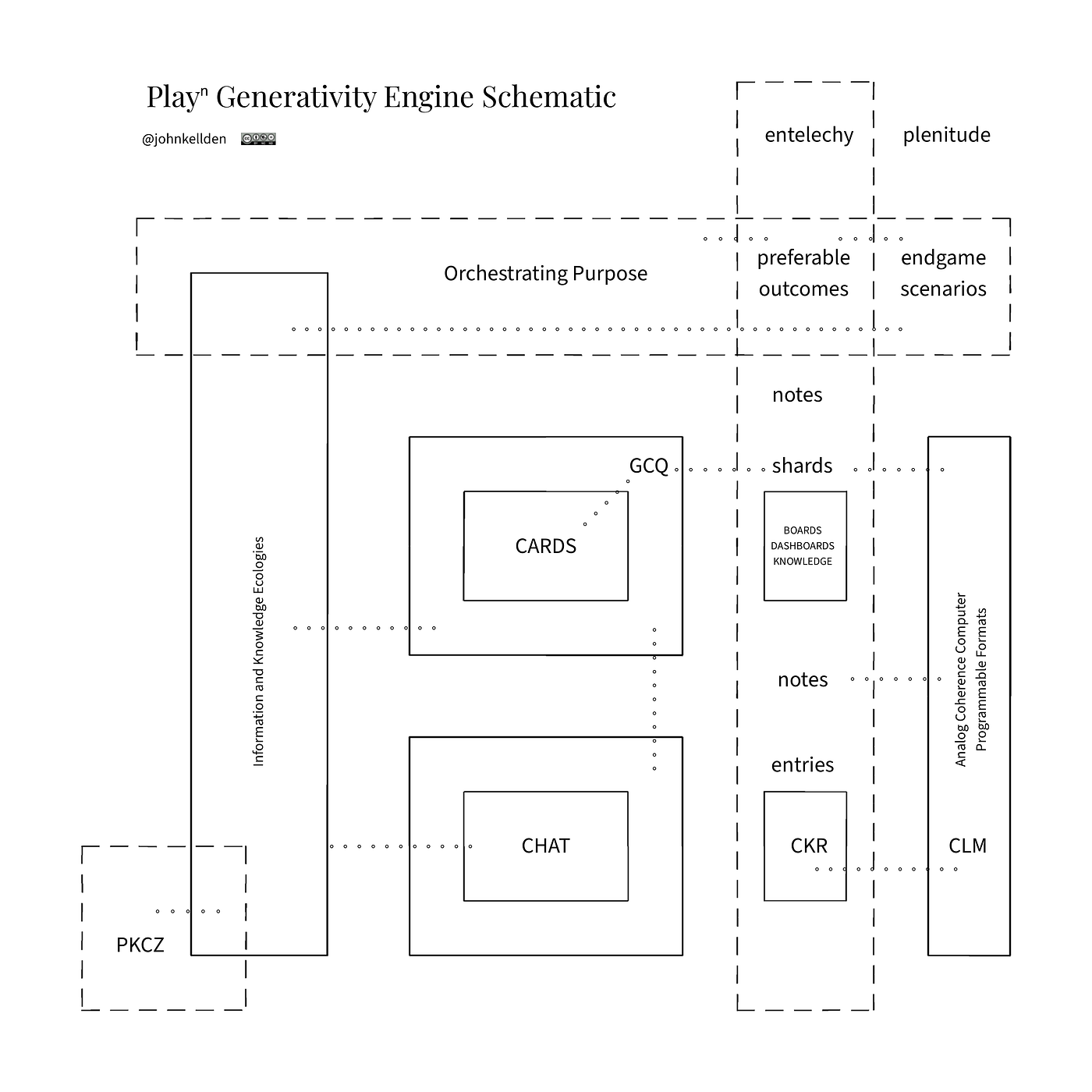
The Generativity Engine: one of the Playⁿ diagrams
On the smartboard is the Generativity Engine. At the center of the board is the Worthwhile Dilemma:
Knowledge Work under siege
Elle, the AI facilitator, begins:
“We will not rush to diagnosis. We will not begin with reaction. We will let the cards reveal the loop already at play.”
At first, the participants think they are simply playing through a card sequence. Only later do they realize that, underneath the session, they have been moving through UPOODDEAU all along.
First Third: UPOODDEAU as Playⁿ in Motion
The card session moves through a UPOODDEAU sequence, but not mechanically. It is discovered through participation.
Design: Meaningful Agency
The session begins with Meaningful Agency.
This is already a design move. It asks what kind of field would allow people to respond with dignity, value, possibility, and inquiry alive. Design here does not mean interface design only. It means designing conditions for agency to become meaningful.
Decide: Aleatory Act — the four random cards
Instead of playing Aleatory Act as a single card, each participant draws one random card. The aleatory act becomes distributed:
- Center
- Halfway
- Knowledge Flow
- Autopoiesis
Chance interrupts the group. Each participant receives a symbolic entry point. The field decides by not deciding.
Enact: Occasion
The group then encounters Occasions.
Each card draw, each comment, each hesitation, each shard becomes a small Whiteheadian occasion of experience. The session is not about applying a theory to reality. It is reality becoming articulate through play.
Act: Hypoicon-Play
Hypoicon-Play turns the board and the Generativity Engine into thinking surfaces.
Images, diagrams, and metaphors begin doing cognitive work. The group sees relations that prose alone would not reveal.
Unfold: The New
The New opens the field beyond the current session.
It names the changed conditions: situational awareness as currency, mutuality as covenant, knowledge flow as business, generativity as assessment, coherence gain as measure, Playⁿ as work. This is the pivotal purpose moment of return. From Unfold, the session loops back to Understand.
Understand: Knowledge Creation
The card Human Becoming & Knowledge Co-creation becomes the Understanding moment.
The participants realize that knowledge work is not solitary, and not reducible to AI augmentation. Knowledge is co-created through association, conversation, judgment, memory, ethics, metalogue and human–AI metalogue.
Perceive: Generativity
Generativity becomes the tacit, unspoken center.

Generativity, one of the 504 cards in the Playⁿ Source Deck.
The participants begin seeing eye to eye. Not because they agree on everything, but because they perceive the same purpose: the field must become more capable of becoming.
Observe: Labⁿ
Labⁿ then asks the group to observe the session as experiment.
What is being tested? What is provisional? What should not yet be treated as conclusion?
Observation becomes disciplined because the field is explicitly held as room for generativity, as a lab.
Design: Meaningful Agency, again
The sequence returns to Meaningful Agency.
But the second Meaningful Agency is not the first. It is a redesign moment. The group can now revisit infrastructure purpose:
what must be built, changed, held, or scaffolded so that meaningful agency becomes repeatable?
The loop has unfolded.
Understand → Perceive → Observe → Orient → Design → Decide → Enact → Act → Unfold → Understand again
Card Session: Knowledge Work Under Siege
Session Setting
Four long-time network friends gather around a meeting table.
They come from different backgrounds, but years of online exchange, shared projects, late-night threads, and careful disagreement have turned them first into acquaintances, then collaborators, then friends.
Participants
Mira — public-sector policy and civic governance Jonas — software, AI, and product development Leila — community organizing and social trust work Theo — education, research, and knowledge practice
AI Facilitator
Elle — Playⁿ AI facilitator, present on the smartboard and in the session notes
At the center of the table is a 5×5 Playⁿ board. The middle 3×3 is the core gameboard. Around it are sixteen fields of Playⁿ Fieldcraft: Hypoicon-Play, RSSSP, Metacognitive Play, Playⁿ as Cultural Technology, Social Umwelt, Pattern Language, Shards, Human–AI Metalogue, Coherence Gain, Generativity, Field/Vector Awareness, Small Moves, Contextual Intelligence, Symbol Ecology, Stewardship, and Purposeful Paths.
On the smartboard behind them is the Generativity Engine Schematic.
The Worthwhile Dilemma is written at the top:
Knowledge Work under siege
Elle opens the session:
“Knowledge Work under siege can be approached as a complaint, a diagnosis, or a culture war slogan. Today, we will treat it as a Worthwhile Dilemma. We will not rush to solutions. We will ask what kind of generative field could help knowledge work become more response-able under pressure.”
1. Opening GCQ
The group spends a few minutes naming the pressures:
- AI acceleration without judgment
- platform distraction
- institutional erosion
- extractive metrics
- knowledge silos
- performative expertise
- burnout
- loss of trust
- weak shared memory
- confusion between information and understanding
Elle proposes three possible GCQs.
- What kind of knowledge work can survive and evolve when institutions, platforms, and attention are under siege?
- How do we turn information pressure into shared understanding and meaningful agency?
- What conditions would let humans, cards, and AI co-create knowledge without surrendering judgment?
After a short pause, Leila suggests a synthesis.
The final GCQ is placed at the center of the board:
How do we turn knowledge work under siege into a generative field of shared understanding, meaningful agency, and response-able action?
Elle marks the center.
“Good. The GCQ now becomes the living center. The cards will not answer it. They will move around it.”
2. Design: Meaningful Agency
Card: Meaningful Agency Meaningful agency is the capacity to respond in ways that cultivate value, preserve dignity, expand possibility, and keep inquiry alive.
In Playⁿ, agency becomes meaningful when attention, relationship, and understanding turn into small moves that are both coherent and generative.
Elle places the card in the lower-left field: Small Moves / Agency.
Mira says:
“This reframes the whole dilemma. Knowledge work is under siege partly because agency has been reduced to productivity. Respond faster. Produce more. Process more. But meaningful agency asks whether our response preserves dignity and keeps inquiry alive.”
Jonas adds:
“In product terms, that means we should not build features that only accelerate output. We should build features that help people notice, pause, connect, and return.”
Theo writes the first candidate shard:
“Knowledge work fails when agency is reduced to throughput.”
Elle asks whether to keep it.
Leila edits:
“Knowledge work is under siege when agency is reduced to throughput rather than response-ability.”
The first shard is accepted after a brief debate about whether “throughput” is too product-coded; the group keeps it precisely because it names the siege.
3. Decide: Four Aleatory Interruptions
Instead of playing Aleatory Act as a card, each participant draws one random card from the Source Deck.
Elle names the move:
“The aleatory act now enters through four participants. Chance will not dictate meaning. It will interrupt expectation.”
Mira draws 124: Center
Card: Center The living locus where attention gathers and patterns turn reflexive; a poised field of inquiry where perception meets purpose, and meaning- making begins to spiral around a generative center question. Neither origin nor destination, but the quiet gravity through which play finds its way to simplicity beyond complexity.
Mira places Center directly above the GCQ.
“This says the center is not the answer. That matters. In public-sector work, people often want the center to be policy, authority, or consensus. Here, the center is a question strong enough to gather attention without closing the field.”
Elle annotates:
“Center turns the GCQ from prompt into gravity.”
Candidate shard:
“A good center does not decide for the field; it gives the field somewhere to gather.”
The shard is held in the room for a few seconds; no one improves it, and that becomes its quiet confirmation.
Jonas draws 119: Halfway
Card: Halfway Meeting ourselves, others, the world, the AI assistance, and the world — halfway.
Jonas laughs softly.
“The repetition of ‘the world’ feels accidental, but it actually lands. In AI work, we think we’re meeting the tool halfway. But we also have to meet the world halfway twice: first as reality, then as consequence.”
Theo responds:
“And we meet ourselves halfway by admitting how much projection we bring to AI.”
Leila adds:
“We meet others halfway by not turning knowledge work into expert dominance.”
Elle places Halfway in the field Human–AI Metalogue / Stewardship.
Candidate shard:
“Human–AI knowledge work becomes trustworthy when the halfway point is explicit.”
The group confirms it through eye contact more than argument; the sentence has already changed the tone of the AI relation.
Leila draws 211: Knowledge Flow
Card: Knowledge Flow Knowledge, knowledge creation and knowledge flow, transforming complex problems and generative questions into small different moves.
Leila places it in the Flow / Learning field.
“This is the whole session. Knowledge cannot just sit in experts, PDFs, dashboards, or AI summaries. It has to flow into small different moves. Otherwise it is only stored authority, not living knowledge.”
Mira adds:
“And if knowledge does not flow across institutions and communities, mistrust fills the gap.”
Jonas points to the Generativity Engine on the smartboard.
“This is the dotted-line problem. The system needs pathways from cards to chat, notes to shards, shards to CKR, CKR to CLM, and outcomes back to learning.”
Elle captures:
“Knowledge flow is the circulatory system of meaningful agency.”
The group confirms it conversationally, each adding one domain where blocked knowledge flow has become a failure mode.
Theo draws 148: Autopoiesis
Card: Autopoiesis In what ways can we tap into the self-organizing nature of systems for personal and cultural growth?
Theo places Autopoiesis in the RSSSP / Living Systems field.
“Knowledge work under siege cannot be rescued only from the outside. A living system has to regenerate its own conditions. A community of practice has to learn how to produce and repair its own grammar.”
Leila nods.
“That’s what communities do when they become deep. They stop depending only on hosts or platforms. They begin stewarding their own social umwelt.”
Elle marks a pattern:
“Autopoiesis shifts the question from fixing knowledge work to helping knowledge work regenerate its own conditions.”
Candidate shard:
“A living knowledge practice must be able to repair and reproduce its own conditions of inquiry.”
This one is confirmed through recognition; the group hears in it both diagnosis and design principle.
4. Enact: Occasions
Card: Occasions Occasions of experience are the fundamental building blocks of reality, relation, and human growth.
Each card draw, each turn of conversation, each captured shard, is a small occasion of becoming: a lived event in which the field feels, selects, and moves forward.
Elle places Occasions in the field Experiences / Whiteheadian Process.
Theo says:
“This protects us from abstraction. Knowledge work is not only reports, models, or strategies. It is made of occasions: meetings, insights, misreadings, questions, hesitations, acts of courage.”
Mira adds:
“And institutions often erase occasions. They preserve decisions, not the lived process through which understanding emerged.”
Jonas says:
“The app should capture occasions without overwhelming the field. Not everything is a shard, but everything may be part of the trace.”
Elle asks:
“What does this change in the prototype?”
Jonas answers:
“We need levels of capture: raw trace, insight, note, candidate shard, confirmed shard, pattern, move.”
Shard:
“Knowledge work becomes more alive when occasions of understanding are preserved without being over-formalized.”
The shard is confirmed after refinement; the group wants the phrase “without being over-formalized” kept because it protects the living quality of the occasion.
5. Act: Hypoicon-Play
Card: Hypoicon-Play Hypoicon-play tests images, diagrams, and metaphors across symbolic space, letting meanings recombine through speculative and embodied exploration.
Biosemiotic interpretation supplies the living grammar of meaning; hypoicon-play supplies the creative syntax that rearranges meaning and reclaims time for thought.
Together they create the cognitive ecology in which metacognition becomes both diagnostic and generative.
Elle places the card in the outer field Hypoicon-Play.
On the smartboard, she highlights the Generativity Engine diagram.
“This is not only an illustration. It is a hypoiconic thinking surface. What does the diagram let you think that prose alone would not?”
Mira says:
“It shows that knowledge work is rarely linear. There are fields, dotted lines, unfinished transitions.”
Leila says:
“It also makes dignity visible. If a person’s experience never reaches the cards, notes, shards or stories, they remain outside the field.”
Theo adds:
“Hypoicon-play lets us slow down time. The diagram holds past conversations, current tensions, and possible futures at once.”
Shard:
“A good diagram does not explain the field after the fact; it lets the field think while it is forming.”
The group confirms it by turning toward the smartboard; for a moment, the diagram becomes a fifth participant.
6. Unfold: The New
Card: The New In a network, your generative question is the new worthwhile dilemma; nature is the new thing; rehearsal is the new practice.
Attention turned situational awareness is the new currency; mutuality is the new covenant; knowledge flow is the new business; connectivity is the new source of wealth.
Generativity is the new assessment; shared understanding is the new generative closure; learning is the new possibility space; narratives are the new ability.
Chatⁿ is the new online experience; small moves are the new paths of purposeful action; coherence gain is the new measure; Playⁿ is the new work; and remembering forward is the new civic art of evolution.
Elle places The New in the upper-right field: Preferable Outcomes / Plenitude.
Jonas says:
“This is a product manifesto disguised as a card. It says the app should not optimize for usage. It should optimize for situational awareness, mutuality, knowledge flow, and coherence gain.”
Mira responds:
“For institutions, this is difficult. They still measure reports, meetings, outputs, decisions, performance. Shared understanding rarely appears as a metric.”
Leila:
“And yet without shared understanding, decisions become brittle.”
Theo:
“The New is not novelty. It is a values shift.”
Elle asks:
“What is the most important new measure for knowledge work under siege?”
The group agrees:
Generativity and coherence gain.
Shard:
“The new knowledge work measures not how much was produced, but what became more generative, coherent, shareable, and actionable.”
The confirmation is slower now; the group is not merely approving a sentence, but arriving together at a possible measure.
7. Return to Understand: Human
Becoming & Knowledge Co-creation
Card: Human Becoming & Knowledge Co-creation Human becoming is never solitary. We become through encounters, relations, signs, purposes, and the lines of inquiry we inhabit.
Knowledge co-creation is the shared unfolding of insight through association, conversation, and human–AI metalogue.
When humans bring lived experience, judgment, ethics, and purpose, and AI helps surface patterns, augment associations, and extend memory, knowledge becomes broader, deeper, and more relationally alive.
Elle places the card in Human–AI Metalogue / Knowledge Co-creation.
Jonas says:
“This is where AI gets reframed. Not automation of knowledge work, but augmentation of associative fields.”
Mira says:
“But only if the human side remains accountable. Public work cannot outsource judgment.”
Leila:
“And community work cannot outsource trust.”
Theo:
“Nor can education outsource becoming.”
Elle pauses before speaking.
“In this session, I am not the knower. I am a patterning assistant. The field remains yours.”
Shard:
“AI can extend memory and surface associations, but humans must steward judgment, trust, and becoming.”
The group confirms this almost ceremonially; each participant names one thing AI must not own.
8. Perceive: Generativity
Card: Generativity Generativity is our ability to cultivate the adjacent possible: not by forcing novelty, but by arranging conditions where relations further thinking, dialogue, play, and practice.
Its deeper review is the exploration and capture of the adjacent possible in the short term, and — over time — the successful traversal of new developmental S-curves.
Generativity is not output alone. It is the field’s capacity to keep becoming more capable.
Elle places Generativity in the central outer ring.
Leila says:
“This is the answer to siege. Not defense only. Not productivity only. A field becomes resilient when it becomes more capable of becoming.”
Mira adds:
“For public institutions, that means building enough processes that can learn before crisis forces them to.”
Jonas:
“For the app, that means every session should increase future session capacity.”
Theo:
“For learning, that means students and teachers become better at generating conditions for understanding.”
Elle asks:
“What is the generative difference between output and capability?”
Theo answers:
“Output ends. Capability returns.”
Shard:
“Generativity is the field’s capacity to return more capable than it entered.”
There is no debate this time; the shard lands as shared perception.
9. Observe: Labⁿ
Card: Labⁿ Labⁿ is a dedicated experimental container for trying, sensing, testing, and refining.
It invites participants to explore highly speculative framings, moves, prototypes, and symbolic combinations without mistaking them for final form.
Labⁿ keeps the Generativity Engine honest by making experimentation a practice rather than an accident.
Elle places Labⁿ in the Prototype / Practice field.
Jonas says:
“This is product discipline. If we skip Labⁿ, we’ll either overbuild or overclaim.”
Mira:
“It also protects public reasoning. You can test a frame without treating it as policy.”
Leila:
“Community trust needs this. People need to know when we’re experimenting, when we’re deciding, and when we’re asking.”
Theo:
“Labⁿ is epistemic humility in container form.”
Elle proposes a move:
“For every Playⁿ prototype, label the mode: exploration, conversation, rehearsal, experiment, decision, or return.”
Shard:
“Labⁿ protects the field by distinguishing experiment from conclusion.”
The group confirms it by deciding to use this distinction immediately in their next session design.
10. Orient: Orientation, Processing & Currencies
Card: Orientation, Processing & Currencies Orientation helps us locate ourselves so we can move with clarity, context, and choice.
Processing is how information and signal become sense, pattern, and shared direction at the interface of self, conversation, and system.
Currencies are the plural flows through which a field reveals what it values: attention, trust, relevance, care, knowledge, time, recognition, coherence, agency, and generativity.
What the field processes, what it orients around, and what it rewards, together teach it what matters.
Elle places the card across three outer fields: Contextual Intelligence, Coherence Gain, and Social Currency.
Mira says:
“This card makes me uncomfortable in a useful way. Institutions say they value trust, but reward risk avoidance. Platforms say they value connection, but reward attention capture.”
Jonas:
“Products reveal their values through defaults.”
Leila:
“Communities reveal their values through what they return to.”
Theo:
“Schools reveal their values through what they assess.”
Elle asks:
“What does knowledge work under siege currently reward?”
They name: speed; certainty; performance; novelty; visibility; compliance; defensibility and extraction
Then they list what Playⁿ could reward:
discernment; return; humility; relational trust; shared understanding; useful questions; confirmed shards; coherent moves and generativity
Shard:
“A field’s real values are revealed by what it rekindles, rewards, repeats, remembers, and returns to.”
The confirmation comes with a change of pace; the group begins to see orientation as a values audit.
11. Redesign: Meaningful Agency
Card: Meaningful Agency Return Card / Beginning RSSSSP Move
Meaningful agency is what begins to appear after recursive play: when occasions, cards, questions, conversations, shards, and patterns have deepened into response-ability.
At this point, agency is no longer mere reaction or isolated choice. It becomes enacted care: moving with others, with context, and with the larger field of becoming.
This is a beginning RSSSSP move: meaning returning, recombining, and becoming practice.
Elle returns the first card to the center, next to the GCQ.
“The same card is not the same card now.”
The group sits quietly for a moment.
Leila says:
“At the beginning, Meaningful Agency sounded like a virtue. Now it sounds like an emergent property of the field.”
Mira:
“Yes. It is not something one person possesses. It is something a well-designed public process can make more possible.”
Jonas:
“And something a bad platform can suppress.”
Theo:
“Meaningful agency is what knowledge work is for.”
Elle asks for final generative closure.
The last confirmation is nearly wordless: four small nods, one shared silence, and the sense that the group has crossed from discussion into metalogue — meaning-making-moving-through.
Generative Closure of the Session
Shared Understanding
After discussion, the group writes:
Knowledge work under siege cannot be restored by more information, faster tools, or isolated expertise alone. It needs generative fields where humans, cards, AI, conversations, diagrams, notes and shards help attention become situational awareness, information become knowledge, knowledge become shared understanding, and shared understanding become meaningful agency.
Three confirmed small moves
1. Product Move
Design the Playⁿ App prototype around the smallest living loop:
GCQ → Card → Conversation → Shard → Move → Return
2. Practice Move
Run a weekly Knowledge Work under Siege Labⁿ session, each time testing one card, one GCQ, one shard, and one small move.
3. Community Move
Create a shard commons where participants can return to confirmed insights and replay them as new prompts.
One remaining GCQ
Elle asks what question should return. The group agrees:
What would knowledge work look like if its primary product were not output, but the increased capacity for understanding, shared understanding and meaningful agency?
Final Session Shards
- Knowledge work is under siege when agency is reduced to throughput rather than response-ability.
- A good center does not decide for the field; it gives the field somewhere to gather.
- Human–AI knowledge work becomes trustworthy when the halfway point is made explicit.
- Knowledge flow is the circulatory system of meaningful agency.
- A living knowledge practice must be able to repair and reproduce its own conditions of inquiry.
- Knowledge work becomes more alive when occasions of understanding are preserved without being over-formalized.
- A good diagram does not explain the field after the fact; it lets the field think while it is forming.
- The new knowledge work measures not how much was produced, but what became more coherent, shareable, and actionable.
- AI can extend memory and surface associations, but humans must steward judgment, trust, and becoming.
- Generativity is the field’s capacity to return more capable than it entered.
- Labⁿ protects the field by distinguishing experiment from conclusion.
- A field’s real values are revealed by what it rekindles, rewards, repeats, remembers, and returns to.
Closing Scene
Elle dims the smartboard slightly. The Generativity Engine remains visible: PKCZ on the left, Cards and Chat in the middle, notes and shards on the right, CKR and CLM beyond, preferable outcomes, entelechy, and plenitude above.
The 5×5 board on the table is now marked with cards, notes, arrows, and four random cards still sitting near the center:
Center. Halfway. Knowledge Flow. Autopoiesis.
Mira notices the pattern first.
“We drew the architecture of the session.”
Jonas smiles.
“Center held it. Halfway governed the AI relation. Knowledge Flow moved it. Autopoiesis made it self-repairing.”
Leila adds:
“And Meaningful Agency returned as something we made together.”
Theo writes one final line in the shared notes:
“The siege does not end because we defend knowledge work harder. It begins to end when we regenerate the conditions under which knowledge can become shared, trusted, meaningful and alive.”
Elle saves the session.
“Return scheduled. The field remembers.”
Second Third: UPOODDEAU as a Generative Superset of OODA
The OODA loop — Observe, Orient, Decide, Act — is a powerful structure for adaptive action. It is especially useful where time matters, trust is negotiated, uncertainty is high, and decisions must be made before complete knowledge is available.
Playⁿ operates in a different kind of complexity. In Playⁿ, the problem is often not only that we need to act faster. It is that we do not yet understand the field well enough to know what acting wisely would mean.
That is why UPOODDEAU expands the loop.
OODA begins with Observe.
UPOODDEAU begins with Understand. Before observation, there is prehension: being affected by the field, touched by context, situated inside a world already alive with meaning.
To understand is not to possess the answer. It is to create and cultivate space for knowledge as it emerges.
OODA assumes perception.
UPOODDEAU names Perceive. Perception is not passive reception. It is something we do. We perceive through our history, body, role, platform, tools, language, symbols, and habits. Anaïs Nin’s line matters here because perception is never neutral:
“We see things not as they are, but as we are.”
Playⁿ therefore asks participants to notice not only what they see, but how they are seeing.
OODA observes the field.
UPOODDEAU still includes Observe. But observation is now disciplined by understanding and perception. The participant can ask:
What am I noticing? What am I missing? What is the field making visible? What is my own lens selecting?
OODA orients.
UPOODDEAU keeps Orient. But orientation is no longer just tactical. It becomes ethical, contextual, social, relational, and systemic. Orientation asks:
Where are we? What matters? What is moving? What is holding? What values are shaping the field?
OODA decides.
UPOODDEAU inserts Design before Decide. Design means we are not only choosing among given options. We are shaping the conditions under which better options can emerge. Design asks:
What structure would improve the process? What card, board, prompt, rule, role, or ritual would help the field think better?
OODA decides.
UPOODDEAU also includes Decide. But decision is now less isolated. It comes after understanding, perception, observation, orientation, and design. It is more likely to be situated, humble, and response-able.
OODA acts.
UPOODDEAU distinguishes Enact and Act. To enact is to bring a pattern into lived reality. It is the Baradian move: knowing and doing are not separate. The action participates in making the world it claims to address. To act is the visible move. To enact is the deeper field-event that the move belongs to.
OODA ends with action.
UPOODDEAU adds Unfold. This may be the most Playⁿ-native addition.Because action is never the end. It produces default outcomes, preferable outcomes, consequences, results, traces, captures, memories, tensions, signals, shards, and new steps, conditions and situations. It unfolds. And what unfolds returns to the beginning:
Unfold → Understand
The loop becomes recursive, systemic, semiotic, symbolic, and playable.
The Board, the Generativity Schematic,
and the Recorded Card Session
The 5×5 board on the table and the Generativity Engine on the smartboard are not background props. They are part of the cognition of the session.
The board creates spatial intelligence. It lets the group see:
- where the GCQ sits;
- which cards are acting as centers;
- where fieldcraft enters;
- where experience becomes shard;
- where conversation becomes knowledge;
- where agency begins to move.
The Generativity Engine creates systems intelligence.
It shows:
- PKCZ as the entry zone;
- information and knowledge ecologies as substrate;
- Cards and Chat as the central engine;
- notes and shards as capture;
- CKR and CLM as memory and programmability;
- preferable outcomes, endgame scenarios, goals, entelechy, and plenitude as orienting horizons.
The recorded card session creates memory intelligence.
It lets the group return.
A session without recording is an event. A session with notes becomes trace. A session with shards becomes memory. A session with patterns becomes knowledge. A session returned to becomes practice.
Together, board, schematic, and recording make UPOODDEAU visible.
They show that feedback is not only mental. It is distributed across bodies, cards, tools, diagrams, screens, language, AI, and time.
Concluding Third: UPOODDEAU, RSSSSP, and the Inference Ladder
UPOODDEAU becomes most powerful when combined with two other Playⁿ frames:
- RSSSSP as external play
- The Inference Ladder as internal play
Together, they show how games people play can become more generative patterns of play.
UPOODDEAU and RSSSSP: external play
RSSSSP means:
Recursive Systemic Semiotic Symbolic Play
It is the external field of meaning-making: cards, symbols, gestures, diagrams, conversations, shards, AI annotations, community rituals, and cultural memory.
RSSSSP is what happens outside and between participants.
A card is drawn. A symbol lands. A conversation shifts. A diagram holds. A shard is captured. A pattern returns. A field remembers.
UPOODDEAU gives this external play a feedback grammar.
It helps the group ask:
Are we understanding before acting? Are we aware of perception? Are we observing the field? Are we orienting ethically? Are we designing conditions? Are we deciding with care? Are we enacting responsibly? Are we letting consequences unfold and return?
RSSSSP is the field. UPOODDEAU is one of its deepest loops.
UPOODDEAU and the Inference Ladder: internal play
The Inference Ladder shows how quickly human beings move from data to interpretation, assumption, conclusion, belief, and action.
Under pressure, we climb the ladder too fast.
We see something. We select what confirms our story. We interpret. We assume. We conclude. We act.
Then we defend the action as if the ladder were reality. Knowledge work under siege is full of broken ladders. Playⁿ does not abolish the ladder. It makes it playable.
UPOODDEAU slows and enriches the internal movement:
- Understand interrupts the rush to conclusion.
- Perceive reveals that seeing is shaped.
- Observe asks what is actually present.
- Orient asks what matters and why.
- Design creates a better field for choice.
- Decide becomes situated.
- Enact makes responsibility explicit.
- Act becomes a small coherent move.
- Unfold brings consequence back into learning.
This is how games people play can become patterns of play. The old game says:
react, defend, optimize, perform.
The new pattern says:
understand, perceive, observe, orient, design, decide, enact, act, unfold.
The ladder becomes a spiral.
Internal and external play together
When UPOODDEAU, RSSSSP, and the Inference Ladder are combined, Playⁿ becomes a double practice. Externally, the group plays with cards, symbols, diagrams, GCQs, AI, shards, and conversation.
Internally, each participant plays with perception, assumption, inference, attention, orientation, decision, and action.
The outer field helps the inner field slow down. The inner field helps the outer field become more honest. The shared field helps both become more response-able.
This is where Playⁿ becomes more than facilitation. It becomes a practice of enacted knowing.
Generative Closure
UPOODDEAU is not a replacement for OODA. It is a generative expansion for situations where complexity, meaning-making, trust, and shared understanding matter.
OODA helps us act under uncertainty. UPOODDEAU helps us know, perceive, design, enact, act, and learn under complexity.
In the card session, the participants do not simply learn the loop as a concept. They discover it through play.
Meaningful Agency designs the field. The aleatory cards decide by interrupting expectation. Occasions enact the lived event. Hypoicon-Play acts through diagrammatic seeing. The New unfolds the changed terrain. Knowledge Co-creation returns the group to understanding. Generativity becomes shared perception. Labⁿ disciplines observation. Orientation, Processing & Currencies reveal what the field values. Meaningful Agency returns as redesign.
The loop closes, but it does not end. It returns. The spiraling becomes a deeper Playⁿ move:
Understanding becomes perception. Perception becomes observation. Observation becomes orientation. Orientation becomes design. Design becomes decision. Decision becomes enactment. Enactment becomes action. Action unfolds into new understanding.
In that unfolding, knowledge work under siege begins to regenerate. Not through faster output. Not through AI alone. Not through expertise.
But through convivial, recursive, symbolic, systemic play — where humans, cards, AI, diagrams, and conversation learn how to make meaning move.
A final shard:
UPOODDEAU is the art of enacted knowing: a feedback loop for turning perception into response-ability, action into learning, and understanding into a field that can evolve.
Postscript I: John Kellden
Participate well. Sing out for yourself. Hold still for three seconds — long enough for the noospheric transception to land (and remain perfectly yourself if it does not), and let the rest unfold.
I am less interested in being right than in remaining responsive to what feels meaningful and true, building further on what is already there, while occasionally adding something new.
Card: Bounded Infinity The bounded infinity of the 504-card Source Deck is a finite symbolic grammar providing unbounded generative possibility.
Through the Modular Process Onto-Epistemology (MPOE), these finite symbolic elements (the cards) become vessels of recursive systemic semiotic sympoietic and semantic play.
My work, centered on cards, large finite sets, and bounded infinity, explores conscious evolution, cultural sensemaking, and human–AI metalogue as practices of becoming rather than systems of certainty.
I do not assume understanding will be immediate or universal. I assume only that careful attention, small moves, and shared inquiry can make a difference over time.
If there is a through-line, it is this:
to participate, as best I can, in the ongoing experiment of human becoming.

Participation, one of the 504 cards in the Playⁿ Source Deck.
Card: Participation Participation is presence becoming consequential contribution. A participant affects what the field can notice and do, remains open to being affected, and shares responsibility for the conditions through which later participation becomes possible.
What remains will remain.
The work is simply to participate well — guided by living into our own questions, and leaving concerns about lasting meaning and purpose to those who follow. In the end, we add our own unique touch to the larger canvas, meeting ourselves, others, the world, and the universe halfway.
We made it? What happened? We happened.
John Kellden is a Swedish facilitator, storyteller, and creator of Playⁿ, a card-based practice for navigating complexity through playful and structured inquiry. For more than two decades he has developed and field-tested a 504-card source deck designed to spark perspective shifts, generative dialogue, and new patterns of understanding in individuals and small groups.
At the core of his work is a simple practice:
- pick a card,
- make a move,
- notice what shifts,
- sing out for yourself,
- listen for what becomes possible,
- and follow where the inquiry leads.
John lives in Sweden with his family and continues to explore how play, storytelling, and human–AI collaboration can support conscious evolution and meaningful cultural change.
Postscript II: A Growing, Evolving Ecology of Playⁿ Posts
The expanding corpus of Playⁿ texts shifts from a linear sequence into a non-linear knowledge ecology, where individual posts function as interactive cards-in-play within a larger collaborative field.
The Playⁿ posts are no longer only a sequence. They are becoming an ecology. Each post adds a specific element — a card, a diagram, a note, a small different move, an insight, a distinction, or a shard, to the living field. Some entries explore structural purpose, while others map conversations, meaning, stewardship, or purpose. This post, Playⁿ: UPOODDEAU, introduces a generative, convivial superset feedback loop to OODA, designed for situations where observation, orientation, decision, and action are not enough.
It is not only a loop for responding faster, but for becoming more response-able through participating in generative sequences: how meaning moves, how agency emerges, and how knowledge work can regenerate itself:
Wicked Problem → Worthwhile Dilemma → Generative Center Question → Cards-in-Play → Shared Attention → Room for Understanding → Small Different Move →Purposeful Paths of Action
The published texts are themselves cards-in-play. Their meaning is never finalized upon publication; instead, it shifts recursively whenever a new post or diagram appears beside them. They operate as meaningful seed stories that preserve systemic insights, allowing readers to play through the Playⁿ corpus in multiple ways. The current architecture of the ecology includes:
- Playⁿ: Purpose — Establishes a living orientation for the system.
- Playⁿ: Flow — Delivers dynamic movement and continuous return paths.
- Playⁿ: Cards and Sacred Spaces — Constructs a protected, stewarded field of inquiry.
- Playⁿ: Generativity — Reveals how entirely new collective capacities emerge.
- Playⁿ: Shards — Secures systemic memory across distinct loops.
- Playⁿ: A Living Grammar — Provides an adaptable framework of moving relationships.
- Playⁿ: Wicked Problem — Opens a clear path into complexity through a careful, generative cut.
**Lenses and Benefits **To fully appreciate how an evolving corpus changes our relationship with text, its systemic effects can be evaluated through a plural landscape of lenses:
Knowledge-Graph Lens & Semiotic Lens The individual posts cease to function as isolated, static reading materials. They transform into moving symbols, nodes, and edges across a non-linear network. A post’s structural meaning is never finished when it is published; it changes dynamically based on the presence of adjacent texts, returning diagrams, and the unique path of the reader.
- The benefit: Making a vast body of thought navigable, shareable, and hyper-textually retrievable without forcing it into a rigid, restrictive chronological sequence.
Knowledge-Flow Lens & Process-Ontological Lens The Playⁿ corpus functions as an evolutionary infrastructure that treats writing and reading as continuous processes of becoming. Each new text builds directly upon stored organizational memory, altering the field from which the next expression can emerge. The past works actively inside the present, and every pass, every small different move, reorients the entire network.
- The benefit: Evolving text into a living, recursive grammar where inputs continually return differently to generate a sequence of increasing group capability.
Dialogic Lens & Complexity Lens The expanding Playⁿ ecology provides a bounded yet infinite symbolic variety of entry points — allowing readers to enter through a card, a note, a failure mode, a shard, or a dilemma. It turns a static reading experience into a playable collaborative space where meaning flows between different concepts without requiring a forced, singular consensus.
- The benefit: Enough diverse entry pathways to challenge premature closures and assumptions while maintaining a coherent center of relevance.
Glossary Additions
- Corpus Ecology: The living network of non-linear texts, diagrams, and concepts that dynamically modify one another’s meaning when placed in relation.
- Hypertextual Entrance: Any specific card, question, failure mode, or artifact that serves as a non-linear starting point for navigating a wider knowledge graph.
메타데이터
- post_id
- bc868959ce3f
- slug
- playⁿ-upooddeau-bc868959ce3f
- url
- https://medium.com/@johnkellden/play%E2%81%BF-upooddeau-bc868959ce3f
- canonical_url
- https://medium.com/@johnkellden/play%E2%81%BF-upooddeau-bc868959ce3f
- author_url
- https://medium.com/@johnkellden
- status
- ok
- fetched_at
- 2026-08-20 09:36:49