Disposable Email Addresses: Why They’re Killing Your Signup Funnel
You finally hit your growth target. Signups are up 40% this month. The dashboard looks great. Then you check your actual engagement numbers…
Disposable Email Addresses: Why They’re Killing Your Signup Funnel

You finally hit your growth target. Signups are up 40% this month. The dashboard looks great. Then you check your actual engagement numbers — open rates are down, trial-to-paid conversion has cratered, and your onboarding emails are bouncing at a rate that makes no sense.
Somewhere in that “40% growth,” a large chunk of your new users typed in an address from Mailinator, Guerrilla Mail, or one of the dozens of other temporary inbox services. They got their verification code, did what they came to do, and vanished. Your funnel looks healthy. It isn’t.
What a Disposable Email Actually Is
A disposable (or “temp mail”) address is a throwaway inbox generated by a third-party service, designed to receive a message or two and then expire — sometimes within minutes, sometimes within a day. Services like Mailinator, 10 Minute Mail, and Guerrilla Mail exist specifically so people can bypass “verify your email” gates without giving up a real address.
There’s nothing inherently malicious about them. Plenty of privacy-conscious users reach for a disposable inbox just to avoid marketing spam. But from a product and growth standpoint, they’re a serious liability, because a disposable address is, almost by definition, an address you will never be able to reach again.
Why They Quietly Wreck Your Metrics
They inflate your funnel numbers without adding real users. If 15–20% of your signups are disposable — a common range for public-facing SaaS products — your “new user” count is lying to you. Every downstream metric built on top of it (activation rate, retention, LTV) is calculated against a denominator that includes people who were never going to stick around, because they physically can’t receive your emails.
They tank your onboarding email performance. Most onboarding sequences depend on the user actually getting that first “welcome” or “verify your account” email. When the inbox expires before the message lands — or never existed to begin with — you lose the single highest-intent touchpoint in the entire customer journey.
They hurt deliverability for your real users too. Sending repeatedly to dead disposable domains increases your bounce rate, and bounce rate is one of the strongest signals inbox providers use to judge sender reputation. A dirty signup funnel doesn’t just fail the fake users — it can push your legitimate welcome emails into spam folders as well.
They distort A/B tests and cohort analysis. If disposable-email users are randomly distributed across your test groups, they add noise. If they’re not evenly distributed (say, more likely to come from a specific acquisition channel like a coupon site or referral program), they can actively bias your results.
They open the door to abuse. Free trials, referral bonuses, one-time discount codes — anything gated behind “one signup per email” is trivially defeated by disposable addresses. A single user can spin up unlimited “unique” accounts in seconds.
Why “Just Send a Verification Email” Isn’t Enough
Email verification links feel like a solution, but they only prove that some inbox received the message — not that it’s a real, persistent one. A disposable address can click a verification link just as easily as a permanent one. By the time you’d notice the inbox is dead (a bounced newsletter three weeks later), the damage to your funnel data is already done, and the user has often already consumed whatever free trial or incentive you offered.
What actually works is catching the disposable domain before the signup completes — at the form itself, not after the fact.
Filtering Disposable Emails at the Source
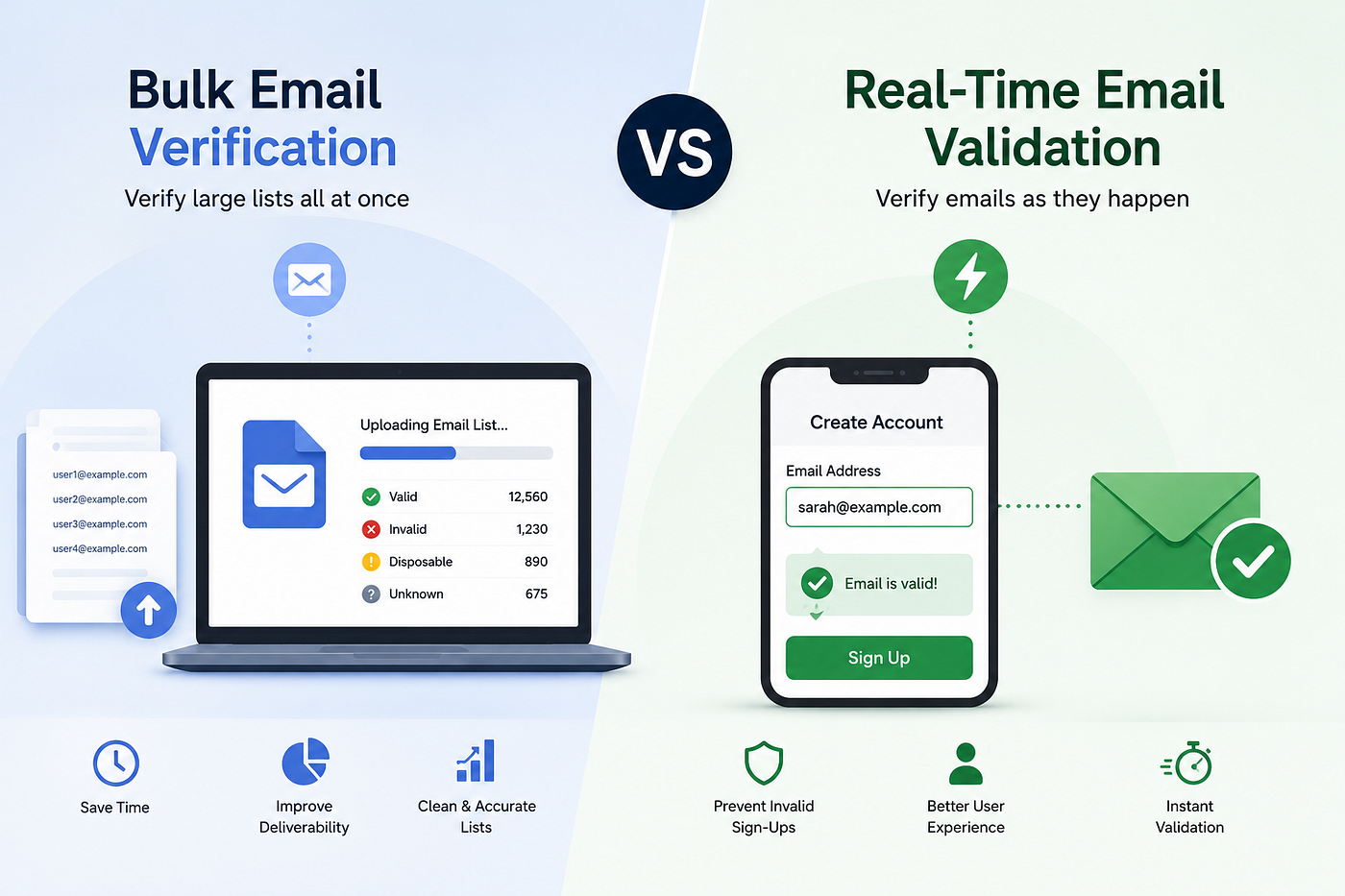
The most effective fix is a real-time check at the point of signup that cross-references the domain against a maintained list of known disposable and temporary email providers, then blocks or flags the submission before it ever reaches your database. This is typically done through an API call that returns a result in milliseconds, so it doesn’t add noticeable friction to the signup flow.
This is exactly the kind of check the email validation API’s are built for — it flags disposable domains, catch-all addresses, and syntax errors in a single lookup, so you’re not relying on a delayed bounce report to tell you something went wrong. Instead of discovering the problem in your analytics weeks later, you stop it at the form.
For teams with an existing user base, the same logic applies retroactively: running your current list through a bulk check via something like the Gamalogic email validation API will surface exactly how much of your “active” user base is actually reachable, which is often a sobering number the first time you look.
Building This Into Your Signup Flow
A few practical patterns worth adopting:
- Validate on blur, not just on submit. Check the email field as soon as the user tabs away from it, so they get instant feedback instead of a rejected form after filling out everything else.
- Block hard, warn soft. Known disposable domains can be blocked outright. Role-based addresses (support@, admin@) or catch-all domains are riskier calls — consider flagging rather than blocking, since some are legitimate.
- Don’t rely on a static blocklist alone. New disposable email services launch constantly. A maintained, regularly updated list (via an API rather than a hardcoded array in your codebase) keeps pace with new providers automatically.
- Re-audit periodically. Even with signup-time filtering, some disposable addresses will slip through as new services appear. A quarterly bulk check catches what real-time filtering missed.
The Bottom Line
Growth metrics are only useful if they represent real people who can actually be reached. Disposable email addresses create the illusion of growth while quietly poisoning your engagement data, your deliverability, and your ability to trust your own funnel. The fix isn’t complicated — it’s a validation check at the exact moment someone signs up — but it has to be there from the start, because by the time a disposable address shows up in your bounce report, the damage to your funnel is already done.
메타데이터
- post_id
- bca73f4445f3
- slug
- disposable-email-addresses-why-theyre-killing-your-signup-funnel-bca73f4445f3
- url
- https://medium.com/@angelantony1526/disposable-email-addresses-why-theyre-killing-your-signup-funnel-bca73f4445f3
- canonical_url
- https://medium.com/@angelantony1526/disposable-email-addresses-why-theyre-killing-your-signup-funnel-bca73f4445f3
- author_url
- https://medium.com/@angelantony1526
- status
- ok
- fetched_at
- 2026-07-18 13:41:51