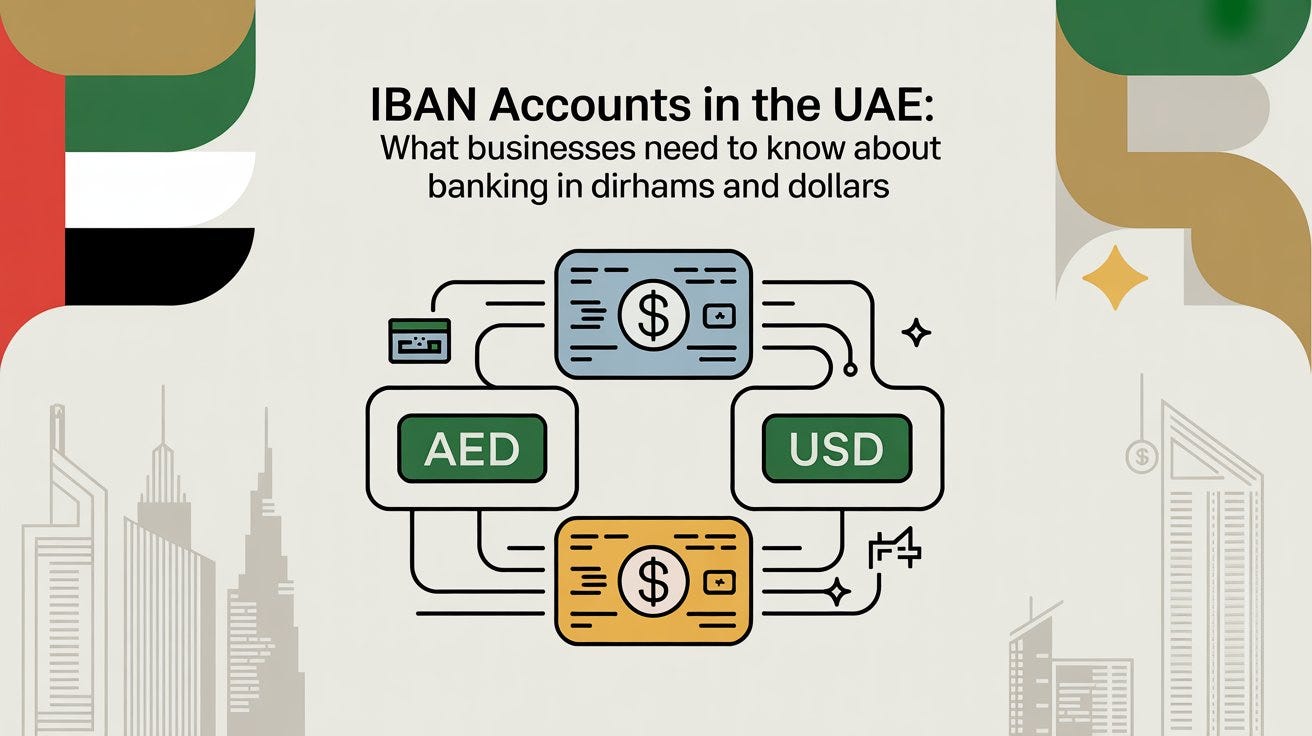
IBAN Accounts in the UAE: What Businesses Need to Know About Banking in Dirhams and Dollars
The UAE is no longer just a regional banking hub. It is one of the fastest-growing international banking destinations for businesses…
IBAN Accounts in the UAE: What Businesses Need to Know About Banking in Dirhams and Dollars
The UAE is no longer just a regional banking hub. It is one of the fastest-growing international banking destinations for businesses operating across the Middle East, Africa, South Asia, and the broader emerging market corridor. In 2023, the UAE handled over $600 billion in international trade flows. Its banks collectively hold correspondent relationships with institutions in over 150 countries. And the dirham’s peg to the US dollar — unchanged since 1997 — makes UAE-based USD banking among the most stable in the world.
For any internationally active business with operations, customers, or suppliers in the Gulf region, South Asia, East Africa, or global USD markets, understanding how IBAN accounts work in the UAE is not optional knowledge. It is foundational infrastructure.
This guide covers everything you need to know about UAE IBANs as a business owner: the format, the account opening process, the banking landscape, and the strategic cases for UAE-based banking in 2025.
The UAE IBAN Format: Structure and Specifics
The UAE adopted the IBAN standard in 2011 under a directive from the Central Bank of the UAE (CBUAE). UAE IBANs are 23 characters — shorter than most European IBANs, which run to 22–27 characters, and structured somewhat differently.

Important UAE IBAN note: The UAE IBAN format is mandatory for all domestic and international bank transfers processed through UAE banks. Payments without a valid UAE IBAN may be rejected by the receiving bank’s automated processing system.
Why Businesses Choose UAE Banking
The strategic case for UAE banking is multi-dimensional — and it differs from the reasons businesses choose European or UK banking. Here are the primary drivers:
USD infrastructure. The UAE dirham has been pegged to the US dollar at 3.6725 AED/USD since 1997. This makes UAE banks among the world’s most stable USD banking partners. Businesses that collect, hold, or disburse significant USD volumes find UAE banking a natural home for their dollar operations — with none of the currency risk of banking in a freely floating currency.
Geographic position. The UAE sits at the intersection of trade flows between Asia, Africa, Europe, and the Americas. For businesses with suppliers in South Asia, customers in the Middle East, and investors in Europe, UAE banking provides a single banking hub that maintains strong correspondent relationships in all directions.
No personal income tax. The UAE has no personal income tax and a corporate tax rate of 9% (effective for most businesses from June 2023, with a zero-rate threshold for profits below AED 375,000). For businesses operating genuine UAE entities, the tax environment is favourable by global standards.
Banking infrastructure quality. UAE banks — particularly the large government-linked banks like Emirates NBD, First Abu Dhabi Bank, and ADCB — have invested heavily in digital banking infrastructure. Mobile banking, API integration, and international payment capabilities are generally strong by global comparison.
Regulatory improvement trajectory. The UAE’s AML and financial crime compliance framework has strengthened substantially since 2020. The UAE was removed from the FATF ‘grey list’ in June 2024 — a significant development that has improved the correspondent banking relationships of UAE institutions with global banks.
Who Should Consider UAE Banking
Businesses with Middle East customers or operations. If your customers are in Saudi Arabia, Kuwait, Bahrain, Oman, or Qatar — or in the UAE itself — a UAE AED or USD account provides local payment credibility. Gulf businesses typically prefer to transact with counterparties that have UAE banking details.
Businesses importing from or exporting to South Asia. Trade between South Asia (India, Pakistan, Sri Lanka, Bangladesh) and the UAE is among the world’s highest-volume bilateral trade corridors. UAE banks have deep correspondent relationships with South Asian institutions, making payment flows faster and cheaper than routing through European banks.
Businesses with East African operations. UAE banking is the primary hub for businesses trading between the Gulf and East Africa (Kenya, Tanzania, Ethiopia, Somalia). Nairobi is increasingly mirroring Dubai as a regional financial centre, and UAE-Kenya banking corridors are among the more efficient in the emerging market space.
Digital businesses and consultancies seeking a tax-efficient base. For businesses incorporated in UAE free zones (DMCC, DIFC, ADGM), the combination of competitive corporate tax, no personal income tax, and world-class banking makes the UAE a compelling operational base — provided the business has genuine substance in the jurisdiction.
Opening a UAE Business Bank Account: The Reality
The UAE bank account opening process has a reputation for being demanding — and that reputation is, in many respects, earned. Here is an honest account of what to expect:
For UAE-incorporated businesses (free zone or mainland): Account opening is more straightforward. You will need your trade licence, memorandum and articles of association, passport copies and Emirates ID (or application) for all shareholders and directors, a business plan or description of activities, and 6 months of bank statements from existing accounts. Most major UAE banks can complete onboarding in 2–4 weeks for straightforward cases.
For non-resident businesses: Account opening is significantly more challenging at traditional UAE banks. Most UAE banks require either a UAE trade licence or a demonstrable operational link to the UAE — a regular UAE customer base, supplier relationships, or a UAE registered office. Non-resident businesses without these connections will struggle with traditional banks and should explore UAE-licensed fintech alternatives.
UAE fintech alternatives: Several UAE-licensed payment institutions and digital banks have emerged with more accessible non-resident account opening processes. These operate under CBUAE licences and offer UAE IBANs (AE prefix) with full payment functionality. Due diligence on regulatory status is essential — the CBUAE maintains a public register of licensed institutions.
UAE Free Zone Banking: DIFC, ADGM, and DMCC
The UAE’s financial free zones — particularly the Dubai International Financial Centre (DIFC) and the Abu Dhabi Global Market (ADGM) — operate under distinct legal and regulatory frameworks from the broader UAE. Both have world-class financial regulators (the DFSA in DIFC; the FSRA in ADGM) that are internationally respected.
DIFC banking. DIFC is home to branches and subsidiaries of many major international banks — HSBC, Standard Chartered, Citi, Deutsche Bank — operating under DFSA regulation. For businesses incorporated in DIFC, banking with DIFC-based institutions provides the combination of UAE location with internationally recognised regulatory standing.
ADGM banking. ADGM is the financial centre of Abu Dhabi, with a similarly strong regulatory framework. For businesses in the fintech, asset management, or professional services sectors, ADGM offers specific regulatory frameworks (including a sandbox environment) that DIFC does not.
DMCC banking. The Dubai Multi Commodities Centre free zone is the most popular free zone for trading, import/export, and commodity businesses. DMCC companies can open accounts at any UAE bank — they do not need to bank within the free zone specifically.
UAE IBAN for International Payments: What to Know
UAE IBANs are increasingly well-supported in international payment systems — but there are still edge cases where awareness matters:
SWIFT is the primary rail. The UAE is not a SEPA member — there is no euro payment network equivalent for AED. International payments to and from UAE banks travel via SWIFT. For USD payments, the UAE’s well-developed correspondent banking relationships mean settlement is generally efficient — typically 1–2 business days for major corridors.
AED is not freely transferable. While the AED is freely convertible (no capital controls), it is not a widely traded international currency. Most international businesses holding UAE accounts operate them primarily in USD rather than AED, using the stable peg relationship for predictability.
Beneficiary name matching. UAE banks have tightened beneficiary name matching requirements in line with FATF recommendations. The name on an incoming international transfer must closely match the registered account holder name. Discrepancies — even minor ones — can result in payment holds requiring manual review.
The UAE is not a one-size-fits-all banking solution. It is a highly specific tool for businesses with specific geographic footprints. Used correctly — for the right corridors, with genuine operational substance — it is among the world’s most strategically useful banking jurisdictions.
Compliance Considerations for UAE Accounts in 2025
CRS reporting. The UAE is a CRS-participating jurisdiction. Financial account information for non-UAE residents holding UAE accounts is automatically reported to their home country tax authority. UAE bank accounts held by UK businesses are reported to HMRC; those held by US persons trigger FATCA reporting.
AML and source of funds. UAE banks have strengthened AML requirements significantly since 2020. Expect detailed source of funds documentation, particularly for accounts receiving large international transfers. Having clear documentation of your business model and the source of incoming funds is essential.
Economic substance. For businesses incorporated in the UAE, the Economic Substance Regulations (ESR) require demonstrating genuine operational activity in the UAE for certain business activities. This is particularly relevant for holding companies, financing businesses, and intellectual property holding structures.
메타데이터
- post_id
- bcc5311e09ef
- slug
- iban-accounts-in-the-uae-what-businesses-need-to-know-about-banking-in-dirhams-and-dollars-bcc5311e09ef
- url
- https://medium.com/@SkyUnleased/iban-accounts-in-the-uae-what-businesses-need-to-know-about-banking-in-dirhams-and-dollars-bcc5311e09ef
- canonical_url
- https://medium.com/@SkyUnleased/iban-accounts-in-the-uae-what-businesses-need-to-know-about-banking-in-dirhams-and-dollars-bcc5311e09ef
- author_url
- https://medium.com/@SkyUnleased
- status
- ok
- fetched_at
- 2026-07-20 10:12:08