How 1inch Fusion+ works?
Recently I joined ETHGlobal’s New Delhi 2025 hackathon, where I had opportunity to create a non-evm extension of 1inch’s Fusion+ protocol…
How 1inch Fusion+ works?
Recently I joined ETHGlobal’s New Delhi 2025 hackathon, where I had opportunity to create a non-evm extension of 1inch’s Fusion+ protocol (you can check it here). Just think Ethereum to Cosmos, and beyond. Along the way I dove deep into 1inch’s Fusion+ protocol. This post is a distilled version of what I learned, written to help you look at Fusion+ quickly and clearly.
What is Atomic Swaps?
Before getting into Fusion+, you need to understand atomic swaps. In short, atomic swaps enable two parties to exchange assets across different blockchains without a trusted intermediary. No middleman is needed to ensure fairness. This is made possible by Hashed Timelock Contracts (HTLCs), which power the whole flow.
What is a Hashed Timelock Contract (HTLC)?
An HTLC combines two core mechanisms:
Hashlock
- When creating the contract, you include the hash of a secret.
- Only by revealing the preimage (the original secret) can funds be withdrawn.
- This ensures funds can only be claimed by the intended party.
Timelock
- Actions must happen within specific time windows.
- If deadlines aren’t met, both sides can reclaim their funds.
- This prevents funds from getting stuck and sets clear timelines for the swap.
Why Atomic Swaps Matter
Fusion+ builds on atomic swaps:
User experience upgrade
- In classic atomic swaps, you create and fund an escrow on the source chain yourself.
- In Fusion+, you just sign an order that authorizes the counterparty to deposit your funds into the source escrow. Your “job” is simply signing — everything else is handled for you.
Dutch auction mechanics
- Prices move along a curve over time.
- This encourages resolvers to compete to fill earlier at better prices, improving execution efficiency.
What about security?
Can you trust the counterparty? You don’t have to. Your signature is only valid within the Fusion+ Limit Order Protocol (LOP) contract. The signature specifies the LOP address, and your funds can only be moved by that contract when conditions are met.
So what is the Limit Order Protocol (LOP)? It’s the core 1inch contract that securely transfers tokens when a signed order’s conditions are satisfied. Think of LOP as a trustless coordination layer between parties — it’s open source, auditable, and can’t custody funds. It just enforces the rules of the trade.
Now that atomic swaps and LOP are clear, you’re ready to tackle the Fusion+ flow.
Why escrows matter
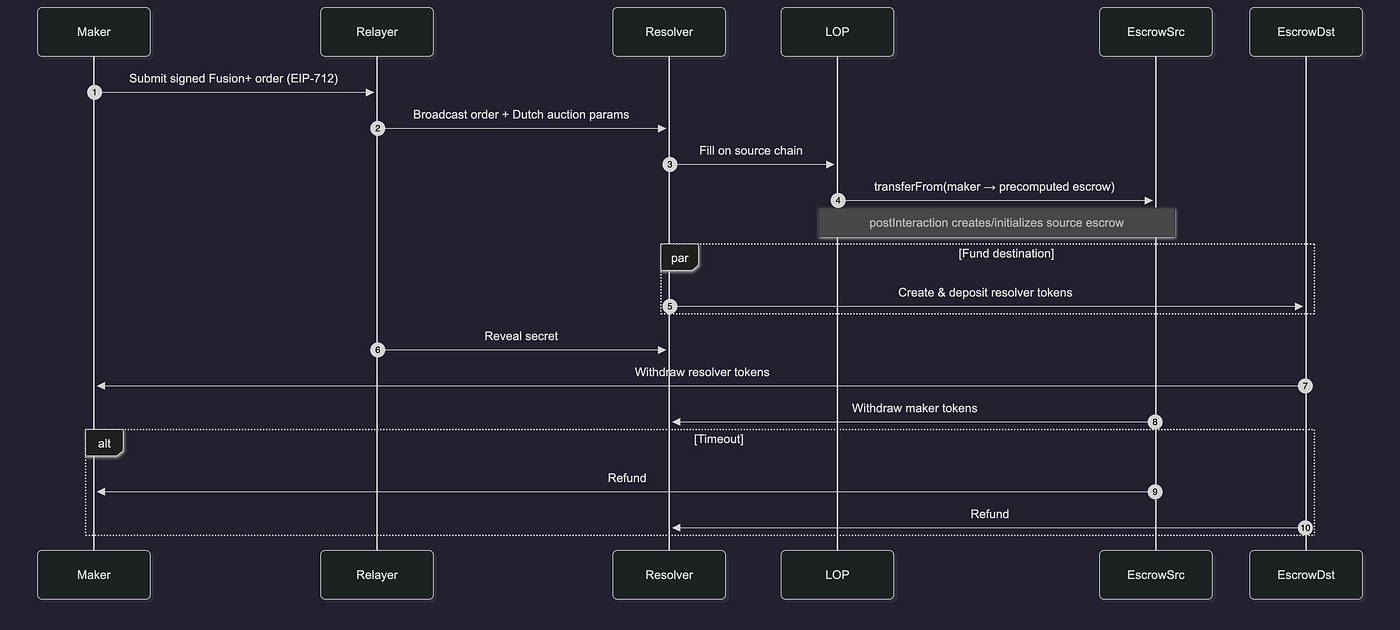
The sequence above shows the full outer‑to‑inner process. While LOP is the core of 1inch swaps, the escrow contracts are crucial for cross‑chain flows. Let’s zoom in.
EscrowFactory, the key piece
The main escrow component is the EscrowFactory. It ties together several base contracts to manage vaults for cross‑chain swaps. LOP and the resolver interact with it to deploy either the source escrow (on chain A) or the destination escrow (on chain B). Each swap gets its own dedicated escrow, so funds never mix.
The sequence, step by step
- Maker signs a Fusion+ order and sends it to the relayer.
- Relayer broadcasts the order and Dutch‑auction params to resolvers.
- A resolver decides the price is good and fills on the source chain via LOP.
- LOP moves maker tokens to a precomputed source‑escrow address; postInteraction deploys/initializes that escrow.
- Resolver creates and funds the destination escrow on the target chain.
- Relayer shares the secret (after both escrows are funded).
- Maker withdraws from the destination escrow; resolver withdraws from the source escrow.
- If timeouts hit, each side refunds from its own escrow.
This is the major Fusion+ flow, simplified for clarity. For full details — auction model, timelocks, partial fills, cancellation — read the 1inch whitepaper. If you see any mistakes or have a different interpretation, let me know. We learn by comparing notes.
1inch Fusion+ whitepaper: https://1inch.io/assets/1inch-fusion-plus.pdf
메타데이터
- post_id
- bd0f1d9b6cb9
- slug
- how-1inch-fusion-works-bd0f1d9b6cb9
- url
- https://medium.com/@aadish01/how-1inch-fusion-works-bd0f1d9b6cb9
- canonical_url
- https://medium.com/@aadish01/how-1inch-fusion-works-bd0f1d9b6cb9
- author_url
- https://medium.com/@aadish01
- status
- ok
- fetched_at
- 2026-06-22 05:41:33