Aviation Meteorology Atmospheric Pressure
Atmospheric pressure is a crucial concept in aviation meteorology, affecting everything from aircraft performance to weather forecasting…
Aviation Meteorology Atmospheric Pressure
Atmospheric pressure is a crucial concept in aviation meteorology, affecting everything from aircraft performance to weather forecasting. Understanding how atmospheric pressure behaves under different conditions helps pilots and meteorologists make informed decisions. In this article, we will delve into the basics of atmospheric pressure, explore how it varies with altitude, and examine its relationship with temperature.
Before we start studying about atmospheric pressure we need to know what is pressure itself.
Pressure
So pressure is force per unit area which means any force exerted on a per unit area is known as pressure.
The formula to calculate pressure is P = F/A where P is the pressure, F is the force and A is the area per unit.
So atmospheric pressure will be the force exerted by the atmosphere per unit area.
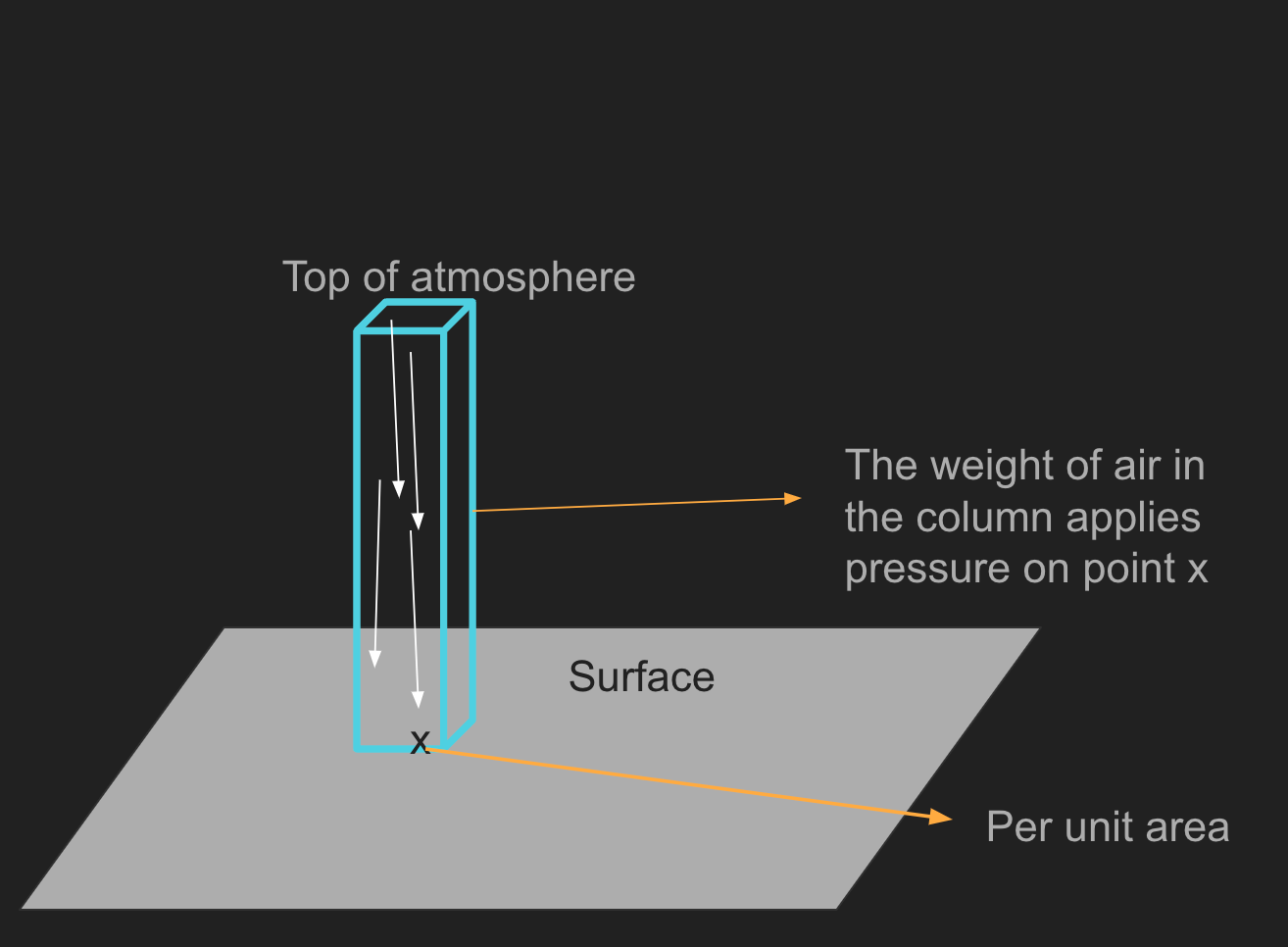
atmospheric pressure
This pressure can be exerted on anything, whether a man standing on the ground or an aircraft flying at 10,000 feet.

Atmospheric pressure meteorology
So How does the air exert pressure?
The Earth’s atmosphere consists of countless air molecules, which have mass. Gravity pulls this mass towards the Earth’s center, creating what we call the weight of the air. This weight is calculated as mass multiplied by gravity.
the weight of the air is weight = mass x gravity
Atmospheric pressure at any point on Earth is caused by the weight of the column of air directly above that point.

Weight of the air
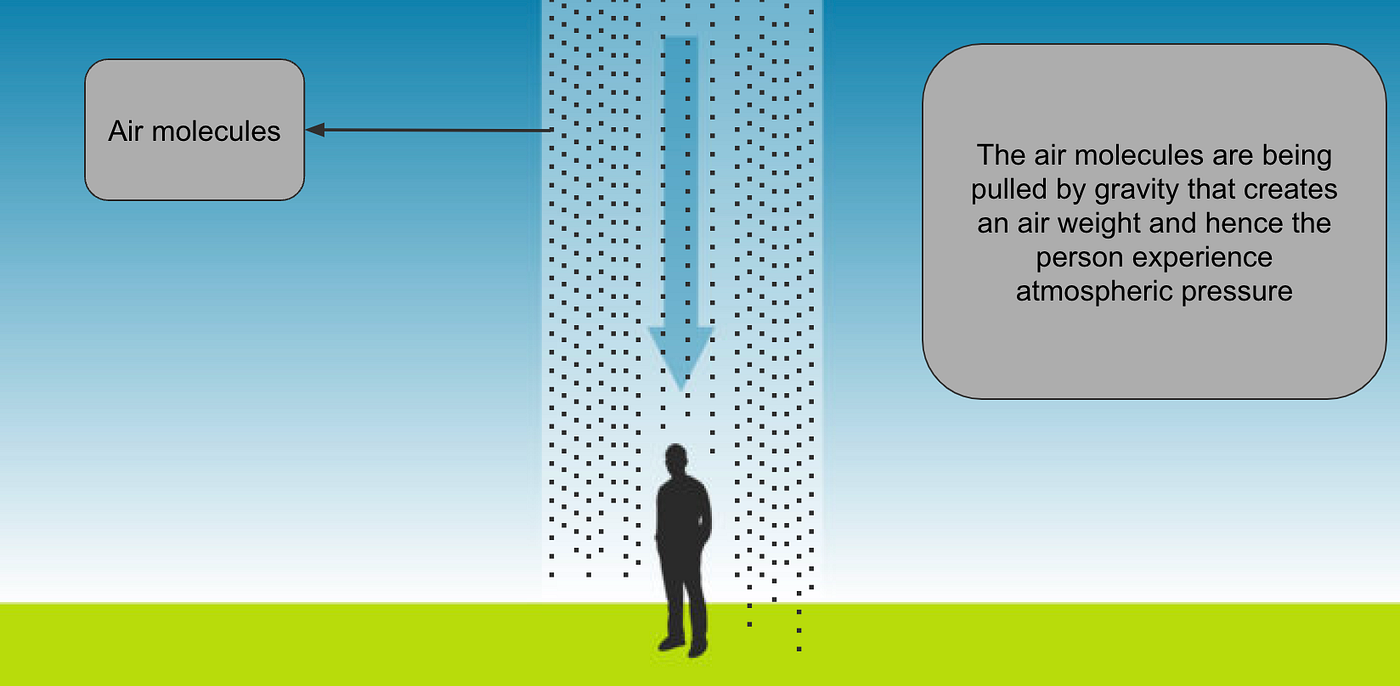
Static pressure
There are two types of atmospheric pressure the above one is static pressure since the person is not moving and still he is experiencing a static pressure this. The fact about static pressure it is experienced equally from all the directions.
Dynamic Atmospheric Pressure:

DYNAMIC ATMOSPHERIC PRESSURE
- When the car is moving, the air molecules exert a force on the hand due to the relative motion between the hand and the air. This force is what we refer to as dynamic atmospheric pressure.
- When the car stops, this dynamic pressure disappears because there is no longer relative motion between the hand and the air.
An aircraft will experience both static and dynamic atmospheric pressure while flying the static pressure is always there but the dynamic pressure will be experience due to the movement of aircraft.

Atmospheric pressure at a given location is influenced by the weight of the air column above that point. If there is a large mass of air (high density) above a location, the pressure will be higher. Conversely, if the air mass is smaller (low density), the pressure will be lower.
Pressure and Altitude:
- Gravity’s Effect on Air Molecules: Gravity pulls air molecules towards the Earth’s surface, making the air denser (more molecules per unit volume) at lower altitudes.
- Pressure and Altitude Relationship: As a result of the higher density of air at lower altitudes, atmospheric pressure is greater near the Earth’s surface. Conversely, at higher altitudes, the air is less dense because there are fewer air molecules, leading to lower atmospheric pressure.
- Aircraft Experience: Therefore, an aircraft flying at a low altitude will experience higher static atmospheric pressure compared to an aircraft flying at a high altitude.
In summary, the atmospheric pressure decreases with increasing altitude due to the decreasing density of air molecules. This explains why aircraft at lower altitudes encounter higher pressure than those flying at higher altitudes.
Atmospheric Pressure Lapse Rate:
The rate at which atmospheric pressure decreases with altitude, known as the lapse rate of atmospheric pressure, varies with altitude due to changes in air density.
Near the Surface (Low Altitude):
- At low altitudes, the air is denser because there are more air molecules per unit volume.
- Consequently, the pressure decreases more rapidly with altitude.
- The typical rate of pressure decrease at low altitudes is approximately 1 hPa for every 27 feet (or roughly 8.23 meters).
At Higher Altitudes:
- As altitude increases, the density of the air decreases because there are fewer air molecules.
- This results in a slower rate of pressure decrease with altitude.
- Around 20,000 feet, the pressure decreases at a rate of approximately 1 hPa for every 50 feet (or about 15.24 meters).
- At even higher altitudes, such as 40,000 feet, the rate of pressure decrease slows further to about 1 hPa for every 100 feet (or around 30.48 meters).
These figures illustrate how the lapse rate of atmospheric pressure diminishes with increasing altitude due to the reduction in air density. This is a critical concept in aviation and meteorology, as it affects everything from aircraft performance to weather prediction.
Atmospheric Pressure and Temperature:
The relationship between atmospheric pressure and temperature is fundamental to understanding weather patterns, aviation, and atmospheric science. Temperature affects the density of air molecules, which in turn influences the atmospheric pressure at various altitudes. This section explores how atmospheric pressure changes under different temperature conditions.
- Hot Temperature: In hot conditions, air molecules are more spread out, making the air less dense. This results in lower atmospheric pressure near the surface. However, as altitude increases, the thermal expansion causes the atmosphere to extend further, leading to higher pressure at higher altitudes compared to normal conditions.
- Normal Temperature: Under normal conditions, air density and pressure follow standard values. The rate of pressure decrease with altitude is standard.
- Cold Temperature: In cold conditions, air molecules are tightly packed, making the air denser. This results in higher atmospheric pressure near the surface. As altitude increases, the pressure decreases more rapidly, leading to lower pressure at higher altitudes compared to normal conditions.
Conclusion
Understanding atmospheric pressure and its variations with altitude and temperature is essential in aviation meteorology. It helps pilots, meteorologists, and aviation professionals to predict weather conditions, ensure safe flight operations, and optimize aircraft performance.
In our next article, we will focus on the topic of altimetry, which involves measuring altitude and understanding its implications in aviation. Stay tuned!
메타데이터
- post_id
- bd1d681b5aa4
- slug
- aviation-meteorology-atmospheric-pressure-bd1d681b5aa4
- url
- https://medium.com/@khanumair-9430/aviation-meteorology-atmospheric-pressure-bd1d681b5aa4
- canonical_url
- https://medium.com/@khanumair-9430/aviation-meteorology-atmospheric-pressure-bd1d681b5aa4
- author_url
- https://medium.com/@khanumair-9430
- status
- ok
- fetched_at
- 2026-06-16 19:09:56