The DMM, Trauma and Me: Part One: Childhood.
When I wrote my first article about the Dynamic Maturational el of Attachment (DMM), a colleague suggested I write about the DMM and…
The DMM, Trauma and Me: Part One: Childhood.
Photo by Christian Lue on Unsplash
When I wrote my first article about the Dynamic Maturational el of Attachment (DMM), a colleague suggested I write about the DMM and trauma. I have hesitated and procrastinated for 4 years as I realised that the most accessible way I could do this would be to tell my own story, but that would mean being publicly vulnerable, and anyone with a history of trauma will recognise that doesn’t feel a safe thing to do. I like to think as I’m typing this that it’s a sign I’ve done a lot of healing I now feel able to.
The other reason I’ve hesitated is that my story is inevitably tangled with others: my parents, siblings and friends. It’s not my place to tell their stories, and their recall and experiences will be different from mine. Our collective memories are a kaleidoscope of different perspectives and viewpoints, the picture changing each time we look and notice something we hadn’t before. I have been wary of offending those I care about, or misrepresenting them. For this reason a lot is left out. If I do cause offence, I’m sorry. I know that everyone did their best. My intention in writing this is to help others understand themselves better and as a result be kinder and more compassionate to themselves and others.
I first heard Dr Pat Crittenden speak about the DMM in 2006. What she was saying made more sense to me in understanding the human condition than anything I’d heard before. I was blown away and emailed asking about her courses as soon as I got home. A few months later I took the 5 day Attachment and Psychopathology course, a prerequisite to training in the assessment tools. We learnt about the basic strategies, A, B, and C, and how they develop. I pondered my own relationship with my parents, and recognised both A and C strategies as my own. I asked Pat in the break whether someone could have both? ‘Yes if they grew up in a complicated environment’ she replied. Thus began my journey of self discovery with the DMM.
‘The only information we have is about the past. the only information we need is about the future’ Pat Crittenden
The DMM is a theory about danger and how we protect and comfort ourselves and our children. It’s about staying alive. Children are not developmentally able to protect themselves, and attachment behaviour is how they elicit protection and comfort from their parents. Some danger in life is inevitable, protection and comfort sadly less so. It is the lack of these that causes trauma, not the event per se. A child’s attachment behaviour is organised around their specific parents and represents the best they can do to maximise their chances of having their needs met in their unique context. As we develop, a wider array of strategies are available, and we adapt and change as we mature. By adulthood the full array of strategies is potentially available.
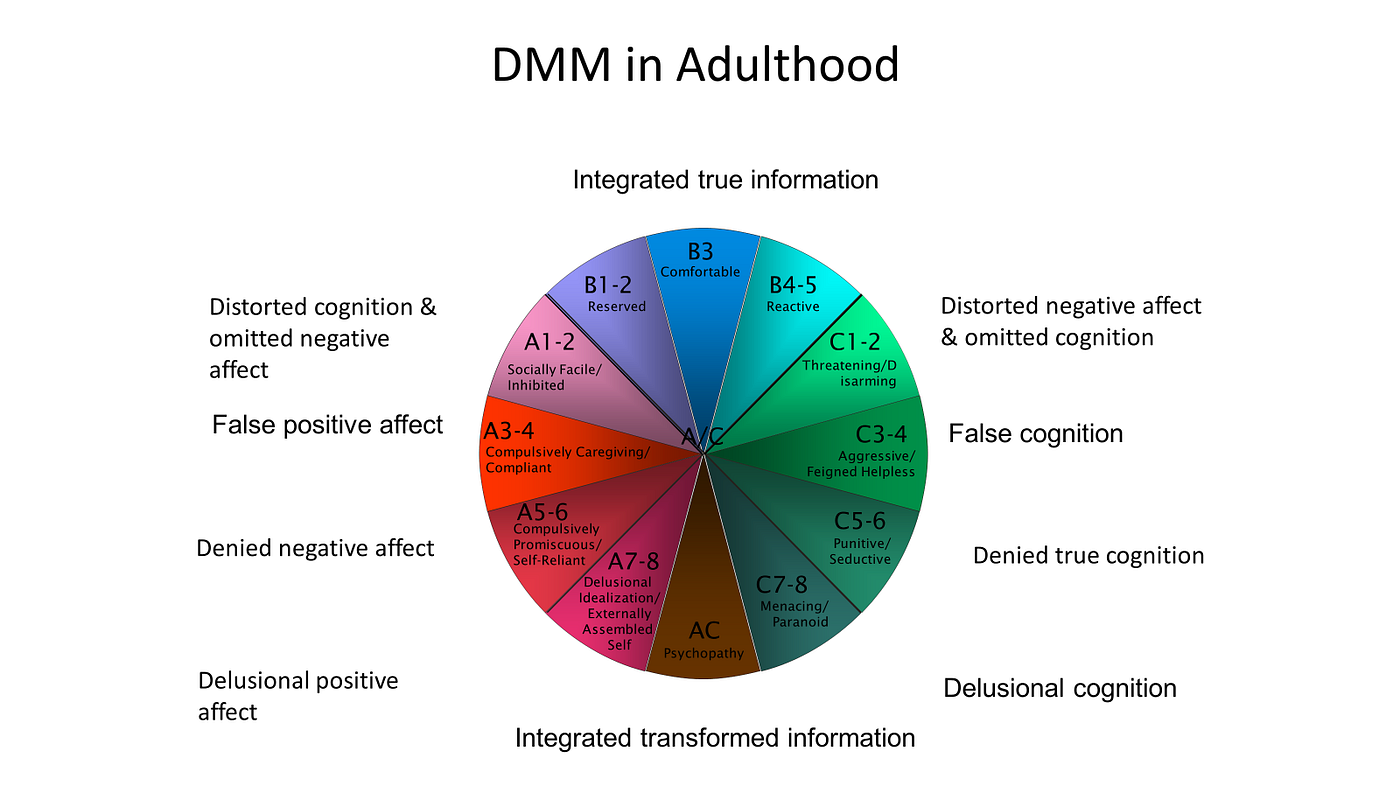
Reproduced from https://familyrelationinstitute.org with permission from Dr Pat Crittenden
Underpinning attachment behaviour is information processing. Our attachment strategies reflect behaviourally what our brains do with information. What we pay attention to, what we dismiss, exaggerate or distort. Attachment is the filter through which we see and evaluate the world. We do this to try and predict danger so we can protect ourselves. Our predictions are based on our past experiences. Parents were once children too. Their childhood experiences will shape their parenting both consciously and unconsciously.
I am about 2 years old I think. I am at home with my mum. She puts The Clangers on and makes us lunch. The memory is vague and grainy but warm and safe. I am at the village hall play group and mum arrives to fetch me and my brother. We hide from her and she stands in the middle, heavily pregnant. Eventually I run to her and throw my arms around her legs. We are all laughing.
I didn’t always have these memories. I am holding my new baby and feel a deep sense of peace that is unfamiliar to me. I am 30 years old. My body remembers something I hadn’t known was there: love and security. The memories come later, and in the present my relationship with my mum changes as we reconnect through my daughter.
My youngest brother was a sick baby. I have no recollection of this period but I know that my mum, her mother and him went away for several months to help him recover. I think my Dad’s sisters and mum looked after me and my older siblings. My next memory I am riding my tricycle and my aunt asks me if I’d like to live nearer to them. Soon after we move to one of my grandfather’s farms.
This early separation was the first significant trauma I experienced I think. I cannot know but the emergence of the earlier positive memories suggests things were good enough until then. I don’t know how I coped. I don’t know if I was comforted. I don’t know if anyone tried to explain. I was not old enough to be able to form a coherent narrative on my own. What I do know is my Adult Attachment Interview (AAI) showed an unresolved loss, anticipated, suggesting I anticipate losing loved ones. I know that when my best friend moved away when I was 11 years old, I was utterly heartbroken. Similarly when my first serious relationship ended I was despairing and couldn’t accept it. It’s a family joke that I have been anticipating my mum’s death for over 10 years! To be fair she is in poor health but now I understand all of this as the sequelae of that early separation. The suppressed memories exerting their influence unconsciously — I expect people to leave me and I don’t believe I can bear it.
The nature of traumatic memories is they are fragmented, incomplete and unintegrated. Pat Crittenden likens them to landmines that explode and disrupt our usual strategic functioning. When this happens we are psychologically in the past. We express feelings that belong to the original event as if they belong to the present. We behave in ways that have no strategic meaning in the present and confuse and hurt those around us. We are not accurately evaluating the danger in the here and now nor behaving in self protective ways. Others might think we are crazy and we probably think we are too. The triggers are not perceptible to others, maybe not even to ourselves.
I am 11 years old, practicing my gymnastics in the garden. The kitchen window is open and I can hear my parents arguing. My mum is speaking in a low, disdainful voice berating my father for having been caught in bed with other women by his eldest son and his youngest daughter. My first thought is that I didn’t know my sister had caught him— I knew about my brother. I then realise that I am the youngest daughter. Something shifts inside me and I remember. I am about 5 years old playing on the landing upstairs. My mum has been away and comes to ask me if we have been ok. I tell her yes because our nanny kept Daddy warm. My mum holds me and is visibly angry. ‘What did you say?’ I don’t understand why she is so angry and I hesitantly repeat it.
Young children cannot accurately source information. I think I experienced myself as the source of my Mum’s anger as I didn’t understand the adult issues. Around this time my Mum started to drink and parental arguments increased both in frequency and intensity. In my mind I had caused these changes and I blocked the event from conscious memory. When we block out bad stuff we often lose access to positive memories, too. I distanced myself emotionally and physically from my Mum. Mostly I sought comfort in the company of animals. During these early school years I struggled to learn to read. I was bottom of the class but by the time I was 7 years old I was way ahead of my years. I wonder if this could be explained in part by a change in strategy? I went from being a coy, shy little girl (possibly C4) to a high achiever who did what others wanted her to (A4-). We don’t lose our old strategies — we add to them when they no longer work for us strategically. The C4 strategy of feigned helplessness develops when care is inconsistent and unpredictable. The A4 strategy in it’s softer form is compulsive achievement whereby parental love and approval is tied to doing as others wish, ignoring one’s own feelings. I don’t think my parents explicitly expected me to achieve; rather that I learnt this was a way to get their positive attention, and that of other adults. It becomes self-perpetuating and the emotional cost to the self is overlooked. My AAI done years later revealed I use both A and C strategies at around this level. As I developed, and in response to a changing context and increased danger, my attachment strategies evolved. This is the ‘dynamic maturational’ aspect of the DMM.
I am 7 years old. We have moved back to the old farm and when I start school another Louise tells me we knew each other as babies. We become inseparable best friends. I love my teacher and school is my safe place. One day we are messing around and me and my best friend are told to stand in the corner. When I go home I’m still visibly upset. My parents are unusually both there and ask what’s wrong and I can’t tell them. They try to call my teacher. The next day she asks me if they had tried to call. I can’t tell her. I’m too ashamed.
When we are organised around pleasing others and we fail we are mortified. In my mind I was a bad person and it was so bad it couldn’t be spoken about. An ordinary childhood experience becomes a traumatic one. In this instance my parents tried to comfort me but I was unable to accept it. Earlier events had led me to organise psychologically into a pattern where I didn’t believe comfort was available nor that I was worthy of it. My strategy was too inflexible to allow me to be comforted. Thus we create our own context in part, with our internal beliefs and attributions (that arise from our attachment strategies), shaping how others respond to us, and how we respond back in turn, meaning life can often seem like a self-fulfilling prophecy, especially as the driving beliefs are unconscious and hidden.
The school bus drops us at the top of the drive. I can see my mums’ friends’ car and my heart sinks. They are both sat at the kitchen table, an almost empty bottle of gin between them, dirty breakfast pots in the sink. The house is cold and there’s nothing to eat.
Coming home was a time of arguments for much of my first marriage. It is only in recent years I have understood it as relating to childhood. I would imagine the reunion as I travelled, then as soon as I was home I would notice something — the dishwasher not loaded, a lack of response, anything really, and I would pick a fight. I would get unreasonably angry and end up tearful. I would be on automatic pilot, neither liking nor understanding my own behaviour. The feelings were much bigger than the situation and had a life of their own. I would unwittingly be on high alert for any sign of threat or neglect. I would create narratives about myself or my partner to explain it. This erroneous understanding was corrosive to our relationship. Neither of us understood what was going on. Now I see coming home as a trigger for the somatic hypervigilance I had as a child and I consciously override it by breathing deeply, grounding myself, and trying to pause before I react. In other words I try not to trip the landmine.
It’s Sunday and Mum is cooking lunch. We can hear the clink of ice in a glass and the pouring of a drink. She is cheerful in that way we have all come to dread. As we sit down to eat she looks a bit glazed. Slowly her tone changes and she begins to bait my father. Before long plates, insults, and punches are being thrown. We children have to figure out the right moment to leave so we don’t get caught up in the fight.
During the last few years of my parents’ marriage these incidents were more frequent. Sometimes one of them would leave. My Mum would sometimes take me with her, either on foot or in the car. I wonder now where my siblings were and why me? I think I was more triangulated into my parents relationship than they were at this time. We would walk in the dark the mile to the nearest village, or I would be terrified in the car as she was invariably drunk. My AAI showed an unresolved trauma for parental conflict. I have thankfully not experienced any violence in my own intimate relationships. I have been the one most likely to shout — part of my C strategy or a reaction to the vulnerability and helplessness I felt in conflict situations as a child? What I have experienced is a need to control, to prevent bad things happening, to check and double check that everything is perfect. This is exhausting to experience and exhausting for others to live with too. Thankfully, this lessened significantly after I first had therapy in my twenties and understood more and before I became a parent myself. It isn’t how I see myself today though I’m still an anxious passenger in cars and prefer to drive. These kind of behaviours are often attributed to someone’s personality rather than being understood as a coping strategy, albeit an old one from a different context that no longer fits.
As we approach the end of childhood and the start of adolescence I want to emphasise some of the positive things from my childhood. We lived on a farm and I had lots of space and animals to keep me company. It was the 1970s and children were out playing all day unsupervised. I would cycle off to the village in the morning and come home in the evening. I loved school and I loved learning. This meant teachers liked me and took an interest in me — something that research has shown is a powerful protective factor for troubled children. I had good friends and through contact with their families I learnt a bit about what ‘ordinary’ looks like (I hesitate to use the word ‘normal’). My parents were never physically abusive to me and both could be loving, supportive, and kind at times. This was the every day and the trauma punctuated it, to then be ‘forgotten’ so you could carry on. Much writing about trauma doesn’t convey this aspect of it.
The unwritten rules of alcoholic families — don’t talk, don’t trust, don’t feel, along with our geographical isolation meant the outside world knew little or nothing of what was happening at home. Whenever anyone did notice something or ask it would provoke huge anxiety and shame. Somehow we understand as children that protecting our families from outside interference is the most self protective thing to do. I was not an unhappy or overtly troubled child. The impact of the trauma has been woven through my life like unseen threads in a cloth and has taken years to unravel.
메타데이터
- post_id
- bd1eb0e051fc
- slug
- the-dmm-trauma-and-me-part-one-childhood-bd1eb0e051fc
- url
- https://medium.com/@attachmentmattersmanchester/the-dmm-trauma-and-me-part-one-childhood-bd1eb0e051fc
- canonical_url
- https://medium.com/@attachmentmattersmanchester/the-dmm-trauma-and-me-part-one-childhood-bd1eb0e051fc
- author_url
- https://medium.com/@attachmentmattersmanchester
- status
- ok
- fetched_at
- 2026-06-16 19:09:56