Founding Engineer: Earning the Right to Scale
A founding engineer earns quality through market validation, not technical ambition. Traction drives architecture decisions.
Founding Engineer: Earning the Right to Scale — When Traction, Not Perfection, Sets the Bar for Quality
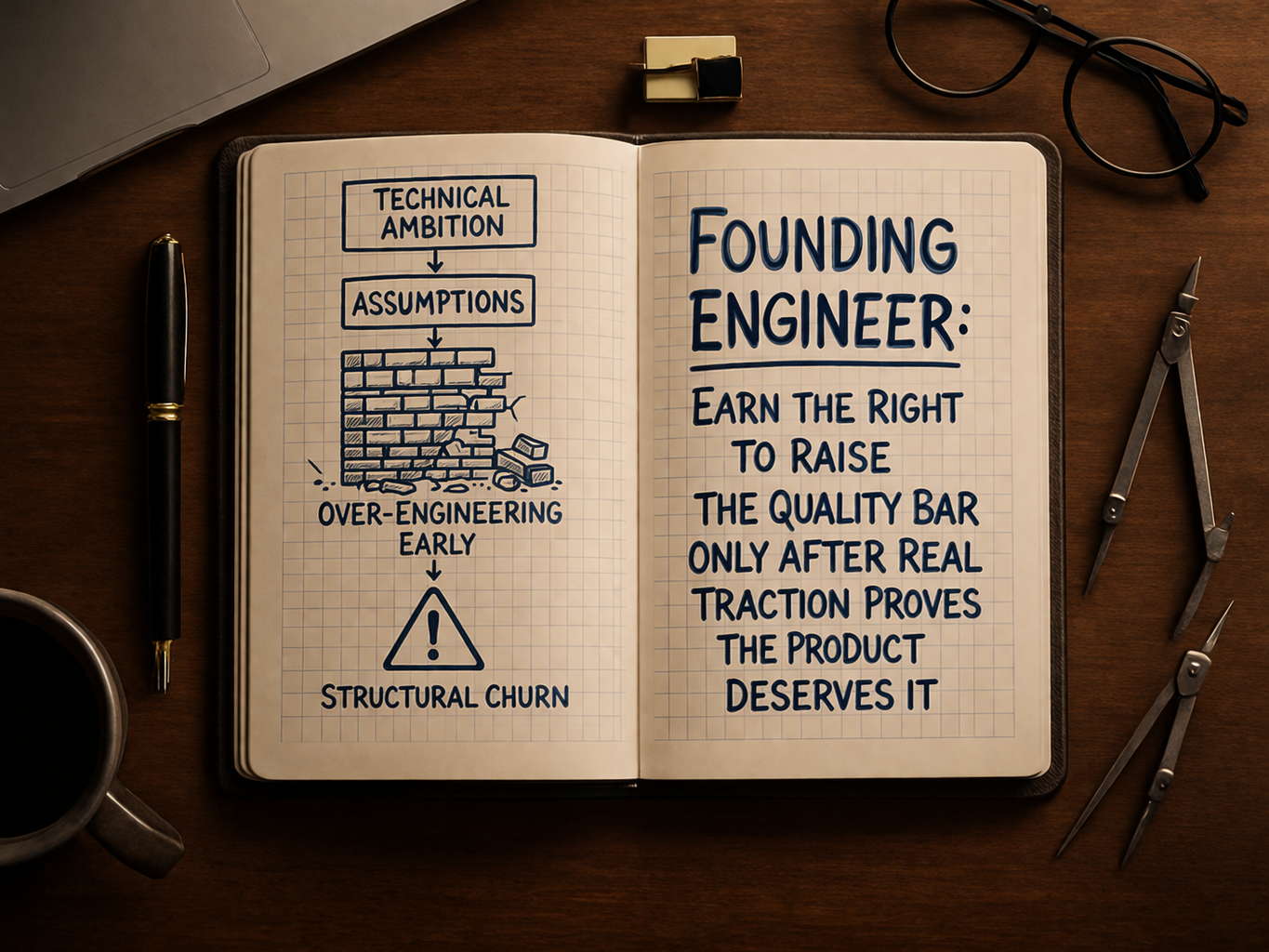
The right to raise the quality bar is earned only after real traction proves the product deserves it.
Key Takeaways
- Quality must be earned through market validation, not granted by technical ambition
- Over-engineering early creates structural churn when assumptions inevitably break
- The MVP should hurt slightly — discomfort signals you shipped early enough to learn effectively
- Traction transforms quality from theoretical to operational, revealing where polish creates leverage
- Before product market fit, optimize for learning velocity over premature sophistication
Part of the **Founding Engineer: Field Notes Series. This note belongs to: [Engineering](https://medium.com/@Chernukos/founding-engineer-field-notes-engineering-vertical-52e528bfee92) vertical Other verticals: [Product](https://medium.com/@Chernukos/founding-engineer-field-notes-product-vertical-a481c013db35), [Business](https://medium.com/@Chernukos/founding-engineer-field-notes-business-vertical-b356de331d95), [Personal Strategy](https://medium.com/@Chernukos/founding-engineer-field-notes-personal-strategy-vertical-60e754330df1)**
You know the feeling. We fall in love with the idea, convince ourselves we understand the problem deeply enough, and then start designing the version of the product we wish already deserved world-class quality. We want beautiful software architecture, elegant abstractions, strong scalability, polished UX, serious availability, and a level of engineering rigor that makes us feel safe.
That is usually a strategic mistake. In startup environments, quality must be earned. We do not earn the right to build the amazing long-term solution just because we are technically capable of imagining it. We earn that right when real traction shows up, when users start depending on the product, and when actual market signal tells us which parts deserve deeper investment.
Product Validation Before Perfect Architecture
In the earliest stage, we are operating mostly on belief. We believe we understand the problem. We believe we understand the user. We believe we know how the user will move through the product, what they will value, which flows will matter, and which constraints the future system will need to carry. Those beliefs may be thoughtful. They may even be informed. But they are still assumptions.
Then we encode those assumptions into architecture. We create system boundaries, workflows, abstractions, data models, and UX decisions that all make perfect sense inside our own mental model. The problem is that the first meaningful exposure to customers almost always breaks that model in ways that matter. Users ignore areas we thought were central. They struggle with flows we believed were obvious. They reveal gaps in experience, gaps in understanding, and gaps in the problem definition itself.
The first hard truth: the product we imagined is rarely the product the market validates.
This is why the early job is not to build the best possible minimum viable product in the abstract. The early job is to build a product that is good enough to create a real learning loop. We need enough coherence that users can engage with it meaningfully, enough completeness that we can observe behavior instead of guessing at it, and enough speed that we can keep learning before time, money, and conviction run out.
That means optimizing for learning velocity instead of premature quality theater. It means accepting that some parts of the early experience will be rough. It means understanding that before traction, the key question is not “How do we perfect this?” but “How do we expose this to reality quickly enough to discover what is true?”
A founding engineer should be extremely suspicious of the instinct to over-harden too early. We absolutely need judgment. We should avoid reckless sloppiness. We should build in a way that still allows us to move. But we should not confuse responsible startup engineering with investing in sophistication that the product has not yet earned.
Without traction, we are still building in a bubble. Solutions built in a bubble almost never survive intact.
The Hidden Cost of Over-Engineering
The obvious cost of over-engineering is time. The deeper cost is structural churn.
Once we decide to build the scalable, highly polished foundation too early, we are not just spending more upfront. We are also locking in assumptions through code structure, dependencies, workflows, and operational constraints that the rest of the product now has to work around. We create complexity in the name of future readiness before we know whether the future we are preparing for is even the right one.
Then the market shows up and starts disagreeing with us.
A feature we thought was central gets ignored. A capability we treated as secondary becomes the thing users care about most. An onboarding path collapses. A workflow that looked elegant in design turns out to be awkward in practice. Now the supposedly durable foundation becomes friction. The architecture is not helping us move faster. It is slowing down the product’s ability to adapt to what we are learning.
This is where premature sophistication turns into technical debt without matching value. The debt is real because the complexity is real. The maintenance burden is real. The constraints are real. But the value side of the equation is weak because the product itself was not validated enough to justify that investment.
Early product work should often be treated like a serious learning system rather than a permanent asset. Not sloppy. Not careless. Not random. Serious. But still intentionally temporary in important ways.
A strong early product can absolutely have rough edges. It can have incomplete features. It can be a little embarrassing. In many cases, it should be, because that discomfort is often the price of learning early enough. The first version exists to help us extract signal. It exists to expose wrong assumptions. It exists to create contact with reality before we waste too much effort polishing the wrong thing.
This also requires product partnership. If we are putting an early solution in front of customers, we need to manage expectations properly. We need to position it honestly. We need to be explicit that this is an early version, that the experience may not be ideal, and that the user’s engagement is valuable precisely because it helps shape what comes next.
The point is that product exposure gives us something architecture alone never can: truth. Without that truth, we do not know where quality matters most. We do not know what deserves resilience. We do not know where UX polish creates leverage and where it is just decoration.
Earning the Right to Scale Through Traction
There is an uncomfortable but important reality here: the MVP should often hurt a little.
Not irresponsibly. Not in a way that burns trust recklessly. But enough that we feel the tension between the version we wanted to build and the version we were willing to ship in order to learn. If the first product feels slightly embarrassing, that is often evidence that we shipped early enough to get actual lessons instead of private satisfaction.
The early version has to be complete enough that people can engage with it and teach us something meaningful. It may be a prototype. It may have bugs. It may contain incomplete features. It may expose rough UX or inconsistent workflows. That is acceptable if the product is still effective enough to create strong learning loops with real users.
Early on, that is what we are optimizing for: extracting lessons.
Once enough real users engage, the picture changes. Now we have evidence. We know the actual pains. We know where the product is weak in ways that matter and where it is weak in ways that do not. We know which workflows deserve polish, which reliability issues are unacceptable, which technical boundaries need to be cleaned up, and which investments can still wait.
This is when the quality bar stops being theoretical and becomes operational. We can raise it with intent because now we finally understand where quality creates leverage. We can improve architecture based on validated workflows instead of imagined ones. We can invest in better UX around actual high-friction paths. We can make stronger calls about scalability, availability, and maintainability because the product has earned the right to those decisions.
This is also where prioritization improves dramatically. Before traction, we are mostly guessing which bar matters. After traction, we know. We know which flaws hurt adoption. We know which parts of the product users rely on most. We know what can be abandoned, what can be postponed, and what now demands deeper engineering discipline.
That is the real meaning of earning the right to scale. It is not permission granted by technical ambition. It is permission granted by traction.
Conclusion: Traction Before Perfection
The mindset shift is simple: traction comes first. We do not earn the right to scale quality because we are capable of building something impressive. We earn it when the market proves the product matters and gives us enough truth to raise the bar intelligently.
That is the practical discipline. Resist the urge to perfect what has not been validated. Optimize early for learning instead of self-congratulation. Then, once the product has real users and real pull, raise the quality bar deliberately, aggressively, and in the places that now matter most.
What assumptions are you hardening too early in your current product?
Follow for More and Let’s Connect
If you found this article useful, follow me on Medium for more writing on engineering, product, leadership, and the disciplined work of turning ideas into meaningful products.
If you have questions, want to exchange ideas, or have topics you’d like me to explore in future articles, feel free to reach out.
Connect with me on LinkedIn: **Stas Chernychko**
I’m always happy to connect, learn more, and explore new ideas and perspectives together.
메타데이터
- post_id
- bd2bf0cc619d
- slug
- founding-engineer-earning-the-right-to-scale-bd2bf0cc619d
- url
- https://medium.com/@Chernukos/founding-engineer-earning-the-right-to-scale-bd2bf0cc619d
- canonical_url
- https://medium.com/@Chernukos/founding-engineer-earning-the-right-to-scale-bd2bf0cc619d
- author_url
- https://medium.com/@Chernukos
- status
- ok
- fetched_at
- 2026-07-21 15:02:46






