Dune’s Ornithopters Don’t Break Physics – They Break Engineering
Flapping flight is real. Scaling it into a fast, crewed desert aircraft is where things start to break down.
Dune’s Ornithopters Don’t Break Physics – They Break Engineering
Flapping flight is real. Scaling it into a fast, crewed desert aircraft is where things start to break down.
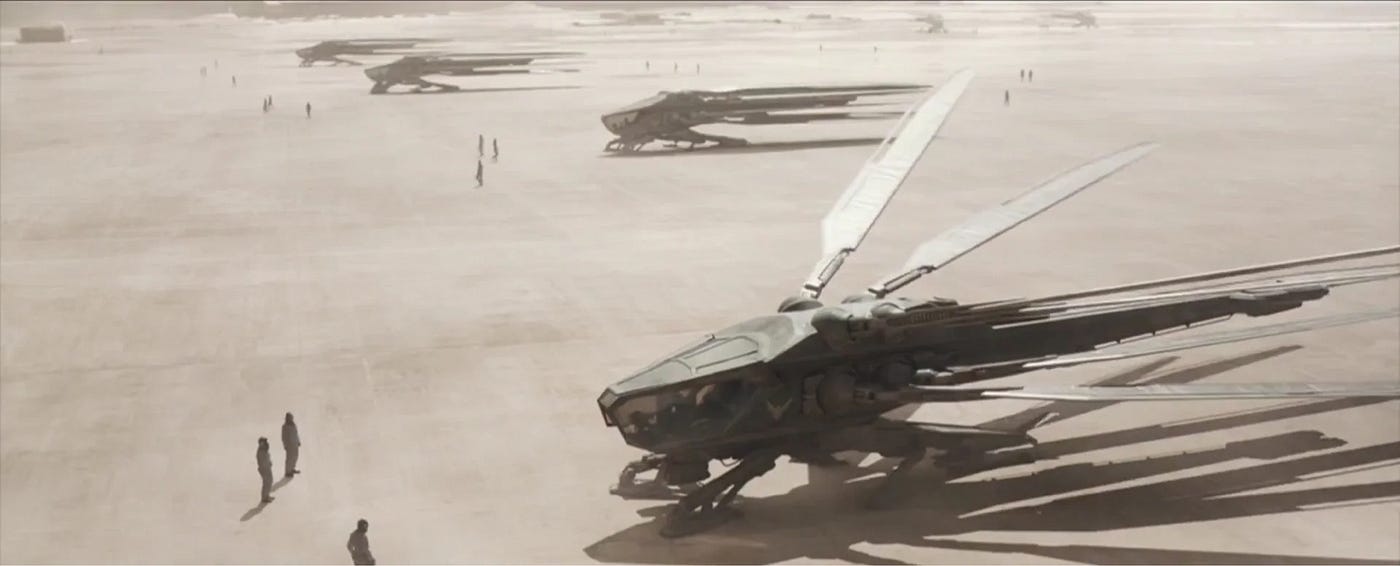
The ornithopters in Dune feel convincing for a reason.
They don’t glide like magic carpets. They fight the air. The wings flex, the body shudders, everything looks like it’s under stress. They resemble giant dragonflies more than sleek sci‑fi ships.
That realism is exactly what makes them questionable.
Dragonflies work because they’re small. Scaling that motion up doesn’t just make everything bigger – it changes how forces, weight, and energy interact. Physics doesn’t forbid it, but it stacks constraints that reinforce each other.
That’s the real issue: not one fatal flaw, but a tightly coupled set of problems that get worse together.
Flapping flight is real – but scaling ties everything together
Flapping-wing aircraft exist. Engineers have built small ornithopters that can hover, glide, and maneuver. The aerodynamics are legitimate – moving wings can generate lift and thrust simultaneously.
But almost all successful designs stay small.
As size increases, aerodynamics, structure, and actuation stop scaling cleanly. The wings don’t just get larger – they become heavy moving structures that must be accelerated, stopped, and reversed repeatedly.
That creates a feedback loop:
More wing mass → more power required → stronger structure → more weight → even more wing mass.
At small scales, lightweight materials and flexible structures keep this manageable. At the scale shown in Dune, the wings themselves become one of the aircraft’s biggest engineering burdens.
Moving the wings becomes the core problem
Unlike a conventional aircraft, where wings stay mostly still, an ornithopter turns its wings into the primary moving system.
As those wings grow:
- Their mass increases, especially far from the hinge, raising rotational inertia
-
- Each flap requires accelerating and reversing that mass
-
- Outer sections move fastest, generating large forces and bending loads at the root
Trying to solve one issue worsens another. Lighter wings reduce inertia but lose stiffness and durability. Stronger wings add weight, which demands more powerful actuators and stronger attachments.
This isn’t just a structural problem – it’s also a power problem. Every extra kilogram in the wings increases the energy needed to move them, which increases heat, which requires more cooling, which adds more weight.
The system compounds itself.
Reversing motion amplifies stress and inefficiency
Helicopters also move large blades quickly – but they spin continuously in one direction.
Ornithopters must reverse direction every stroke.
That means repeatedly stopping and re-accelerating large masses, sending fluctuating loads through hinges, transmissions, and wing roots multiple times per second. Even if elastic structures recover some energy, losses from friction, deformation, and imperfect timing are unavoidable.
Those losses show up as heat.
And because the system is constantly changing – hovering, turning, reacting to gusts – it can’t stay perfectly tuned for efficient motion. Control becomes harder, and loads become less predictable.
Fatigue and heat become long-term limits
All of this repeated motion creates two linked problems: structural fatigue and thermal buildup.
Every flap cycles stress through the structure. Wing roots, hinges, spars, and actuators experience millions of load reversals. Even below breaking strength, microscopic damage accumulates and grows over time.
At the same time, the power system is dumping heat into the aircraft.
Motors, gearboxes, and electronics are never perfectly efficient. At large scales, even modest inefficiencies produce enormous heat loads. And the more power required to move heavy wings, the more heat must be managed.
Cooling that heat adds weight and complexity – radiators, airflow systems, pumps – all of which feed back into the same mass and power loop.
The environment makes everything worse
Arrakis compounds every one of these issues.
Hot air reduces cooling efficiency. Sand erodes surfaces, contaminates joints, and degrades lubrication. Fine particles infiltrate bearings, seals, and cooling systems, increasing friction and wear.
An ornithopter’s design – exposed joints, oscillating mechanisms, tight tolerances – makes it especially vulnerable.
Protecting against sand adds seals, filters, and enclosures, which increase weight and restrict airflow, making cooling harder.
Again, the problems reinforce each other.
So could we ever build one?
Maybe – but it likely wouldn’t look like the ones in Dune.
You’d need advances across multiple fronts at once:
- lighter, stronger materials with better fatigue resistance
- distributed actuation instead of heavily loaded hinges
- efficient energy recovery systems
- adaptive wings that change shape and stiffness
- higher-density power sources
- lightweight thermal management
- dust-tolerant or sealed mechanisms
- real-time structural monitoring
Even then, flapping may still lose to simpler designs.
Rotors provide lift without reversing motion. Fixed wings provide efficient forward flight without turning the lifting surface into a moving machine.
So the real question isn’t “can it fly?”
It can.
The question is whether flapping remains the best solution once structure, power, heat, fatigue, and environment are all considered together.
Right now, it probably isn’t.
The fantasy in Dune isn’t that flapping wings work.
It’s that all of these tightly linked problems have been solved at once – without making the aircraft too heavy, too fragile, or too complex to be practical.
메타데이터
- post_id
- bd3b0b54daaf
- slug
- dunes-ornithopters-don-t-break-physics-they-break-engineering-bd3b0b54daaf
- url
- https://medium.com/@nightshade7/dunes-ornithopters-don-t-break-physics-they-break-engineering-bd3b0b54daaf
- canonical_url
- https://medium.com/@nightshade7/dunes-ornithopters-don-t-break-physics-they-break-engineering-bd3b0b54daaf
- author_url
- https://medium.com/@nightshade7
- status
- ok
- fetched_at
- 2026-07-21 08:25:23