Reading to learn Chinese
Some time back in 2015, I came across a fantastic language learning app, LingQ (link: www.lingq.com), which I’ve used extensively with…
Reading to learn Chinese
Some time back in 2015, I came across a fantastic language learning app, LingQ (link: www.lingq.com)), which I’ve used extensively with French, Spanish and Italian. If you aren’t familiar with it, LingQ lets you read and listen to stories, news articles or anything you import, it provides you with integrated dictionaries and most importantly, highlights words that are new or that you’ve previously identified as not fully knowing. While you read, you let LingQ know how well you know these highlighted words.
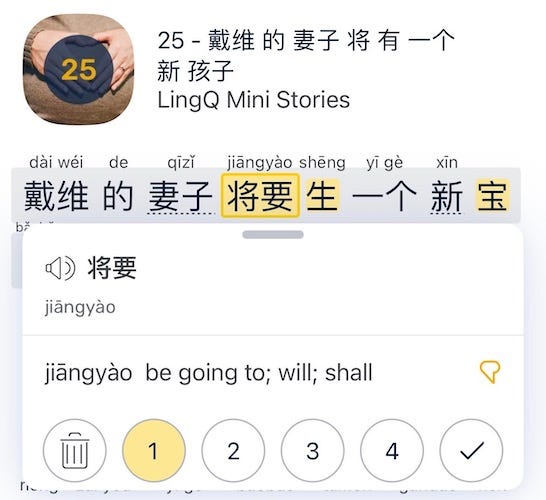
As you build a habit of reading a bit each day, LingQ accumulates an understanding of your current abilities with the language, and you use this to your advantage by selecting new material from its vast repository that is almost fully comprehensible by you. That is, content that has fewer than 5–10% new and difficult words. This helps in two ways: it exposes you to these words in the context of text that you can already read, and increases the speed by which you can ingest lots of material as you’re not hunting for the definition of every word.
Do I recommend LingQ? My stats will answer that. I’ve read about one million words in each of French, Spanish and Italian.
Enter Chinese.
As you can see from the image above, when I started learning Mandarin in Spring 2022, I naturally turned to my favourite tool, LingQ, to help with Chinese. After an honest effort I recognized the benefits I saw with other languages weren’t helping me with Chinese.
- I didn’t want to solely rely on pinyin, but as you can imagine, as soon as I turned on pinyin, that’s all I saw. While I was learning characters, I wasn’t learning them from LingQ. This wasn’t LingQ’s fault — I would have had the same problem with any tool I’d picked at that point.
- Beginner content was really simple or really boring.
- Finding content where I knew 90% of the words was more time consuming than the time I actually spent reading. More often than not, I’d open a beginner story and find > 50% of the words were new/unknown.
Not hard to guess, I started looking for alternatives.
Enter Du Chinese.
By the time I started my search, I’d completed the HSK 1 content on Anki and was working through HSK 2. From a podcast on I’m Learning Mandarin (link: https://imlearningmandarin.com/2021/08/15/learning-characters-with-hack-chinese) I found HackChinese (link: www.hackchinese.com)) and through it, Du Chinese (link: https://duchinese.net)..) While I’ll talk about HackChinese another time, Du Chinese turned out to be the tool that best suited me.
- Du Chinese separates lessons, stories, and standalone articles into six levels: Newbie (where I was at the start), Elementary (where I am now and shown below), Intermediate, Upper Intermediate, Advanced and Master.

- From what I’ve seen so far, Newbie content aligns with your first 150 characters and Elementary content with your first 300. Which, no surprise, aligns with HSK 1 and HSK 2.
- You can optionally show pinyin (I’ve turned it off) and underline words in a color that indicates where they appear in the HSK.

- The reading voice is very clear, the speed is controllable, and words are highlighted in the text as they are read.
- Clicking and holding on a word pops up its definition and provides an option to add it to its spaced-repetition flash card list.

What I like most about Du Chinese is the content because the stories/lessons are entertaining to read and they align to my HSK level. What I miss, is knowing how much content is new to me, a recommendation that I’ve made to the developer since I know they track which words I’ve been exposed to. However, I know the material in the Elementary section comes from the HSK 1/2 word lists (or at least that is what it looks like to me), so I’m not going to be forced to learn random words that don’t align with what I’m currently working on.
Where do I stand now?
As mentioned, I’ve really enjoyed the content on Du Chinese, specifically because the material was purposely written by the Du Chinese team for the beginner, intermediate and advanced levels. They continue to add new stories so I can’t imagine I’ll run out any time soon, but I do miss the one thing that I enjoyed with LingQ at the intermediate/advanced levels — that is, the ability to import my own content and news articles from a variety of sources, so I know one day I will add my trusted LingQ back into my routine once I have enough characters under my belt to take advantage of what it offers.
메타데이터
- post_id
- bd45fde8488e
- slug
- a-path-to-reading-chinese-bd45fde8488e
- url
- https://medium.com/@dansthings/a-path-to-reading-chinese-bd45fde8488e
- canonical_url
- https://medium.com/@dansthings/a-path-to-reading-chinese-bd45fde8488e
- author_url
- https://medium.com/@dansthings
- status
- ok
- fetched_at
- 2026-06-29 22:44:20