AI Was Supposed to Make Work Easier. In China, It Made Work Harder.
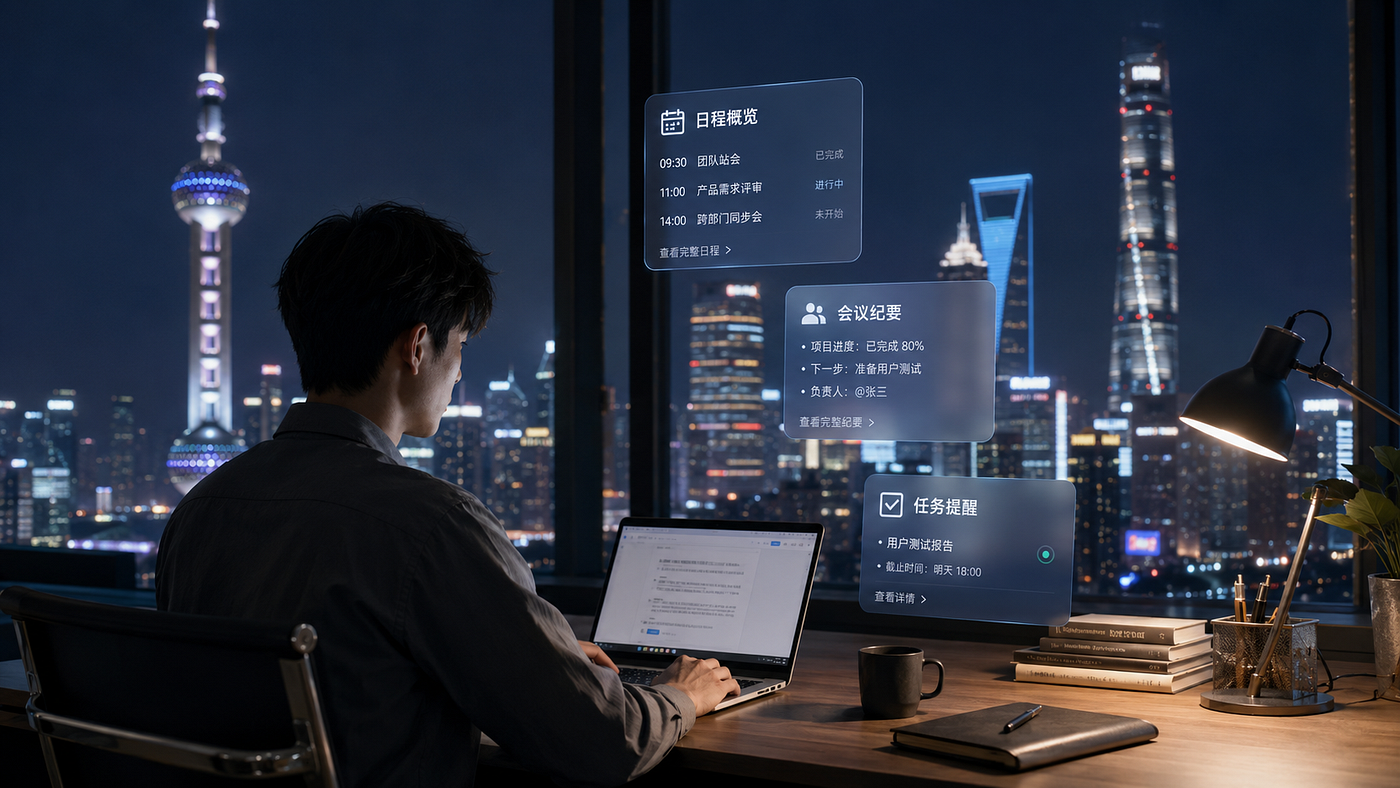
A few months ago, DingTalk, one of China’s largest workplace apps, became the center of an unusually public controversy.
AI Was Supposed to Make Work Easier. In China, It Made Work Harder.
Generated by Arthur via GPT
A few months ago, DingTalk, one of China’s largest workplace apps, became the center of an unusually public controversy.
The problem was not a data breach, a failed launch, or a collapsing business.
It was an AI product.
The product had a simple promise: make work feel lighter.
It would sort messages, extract tasks, summarize information, and surface what mattered most. Instead of forcing employees to search through endless chats, documents, and reminders, the system would bring the important work to them.
The slogan sounded almost humane.
People should not have to chase work.
Work should find people.
Then the people building it began to break.
A product manager who had spent more than 300 days inside the project later published a long account of what happened. She described a team caught in constant iteration, shifting requirements, compressed deadlines, and repeated demands to produce something visible by the end of the day.
The product was supposed to reduce cognitive overload.
The process of building it created more.
Eventually, the project was scaled back. Leadership changed. And an AI system designed to make work easier became a case study in why workplace AI often does the opposite.
This may sound like a story about one Chinese technology company.
It is not.
It is a story about what happens when AI saves time at work, but the worker does not own the time it saves.
My Friend Thought AI Would Help Him Leave Earlier
A friend of mine works as a product manager at a technology company.
When he first started using AI seriously, he loved it.
A product proposal that once took most of a day could now be drafted in an hour. AI helped him structure the argument, summarize research, turn rough notes into clean paragraphs, and prepare a first version of the slides.
For a few weeks, he believed the promise.
He thought he might finally leave work earlier.
That never happened.
His company noticed the same improvement he did.
A task that once required a full day no longer looked like a full day of work. Soon, one proposal became three directions. One draft became several versions. The afternoon review produced another round of changes, and the evening was used to prepare alternatives for the next morning.
The tool worked.
That was the problem.
“AI definitely made me faster,” he told me once. “But now I’m expected to do more things in the same day.”
That sentence explains more about workplace AI than most product demonstrations do.
We imagine automation in a very specific way.
Eight hours of work become three hours. The remaining five hours return to the person who did the work.
But companies rarely treat saved time that way.
If someone once produced two reports in eight hours and can now produce five, the organization does not see five free hours.
It sees a new production standard.
The workday stays the same length.
Only the amount of work considered normal changes.

Generated by Arthur via GPT
The Time AI Saves Does Not Automatically Belong to You
This is the part of the AI productivity story that is usually left out.
A tool can save time without giving that time back to the person using it.
In most companies, employees use the software, but management defines the workload. That difference matters more than the quality of the model.
When a task becomes faster, the worker may see relief.
The organization sees capacity.
It begins to ask reasonable-sounding questions.
Could we test another direction?
Could we prepare another version?
Could we respond to the client today instead of tomorrow?
Could we run three experiments instead of one?
None of these requests sounds extreme by itself.
That is what makes the system difficult to resist.
AI does not usually make work unbearable by creating one obviously absurd demand. It makes dozens of additional demands feel cheap.
A new proposal now looks almost free.
Another draft looks harmless.
A last-minute change looks manageable.
The execution may be faster, but the surrounding work remains human. Someone still has to understand the vague request, check the output, correct mistakes, defend the reasoning, coordinate with other teams, and take responsibility when the result fails.
AI reduces the visible cost of producing the first version.
It does not remove the cost of judgment.
DingTalk Revealed Who Workplace Software Really Serves
DingTalk’s AI project was built around an attractive idea: important work should find the employee automatically.
Messages would be summarized. Tasks would be identified. Priorities would surface without the user having to search for them.
But there was a hidden assumption inside that vision.
It assumed that the work being surfaced was worth doing.
That is not always true.
In a real organization, tasks do not appear from nowhere. They are created by people with different levels of authority, information, and judgment. Some are necessary. Some are poorly defined. Some exist because a manager is uncertain and wants several options. Some survive only because the cost of trying them has become low enough.
AI makes all of these tasks easier to package and distribute.
That changes the balance of power.
DingTalk was never just a neutral communication tool. Its defining features were designed around organizational visibility: read receipts, reminders, attendance, approvals, task tracking, and confirmation that something had been seen or completed.
These features solve a real problem for managers.
They answer a basic question:
Did the employee receive the instruction, and has the work moved forward?
When AI is added to that kind of system, it inherits the same direction.
It becomes easier to detect unfinished tasks, surface unread messages, generate reminders, assign follow-up work, and convert vague requests into formal obligations.
The technology may be described as an assistant.
But it can easily become a more efficient supervisor.
AI Makes Bad Ideas Cheaper Too
There is another reason employees often become busier after adopting AI.
Execution used to create friction.
A manager could casually suggest a new direction, but turning that suggestion into reality required research, planning, design, development, and coordination. The cost forced people to think before acting.
Not always.
But often enough.
AI weakens that filter.
Now a rough idea can become a proposal before lunch. A vague request can become a polished deck. A feature concept can become a convincing prototype before anyone has decided whether customers need it.
This feels like speed.
Sometimes it is.
But speed also allows uncertainty to spread through an organization.
A manager no longer needs to choose between three ideas. The team can try all three.
A client no longer needs to explain exactly what they want. The team can generate several interpretations.
A company no longer needs a clear product strategy before launching experiments. AI can help it produce enough activity to look like a strategy.
The number of things a company can execute grows faster than its ability to decide what is worth executing.
That is how productivity turns into exhaustion.
AI does not only accelerate good judgment.
It accelerates the absence of judgment too.

Generated by Arthur via GPT
The Managers Are Not Necessarily Winning
It would be easy to reduce this story to one conclusion: bosses benefit, employees suffer.
The reality is less satisfying.
Managers gain more power over execution, but they also face a much faster test of their own decisions.
Before AI, a bad direction might survive for six months because the team needed time to build it.
Now the team can produce several versions in a few weeks.
If none of them works, the explanation can no longer be that execution was too slow.
The problem moves upward.
A manager friend once described it to me this way:
“Before AI, you might need six months to discover that you chose the wrong direction. Now you find out in three weeks. But you are also expected to prove within those three weeks that you were not wrong.”
That pressure changes leadership too.
Managers ask teams to move faster because they themselves are being judged faster. Executives ask for more experiments because competitors are releasing products faster. Companies start projects before they understand the market because doing nothing looks more dangerous than doing the wrong thing.
Everyone becomes more productive.
Nobody feels less anxious.
The DingTalk story ended with both sides losing.
The employees did not receive the lighter working life the product promised.
The leader did not receive enough strategic value from all that speed to keep his position.
The system produced more movement.
It did not produce enough clarity.
AI Changes the Meaning of “Enough”
The deepest change may not be that AI makes people faster.
It changes what counts as enough.
A good draft is no longer enough if another version can be produced in minutes.
A thoughtful answer may no longer be enough if an immediate answer is technically possible.
One experiment may look lazy when five can be run.
One clear direction may look less impressive than a dashboard full of activity.
The standard rises quietly.
At first, AI is treated as an advantage.
Then its use becomes expected.
Eventually, the output it enables becomes the baseline.
At that point, the worker is no longer praised for being faster.
The worker is questioned for not being faster still.
This may become one of the defining sentences of the AI workplace:
You have AI now. Why is this still taking so long?
That is very different from liberation.
It is a new form of pressure, made more powerful because it presents itself as common sense.
The Real Question Is Who Controls the Workday
So is AI helping us or hurting us?
That question is probably too simple.
AI can help a person write, analyze, design, code, and communicate faster. The improvement is real.
But productivity is not the same as relief.
Relief depends on what happens after the time is saved.
Does the employee gain more control over the day?
Does the workload fall?
Does the company shorten working hours?
Does the worker receive more pay for producing more value?
Or does every saved hour return as another request?
The answer depends less on the intelligence of the tool than on the structure around it.
When workers have little control over workload, AI does not necessarily reduce labor.
It increases the amount of labor that can be fitted into the same number of hours.
That is what happened in my friend’s workday.
It is what the DingTalk controversy exposed at a much larger scale.
And it may be what millions of workers are about to discover.
The future of work may not be humans competing against AI.
It may be humans working with AI inside organizations that have learned to ask for more.
The machine saves time.
The company decides where that time goes.
That is the real relationship between AI and work.
Not replacement.
Not freedom.
A negotiation over who owns the hours that technology gives back.
메타데이터
- post_id
- bd4a36c495dd
- slug
- ai-was-supposed-to-make-work-easier-in-china-it-made-work-harder-bd4a36c495dd
- url
- https://www.towardsdeeplearning.com/ai-was-supposed-to-make-work-easier-in-china-it-made-work-harder-bd4a36c495dd
- canonical_url
- https://www.towardsdeeplearning.com/ai-was-supposed-to-make-work-easier-in-china-it-made-work-harder-bd4a36c495dd
- author_url
- https://medium.com/@arthur-gilbert
- status
- ok
- fetched_at
- 2026-07-17 00:42:37