The $2.6 Billion Lawsuit That Could Shake the Pet Food Industry to Its Core
A dog food company, funded veterinary researchers, a hijacked FDA investigation — and the science that quietly fell apart four years later.
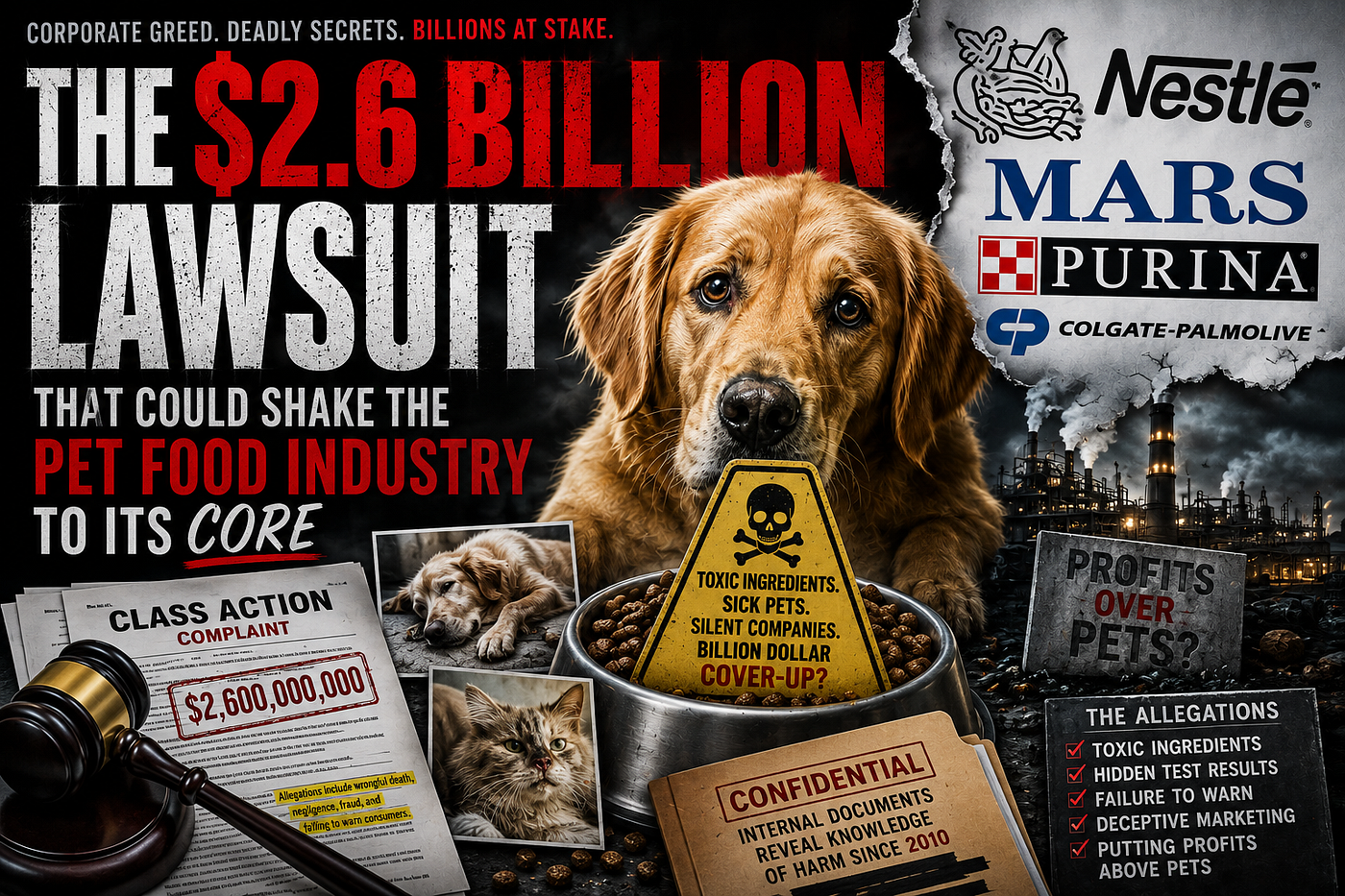
The $2.6 Billion Lawsuit That Could Shake the Pet Food Industry to Its Core
A dog food company, funded veterinary researchers, a hijacked FDA investigation — and the science that quietly fell apart four years later.
I want to be upfront about something before you read further.
As a veterinarian, I was trained to recommend Hill’s, Royal Canin, and Purina. These were the “science-backed” brands. I said it to clients with confidence, the way my professors said it to me.
But in February 2024, a $2.6 billion lawsuit was filed that made me go back and ask a question I should have asked years ago: What if the science behind that confidence was manufactured?
What follows is not a verdict. The case is ongoing. But the documented facts alone — the funding trails, the FDA records, the market data, the internal emails — tell a story that every pet owner deserves to know.
Part 1: The Panic That Came From Nowhere
In 2016, grain-free dog food was having a moment.
Pet owners had decided — much as they did with their own food — that grains were the enemy. Corn, wheat, soy: out. Peas, lentils, chickpeas, sweet potato: in. By 2019, grain-free products had grown into a $5.4 billion market, representing roughly 43% of all dry dog food sold in the United States.
For legacy pet food companies like Hill’s Pet Nutrition — a Colgate-Palmolive subsidiary — this was a problem. In the four years leading up to 2018, Hill’s had lost approximately 20% of its market share to grain-free competitors.
Then, in July 2018, the FDA announced something alarming.
It said it was investigating a potential link between grain-free dog food and dilated cardiomyopathy (DCM) — a serious, often fatal heart disease in which the heart muscle weakens and enlarges, reducing its ability to pump blood. The FDA said veterinary cardiologists were seeing DCM cases in dog breeds not typically predisposed to the disease, and many of these dogs had one thing in common: they were eating grain-free diets.
The announcement went everywhere. Veterinarians shared it. News outlets ran with it. Frightened pet owners flooded clinics asking whether their dog’s food was killing them.
And grain-free pet food sales — which had been climbing for nearly a decade — fell off a cliff.
Part 2: The Three Veterinarians at the Center of It All
Every major investigation has a starting point. This one had three names.
Dr. Lisa Freeman of Tufts University Cummings School of Veterinary Medicine. Dr. Darcy Adin of the University of Florida College of Veterinary Medicine. Dr. Joshua Stern of the University of California, Davis.
These were the only three veterinarians named by the FDA as consultants in its DCM investigation. In April 2018, they held a call with the FDA to discuss their clinical observations on DCM and grain-free diets. What followed was a cascade of case reports and publications that shaped public perception — and regulatory action — for the next four years.
Here is where things get complicated.
According to records on PubMed, all three had deep and longstanding financial ties to pet food companies — specifically the ones that stood to gain most from a grain-free scare.
Dr. Freeman had received funding from Hill’s Pet Nutrition, Nestlé Purina PetCare, and Mars Petcare since 2002. Over two decades, she was an author on approximately 30 studies funded by these companies. Dr. Adin and Dr. Stern also had documented financial relationships with the same industry players.
These are not obscure companies. Hill’s, Purina, and Mars are the three largest sellers of grain-containing pet food in the country — and the three companies that were losing ground most directly to the grain-free market.
None of this proves wrongdoing. Conflicts of interest are common in nutrition science, both human and animal. Researchers routinely work with industry partners. But what happened next makes the funding trail harder to dismiss.
Part 3: The Case Reports That Triggered an Investigation
Between January and early July 2019, the FDA received 25 reports of DCM in dogs. This was a dramatic spike — the agency had typically seen just one to three reports per year.
More striking: over 90% of the affected dogs were reportedly eating grain-free diets.
The FDA used this data to publish a major update in June 2019, taking the extraordinary step of naming 16 specific dog food brands most frequently appearing in DCM reports. Most were grain-free. This was, as one veterinary researcher later put it, something the agency had “never done before without certainty of the cause.”
The named brands saw immediate and severe consumer backlash.
But when journalists filed Freedom of Information Act (FOIA) requests for the underlying FDA records, something unusual surfaced.
Seven of the 25 DCM cases — more than a quarter of the reports that triggered the investigation — came from a single source: Dr. Lisa Freeman at Tufts University.
The FOIA documents also revealed that Freeman had shared a reporting protocol with the FDA — a document that instructed veterinary cardiologists to filter and submit cases in a specific way. When asked whether this amounted to cherry-picking data, Freeman stated through Tufts’ media relations that the protocol was developed to help veterinary cardiologists in the early stages of the investigation and was shared to inform the FDA of what their clinical recommendations were at the time.
The FDA, for its part, stated: “The FDA has never requested that DCM cases reported to the agency be limited to certain diet types. We welcome all DCM reports with a suspected link to food, regardless of the type of diet.”
The contradiction between those two statements has never been fully resolved.
Part 4: The Science That Didn’t Hold Up
For four years, the DCM-grain-free link was treated as established fact in clinical veterinary practice. Vets advised clients to switch foods. Grain-free brands collapsed in some cases. The phrase “BEG diets” — Boutique, Exotic-ingredient, and Grain-free — entered the lexicon as shorthand for dangerous.
Then, quietly, the FDA closed the investigation.
On December 23, 2022, buried in a website update, the agency announced that it had found “insufficient data to establish causality among DCM case reports and pet food products eaten by afflicted dogs” and that it would not release further public updates.
The agency had received 1,382 DCM reports between January 2014 and November 2022. Crucially, most case reports clustered around FDA announcement dates — suggesting that reporting surged when the issue was in the news, not because DCM itself was surging.
An independent study published in March 2022 by researchers from BSM Partners and the University of Missouri found “no significant correlation between the national canine DCM incidence rates in relation to grain-free pet food sales.” If grain-free diets were genuinely causing DCM, one would expect to see DCM cases rise as grain-free sales rose between 2011 and 2019. No such pattern was found.
The investigation had started with a roar. It ended, as one industry publication put it, “with a whimper.”
But by then, the damage was done.
Grain-free dog food sales had already fallen by $60 million from 2021 to 2022 alone. Hundreds of small and mid-sized grain-free pet food companies had lost market share, customers, and in some cases, their businesses. The “BEG diet” warning was still echoing in vet clinics long after the FDA had quietly stepped back from it.
And Hill’s? In the five years since the investigation began, the company became, by multiple accounts, arguably the fastest growing pet food company in the country.
Part 5: The $2.6 Billion Lawsuit
On February 6, 2024, a 124-page legal complaint landed in the United States District Court for the District of Kansas.
The plaintiff: KetoNatural Pet Foods, a Utah-based manufacturer of low-carbohydrate dog food. The defendant: Hill’s Pet Nutrition, the Morris Animal Foundation, the Mark Morris Institute, and a group of veterinary researchers including Freeman, Adin, Stern, and others.
The damages sought: $2.6 billion — which, if awarded, would be the largest in the history of the US pet food industry.
The lawsuit is brought under the Lanham Act, which governs unfair competition and false advertising. It alleges that Hill’s and its co-conspirators carried out “an egregious, wide-ranging, and damaging campaign of coordinated, for-profit, faux-scientific misinformation” to destroy competitors and recapture market share.
Specifically, the complaint alleges:
On the FDA investigation: That Hill’s-affiliated veterinarians flooded the FDA with DCM case reports intentionally chosen to overrepresent grain-free diets, manufacturing a false scientific signal that triggered the agency’s investigation.
On the research: That the “Veterinarian Defendants authored study after study about DCM and then mischaracterized the findings” — framing inconclusive or preliminary data as evidence of a link that rigorous science has not established.
On social media manipulation: That the defendants “created and fostered social media environments including at least one Facebook group that was an echo chamber, suppressing any contradiction of the propaganda campaign.”
On the financial motive: That Hill’s had directly lost 20% of its market share in the four years before the investigation began, and directly regained its standing in the years that followed.
Colgate-Palmolive, Hill’s parent company, has not publicly commented on the lawsuit’s specific allegations. The case remains active as of 2025.
Part 6: The Deeper Problem This Exposes
Whether or not this lawsuit succeeds — and the legal bar for Lanham Act claims is high — the documented facts it brings into public view point to a problem that goes far beyond one company, one investigation, or one lawsuit.
Who funds veterinary nutrition science?
The honest answer is: mostly the companies that sell pet food.
A systematic review published in Veterinary Evidence found that most published pet nutrition studies received funding from pet food manufacturers, yet many declared no conflicts of interest. The researcher who conducted the review was careful not to claim the studies were biased — only that the perception of bias was entirely reasonable, and that undisclosed industry ties could erode trust in veterinary nutrition science.
This is not a fringe concern. The three largest pet food companies in the world — Hill’s, Purina, and Mars — are also the dominant funders of veterinary nutrition research, veterinary school programs, student scholarships, and continuing education for practicing vets. The food your vet recommends is, in many cases, made by the same company that funded your vet’s training.
What about the clinical guidance that was never corrected?
This may be the most consequential part of the story.
A 2026 analysis published by NorthPoint Pets noted that clinical recommendations against grain-free diets “have not been systematically revisited” following the FDA’s 2022 decision to stop updates for lack of causal evidence. The announcement that grain-free food was dangerous traveled fast and wide in 2018 and 2019. The quiet closure of the investigation in December 2022 did not.
As one analysis described it: “This is how preliminary signals become clinical dogma: the announcement travels fast and wide; the quiet closure does not.”
Countless pet owners switched their dogs off grain-free food based on warnings that were never retracted — and may never know that the FDA itself walked away from the evidence.
What I Think, As a Veterinarian
I want to be careful here, because this story genuinely has two sides.
DCM is a real disease. Some dogs with DCM have improved when switched from grain-free to grain-inclusive diets — and that clinical observation is not nothing. The debate about taurine deficiency, legumes, and cardiac health in dogs is scientifically unresolved, not definitively debunked.
Dr. Freeman and her colleagues are credentialed, accomplished researchers. Receiving industry funding does not automatically mean producing biased science. And the FDA conducted a real investigation into reports submitted in good faith by practicing cardiologists.
But here is what I can say with confidence:
A federal agency launched a major public investigation that named specific brands, decimated an industry, and changed how millions of vets counsel their clients — and then quietly concluded it couldn’t establish causation, leaving the original warnings uncorrected in clinical practice.
The investigation was initiated primarily on the basis of reports from researchers with documented financial ties to the companies that benefited most from its outcome.
A $2.6 billion lawsuit — with 124 pages of documented evidence — has now made these connections a matter of public legal record.
And the broader system that allowed this to happen — where the same corporations fund the research, train the vets, and market to the consumers — remains entirely intact.
What You Can Do
This is not a call to distrust your vet or abandon your dog’s current food, especially without veterinary guidance. But it is a call for a more informed kind of trust.
When your vet recommends a specific pet food brand, it is reasonable to ask: Is there published independent research behind this recommendation? Who funded the studies that support it?
When you read about a dietary risk in the news or hear it from a clinic, ask: Did the FDA or a regulatory body confirm this as causation, or was it correlation in an early investigation?
When choosing a pet food, consider: Are there independent, non-industry-funded nutritionists or researchers who have reviewed this diet?
The lawsuit will likely take years to resolve. The science around DCM and diet will continue to evolve. But the questions this case raises — about who funds veterinary science, who shapes what vets are taught, and who benefits when the scientific narrative moves in a particular direction — are questions that will outlast any court ruling.
They are, at minimum, questions worth asking.
Dr. Jivitesh Singh, B.V.Sc & A.H. is a veterinarian writing about the intersection of animal health, science, and the systems that shape both. This article draws on court filings, peer-reviewed literature, FDA records, and investigative journalism from 100Reporters, PetfoodIndustry, and STAT News. All allegations cited from the lawsuit are allegations — not established findings of fact.
메타데이터
- post_id
- bd92b50a27c0
- slug
- the-2-6-billion-lawsuit-that-could-shake-the-pet-food-industry-to-its-core-bd92b50a27c0
- url
- https://medium.com/@jiviteshsingh0102/the-2-6-billion-lawsuit-that-could-shake-the-pet-food-industry-to-its-core-bd92b50a27c0
- canonical_url
- https://medium.com/@jiviteshsingh0102/the-2-6-billion-lawsuit-that-could-shake-the-pet-food-industry-to-its-core-bd92b50a27c0
- author_url
- https://medium.com/@jiviteshsingh0102
- status
- ok
- fetched_at
- 2026-06-20 20:29:01