Anglo-Jat Relations : A Legacy of Mutual Benefaction
The Jats have been a Dominant Caste in North India since Punjab Census 1901. Records further suggest that by 1910, 60% of landholdings…
Anglo-Jat Relations : A Legacy of Mutual Benefaction

The Jats have been a Dominant Caste in North India since Punjab Census 1901. Records further suggest that by 1910, 60% of landholdings belonged to them¹. There has been a legacy of Jat ruled estates as well; where the Jat rulers retained friendly relations with the British after the extension of British rule over other areas. For the common Jats, they have been in occupation as the principal peasant caste, mainly of that part of India where the beneficial effects of British rule for the peasantry were maximally felt namely, Punjab, Haryana and western Uttar Pradesh.²²
Amongst the recent clamour of reservations based on socio-educational backwardness and on ground social dominance of the Jats, they shuttle between both diagrammatically opposite ends of this social fulcrum. An objective probe into history categorically points out how the common Jats forged their socio-economic dominance through tactical alliance with the British colonists; which we try to revisit with references.
Colonial Repackaging of the Jat Identity
The Kshatriya Ambition
The Jats had aspired for Kshatriya status during the colonial period because they had been denied the status of Dwij (twice born caste) in the hierarchy of Hindu Varnas and were being treated as the Shudras till the Arya Samaj recognised their Kshatriya status and authorised them to wear Janeau (sacred thread) and perform Havana (burn the sacred fire).²

“For well over a century, the Jats of north India engaged in two parallel processes. They have, via the Arya Samaj movement, clamored for Kshatriya status, which was denied to them by the higher castes. At the same time, they have persistently appealed for reservations and fought for their status, in colonial India, as an agricultural caste. The All-India Jat Mahasabha founded in 1905, forcefully expressed these two demands.” (Datta, 1999).
Further, the British Indian Army’s recruitment politics shaped new dimensions of power and social hierarchies, percolating through British offices and their tactics to establish legitimacy within parts of rural India. However, as they also overlapped the ‘martial caste’ category from which the British drew their recruits for the British Indian Army, they were considered by the British to have entered the Hindu hierarchy as high caste men and being warriors belonged to the Kshatriya category.³ The British “accorded them the status of a martial caste” to facilitate their recruitment in the Army.
Orientalist Theory of Origin
Interestingly, British Orientalists paved a way for manufacturing an identity for the Jats through numerous ethnographic studies. James Tod, Alexander Cunningham and H.M. Elliot maintained that the Jats were of ‘Indo-Scythian’ stock. Cunningham associated them with the ‘Zanthi’ of Strabo and the ‘Jatti’ of Pliny and Ptolemy, and asserted that the Jats had entered the Punjab from the home of Oxus soon after the Meds or Mands (Indo-Scythians) who had settled in the Punjab a century before Christ. (See J. Tod, Annals, Vol. 1, pp. 72–75, 96–101. M. Elphinstone, The History of India. The Hindu and Mahomedan periods, London, 1889, pp. 250–53, H.M. Elliot, Memoirs on the History, Folklore, and Distribution of the Races of the North Western Provinces of India, Vol. 1, London, 1869, pp. 130–37. H.A. Rose and D.C.J. Ibbetson, A Glossary of the Tribes and Castes of the Punjab and North West Frontier Provinces, Vol. 1, Lahore, 1911, pp. 362–63). Ibbetson also emphasized the non-Aryan origin of Jats and added that they had lived in Samana, the early Indo-Scythian kingdom. (D.C.J. Ibbetson, Report on the Revision of Settlement of the Panipat tahsil and Karnal pargana, 1872–1880, Allahabad, 1883, p. 81.) This orientalist narrative gave the Jats a much needed air of superiority and a sense of history.

British endowment of ‘Kisaan Qaum’ title
The Britishers passed the Punjab Land Alienation Act of 1900,which created a favoured, dominant, agriculturist class and a non-agriculturist class. The former included Hindu Jats and Sikh Jats and Muslim tribes, and the latter, Hindu Brahmins, Khatris and Banias. The Act made tribe and caste the basis for land ownership. Under the Punjab Alienation of Land Act, 1900, the Jats were declared an ‘agricultural tribe’ for all administrative, political and economic purposes, but in the judicial category, as stated above, they were clubbed with other menial caste groups under the varna category of Sudras. “Defined as a ‘tribe’ in the nineteenth century, the Jats were recognized as a caste group only in 1931. The 1901 Census of the Punjab even stated that “there is no caste above the Jat.”¹⁸ Thus, the Britishers had not only “recognised” them as an agricultural tribe/caste under the Punjab Land Alienation Act (1900) but also gifted an identity to the Jats that of “Kisaan Qaum”, which is still asserted by the Jats themselves.

Jat as Caste
Further, The division of the constituencies of the Punjab Legislative Council under the Government of India Act (1919) and of the Punjab Legislative Assembly under the Government of India Act (1935) into the rural and urban and their mobilisation in favour of the Unionist Party by Chaudhary Chhotu Ram had also enabled the Jats of Haryana to become shareholders in the power structure of colonial Punjab. Moreover, the charging of lower fees from the agriculturalist castes in the educational institutions and the reservation of jobs for them had enabled the Jats to get a fair share in administrative services during the colonial period. This contradiction in essence meant that the administrative and political view of caste as understood and adopted by British officials was very different from the judicial view enforced by the law courts. This inconsistency was never resolved.” (Chowdhry, 2019)

Statutory casteism created by British imperialism became a potent force in various parts of India. In Haryana, it struck deeper roots because of the relative weakness of the anti-caste movements. The caste syndrome, nurtured in the region from the early 1920s by the British officials with the support of ‘caste leaders’ could not remain dormant for long and continues till today.¹⁵. Casteism as an ideology came to the force during the Freedom Struggle. Even the Arya Samaj and the Congress Party were afflicted with this disease in Haryana. The Congress movement was initially very popular with the Jat peasantry in Haryana, but the ascendancy of Sir Chhotu Ram in the politics of Punjab led many of them away from the freedom struggle. The economic, social and numerical dominance of the Jats might have helped Chhotu Ram to outshine others & resulted in conglomeration of the Jat Caste Identity.
Jats as British Footsoldiers
At the beginning of the 18th century, the non-Sikh Jats, who dominated southern and eastern Delhi, are described by sources as “plunderers and bandits preying on the imperial lines of communication.” They became infamous for ambushing caravans on the crucial Delhi-Multan corridor, which passed through Panipat, Hissar, Sirsa, Hansi, Jhajjar and Mahim — the qasbas on the borders of their locality.
In view of tapping on their raiding potential & pacifying engagement, the Jats were among the 5,000–6,000 soldiers who George Thomas enlisted in his army. He gave them pensions and encouraged them to reside in Haryana. In the 1790s, land colonization by giving pensions to soldiers played a part in Haryana turning into a reliable military labour market. Thomas gradually recruited a force of eight infantry regiments including 1,500 Rohillas, 1,000 cavalry, fifty pieces of cannon and 6,000 men, as well as 2,000 soldiers managing his numerous fortresses in the empire.

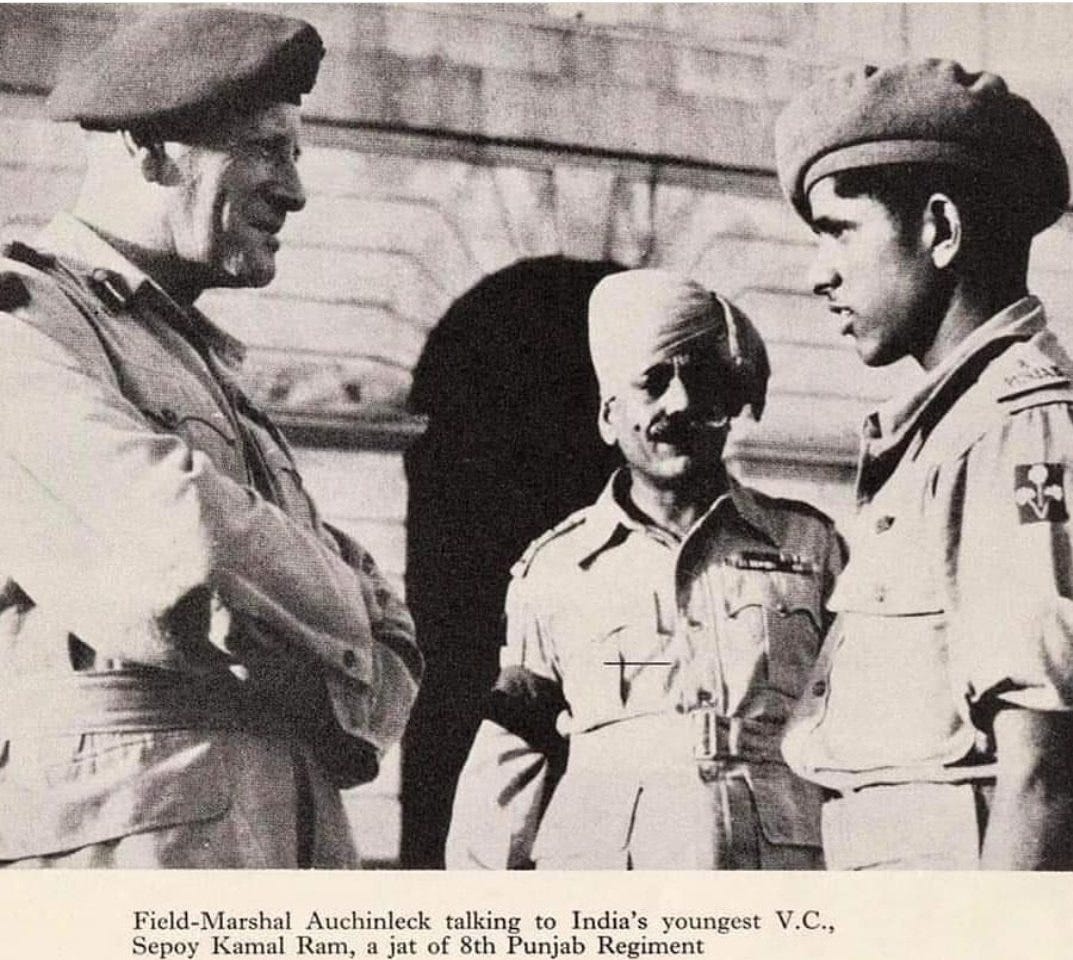
The British colonists were impressed by the martial qualities of the Jats and they started recruiting them in ever-increasing numbers into all branches of the Bengal Army. The 1st Battalion was raised as the 22nd Bengal Native Infantry in 1803. The 2nd and 3rd Battalions were raised in 1817 and 1823 respectively. All three battalions had distinguished records of service including the winning of many honours during World War I. The 1st Battalion, in particular, served with great distinction in France and Mesopotamia and was conferred the signal honour of being declared ‘Royal’ in addition to being made Light Infantry. 9th JAT Regiment, an elite-fighting Unit of the Jat Regime saw a great deal of fighting in North Africa, Ethiopia, Burma, Malaya, Singapore, and Java-Sumatra. A large number of gallantry awards were won including a Victoria Cross and two George Crosses. At the end of the war, the Regiment, in company with other regiments of the Indian Infantry, dropped the numeral 9 from its title and became simply the Jat Regiment.⁶

During World War 1, the Jat communities were first to participate with the British Indian Army due to a long history of previous invasions. One such Jat soldier was Badlu Singh VC (13 January 1876–23 September 1918) who was an Indian recipient of the Victoria Cross, the highest and most prestigious award for gallantry in the face of the enemy that can be awarded to British and Commonwealth forces. He was born in village Dhakla, district Rohtak (now Jhajjar), Haryana, India. His valour and initiative were of the highest order.” Notes the London Gazette, 27 November 1918.
In Sir Chotu Ram, the Jats got the great leader who cooperated with the British and was associated with the Unionist regime of Sir Sikandar Hayat Khan when Punjab province had its headquarters in Lahore. Chhotu Ram helped in the British Army recruitment effort for the First World War, and was instrumental in the recruitment of 22,144 Jats from the Rohtak area. He again backed a massive recruitment drive of the British during the Second World War. The Congress boycotted the 1920 elections, while Chhotu Ram got elected on a Zamindara Party ticket. Consequently, the British honoured him with a knighthood in 1937.⁷
Pt Deep Chand, a resident of Sonepat district and Patwari by profession, is credited with giving new dimensions to this folk presentation of Saang. The popularity of ‘Saang’ of Panditji compelled the British to seek his help for recruitment in the army. He sang Ragnis in form of wartime recruitment song, calling on youth to join the army in native language, which left a deep impact:
Bharti ho lyo re”(Haryanvi)
Get enlisted, the recruits who stand out there,
Here you get broken slippers, there you’ll get full boots, get enlisted,
Here you get torn rags, there you’ll get suits, get enlisted,
Here you get dry bread, there you’ll get biscuits, get enlisted,
Here you’ll have to struggle, there you’ll get salutes, get enlisted.
In the Haryanvi version in Jat Gazette, “suits,” “boots,” and “salutes” (mentioned in English) are contrasted with an alternative rhyme of “toote littar” (broken slippers), “phatt chitthde” (torn rags) and “sukhe tittar” (dry bread). Hereafter, the singer Pt. Deep Chand was decorated with the title of ‘Rai Sahib’.⁸

In September 1918, the British government launched an offensive under the command of Gen Edmund Allenby. He led the Expeditionary Force Egypt, about 80 percent of whom were Indians with Haryanvis being the largest in terms of numbers. The area of Yanuh and Jat villages had very heavy fighting between Indian and Turkish soldiers and the area was given the name after brave Jat soldiers.⁹
Colonial Roots of Jat Sportsmanship
Folk traditions, religious customs, qaumi (folk) tales and physical culture akharas (gymnasia) among the Jats in colonial Haryana went into the making of dominant masculinity in this region. This was done by the colonizers through promoting hegemonic masculine spaces that were based on racial politics as well.⁴

When the English East India Company started to exploit north India’s military labour market, it sought to diversify the sources from which they drew their sepoy soldiery and looked to recruit bodies of professionally-trained peasant soldiers. Therefore, the army of the East India Company inevitably constituted the principal venue for continuing this tradition of wrestling and military preparation.These military games like Kushti became firmly entrenched into the colonial Indian army in the decades that followed. Thus, the deep roots of kushti and its great popularity among the Haryana Jats stemmed from this peculiar and unique north Indian phenomenon called the military labour market.
Colonial Land Endowment Policy for The Jats
In 1901, the total Jat population of Punjab was 4,941,658, of which Hindus (including Jains and Buddhist) numbered 1,594,876 (32%) in 1931 census. In that census, Hindu Jats now only numbered 994,309 (16%) in Punjab, most of whom, about 640,101 (65%) lived in the Ambala Division, in which they formed the majority in every district except Ambala itself, and if we add the neighbouring areas of the Phulkian States of Patiala and Jind in what is now Haryana, then the figure was 805,554 (80%). In terms of numbers Rohtak (262,588), Hisar (185,940), Karnal (99,560), the Phulkian States of Jind (87,508) and Patiala State (77,945), Gurgaon (71,388) and Kangra (9,550) were the districts and states with the largest Hindu communities. There remained clusters of Hindu Jats were in the cis-Himalayan districts of Hoshiarpur (41,069), Sialkot (23,948) Ambala (20,518), Gurdaspur (3,500), and Gujrat (2,299). (Pandit Harikishan Kaul, author of the 1911 report.)
The Jats were owner-cultivators who would take part in all agricultural activities themselves (Stokes 1978: 82, 241). The sources of Jat dominance has typically been their control over agricultural lands, their demographics and their networks beyond the village. Though they would make for around a quarter of the total population of Haryana, they control nearly three quarters, if not more, of the agricultural land in the rural settlements.16 It is interesting to trace how the Britishers consolidated the land ownership amongst the Jats.
Canal Colonies & the Jats
By the Surji Arjangaon Treaty, agreed on 30 December 1803, Haryana was ceded to the English East India Company. The East India Company aimed to convert the region’s nomadic and militaristic inhabitants called Jats into sedentary, revenue-generating cultivators. Imperial authority was implemented with two essential aspects. First of all, the Jats were settled in irrigated areas. The second was their initial enlistment in the irregular army, which was followed by enlistment in the regular army.
A major project undertaken by the British Raj was the canalisation of large tracts of barren land, leading to the advent of irrigation and sudden prosperity among the otherwise pauperized peasant communities of the state (Barrier, 1967: 455–357). This canal-based system of arid land irrigation had not only propelled the high-yielding varieties of crops but also gave rise to residential colonies of farmers around the newly-dug canals (Barrier 1967: 356–58). The British surveyed the land, its inhabitants, and then transformed the Indus river system through their canals, and the spirit of community through land reform. The canals cemented the British control of a region, provided immense profits and secured for the British, the loyalty of their subjects²¹.

In 1826, the re-opening of the western canal of Yamuna stabilised the settlements of Jats in Rohtak and Hissar. Around 1833, the peasants started using it. As a result, agriculture became more stable. The transition of the Jats from a nomadic tribe to a more stable and revenue-generating farming community in the 20th century was accelerated by the rising land prices and the population pressure on lands.⁵
The Chenab Canal Colony was the largest colonisation project in the Punjab, beginning in 1892 and ending in 1905. Jats were the single largest community of immigrants here, as the 1911 census report points out. The Jats who represent over 23 percent of the total number of immigrants, Hindu Jats (1,250) and Ambala, Hoshiarpur and Jullundur have contributed about 500 persons each.¹⁰
In the decades after the First War of Independence (1857–59), the British colonial rulers invested in canal irrigation schemes in the Jat-dominated areas in order to feed Delhi and to pacify the area. These areas became the new bread-basket of northern India. This led to a long period of growing wealth (or, at least, falling poverty) among the Jats (Stokes 1978: 211).
Concessions & Provisions in Land Revenue System
The British implemented Mahalwari land revenue system in Haryana, where more than one-half of the produce was collected from the peasants in cash only. In these situations, peasants had to take loans from the village Banias or moneylenders. The small peasants, thus, went into the debt. Peasants had to mortgage or sell their lands to the moneylenders. Thus, the colonial government made some efforts to restrict the transfer of land from peasant to moneylenders or traders etc. by passing Punjab Land Alienation Act of 1900. Under this Act, non-agriculturist classes were not allowed to buy land from a member of the peasants’ family and not to take it in mortgage for more than twenty years.
The British provided the Jat farmers with permanent agricultural settlements by allocating around 3,000 acres to each village commune (mauza).15 After 1847, lower revenue assessments resulted in a remarkable growth of agriculture. The Britishers provided the Jats with jagirs and pensions, as well as land and army service. This elevated their standing in the villages, resulting, in the end, in a more stable pattern of life in Haryana.¹⁷ This secured land holding rights of the Jats in Haryana.

The government passed other various Acts like the Punjab Restitution of Mortgaged Land Act of 1938, Debtors’ Protection Act of 1936 etc. to restrict the transfer of land to non-agriculturists. A good number of Debt Conciliation Boards, Co-operative Credit Societies, Co-operative Banks and Mortgage Banks were also established to free peasants from debts or loans.¹⁹ All these Acts were presented by the British government as what N. Gerald Barrier called ‘paternal protection of the cultivating land-owners’ (Barrier 1967: 354).
Despite the legislations, it was very difficult for the colonial government to make the collection of land revenue in time. The peasants of Haryana had no habit of making payment of land revenue. The government used to take help of the army during the time of collection of land revenue. A Settlement Report of 1883–84 of Rohtak district sows a dictum that:
“Dilli paache mard bhatere base desh Haryana,
Apene boven, ape khaven kise ne de daana.”
(Near Delhi, there reside lots of strong people in Haryana, they sow, reap and eat the foodgrain and do not give even a grain of their produce to anyone).²⁰
Real Cause of Jat Rebellion against Britishers
The Mutiny of 1857 ‘must be regarded in one of its principal aspects, as a peasant revolt led by the zamindars, against the main agrarian exploiter, the British regime’.¹⁴ It was a huge spontaneous outburst against the excessive revenue demand and arbitrary administration of the Company.
But interestingly, the Zamindar League of the Unionist Party, which was a cross-communal alliance of Hindu and Muslim agriculturists, supported by the Jat-gurukuls and local Arya Samajist leaders was primarily aimed at maintaining the imperial power structure in rural Punjab.¹³
Actual small & medium peasants turned against the Britishers only when their interests clashed with the Unionist Leaders’ motives, who were stealthily favoring large landlords. When the Unionist Government intervened in a major way by the enactment of the so-called ‘Golden Laws’ or Agrarian Legislation during the late 1930s, the situation in rural Punjab was actually very alarming. Despite the insistent denial by the Unionists of any division within the cultivators, sharp inequalities had emerged among the peasantry. Only 15.5 per cent of landowners possessed 61.3 per cent of the total cultivated land; 26.2 per cent possessed 26.6 per cent of land and only 12 percent possessed the remaining 58.3 per cent. The average holding for the actual cultivators of land was around 108 acres which was hardly economical. Thus, the changes in the legal structure and the system of land taxation introduced by the British, along with the development of market relations in land, resulted in the commercialization of land and the dispossession of peasantry. As a result, by the end of the colonial period, a highly differentiated structure of peasantry emerged in the region, with most of the peasantry in ‘poor-peasant’, landless sharecropper and agricultural laborer’ categories and more land in the hands of the landlord class.

Soon after, unrest spread among other peasant classes as well. The British war efforts and the Unionist government’s contribution to that effort infuriated even the rich peasants. Their grain was forced to be sold off cheaply, depriving them of wartime profiteering. For the British, it had become imperative to put statutory curbs on food prices. The other articles of daily consumption became rarer and costlier. Hence, the rich peasants thought that the Unionist government was unnecessarily supporting the British war efforts and sacrificing their interests. Hence, many villages of the Jats rose up in rebellion when their self interests were threatened.
Eric Stokes’s account highlights how the ‘factional division between Jats of Dehia and Ghatwal emerged anew’ in the Rohtak district in 1857; the Dehias had found British rule ‘bitter’ and the Ghatwals while fighting the Dehias adopted an ‘attitude of “benevolent neutrality” towards the British’.¹¹ Thus, it was such considerations that shaped the tactical alliances of Hindu Jats with the imperial authority in the Punjab. Interestingly this rhetoric of loyalty was picked out by colonial officials and nationalists in their assessment of the Jats’ role in the 1930s and 1940s. The paradoxes in the Jat rhetoric have been discussed in Datta, Jat Identity.

Assessment of Anglo-Jat relations attest to the fact that Jats were tactical beneficiaries of colonial favours and reinforced their socio-economic and political position in the Indian society by maneuvering their position vis a vis the Britishers. The subject & colonist relationship was based on quid pro quo and a thorough understanding of mutual benefaction. Although, attaching any value judgement to the conditions of those times with respect to present perspective would be unfair. Various groups and communities in the Indian society shared either a benevolent neutrality or conditional loyalty towards the colonizers; which kept changing with immediate conditions and historical circumstances.
References
-
- Chowdhry, Prem. “Socio-Economic Dimensions of Certain Customs and Attitudes: Women of Haryana in the Colonial Period.” Economic and Political Weekly, vol. 22, no. 48, 1987, pp. 2060–66. JSTOR, http://www.jstor.org/stable/4377793. Accessed 15 Dec. 2022.
-
- Yadav R. Popular Religious Traditions, British Military Recruitment and the Social Construction of Masculinity in Colonial Haryana. Current Research Journal of Social Sciences and Humanities. 2021 SI(1).
-
- See Eric Stokes, Peasant and the Raj, p. 17.
-
- Arya Samaj and the Making of Jat Identity by Nonica Datta
-
- Habib, ‘Colonisation of the Indian Economy’.
-
- Economic Transformations and Their Socio-Political Impact in Colonial Haryana, 1857–1947 (Suraj Bhan Bhardwaj)
-
- Ibbetson, D., The Panjab Castes, Superintendent Government Printing, Punjab, Lahore, 1916, p.p. 100–05.
-
- British Land Revenue Policy in Haryana Region (Dr. Gopal Parshad,
- Associate Professor, University College, Kurukshetra University, Kurukshetra)
-
- Settlement Report of Rohtak District, 1883–84, p. 114
메타데이터
- post_id
- bdb0cccc7ca7
- slug
- anglo-jat-relations-a-legacy-of-mutual-benefaction-bdb0cccc7ca7
- url
- https://medium.com/@architectthakur/anglo-jat-relations-a-legacy-of-mutual-benefaction-bdb0cccc7ca7
- canonical_url
- https://medium.com/@architectthakur/anglo-jat-relations-a-legacy-of-mutual-benefaction-bdb0cccc7ca7
- author_url
- https://medium.com/@architectthakur
- status
- ok
- fetched_at
- 2026-07-20 21:53:38