What Transformers Actually Transformed?
Follow-up article :https://medium.com/@ganeshpss/the-idea-that-quietly-changed-ai-0033ff6d9cc0
What Transformers Actually Transformed?
Follow-up article :https://medium.com/@ganeshpss/the-idea-that-quietly-changed-ai-0033ff6d9cc0
What Transformers Actually Transformed?
Following the release of the “Attention Is All You Need” paper, the tech world didn’t just move forward , it split in two. While the Transformer provided the engine, two different “drivers” emerged with very different ideas of how to use it.
From 2018 to 2022, we saw the rivalry and rise of two names you know well: BERT and GPT.
The Great Divergence: Understanding vs. Creating
Think of the early Transformer years like a fork in the road. One path led to a machine that could understand everything you said (BERT), and the other led to a machine that could talk back (GPT).
BERT: The Master of Context (2018–2019)
Google released BERT in 2018, and it was a “lightbulb” moment for search engines. Before BERT, if you searched for “2019 Brazil traveler to USA need a visa,” Google would struggle with the word “to.” It might show you results for Americans traveling to Brazil because it didn’t truly grasp the direction of the sentence.
BERT changed this because it was bidirectional. It didn’t just read left-to-right; it looked at every word in relation to every other word simultaneously.
- The Result: Suddenly, the internet became “smarter.” By 2019, Google integrated BERT into its search algorithm, affecting 1 in 10 searches. It wasn’t about generating new text; it was about finally grasping the nuance of human intent.
GPT: The Rise of the Storyteller (2018–2020)
While Google wanted to understand, OpenAI wanted to generate. Their model, GPT (Generative Pre-trained Transformer), took a different route. It was unidirectional, meaning it read like a human — one word after another — with the sole goal of predicting what word came next.
- GPT-2 (2019): This was the first time the public got a “scare.” GPT-2 was so good at writing coherent paragraphs that OpenAI initially refused to release the full version, fearing it would be used to flood the internet with fake news.
- GPT-3 (2020): This was the “Big Bang.” While BERT was roughly 340 million parameters (the “brain cells” of the model), GPT-3 jumped to a staggering 175 billion. It proved that if you make these models big enough, they start doing things they weren’t even trained to do — like writing code or translating languages — just by guessing the next word.
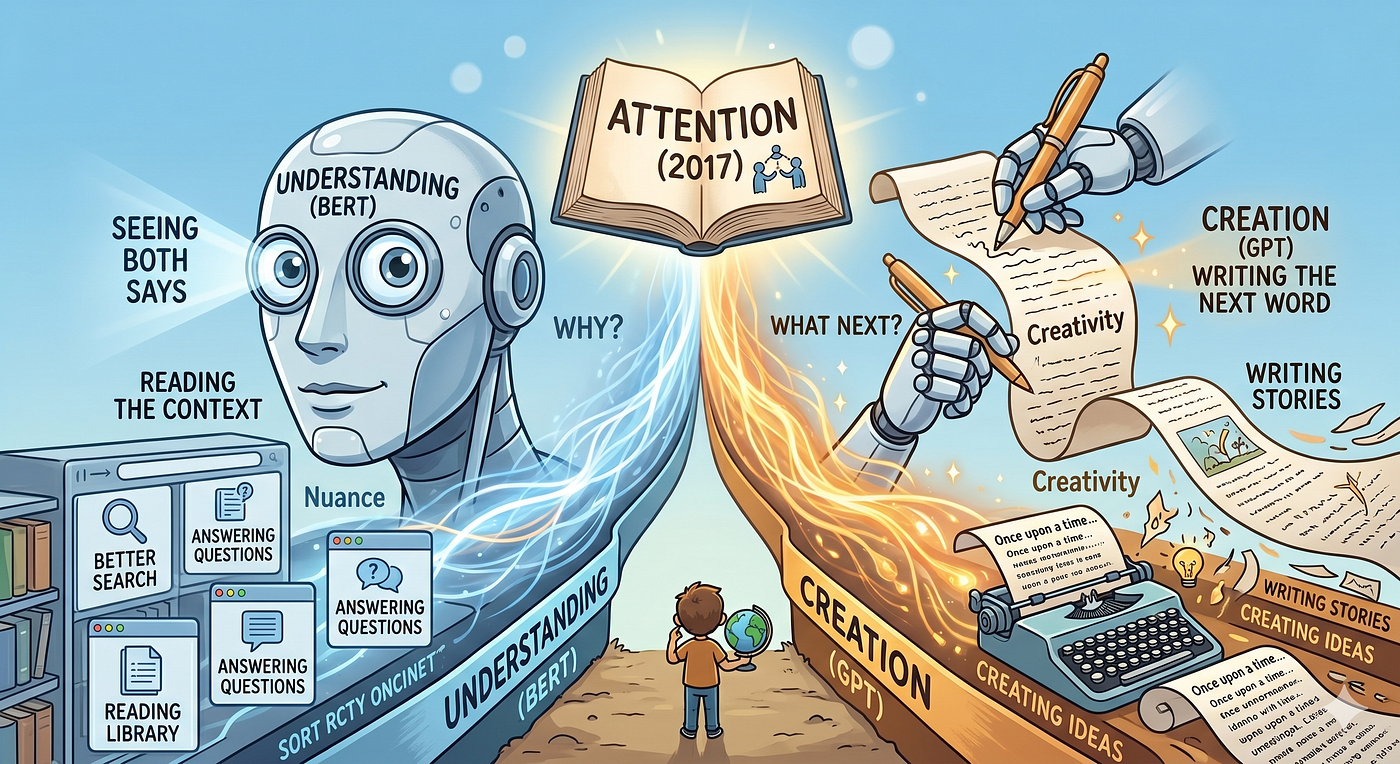
Two Roads, One Destination
Why This Mattered
This period was a massive proof-of-concept. BERT showed us that the Transformer could revolutionize how we find information (Search), while GPT showed us that it could revolutionize how we create it (Content).
We weren’t just building better software anymore; we were building a new kind of “digital intuition.” We had moved from computers that could sort data to computers that could interpret and mimic it.
Two Roads, One Destination
BERT proved Transformers could make search truly intelligent. GPT proved they could mimic human creativity.
메타데이터
- post_id
- bdc1e1bc54ca
- slug
- what-transformers-actually-transformed-bdc1e1bc54ca
- url
- https://medium.com/@ganeshpss/what-transformers-actually-transformed-bdc1e1bc54ca
- canonical_url
- https://medium.com/@ganeshpss/what-transformers-actually-transformed-bdc1e1bc54ca
- author_url
- https://medium.com/@ganeshpss
- status
- ok
- fetched_at
- 2026-06-09 15:37:30




