Using LLM-as-a-Judge for AI Systems Evaluation
The Hardest Part of Building AI Systems Isn’t Generation. It’s Evaluation!
Using LLM-as-a-Judge for AI Systems Evaluation
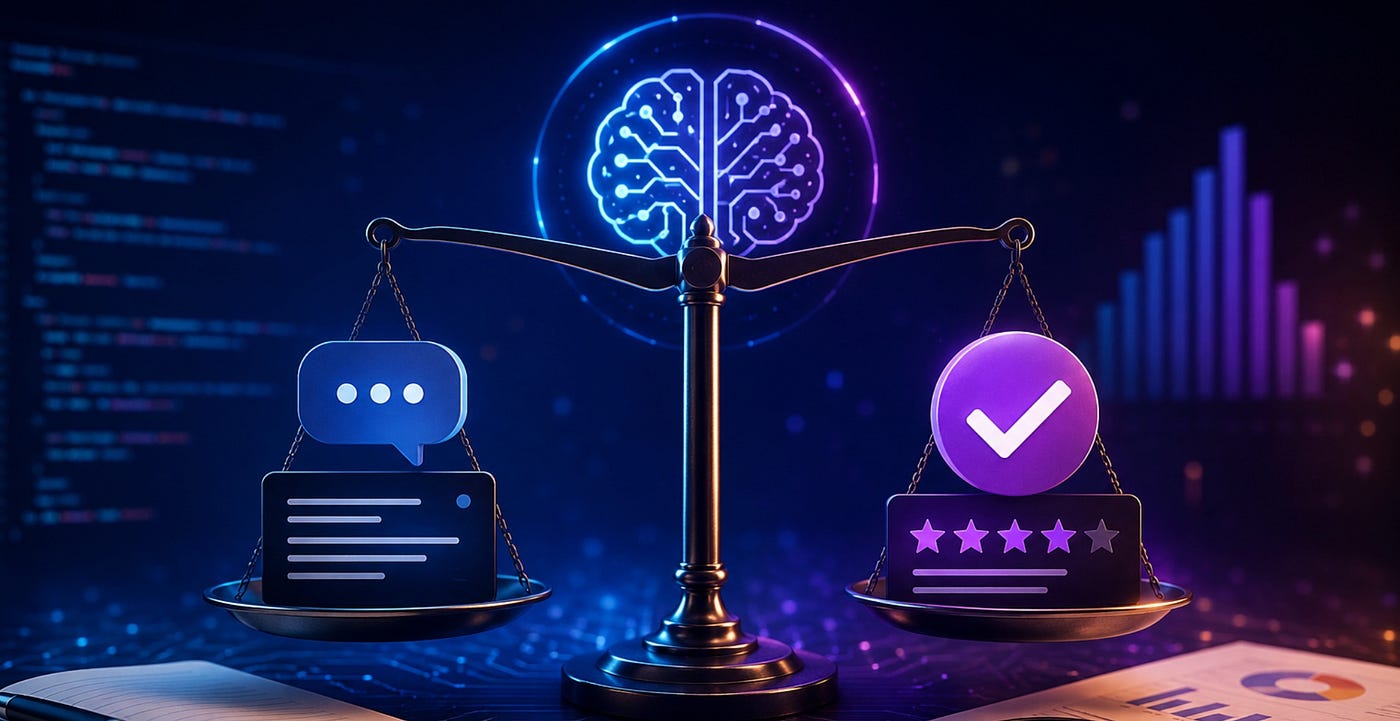
The Hardest Part of Building AI Systems Isn’t Generation. It’s Evaluation!
As engineers, we’re trained to measure what matters. We track latency, monitor error rates, define SLAs, and build dashboards because we know that intuition alone isn’t enough. If a system changes, we want evidence that it actually improved.
Oddly enough, that discipline often disappears when it comes to AI systems.
A prompt gets updated. A retrieval strategy changes. Someone switches to a new model. A handful of examples are reviewed, and eventually someone says, “I think the new version is better.”
The change ships.
That approach might be acceptable during experimentation. But once an AI-powered feature reaches production, it raises an uncomfortable question: How do we know our system is actually improving?
The Problem With Human-Only Evaluation
Human judgment is invaluable, but it doesn’t scale.
If your customer support assistant generates thousands of responses every day, manually reviewing every output becomes impossible. Even when teams review samples, consistency becomes a challenge. Different reviewers prioritize different aspects of quality, and the same person may apply different standards depending on context, fatigue, or time pressure.
Without a structured evaluation process, teams often struggle to answer questions that should be straightforward:
- Did the new prompt improve response quality?
- Is the retrieval pipeline helping or hurting?
- Which model performs best for our use case?
- Did this release introduce regressions?
- What does “good” actually mean for this application?
These are engineering questions. Yet they’re often answered with anecdotal observations.
A Practical Framework I Found Helpful
Recently, I came across a chapter on LLM-as-a-Judge that offered one of the clearest frameworks I’ve seen for addressing this problem.
If you’re a software engineer looking for concrete ways to integrate AI into your daily workflow, I found this book to be one of the more useful resources I’ve come across recently:
What I appreciated about the chapter is that it reframed evaluation as an engineering workflow rather than an afterthought.
Turning Evaluation Into a System
Instead of asking whether an output simply “looks good,” the process starts by defining explicit evaluation criteria.
Depending on the application, those criteria might include factual correctness, completeness, relevance, adherence to instructions, tone, or safety. An LLM can then be used to apply those criteria consistently across large sets of examples.
Humans still define what quality means. Humans still audit the results, review edge cases, and refine the evaluation rubric. But the repetitive process of applying the same standards across hundreds or thousands of outputs no longer has to be done entirely by hand.
The result isn’t perfect objectivity. Evaluation never is.
But it is significantly more rigorous than relying solely on intuition.
From Opinions to Metrics
The broader lesson extends beyond AI evaluation.
As engineers, we naturally gravitate toward systems that are observable and measurable. We don’t deploy backend services and simply ask whether they “feel faster.” We collect metrics, monitor regressions, and compare performance against predefined goals.
AI systems deserve the same discipline.
Once an application moves beyond the prototype stage, evaluation becomes infrastructure. Without it, improvement is difficult to measure and regressions are easy to miss.
The Next Phase of AI Engineering
For all the attention we give to generating better outputs, we spend surprisingly little time thinking about how to judge them systematically.
Perhaps that’s the next phase of AI engineering maturity: moving from asking, “Can we build this?” to asking, “How do we know it’s actually getting better?”
The teams that answer that question well won’t just build more AI features.
They’ll build better systems.
메타데이터
- post_id
- bdc67d4256ce
- slug
- using-llm-as-a-judge-for-ai-systems-evaluation-bdc67d4256ce
- url
- https://medium.com/@alan_hsu_swe/using-llm-as-a-judge-for-ai-systems-evaluation-bdc67d4256ce
- canonical_url
- https://medium.com/@alan_hsu_swe/using-llm-as-a-judge-for-ai-systems-evaluation-bdc67d4256ce
- author_url
- https://medium.com/@alan_hsu_swe
- status
- ok
- fetched_at
- 2026-07-10 03:02:36





