Why Enterprise VR Failed: Episode 2 - Strapped In and Let Down
(Link to audio version of this essay)
Why Enterprise VR Failed: Episode 2 - Strapped In and Let Down
(Link to audio version of this essay)
How the Enterprise VR Got Duped by Consumer Tech

“Episode 2: Cover of American Gothic VR Experience” © 2025 Rocinante Research, AI Generated
Once upon a time — okay, about five years ago — enterprise VR was on the verge of something big. Consultants and gamers alike were gushing over the potential of virtual reality in the workplace, promising a revolution in training, collaboration, and simulation.
Episode 1 “Overpromising and underdelivering” focused on the most common claims to determine if the Enterprise bought a first-class ticket on the hype train — or if they got their money’s worth. That episode concluded there was a real case for using VR in the enterprise. But something must be wrong as we continue to ask: If Enterprise VR was so successful, why isn’t everyone rockin’ a VR headset right now?
“Hey — who says it failed? a few readers quipped. “We are going strong.” And I too embrace their enthusiasm. However…
Our position is that VR in the enterprise didn’t just fail to live up to the hype, it face-planted into a pile of unmet expectations. Despite soaking up years of breathless headlines and TED Talk-level optimism, from 2016–2023 Enterprise VR had a promising start but quickly fell out of favor due to perfect storm of issues and false hopes.
So, what happened? Why didn’t VR revolutionize the workplace like we were promised? And more importantly — who (or what) do we get to blame?
Episode 2 of our series takes us on a stroll through memory lane of the hardware manufacturers. It’s always good to remind ourselves of the culprits, catastrophes, and corporate chaos that turned “the future of work” into a graveyard for Metaverse experts, VR developers, and immersive design enthusiasts.
Episode 2’s story is organized into 4 scenes:
- Scene 1: The Tethered World
- Scene 2: The Oculus Era
- Scene 3: How the Competition Failed to Fill the Void
- Scene 4: The Meta Era (Error)
1. The Tethered World
Flashback to the early VR days when headsets like the Oculus Rift, HTC VIVE Pro, Valve Index, Pimax, HP Reverb, and the Ferrari of headsets — the VARJO — were all tethered to beefy gaming PCs that made more noise than an F4 launching off an aircraft carrier. You needed up to seven cables to make the magic happen, a 12’x12’ immersive play area, two sensors (lighthouses) on 6’ 6” poles on opposite corners, and for those not technically inclined, it was like assembling IKEA furniture blindfolded.
“Cutoff at the knees” © 2025 Rocinante Research, AI Generated
Operating them? Even worse. Unless you had a support team with PhDs in “PC Gaming Rig tuning” good luck getting through an immersion session without dropping frames, crashing, or getting stuck on a driver update.
Oh, and the price? A casual $5,000 per system (headset and PC) — and that was for a mid-range setup. The elite rigs? Try upwards of $15,000. Multiply that by a few dozen employees, and suddenly, your “cutting-edge training initiative” had the budget of a small country’s GDP.
When it worked, it was amazing. But the moment you tried to scale it across the enterprise — it quickly became obvious that tethered solutions just weren’t scalable.
If you were an enterprise, you had two choices:
- Spend a fortune for an overly complicated, wired experience and figure out ways to hide the cost of keeping it running from your boss.
- Ignore VR altogether and pretend e-learns were still innovative.
Clearly, something had to change.
2. The Oculus Era
Enter 2018: Oculus (owned by Facebook) launched the Oculus Go, a standalone VR headset — with built-in processing power and no wires — for just $199. Around the same time, Pico (a lesser-known but major player in Asia and Europe) released the Pico G2. Both were 3DOF headsets — meaning users could look around but couldn’t physically move through space like in a full 6DOF VR experience. These headsets were standalone, wireless, and no longer required tethering to a gaming PC.
Sure, they weren’t as powerful as their tethered 6DOF cousins, but they were cheap and easy to deploy. And if there’s one thing enterprises love, it’s cheap and easy.
Suddenly, businesses could afford to implement VR. Walmart jumped in and purchased 17,000 Oculus Go headsets for customer service training, training over a million employees in VR. Companies like Uptale built no-code platforms so businesses could create VR experiences without hiring an army of gaming developers, script writers, and graphic artists.
Then, in May 2019, the Oculus Quest arrived and blew the doors off the industry. It was a wireless 6DOF headset with 2 motion controllers, not quite as good as a tethered headset, but way better than the wireless 3DOF headsets and just good enough not to suck. No external sensors to setup. Just clear a space, put it on and go. Oh, and at $399/$499, it was one-tenth the cost of traditional tethered VR setup.
In October 2020, the Quest 2 dropped — lighter, faster, with better visuals, longer battery life, and improved performance. By the beginning of 2023, over 20 million Quest VR headsets had been sold globally. It is not confirmed how many were purchased for the enterprise, but even at 2% (a realistic number I just pulled out of my… pocket), that’s still 400,000 headsets.
It was all coming together.
“One Happy ThrillSeeker” © 2025 Rocinante Research, AI Generated
Facebook’s half-baked fix called “Oculus for Business”
Suddenly, enterprises weren’t just interested in VR — they were drooling over it, buying thousands of these standalone headsets.
By this point, enterprises were stuffing Oculus Quests into their training programs like sugar crazed kids grabbing candy on Halloween. More than 400,000 Quest 1’s were sold by the end of 2019 (or an estimated (but not confirmed) 8,000 units were purchased by the enterprise). These were consumer devices trying to get on the corporate network — and IT was losing its mind.
There was one tiny problem: these were consumer devices. The forked Android OS running the Quest was a security nightmare for the enterprise. No enterprise security, no remote management, no proper data protection. Just a fancy Android device that IT departments hated with the fiery passion only geeks could get excited about.
Did that stop companies from using them? No.
Did IT approve? Also no.
So, to address the challenge of using wireless VR headsets in the Enterprise,
in April 2019, Facebook launched Oculus for Business (OfB), a portal solution to manage Oculus enterprise VR headsets built on top of the Facebook Workplace platform. Workplace was nothing more than the Facebook platform, but for the enterprise. It was separate from the consumer Facebook application stack, it was a SaaS solution, and you received it for “free” when you purchased a OfB Quest headset.
At $999 per headset, you received:
- A Quest 1 with 128GB of memory
- A commercial-use license (if you wrote your own software to run on the Quest, you would not have to pay Facebook a license fee).
- A 1-year warranty (with an optional extension)
- A “dedicated” enterprise support line (which was just the consumer support system repurposed because the OfB group hadn’t thought about providing enterprise support until 2-weeks prior to launching of OfB).
- An account for Workplace to manage the headset(s).
These headsets could only be purchased directly from Oculus; your order had to be sent to Oculus (Facebook) to be approved and prepaid before one of two companies fulfilled the order. If you already had a consumer Quest VR headsets, you could not convert it for enterprise use. Consumer Quests could not be managed by OfB.
Sounds great, right? Nope.
From a hardware perspective, these headsets were nothing more than a consumer Quest that you could buy at Best Buy.
To be fair, it was a Quest 1 with a forked version of the Android OS build used in the consumer device, but the fork was significantly slimmed down (i.e. with a lot of functionality removed) and it had with a different UI (rumored to be programmed by none other than John Carmack). It was referred to as “the enterprise build,” and most importantly, it did have a different sticker on the box. If you put a consumer Quest next to an Enterprise Quest — you could not tell the difference.
Given that there was an enterprise class version of Android available at the time, Facebook could have just used that as the base OS and forked that to work with the Enterprise Quest — but they decided it was easier to just fork their existing consumer build. A fork of a consumer build — but for the enterprise. Hmmm… what could go wrong?
When you needed support for your Enterprise Quests or OfB — you called the “dedicated” phone number that just went to consumer support. Once received, they would tell you to “log on to your Workplace account and put your request through the Workplace form system and someone for OfB would contact you via your Workplace account (you never really got to voice with anyone). If your headset needed repair, Oculus couldn’t just cross ship you a new unit. They had to receive your unit, fix it, and then return it. Average turn around was approximately 40 days.
A best practice for enterprises was to buy 10–20% more headsets than needed so you always had a spare just in case something went wrong. This really wasn’t an issue if all of your headsets were in a single location — but… if you deployed headsets to different offices around the country, it was necessary to always have 1–2 spares in every location.
And believe it or not, it kinda worked. OfB allowed companies to provision and manage headsets centrally. But when you employ experienced consumer product managers and ask them to build enterprise solutions that have never built enterprise solutions — you get some… ummm… issues.
Here’s a sampling of some of those issues:
- When launched, Quest headsets and OfB did not support common enterprise class Mobile Device Management (MDM) or Enterprise Mobility Management (EMM) solutions like Airwatch (Omnissa WorkspaceONE UEM (obviously named by someone in KKR engineering), MobileIron (Ivanti), or inTune (Microsoft Endpoint Manager) making it impossible to enforce security policies, monitor usage, or apply updates systematically. Sure… IT was promised this integration, but it took several years before something shipped (and the licensing fees were 20 times that of mobile devices — so IT had to look elsewhere for solutions).
- Workplace, the SaaS solution required to run OfB, ran inside of the Facebook cloud. There was no ability to host it in an enterprise’s own data center or move it to any of the large data center providers such as AWS, Microsoft, or GCP.
- OfB did not support proxy authentication, enterprise-grade VPNs, or advanced firewall configurations, making it difficult to enforce zero-trust network policies.
- There was no support for enterprise authentication protocols like LDAP, SAML, or Active Directory integration. There was no user authentication — the headset was authorized by Workplace, which did not meet corporate security standards as they would require the hardware AND the USER to be authenticated.
- OfB did not provide robust encryption for stored data. If a device is lost or stolen, sensitive corporate data could be extracted.
- The OfB program lacked security patching guarantees. IOW, Oculus controlled software updates, and businesses cannot delay or test patches before deployment. This increases the risk of zero-day vulnerabilities affecting critical operations.
- There was no multi-tenant or Role-Based Access Control (RBAC) — so there was no ability to support multi-user enterprise environments.
- Oculus made it impossible to segregate access to corporate applications and data.
It was obvious; the product management team that was driving design decisions for OfB had NO enterprise experience as a majority of the issues highlighted above are non-starters.
Despite these issues, enterprises still tried to make it work. Some, like several of the organizations I supported, wanted to roll out thousands of Quests — if only they could get them past IT security audits.
Spoiler: they couldn’t.
“Blocked by Security” © 2025 Rocinante Research, AI Generated
Let’s quickly summarize with what happened at a lot of companies that were deploying VR for training:
- Enterprise L&D had identified a way to get more effective training that would improve quality, reduce costs, and make employees want to train more.
- Oculus sold you a $500 headset for $1000 and gave you a way to manage it.
- As you worked through contracting and licensing to secure your purchase, you also begin developing training courses for your employees, spending hundreds of thousands of dollars (turning into millions over the next few years).
- You were ramping up a staff to purchase and manage hundreds if not thousands of these headsets (or already HAD) or were talking to IT to manage them for you, only to discover that IT could not get them to pass a security audit.
- If these headsets could not pass the audit, there was no way these headsets could get on the network behind the firewall, i.e. no connection to your Learning Management System (LMS), no collaboration sessions, no ability to use these for company specific trainings.
- You slowly concluded that OfB was little more than a rebranded consumer Quest, and at twice the price without the ability to load cool applications on it like “Beat Saber”.
- For 2-years you fought the fight, putting your reputation on the line, figuring ways to get around the audit (offline training, wireless DMZ anyone?) and then…
October 2021 Oculus killed, I mean retired, Oculus for Business during their Facebook Connect 2021 conference. Enterprises were stuck with whatever they bought. They were not even allowed to donate your headset or give them away — no tax offset for you! As a consolidation prize you could upgrade to its replacement — Quest for Business (QfB) that would be available in a few months.
FACT CHECK: QfB was released November 2023 — almost two years after the announcement that OfB would be shut down.
Why did Facebook kill OfB? No one really knows, but the spin from Facebook’s PR was nothing but corporate gobbledygook. VR investments in some enterprises exceeded $10M+ (hardware and software). These enterprise’s had thousands of Quests in circulation with zero proper management tools. And Facebook’s answer left many organizations high and dry.
Sadly, this is not unusual behavior from the tech industry. Below is a sampling of similar situations:
- Google Glass Enterprise Edition: Google rebooted Glass as a business product after the consumer failure. They charged a hefty premium (~$999+ per unit), pushed businesses to invest in integration, and then quietly killed the project in 2023. Companies who invested in hardware, software, and training were left with glorified paperweights.
- Microsoft Cortana for Enterprise: Microsoft promoted Cortana integration with enterprise Microsoft 365 solutions, encouraging businesses to embed it in workflows. After pushing the AI assistant as a “productivity booster,” they deprecated it with almost no notice, shifting focus to other AI tools. Enterprises that built it into operations had to scramble to fill the void.
- Amazon Dash Buttons for Business: Amazon pitched Dash Buttons as a way for businesses to streamline supply restocking. Bulk purchases were encouraged. Amazon discontinued support, rendering the devices useless overnight. No software updates, no refunds, and no real alternative. Companies that integrated them into internal ops? Tough luck.
- Cisco Flip Video for Education: Cisco bought Flip Video for $590 million and marketed it hard to educators and businesses, encouraging large-scale adoption. Less than two years later, Cisco shut it all down, even though many schools had invested in entire video programs around it. No support, no trade-in, just dead hardware.
- How the Competition Failed to Fill the Void
With Facebook abandoning ship, you’d think HTC or Pico would step in and save the enterprise market. HP and Lenovo also were baking new products in the oven — maybe not as innovative as Oculus — but the solutions were starting to come from companies with enterprise experience.
**HTC’s VIVE Focus 3, released in June of 2021, was supposed to be the ultimate enterprise headset. It had better specs than the Quest 2 — but somehow, it ran slower.**
“A Fortune 500 company hired us to build six VR job-skill simulations on Quest 2, training technicians to repair data center server farms. Two weeks before launch, they pivoted to from Quests 2’s to the HTC VIVE Focus 3, forcing a four-week code conversion and two months of performance tuning (that we ate because we didn’t want to piss off a major client). Despite the Focus 3 being theoretically 20% faster, it was 30% slower due to poor OS optimization. To add insult to injury, the VIVE Business software bricked 10% of headsets during provisioning, and when they finally worked out the kinks, users struggled with the headset’s awkward strap design. Security was a big issue, and IT wouldn’t approve the HMDs to be on the network so it was necessary to side load the courseware and then turn Wi-Fi off — negating the need for management software. While the training received great reviews, the initiative was ultimately scrapped as executives had moved on to the next shiny object. — Lead Developer of a Fortune 500 Enterprise VR initiative (name and company omitted to save their job).
In Asia and Europe, Pico became the VR headset of choice — not because it offered a stellar user experience (spoiler: it didn’t), but simply because it wasn’t Facebook. Remember, the Quest wasn’t exactly a globetrotter — Facebook only bothered launching it in a handful of countries. And let’s be honest, trusting Facebook with enterprise privacy is like hiring a raccoon to guard your lunch. So, by process of elimination, Pico it was. Sure, the UX was mediocre at best, but at least you could duct-tape on some mobile device management with tools like ArborXR, ManageXR, or 42Gears. Outside the U.S., Picos were everywhere. Inside the U.S.? About as common as a fax machine repairman.
Meanwhile, Lenovo had been quietly building a game-changing VR management platform from the ground up. It was true enterprise-class management software, running on an enterprise Android OS, installed on a white labeled Pico Neo 3. Lenovo software, Lenovo firmware, Pico hardware — it was all coming together. Everything was ready, and Lenovo was putting the final touches on the launch. Then, 90 days before the big debut, ByteDance (yes, the TikTok overlords) swooped in and bought Pico in August 2021.
HP was working on something very similar to Lenovo, and unfortunately, the ByteDance acquisition derailed their efforts too. Lenovo and HP — two companies poised to push enterprise VR forward — ended up canceling their programs and exiting the enterprise VR space shortly after ByteDance took over Pico.
Enterprise VR teams were officially screwed. OfB was shut down. Lenovo and HP shut down. The only real game left was HTC, Pico, and the tethered players, but they were not really equipped to support the enterprise.
And it was going to get even messier.
4. The Meta Era (Error)
On October 21, 2021, at Connect 2021, the tech world braced for a massive Facebook announcement. Was it the grand reveal of the “Presence Platform”, or improved hand tracking? Was it Horizon Home or the new Voice SDK? Was it the under-the-breath blog post announcing the cancellation of Quest for Business? You are getting warmer.
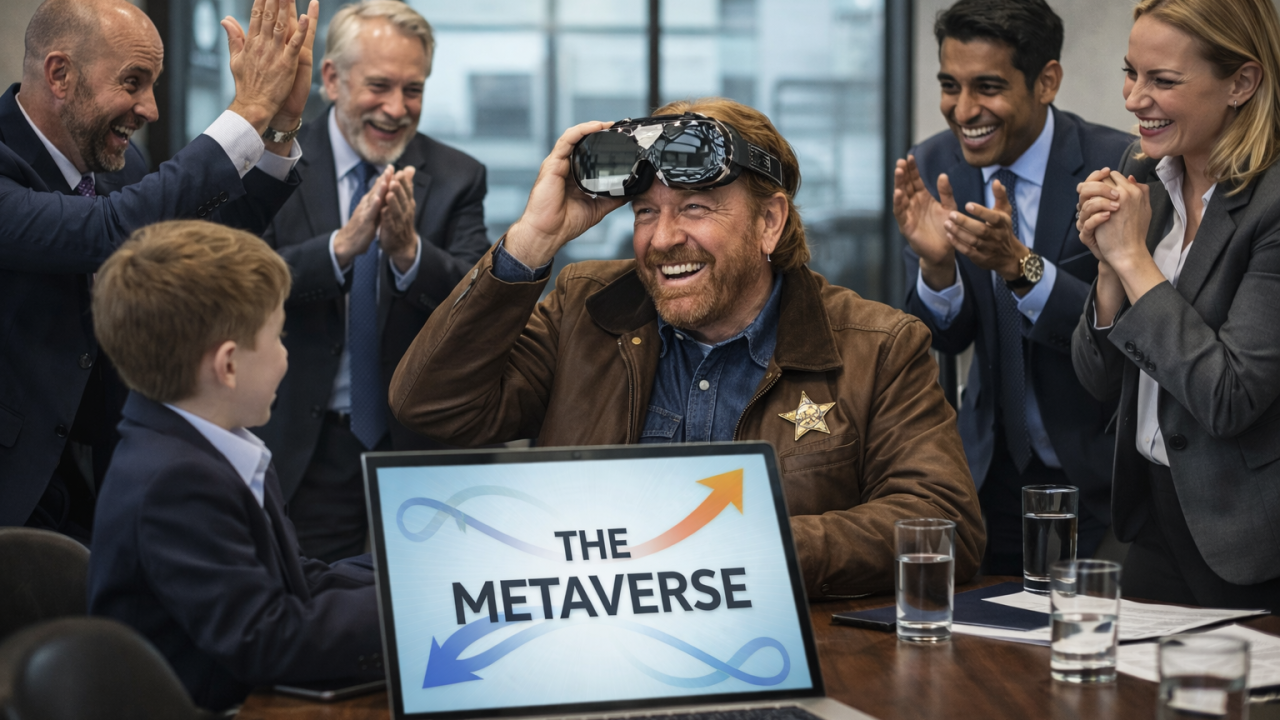
No, the real big-brain play was Facebook (and Oculus) hitting the corporate rebrand button and emerging as Meta. “Meta” was short for “The Metaverse”, as Zuck laid out “his vision of the metaverse as the successor to the mobile internet — The metaverse [according to Meta] is set of interconnected digital spaces that lets you do things you can’t do in the physical world.”
Meta’s metaverse was the future of social engagement and work in the virtual world — because when you’ve got a reputation for data mining, misinformation, and making all your money on advertising, the best way to change the narrative are distractions. Zuck had hijacked the term “metaverse” and set his PR hype cycle machine to “nuclear.”
For businesses that gave a damn about VR — the cancelling of Oculus for Business wasn’t just a slap in the face — it was a full-on, steel-toed kick to the digital groin. It was like watching someone set fire to your house and then offer you a VR headset to “reimagine it” in the metaverse.
How could anyone rationalize Meta stating that the metaverse was the future of work when no enterprise could get their VR headsets behind the firewall?
And just like that, businesses banking on VR were left with the metaphorical stability of a Jenga tower in an earthquake. Meanwhile, Zuck and friends were too busy trying to sell us on legless avatars in virtual boardrooms, as if anyone, anywhere, had ever said, “You know what would make meetings less awful? Cartoon characterized avatars floating in space!”
When the Meta Quest Pro was released at Connect 2022 (October 2022). Zuckerburg announced a partnership with Microsoft and Accenture to connect Intune (Microsoft MDM Software) to Quest VR headsets, enabling Microsoft Teams, providing Office integration, and user management to support enterprise device management.
So, at Connect 2022, Zuck, Microsoft’s Satya Nadella, and Accenture’s Julie Sweet, held hands and sang kumbaya letting everyone know that they had an enterprise solution. Adding InTune to Quest headsets was a big deal!
And for the next year… all you could hear was crickets. Nothing happened. In fact, nothing happened for another 18 months.
For many of the enterprises hanging on a pivot to one of the third-party management platforms like ArborXR, or ManageXR was necessary as these solutions were great at managing heterogenous groups of headsets. But the fact remained, the headsets themselves were still insecure.
To help put things in perspective, see the timeline below.
WIRELESS HMD TIMELINE ©2025 Rocinante Research
Conclusion
Enterprise VR wasn’t actually dead; it was just mostly comatose. The demand for immersive training, collaboration, and simulation is real, but without actual enterprise-grade hardware (you know, with security, IT management, and basic respect for firewalls), businesses are stuck in VR purgatory. Meta keeps pushing its metaverse fantasy, but no one’s buying if the headsets aren’t secure. Meanwhile, HTC and Pico keep tripping over themselves, leaving no real wireless headset savior in sight.
By the beginning of 2022, the enterprise VR landscape looked like this:
- Oculus for Business was dead. Meta had announced Quest for Business was in development and would be available for enterprises “soon.”
- HTC fumbled their shot at dominance.
- Lenovo and HP walked away from the enterprise VR market (for now)
- Pico was now owned by ByteDance.
- Facebook and Oculus had been rebranded Meta.
- Meta promoted the Metaverse as if it was the Segway, 3D TVs, the Fyre Festival, and Google Glass all wrapped up into a single disaster waiting to happen.
What started as a revolution in training and collaboration quickly became an exercise in frustration. Companies poured millions into VR, only to get half-baked enterprise solutions riddled with security flaws, useless management tools, and zero IT compliance.
Meta’s abrupt shutdown of Oculus for Business may have been the final nail in the coffin, stranding enterprises with headsets that didn’t meet corporate standards or identified as a solution with no roadmaps.
Today, companies must choose between duct-taping consumer headsets into workflows or finding creative ways to deploy VR without IT’s blessing. Until enterprise VR gets real support, it’s like betting on a horse that’s already been turned into glue.
So yeah, RIP Enterprise wireless headsets. Meta, HTC, and Pico, didn’t just drop the ball; they deflated it, set it on fire, and then tried to sell us an NFT of the ashes.
But there’s more — it wasn’t just the hardware manufacturers who let us down. Up next in Episode 3: Software Woes, we dive into the next mess, starting with what our developers kept oversharing: “Development tools? What development tools?”
Published April 22, 2025
If you liked this article, smash that share button like your hand hitting the wall while playing Gorilla Tag. Got thoughts? Drop them in the comments — I welcome applause, angry rants, and Interpretive emoji poetry. If you hated it, just scream “What is the Metaverse?” into your next VRChat session and remember: it could be worse… you could still be stuck updating firmware on 54 unsupervised headsets.
About the Author
Daniel Eckert retired from 29-years of consulting in late 2023 after spending 8-years on the front lines of Enterprise VR, preventing big companies from overhyping, under-investing, or half-baking VR solutions. He also co-authored the landmark paper The Effectiveness of Virtual Reality Soft Skills Training in the Enterprise — a paper cited 2.53x more than any inspirational LinkedIn post featuring a stock photo of a mountain and the words “Leadership is a journey.” Daniel now spends his semi-retirement as a Principal at Rocinante Research. (Yes, the name is a Don Quixote reference. Yes, it’s ironic). Check out some of his other articles on Medium.
Articles in the “WHY ENTERPRISE VR FAILED” series:
- Why Enterprise VR Failed — The Prologue (Published April 1, 2025)
- Episode 1 — Overpromising and underdelivering? The Benefits of Enterprise VR. (Published April 8, 2025)
- Episode 2: Strapped-in and Let Down: How Enterprise VR Got Duped by Consumer Tech (April 22, 2025)
- Episode 3: Enterprise VR Development Tools? What Development Tools?(May 8, 2025)
- Episode 4: The IT Problem, or How the middle finger can be used as a pointing device (Q2 2025)
- Episode 5: Corporate Learning and Development: Where good ideas and dreams go to die. (Q2 2025)
- Episode 6: User Experience: “You want me to wear this clunky thing on my head for HOW long?” (Q3 2025)
- Episode 7: VR/Spatial Consultancies: The rise and fall of the Metaverse Industrial Complex (Q3 2025)
- Why Enterprise VR Failed — The Epilogue, or WTF can I do now to turn this all around? (Q3 2025)
메타데이터
- post_id
- bdc7a42e349d
- slug
- episode-2-strapped-in-and-let-down-bdc7a42e349d
- url
- https://medium.com/emergingtech/episode-2-strapped-in-and-let-down-bdc7a42e349d
- canonical_url
- https://medium.com/emergingtech/episode-2-strapped-in-and-let-down-bdc7a42e349d
- author_url
- https://medium.com/@deckert
- status
- ok
- fetched_at
- 2026-06-11 16:11:38