How Coding Can Help Kids Learn Science and Engineering
In today’s digital age, coding has become an increasingly important skill for children to learn. Beyond its practical applications in…
How Coding Can Help Kids Learn Science and Engineering
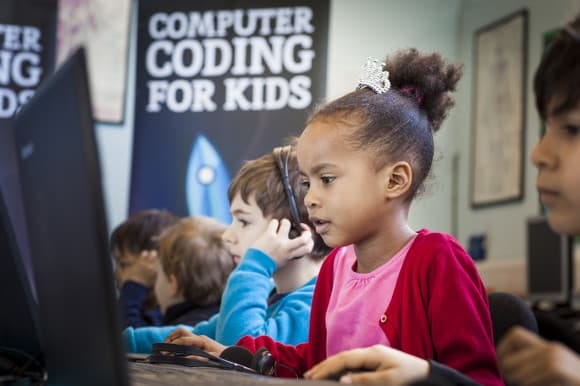
In today’s digital age, coding has become an increasingly important skill for children to learn. Beyond its practical applications in technology, coding can also serve as a powerful tool for fostering scientific and engineering knowledge. By engaging in coding activities, kids can develop critical thinking, problem-solving, and analytical skills while exploring the realms of science and engineering. In this blog, we will explore how coding can help kids learn science and engineering concepts in a fun and interactive manner.
1. Encouraging Computational Thinking
Computational thinking is a fundamental skill in both science and engineering. Coding activities promote computational thinking by breaking down complex problems into smaller, more manageable steps. Through coding, kids learn to analyze problems, devise logical solutions, and translate their ideas into structured code. This process of decomposition and abstraction enhances their ability to approach scientific and engineering challenges systematically, fostering a strong foundation in problem-solving.
2. Exploring Scientific Concepts Through Simulations
Coding provides a unique opportunity for kids to experiment and explore scientific concepts through simulations. By writing code, they can create virtual environments and models that replicate real-world phenomena. For example, they can simulate the behavior of molecules in a chemistry experiment, model the movement of celestial bodies in astronomy, or recreate the effects of gravity in physics. Such hands-on experiences enable kids to visualize and interact with scientific principles, deepening their understanding of fundamental concepts.
3. Building Engineering Projects
Coding is closely intertwined with engineering principles, making it an ideal medium for kids to engage in engineering projects. Through coding platforms, kids can design and build various projects, such as building robots, constructing simple circuits, or creating automated systems. By integrating coding into engineering projects, kids learn to apply scientific knowledge in practical ways, honing their skills in designing, prototyping, and problem-solving. They gain firsthand experience in how science and engineering intersect to bring ideas to life.
4. Collaboration and Iteration
Coding encourages collaboration and iteration, essential aspects of both science and engineering. Kids can work together on coding projects, sharing ideas, and pooling their knowledge. They learn the importance of clear communication, teamwork, and the ability to adapt and refine their code based on feedback. This collaborative process mirrors the iterative nature of scientific experiments and the design cycle in engineering. By engaging in coding activities, kids develop skills that are critical for scientific research and engineering projects.
5. Integrating Data Analysis and Visualization
In both science and engineering, data analysis and visualization are vital for understanding complex systems and drawing meaningful conclusions. Coding equips kids with the tools to process, analyze, and visualize data sets. They can write code to collect data, apply statistical analysis, and create visual representations such as graphs and charts. By exploring real-world data through coding, kids gain insights into scientific phenomena and engineering processes, enhancing their ability to make informed decisions based on evidence.
6. Enhancing Creativity and Innovation
Coding nurtures creativity and innovation, key attributes in science and engineering. By coding, kids can transform their ideas into reality, exploring new solutions and pushing boundaries. Through trial and error, they can experiment with different algorithms, functions, and design choices, fostering a creative problem-solving mindset. Coding empowers kids to think critically, inventively, and adaptively, preparing them for the ever-evolving challenges of scientific discovery and engineering advancements.
7. Career Exploration and Future Readiness
Introducing children to coding at a young age offers them a gateway to explore the vast world of science and engineering careers. Through engaging in coding activities, they gain valuable insights into the endless possibilities and diverse pathways that await them in these fields. By nurturing their coding skills, children develop a strong foundation in problem-solving, logical thinking, and creativity, which are essential attributes in the fields of science and engineering.
The exposure to coding at a young age opens children’s minds to the exciting opportunities available to them. They discover that coding is not just about writing lines of code, but a gateway to designing innovative solutions, developing new technologies, and shaping the future. This exposure instills a sense of curiosity and passion for science and engineering, encouraging children to explore STEM (Science, Technology, Engineering, and Mathematics) subjects further and consider career paths they may not have been aware of before.
메타데이터
- post_id
- bdce32bb772a
- slug
- how-coding-can-help-kids-learn-science-and-engineering-bdce32bb772a
- url
- https://medium.com/@selamhabtsh09/how-coding-can-help-kids-learn-science-and-engineering-bdce32bb772a
- canonical_url
- https://medium.com/@selamhabtsh09/how-coding-can-help-kids-learn-science-and-engineering-bdce32bb772a
- author_url
- https://medium.com/@selamhabtsh09
- status
- ok
- fetched_at
- 2026-07-17 06:52:37




