Structural Stability Points: Why We Don’t Find “Half Eyes” in the Cambrian
by Claudio Bresciano
Structural Stability Points: Why We Don’t Find “Half Eyes” in the Cambrian
by Claudio Bresciano
The fossil record has often been described as incomplete. But perhaps incompleteness is not the most interesting question.
A more interesting question is this:
Why do some biological forms persist long enough to leave millions of descendants, while countless intermediate possibilities disappear without a trace?
This question is usually answered through natural selection. That answer is correct — but incomplete.
Selection acts on organisms. Before selection can preserve a form, however, the form must first be structurally stable.
Evolution Does Not Explore Every Possibility
A common misconception imagines evolution as a continuous walk through every imaginable intermediate state.
Reality is different.
Evolution explores variation, but most variations produce structures that are unstable, inefficient, or non-functional. These disappear almost immediately.
Only a tiny subset reaches what we might call structural stability points — configurations capable of maintaining themselves while continuing to evolve.
The history of life is therefore not a smooth continuum.
It is a sequence of stable attractors separated by vast spaces of unsuccessful possibilities.
The Eye Is an Excellent Example
People often ask,
“Where are the fossils showing half an eye?”
The question itself assumes that every intermediate state should have existed long enough to become common and fossilize.
That assumption is doubtful.
The evolution of vision likely proceeded through a series of functional stages:
- light-sensitive cells;
- shallow photoreceptive pits;
- deeper cup-shaped organs;
- pinhole-like structures;
- primitive lenses;
- modern camera-type eyes.
Each stage already performed a useful function.
Between these stages, however, countless microscopic developmental variations probably existed for only a few generations — or perhaps only a single lineage.
Those unstable configurations had almost no chance of becoming abundant enough to leave a fossil record.
The fossil record therefore preserves stable solutions, not every attempted transition.
Structural Attractors
Imagine dropping a marble onto a mountainous landscape.
The marble does not stop everywhere.
It settles only in valleys.
Evolution behaves similarly.
Genetic variation continuously perturbs biological structures.
Development continuously filters those perturbations.
Natural selection favors successful organisms.
But beneath both processes lies another layer:
the geometry of structural possibility itself.
Only certain organizational states possess sufficient internal coherence to persist.
These are structural attractors.
Stability Before Selection
Natural selection explains why one stable organism outcompetes another.
Structural stability explains why many possible organisms never become organisms at all.
This distinction is subtle but important.
Selection is historical.
Structural stability is architectural.
One describes competition.
The other describes possibility.
A Broader Principle
This idea extends beyond biology.
Languages exhibit stable grammars.
Cultures develop stable institutions.
Scientific theories converge toward internally coherent frameworks.
Artificial neural networks form stable internal representations during training.
In every case, innumerable configurations are mathematically possible.
Only a tiny fraction remain dynamically stable.
Perhaps evolution has always been navigating this deeper landscape.
A TNA Perspective
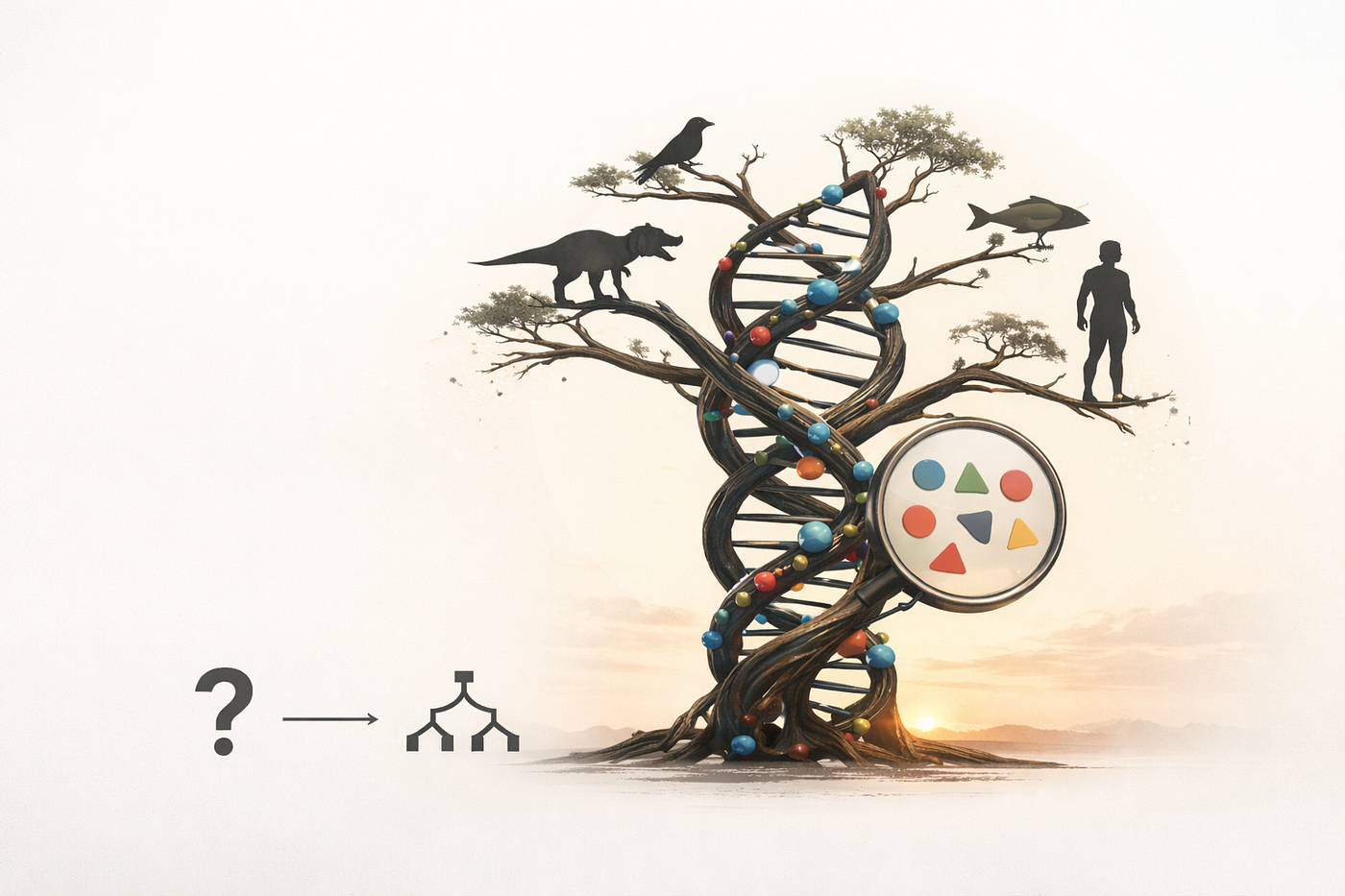
Within the Theory of Axiomatic Necessity (TNA), these stability points can be interpreted as manifestations of deeper structural constraints.
Reality does not merely evolve through random variation filtered by selection.
It evolves through a space where certain organizations possess intrinsic structural necessity.
Selection determines which stable structures survive.
Structure determines which structures can exist long enough to be selected.
Seen this way, Darwin explained the dynamics of adaptation.
Structural theories seek to explain the topology of possibility itself.
The fossil record may therefore be less like a continuous movie and more like a collection of snapshots taken whenever evolution reached another point of structural equilibrium.
Perhaps the real mystery is not why transitional forms are rare.
Perhaps the mystery is why stable structures emerge at all.
메타데이터
- post_id
- bdd43ac7bd50
- slug
- structural-stability-points-why-we-dont-find-half-eyes-in-the-cambrian-bdd43ac7bd50
- url
- https://medium.com/@cbresciano/structural-stability-points-why-we-dont-find-half-eyes-in-the-cambrian-bdd43ac7bd50
- canonical_url
- https://medium.com/@cbresciano/structural-stability-points-why-we-dont-find-half-eyes-in-the-cambrian-bdd43ac7bd50
- author_url
- https://medium.com/@cbresciano
- status
- ok
- fetched_at
- 2026-07-07 09:05:48