Double Standards in Nuclear Governance: Iran, Israel, and the Crisis of Credibility
How uneven rules on sanctions and nuclear weapons are eroding trust in the global non‑proliferation regime
Double Standards in Nuclear Governance: Iran, Israel, and the Crisis of Credibility
How uneven rules on sanctions and nuclear weapons are eroding trust in the global non‑proliferation regime
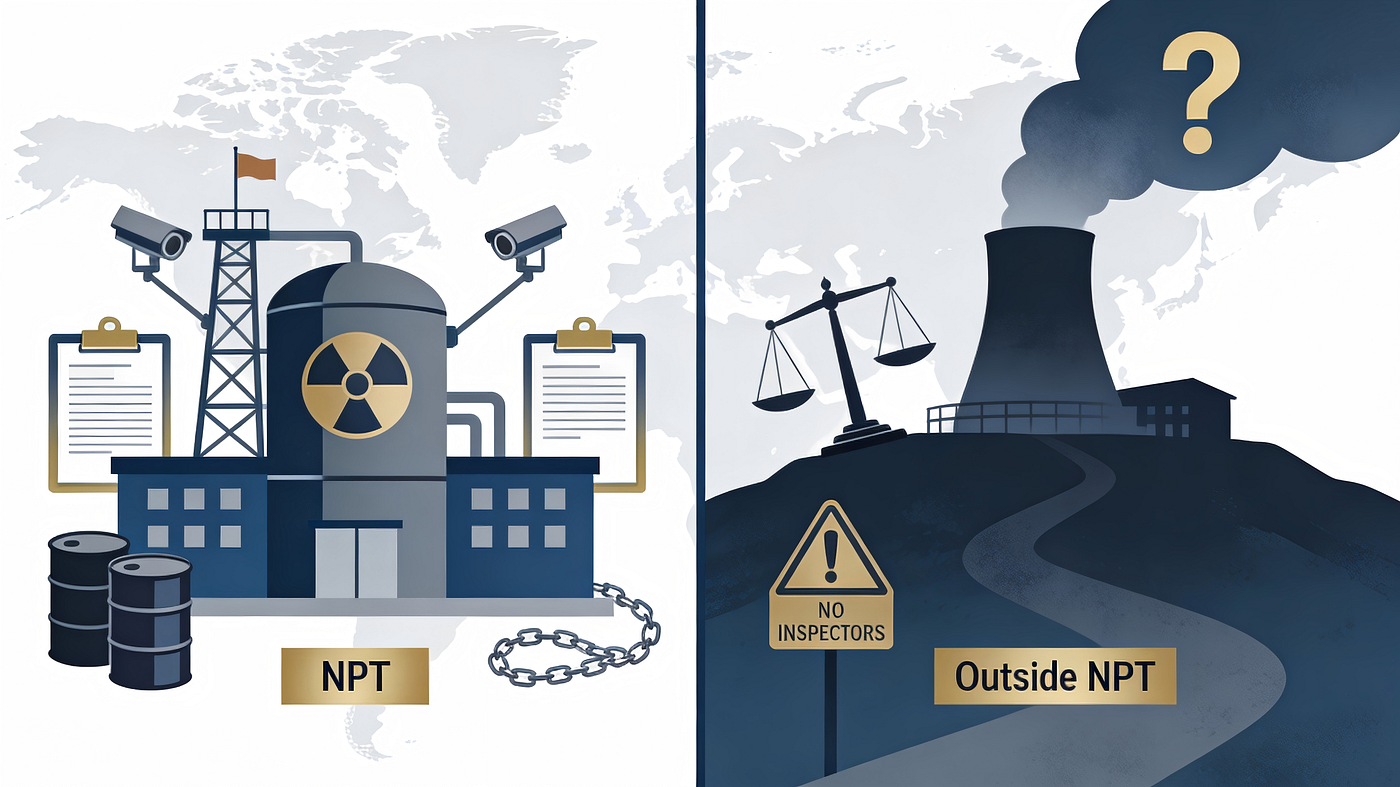
Debates over Iran’s nuclear programme and sanctions policy are often framed as a contest between responsible powers and a reckless state. A closer look at the legal architecture of the nuclear order, and at how it is applied in practice, reveals a more troubling pattern: a system in which similar behaviours are treated very differently depending on who the actor is. This disparity raises serious questions about the legitimacy of sanctions, the credibility of inspections, and the future of global non‑proliferation.
The legal framework: NPT and safeguards
The modern nuclear order centres on the Nuclear Non‑Proliferation Treaty (NPT). It divides the world into two categories: five recognized nuclear‑weapon states, and all other states, which commit not to acquire nuclear weapons. In return, non‑nuclear states are promised access to peaceful nuclear technology and progress toward disarmament by the nuclear‑weapon states.
Verification is entrusted to an international inspectorate that monitors declared nuclear material and facilities to ensure they are not diverted to weapons. States that join the NPT accept legally binding safeguards agreements. In practice, however, the strength of these agreements, and the political consequences of any violation, vary significantly from one country to another.
Iran: inside the regime, under pressure
Iran is a party to the NPT and therefore subject to comprehensive safeguards. For decades, its nuclear programme has been one of the most heavily scrutinized in the world. Inspectors have reported periods of cooperation and transparency, as well as periods of concealment, restricted access, and non‑compliance with some safeguards obligations. These concerns, combined with regional security dynamics, have formed the formal basis for a dense web of sanctions.
What is striking is not that Iran has been asked to account for its activities — that is consistent with the NPT framework — but the scale and duration of the punitive measures that followed. Economic sanctions tied to the nuclear dossier have compounded earlier, broader sanctions, affecting banking, energy exports, and the civilian economy. Over time, this has created the impression that participation in the NPT and acceptance of inspections can expose a state to open‑ended pressure, rather than provide a stable legal framework.
Israel: outside the NPT, beyond comparable scrutiny
Israel occupies a very different position. It has never joined the NPT and maintains a longstanding policy of ambiguity regarding its nuclear capabilities. While it cooperates with international institutions in limited areas, its core nuclear facilities are not subject to the comprehensive safeguards applied in NPT states.
Legally, this posture is possible because Israel remains outside the treaty and has therefore not undertaken the same obligations as Iran. The inspectorate has no equivalent mandate there. Politically, however, this creates a stark asymmetry: a state widely assessed to possess nuclear weapons remains effectively shielded from the intrusive verification and sanctions that NPT members can face. For states that have accepted legal constraints and inspections, this raises a basic question of fairness.
Sanctions, selectivity, and the memory of Iraq
Sanctions are often presented as a lawful, non‑military tool to enforce international norms. Their legitimacy, however, depends on whether they are applied consistently and proportionately. In the Middle East, the record suggests otherwise.
Iraq is central to this history. After the 1991 Gulf War, Baghdad was subjected to an intense regime of disarmament inspections and sweeping economic sanctions. Over time, inspectors reported growing cooperation and, crucially, an absence of active weapons of mass destruction stockpiles. Nonetheless, the 2003 invasion was justified to global audiences largely on the assertion that such weapons existed. None were found.
For many observers, this sequence undermined trust not only in the political decision‑makers who chose war, but also in the entire inspection‑sanctions apparatus that preceded it. When a state is invaded and devastated based on faulty or politicised intelligence, while others enjoy de facto impunity despite serious questions about their arsenals, confidence in the neutrality of enforcement mechanisms inevitably erodes.
Against this backdrop, Iranian skepticism toward international monitoring is not simply paranoia. It reflects a rational concern that technical processes can be subordinated to geopolitical agendas. The lesson drawn in Tehran and in much of the Global South is that “rules‑based” mechanisms are not always applied in a rules‑based way.
The nuclear double standard
The contrast between Iran and Israel highlights a broader structural double standard.
On one side stands a state that is formally non‑nuclear under the NPT, subject to extensive verification, and heavily sanctioned over real and alleged deviations from its obligations. On the other stands a state widely believed to be nuclear‑armed, outside the treaty, and facing no comparable international penalties. At the same time, the only country ever to have used nuclear weapons in war retains a central role in designing and enforcing the rules by which others are judged.
This is not to claim that all actors are morally equivalent, or that concerns about proliferation in Iran are unfounded. Rather, it is to recognize that the current regime distinguishes not only between compliant and non‑compliant behaviour, but also between allies and adversaries. When law and power consistently point in the same direction, many conclude that law is merely an instrument of power. That perception is corrosive for any system that depends on voluntary adherence.
Principles for a fairer regime
If the goal is a credible non‑proliferation system, at least three conditions need to be strengthened.
First, obligations should be applied more universally and transparently. States that possess nuclear weapons outside the NPT should be openly acknowledged as such and brought under some form of meaningful constraint, whether through accession to existing treaties or through new, tailored arrangements. The current combination of opacity and tolerance is difficult to defend.
Second, sanctions should be targeted, time‑bound, and clearly linked to specific, verifiable benchmarks. Measures that disable entire economies for decades, while leaving the policies of more powerful states untouched, weaken the argument that sanctions are a neutral tool of enforcement rather than an extension of geopolitical rivalry.
Third, inspection mechanisms must be insulated as far as possible from political manipulation. Inspectors should report facts, not furnish justifications for decisions already taken in national capitals. When their findings are misused or ignored, there should be institutional reflection and reform, rather than quiet acceptance.
Conclusion
The central issue is not whether Iran, Israel, the United States, or any other state is inherently “trustworthy”. The issue is whether the rules governing nuclear weapons and sanctions are applied in a way that is coherent, consistent, and anchored in law rather than in shifting alliances.
As long as some states are asked to accept far‑reaching obligations and intrusive oversight while others remain effectively exempt, skepticism will persist and the incentives to stay outside — or step outside — the system will grow. Addressing these double standards is not about excusing any state’s misconduct. It is about recognizing that a rules‑based order cannot survive if its rules are seen to bind only the weak.
A non‑proliferation regime that aspires to legitimacy must hold all actors, including the most powerful, to account. Without that, the crisis of credibility at the heart of nuclear governance will only deepen.
메타데이터
- post_id
- bdde9dc533e5
- slug
- double-standards-in-nuclear-governance-iran-israel-and-the-crisis-of-credibility-bdde9dc533e5
- url
- https://medium.com/@sihakwanza/double-standards-in-nuclear-governance-iran-israel-and-the-crisis-of-credibility-bdde9dc533e5
- canonical_url
- https://medium.com/@sihakwanza/double-standards-in-nuclear-governance-iran-israel-and-the-crisis-of-credibility-bdde9dc533e5
- author_url
- https://medium.com/@sihakwanza
- status
- ok
- fetched_at
- 2026-06-28 04:42:08