What Makes an AI System an Agent in the Enterprise Landscape?
The defining threshold is autonomy with purpose. An AI agent doesn’t just generate responses — it perceives its environment, sets goals…
What Makes an AI System an Agent in the Enterprise Landscape?
The defining threshold is autonomy with purpose. An AI agent doesn’t just generate responses — it perceives its environment, sets goals, takes actions, and learns from outcomes. This represents a fundamental paradigm shift from System 1 thinking (reactive pattern-matching) to System 2 cognition (deliberative goal pursuit). With the market projected to grow from $5.2 billion in 2024 to nearly $200 billion by 2034, enterprise leaders must understand what truly distinguishes agentic systems from the chatbots and copilots flooding the market. The stakes are significant: organizations scaling AI effectively report 20–30% productivity improvements and up to 40% faster decision cycles, yet 70–85% of AI projects fail to meet expected outcomes.
1. The Anatomy of an AI Agent
Traditional LLMs optimize for the most probable next word. Agentic LLMs optimize for the most probable successful outcome — a distinction that changes everything about how these systems are designed, deployed, and governed.
Five core capabilities transform a language model into an agent.
- Goal orientation: the system can decompose complex objectives into executable subtasks without constant human guidance.
- Tool use and function calling: the model generates structured API calls that external systems execute, enabling real-world impact.
- Memory architecture: both short-term context within interactions and long-term learning through vector databases that survive session boundaries.
- Planning and reasoning: the ability to create execution strategies and adapt based on observed results.
- Self-correction: evaluating outputs, identifying errors, and refining approaches through reflection loops.
Gartner defines AI agents as “autonomous or semi-autonomous software entities that use AI techniques to perceive, make decisions, take actions and achieve goals.” Forrester describes them as “AI with arms” — systems that don’t just analyze and predict but actually make decisions and act on them. McKinsey frames the evolution as a shift “from task-based productivity tools to outcome-driven systems” where agents “don’t just respond to prompts — they plan, adapt, and execute.”
2. The Four Levels of Agent Maturity
The industry consensus places AI agents on a maturity spectrum from simple reflex agents (responding to immediate stimuli) through goal-based agents (pursuing defined objectives) to learning-based agents (improving from experience) and finally to collaborative agents (coordinating with humans and other AI systems in complex workflows). This aligns with the Level 0–3 complexity framework:
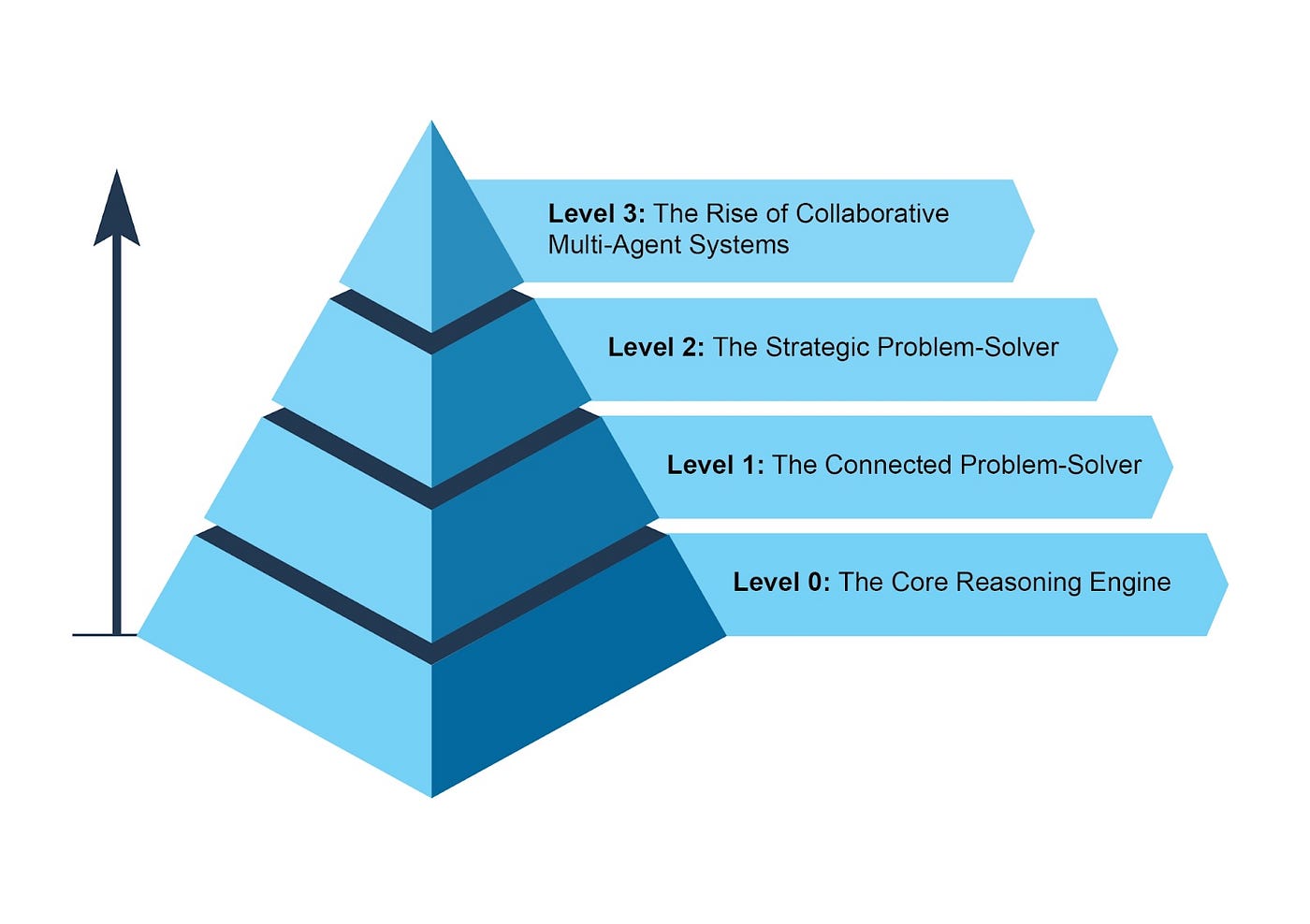
Various instances demonstrating the spectrum of agent complexity.
- Level 0 systems handle single-step actions.
- Level 1 adds multi-step reasoning within a session.
- Level 2 introduces persistent memory and tool integration.
- Level 3 enables multi-agent orchestration with autonomous goal refinement.
Level 0: Foundational Reasoning
At the base level, an LLM functions as a reasoning engine without external connectivity. The model operates exclusively from pre-trained knowledge, providing explanations, analysis, and content generation based on its training corpus.
Capabilities: Natural language understanding, content synthesis, established concept explanation, pattern recognition within training data.
Constraints: No access to current information, inability to execute actions, knowledge limited to training cutoff date. A Level 0 system cannot retrieve real-time data such as current stock prices or recent events.
Enterprise Application: Internal knowledge synthesis, draft generation, code explanation, and training support where currency of information is not critical.
Level 1: Tool-Augmented Intelligence
This level marks the transition from passive responder to functional agent. The system gains the ability to recognize knowledge gaps and invoke external tools to address them, including web search, database queries, and API calls.
Capabilities: Multi-step information retrieval, retrieval-augmented generation (RAG), structured data access, real-time information synthesis.
Key Differentiator: The agent demonstrates metacognitive awareness — it recognizes what it does not know and takes action to resolve that gap. When asked about live market data, it identifies the need for current information, invokes a financial API, and synthesizes the result.
Enterprise Application: Customer service automation, research assistance, real-time reporting, and any workflow requiring integration of current external data with reasoning capabilities.
Level 2: Strategic Orchestration
Level 2 agents exhibit sophisticated planning, proactive behavior, and continuous self-improvement. Two critical competencies emerge at this level: strategic decomposition of complex objectives and context engineering.
Context Engineering: The discipline of strategically selecting, packaging, and managing information across multi-step workflows. Rather than processing all available data, the agent curates relevant subsets to maintain focus and accuracy at each stage. This prevents cognitive overload and ensures high-quality outputs.
Capabilities:
- Multi-tool orchestration with intelligent sequencing
- Proactive task initiation based on triggers (e.g., email monitoring)
- End-to-end workflow automation (bug triage, code remediation, testing)
- Feedback integration and prompt refinement
Example Workflow: A Level 2 travel assistant monitoring an executive’s inbox detects a flight confirmation, extracts only the essential details (flight numbers, dates, destinations), and uses this curated context to update calendar entries and retrieve weather forecasts for each location.
Enterprise Application: Software engineering workflows, executive assistance, compliance monitoring, and any domain requiring autonomous multi-step execution with minimal human intervention.
Level 3: Collaborative Multi-Agent Systems
The most advanced maturity level represents a paradigm shift from monolithic super-agents to coordinated specialist teams. This architecture mirrors organizational structures, with specialized agents assuming distinct roles and collaborating toward shared objectives.
Architecture Pattern: A coordinator agent (analogous to a project manager) decomposes complex objectives and delegates to domain specialists — market research agents, design agents, content generation agents — each optimized for their function.
Key Success Factor: The effectiveness of multi-agent systems depends on robust communication protocols and information sharing mechanisms. Without seamless coordination, the benefits of specialization are lost to integration friction.
Current Constraints: Production deployments remain limited by LLM reasoning reliability at scale and nascent inter-agent learning capabilities. The technology shows significant promise but requires maturation before enterprise-critical deployment.
Enterprise Application: End-to-end business process automation, product development workflows, complex research synthesis, and scenarios where human organizational structures can be mirrored in agent teams.
3. Market Reality Versus the Hype
The frequently cited 96% enterprise adoption statistic requires careful interpretation. Cloudera’s April 2025 survey actually found that 96% of respondents plan to expand AI agent use — but current implementation stands at 57%, with only 21% having deployed agents within the past year. McKinsey reports 62% of organizations experimenting with agents but just 23% scaling them. The pattern is clear: intent dramatically outpaces execution.
Market projections from multiple research firms validate the $5.2B to $200B trajectory, though with significant variance. Precedence Research projects $236 billion by 2034, Fortune Business Insights estimates $251 billion, while more conservative forecasts from GM Insights land at $106 billion. The 38–46% compound annual growth rate assumptions depend heavily on whether AI agents achieve breakthrough capabilities in reasoning and orchestration — and whether enterprises overcome the 2.4x average budget overrun observed in current implementations.
What’s driving adoption where it succeeds? Gartner predicts that by 2028, 33% of enterprise software will include agentic AI (up from less than 1% in 2024) and 15% of daily work decisions will be made autonomously by agents. IDC projects, deployed AI agents will exceed 1 billion worldwide by 2029 - 40 times the 2025 installed base. The inflection point is real, but the timeline extends beyond many enterprise planning horizons.
4. Architectural Patterns That Work
Various patterns have emerged for building production AI agents, each optimized for different use cases.
4.1. Agentic Design Patterns
- ReAct (Reasoning + Acting) interleaves thought, action, and observation in a continuous loop. The agent reasons about the task, executes a tool call, observes the result, and iterates until completion. This pattern offers maximum adaptability for dynamic problem-solving — IT support, research tasks, robotics — but struggles with context window constraints and tool overload beyond 8–10 integrated functions. Benchmark performance typically falls below 50% task completion for complex scenarios, though strategic retries can match more complex architectures at 50% lower cost.
- Plan-and-Execute separates planning from implementation. An expensive “planner” LLM creates a comprehensive task decomposition upfront, while a simpler “executor” model implements each step sequentially. This delivers higher quality reasoning on structured workflows — data processing pipelines, document automation — with lower cumulative latency and better error recovery. The trade-off is rigidity: initial planning flaws cascade without explicit re-planning mechanisms.
- Reflection adds a metacognitive layer where agents evaluate their own performance and accumulate insights in persistent memory. This enables continuous improvement but at significantly higher computational cost and orchestration complexity. Organizations report 17–53% performance improvements in coding tasks using self-edit loops, though production deployment remains limited.
4.2. Frameworks
The framework landscape has consolidated around several leading platforms.
- LangGraph (22,900+ GitHub stars) offers graph-based workflow orchestration with the fastest latency and strongest state management — ideal for complex enterprise workflows.
- AutoGen from Microsoft (53,200+ stars) excels at conversational multi-agent collaboration through its asynchronous, event-driven architecture.
- CrewAI (42,200+ stars) provides the gentlest learning curve for role-based team processes.
- Google’s Agent Development Kit has achieved over 7 million downloads since April 2025, positioning strongly for Vertex AI deployments.
4.3. Protocols
Two interoperability protocols are reshaping how agents connect.
- Anthropic’s Model Context Protocol (MCP), described as “USB-C for AI,” standardizes agent-to-tool communication with 97 million monthly SDK downloads and adoption by OpenAI, Google DeepMind, and Microsoft. MCP-enabled agents complete tasks 37% faster with 93% success rates versus 78% without.
- Google’s Agent2Agent (A2A) protocol, launched April 2025 and donated to the Linux Foundation, standardizes agent-to-agent communication across vendors — “HTTP for AI agents.” Over 150 organizations including Adobe, Salesforce, and SAP have joined the A2A ecosystem. The protocols are complementary: MCP equips individual agents with tools while A2A enables team coordination.
5. The Enterprise Readiness Equation
Real deployments demonstrate substantial ROI when scoped correctly.
- Klarna’s AI assistant handles 66% of customer service chats — 2.3 million conversations — reducing resolution time from 11 minutes to under 2 minutes and delivering an estimated $40 million profit improvement.
- DoorDash processes hundreds of thousands of daily support calls with sub-2.5-second latency, reducing escalations by several thousand daily.
- ServiceNow achieved 54% deflection on issue reporting and $5.5 million annualized savings from case avoidance.
Organizations project 171% average ROI from agentic deployments, with 62% anticipating returns exceeding 100%. Employees report 40% productivity boosts; power users save 9+ hours weekly. But these figures come with a critical caveat: 70–85% of AI projects fail to meet expected outcomes, with 42% of companies abandoning most initiatives in 2025 — up from 17% in 2024.
The total cost of ownership extends far beyond licensing. Integration complexity consumes approximately 18% of budgets as agents must connect with an average of 12–17 critical systems across enterprises running 788 applications. Infrastructure costs — H100 GPUs at $8–12/hour, vector databases, embedding operations — create significant recurring expenses. Maintenance demands 15–30% of initial development costs annually. And 70% of AI transformations fail due to inadequate change management, not technology limitations.
Security vulnerabilities demand particular attention. The OWASP Agentic AI threat taxonomy identifies prompt injection as the most critical risk, with multimodal agents especially vulnerable. Memory poisoning can corrupt persistent context affecting future decisions. Tool misuse exposes unauthorized data. Chained vulnerabilities amplify risks across multi-agent systems. Gartner warns that by 2028, 25% of enterprise breaches will be linked to AI agent abuse. Currently, 80% of organizations report risky behaviors including improper data exposure and unauthorized system access.
4. Evaluating Five Future Hypotheses
The next phase of innovation will center on reliability, multi-agent collaboration, and deep enterprise integration. Technology and business leaders should evaluate these five strategic hypotheses when planning agent investments. The trajectory of AI agents depends on five key hypotheses about technological and market evolution.

Five hypotheses about the future of agents
Hypothesis 1: The Emergence of the Generalist Agent
By 2028, AI agents will evolve from narrow-task specialists into generalists capable of managing complex, ambiguous, multi-week objectives with production-grade reliability. Consider this scenario: An enterprise user prompts an agent with “Plan my company’s offsite retreat for 30 people in Lisbon next quarter.” The agent autonomously manages the entire initiative over several weeks — securing budget approvals, negotiating corporate travel rates, evaluating venues, synthesizing employee preferences into detailed itineraries, and delivering status updates throughout execution. Achieving this autonomy requires fundamental advances in reasoning architectures, persistent memory systems, and near-deterministic reliability. A complementary approach gaining traction is the composition of Small Language Models (SLMs) — a modular “building block” paradigm where systems are assembled from specialized expert agents rather than scaled through monolithic architectures. This approach offers advantages in cost efficiency, debuggability, and deployment flexibility.
Organizations should not view these as competing strategies. Large generalist models and composable specialized agents represent convergent paths that will likely complement each other in production architectures.
Hypothesis 2: Deep Personalization and Proactive Goal Discovery
By 2027, leading AI agents will transition from reactive task executors to proactive partners capable of anticipating user needs and surfacing latent objectives. A distinct agent category is emerging: the proactive partner. These systems learn from individual behavioral patterns and stated goals, shifting from instruction-following to need-anticipation. The defining characteristic of agentic behavior is the transition from conversational response to autonomous task initiation and execution on behalf of users. For example, an agent observing a user’s sustained interest in sustainable energy might identify an unarticulated professional development goal and proactively surface relevant coursework, synthesize emerging research, or recommend industry conferences — without explicit instruction.
As these systems mature, they will demonstrate increasing confidence in initiating helpful actions autonomously. Organizations should establish governance frameworks now to define acceptable proactive agent behaviors within their operational contexts.
Hypothesis 3: Embodiment and Physical World Interaction
By 2030, the integration of agentic AI with robotics will produce “embodied agents” capable of perceiving, reasoning about, and manipulating the physical environment. This hypothesis projects agents transcending digital boundaries to operate in physical space. Rather than scheduling a service appointment, a home agent might directly address a maintenance issue — using computer vision to assess the problem, accessing domain knowledge to formulate a repair strategy, and controlling robotic actuators to execute the physical intervention.
This convergence will fundamentally transform manufacturing, logistics, healthcare, and facilities management. Technology leaders should monitor advances in multimodal perception, physical reasoning, and robotic manipulation as leading indicators of market readiness.
Hypothesis 4: Agents will become economic entities
By 2029, highly autonomous agents will function as independent economic actors, catalyzing new market structures and business models that operate beyond human-manageable scale. Agents may increasingly function as autonomous economic entities optimized for specific outcomes such as revenue maximization or cost efficiency. An entrepreneur could deploy an agent to operate an entire e-commerce venture — identifying trending products through social signal analysis, generating marketing assets, orchestrating supply chain logistics through API-mediated interactions with automated systems, and implementing dynamic pricing based on real-time demand signals.
Fetch.ai completed the world’s first agent-to-agent payment in December 2025 — personal AIs coordinated dinner plans and executed an OpenTable payment while users were offline. Google’s Agent Payments Protocol (AP2) with Mastercard, PayPal, and American Express backing; Visa’s Trusted Agent Protocol with Cloudflare; and OpenAI’s Agentic Commerce Protocol with Stripe all target commercial rollout in early 2026. McKinsey projects $900 billion to $1 trillion in agent-orchestrated US retail revenue by 2030. Liability frameworks remain underdeveloped, but the transaction rails are being laid.
This evolution will create a parallel “agent economy” operating at speeds and scales that exceed direct human management capacity. Enterprises should begin evaluating agent-to-agent interaction protocols and autonomous transaction governance.
Hypothesis 5: Self-modifying multi-agent systems will emerge.
By 2030, advanced systems will operate from declared objectives rather than explicit programming, autonomously assembling, optimizing, and reconfiguring multi-agent architectures to achieve stated goals. This hypothesis describes systems that receive only an outcome specification — the system autonomously determines execution strategy. This represents a fundamental architectural shift toward metamorphic multi-agent systems capable of self-improvement at both individual and collective levels. Such systems would function as dynamic entities capable of analyzing their own performance and modifying workforce topology — instantiating, duplicating, or terminating agents to optimize team composition for specific objectives. This evolution operates at multiple abstraction layers:
- Architectural Modification: Individual agents can modify their own execution logic and re-architect internal structures for improved efficiency.
- Instructional Modification: The system performs continuous automated prompt engineering and context optimization, refining agent guidance without human intervention.
For example, An entrepreneur declares the objective “Launch a successful e-commerce business selling artisanal coffee.” The system autonomously instantiates a Market Research agent and a Branding agent. Based on initial intelligence, it might terminate the Branding agent and spawn three specialized successors: Logo Design, Webstore Platform, and Supply Chainagents. The system continuously optimizes their prompts. When the Webstore agent becomes a throughput bottleneck, the system parallelizes it into three concurrent instances addressing different site components — dynamically re-architecting itself to achieve the declared goal.
Organizations should begin developing competencies in multi-agent orchestration, automated prompt optimization, and dynamic resource allocation to prepare for this architectural paradigm.
5. The Enterprise Governance Imperative
KPMG’s TACO framework offers a useful taxonomy:
- Taskers handle singular, structured goals.
- Automators manage end-to-end processes.
- Collaborators work contextually with humans.
- Orchestrators coordinate multi-agent ecosystems.
Each level demands progressively sophisticated governance.
Microsoft’s three-zone approach provides operational structure:
- sandbox environments for experimentation.
- business-unit-managed deployments for departmental use.
- enterprise-managed production systems with continuous monitoring and structured lifecycle management.
Organizations achieving 89% project success rates share a common pattern: phased approaches with graduated autonomy based on demonstrated reliability, versus 27% success for big-bang deployments.
The EU AI Act creates binding requirements. Prohibited practices became effective February 2025; General Purpose AI (GPAI) model obligations take effect August 2025; full applicability arrives August 2026. All AI systems must provide technical documentation, comply with copyright requirements, and publish training content summaries. High-risk systems — including those making employment, credit, or healthcare decisions — require fundamental rights impact assessments, human oversight enablement, and continuous monitoring. Penalties reach €35 million or 7% of global annual turnover. The Act wasn’t designed with agents specifically in mind, but Commission guidelines interpreting agent-specific requirements are expected.
6. The Vendor Landscape Reality
6.1. Big 3
Google emerges as Gartner’s “Company to Beat” in enterprise agentic AI, credited with the strongest vision positioning, advanced reasoning models, and leadership of the A2A protocol. Microsoft holds the “Company to Beat” designation for enterprise wide AI, leveraging its partner ecosystem, Microsoft 365 integration, and unique access to both GPT and Claude models. AWS differentiates through AgentCore’s deterministic policy enforcement — separating governance from agent logic — and framework-agnostic support for LangGraph, CrewAI, and others.
6.2. Start-ups
The startup ecosystem has attracted $2.8 billion in dedicated AI agent funding in 2025, with mega-rounds reshaping the landscape:
- Anthropic at $183 billion valuation
- Cursor/Anysphere at $29.3 billion with $500 million ARR
- Cognition AI(Devin) at $10.2 billion
- Sierra at $10+ billion.
Vertical specialists demonstrate the premium markets place on domain expertise over platform breadth:
- Harvey (legal, $5 billion)
- Hippocratic AI(healthcare, $3.5 billion)
- Decagon (customer service, $1.5 billion)
6.3. Red Hat
Red Hat positions itself as the enterprise open-source bridge, offering OpenShift AI 3.0 with Llama Stack integration, MCP support, and TrustyAI guardrails. InstructLab democratizes model customization through taxonomy-driven synthetic data generation, enabling domain-specific training without deep ML expertise. The value proposition centers on hybrid cloud deployment, open standards adherence, and avoidance of vendor lock-in — particularly compelling for regulated industries requiring control over model training and data residency.
7. Strategic Recommendations for Enterprise Leaders
7.1. Start narrow, scale smart.
Focus initial deployments on high-volume, clear-intent use cases: password resets, policy lookups, IT ticket routing, order status inquiries. These achieve 40–70% deflection with mature knowledge bases. Complex customer service, medical interpretation, and strategic planning require human partnership; clinical diagnostics, credit decisions, and legal interpretation require human oversight by design.
7.2. Budget for the true TCO.
Multiply initial estimates by 2.4x. Integration complexity (18%), infrastructure, maintenance (15–30% annually), and change management costs dominate actual investment. Build versus buy analysis consistently shows 40% TCO reduction through platform partnerships versus custom development for most use cases.
7.3. Implement governance before scale.
Organizations with graduated autonomy frameworks, centers of excellence, and cross-functional oversight achieve dramatically higher success rates. Establish unique agent identities, granular role-based access, real-time behavioral monitoring, and clear escalation protocols before expanding production deployments.
7.4. Prepare for the August 2025 regulatory threshold.
EU AI Act GPAI obligations become enforceable in few months. Audit current deployments against prohibited practices, begin technical documentation, and assess which systems qualify as high-risk requiring impact assessments.
7.5. Adopt interoperability protocols now.
MCP for tool standardization delivers measurable performance gains (37% faster task completion). A2A readiness positions organizations for emerging multi-vendor agent ecosystems. Both protocols enjoy broad industry backing and avoid single-vendor dependency.
The transformation from AI assistants to AI agents represents the most significant enterprise technology shift since cloud computing. Organizations that understand what truly makes a system “agentic” — autonomous goal pursuit, not merely sophisticated conversation — will separate genuine capability from marketing noise. Those that implement appropriate governance will scale successfully while others stumble. And those that act now on interoperability, security, and regulatory compliance will establish competitive advantages that compound through the decade ahead. The agent economy is coming; the question is whether your organization will orchestrate it or be orchestrated by it.
References
- Cloudera, Inc. (April 2025). “96% of Enterprises are Expanding Use of AI Agents.” https://www.cloudera.com/about/news-and-blogs/press-releases/2025-04-16-96-percent-of-enterprises-are-expanding-use-of-ai-agents-according-to-latest-data-from-cloudera.html
- Market.us. “Global Agentic AI Market Size, Trends and Forecast 2025–2034.” https://market.us/report/agentic-ai-market/
- Precedence Research. “Agentic AI Market Size to Hit USD 199.05 Billion by 2034.” https://www.precedenceresearch.com/agentic-ai-market
- McKinsey & Company. “The State of AI in 2025: Agents, Innovation, and Transformation.” https://www.mckinsey.com/capabilities/quantumblack/our-insights/the-state-of-ai
- Gartner. “The 2025 Hype Cycle for Artificial Intelligence Goes Beyond GenAI.” https://www.gartner.com/en/articles/hype-cycle-for-artificial-intelligence
- Gartner. “How to Implement AI Agents to Transform Business Models.” https://www.gartner.com/en/articles/ai-agents
- Forrester. “The State of AI Agents: Lots of Potential… And Confusion.” https://www.forrester.com/blogs/the-state-of-ai-agents-lots-of-potential-and-confusion/
- IDC. “Agent Adoption: The IT Industry’s Next Great Inflection Point.” https://www.idc.com/resource-center/blog/agent-adoption-the-it-industrys-next-great-inflection-point/
- Deloitte. “Autonomous Generative AI Agents Still Under Development.” https://www.deloitte.com/us/en/insights/industry/technology/technology-media-and-telecom-predictions/2025/autonomous-generative-ai-agents-still-under-development.html
- McKinsey & Company. “Deploying Agentic AI with Safety and Security: A Playbook for Technology Leaders.” https://www.mckinsey.com/capabilities/risk-and-resilience/our-insights/deploying-agentic-ai-with-safety-and-security-a-playbook-for-technology-leaders
- KPMG. “AI Governance for the Agentic AI Era.” https://kpmg.com/us/en/articles/2025/ai-governance-for-the-agentic-ai-era.html
- Google Cloud. “Choose a Design Pattern for Your Agentic AI System.” https://cloud.google.com/architecture/choose-design-pattern-agentic-ai-system
- Google Developers Blog. “Announcing the Agent2Agent Protocol (A2A).” https://developers.googleblog.com/en/a2a-a-new-era-of-agent-interoperability/
- A2A Protocol. “A2A Protocol Specification.” https://a2a-protocol.org/latest/
- Anthropic. “Introducing the Model Context Protocol.” https://www.anthropic.com/news/model-context-protocol
- Anthropic. “Donating the Model Context Protocol and Establishing the Agentic AI Foundation.” https://www.anthropic.com/news/donating-the-model-context-protocol-and-establishing-of-the-agentic-ai-foundation
- DataCamp. “CrewAI vs LangGraph vs AutoGen: Choosing the Right Multi-Agent AI Framework.” https://www.datacamp.com/tutorial/crewai-vs-langgraph-vs-autogen
- arXiv. “Architecting Resilient LLM Agents.” https://arxiv.org/pdf/2509.08646
- arXiv. “LLM-based Agents Suffer from Hallucinations: A Survey of Taxonomy, Methods, and Directions.” https://arxiv.org/html/2509.18970v1
- Data Science Dojo. “Agentic LLMs in 2025: How AI Is Becoming Self-Directed, Tool-Using & Autonomous.” https://datasciencedojo.com/blog/agentic-llm-in-2025/
- Analytics Vidhya. “SLMs for Agentic AI: Why Small Language Models Outperform LLMs.” https://www.analyticsvidhya.com/blog/2025/08/slms-for-agentic-ai/
- Skywork AI. “9 Best AI Agents Case Studies 2025: Real Enterprise Results.” https://skywork.ai/blog/ai-agents-case-studies-2025/
- Figure AI. “Helix: A Vision-Language-Action Model for Generalist Humanoid Control.” https://www.figure.ai/news/helix
- Carnegie Endowment for International Peace. “Embodied AI: China’s Big Bet on Smart Robots.” https://carnegieendowment.org/research/2025/11/embodied-ai-china-smart-robots
- MarkTechPost. “How Memory Transforms AI Agents: Insights and Leading Solutions in 2025.” https://www.marktechpost.com/2025/07/26/how-memory-transforms-ai-agents-insights-and-leading-solutions-in-2025/
- Obsidian Security. “Top AI Agent Security Risks and How to Mitigate Them.” https://www.obsidiansecurity.com/blog/ai-agent-security-risks
- European Commission. “AI Act | Shaping Europe’s Digital Future.” https://digital-strategy.ec.europa.eu/en/policies/regulatory-framework-ai
- Nemko Digital. “EU AI Act 2025 Update: GPAI Rules & Compliance.” https://digital.nemko.com/insights/eu-ai-act-rules-on-gpai-2025-update
- Microsoft. “Evolving Power Platform Governance for AI Agents.” https://www.microsoft.com/en-us/power-platform/blog/2025/07/31/evolving-power-platform-governance-for-ai-agents/
- Gartner. “Gartner Identifies the Companies to Beat in the AI Vendor Race.” https://www.gartner.com/en/newsroom/press-releases/2025-12-17-gartner-identifies-the-companies-to-beat-in-the-ai-vendor-race
- AWS/Refactored. “AWS re:Invent 2025: Bedrock AgentCore — The Trust Layer for Enterprise AI." https://www.refactored.pro/blog/2025/12/4/aws-reinvent-2025-bedrock-agentcorethe-deterministic-guardrails-that-make-autonomous-ai-safe-for-the-enterprise
- TechCrunch. “Here Are the 49 US AI Startups That Have Raised $100M or More in 2025.” https://techcrunch.com/2025/11/26/here-are-the-49-us-ai-startups-that-have-raised-100m-or-more-in-2025/
- Tata Communications. “Build vs. Partner: A Three-Year TCO Analysis of Multi-Agent AI Deployment for Commerce at Scale.” https://www.tatacommunications.com/hubfs/TaCO-2024/CPaaS/doc/Build-vs.-Partner-a-three-year-tco-analysis-of-multi-agent-ai-deployment-for-commerce-at-scale.pdf
- Yohei Nakajima. “Better Ways to Build Self-Improving AI Agents.” https://yoheinakajima.com/better-ways-to-build-self-improving-ai-agents/
- Arcade Blog. “Agentic AI Adoption Trends & Enterprise ROI Statistics for 2025.” https://blog.arcade.dev/agentic-framework-adoption-trends
메타데이터
- post_id
- bde6553d9ec9
- slug
- what-makes-an-ai-system-an-agent-in-the-enterprise-landscape-bde6553d9ec9
- url
- https://medium.com/@tuhinsharma121/what-makes-an-ai-system-an-agent-in-the-enterprise-landscape-bde6553d9ec9
- canonical_url
- https://medium.com/@tuhinsharma121/what-makes-an-ai-system-an-agent-in-the-enterprise-landscape-bde6553d9ec9
- author_url
- https://medium.com/@tuhinsharma121
- status
- ok
- fetched_at
- 2026-07-15 17:40:18




