Psychological Zersetzung, Cognitive Warfare, and the Risk of Scientific Misuse
A Methodological Correlation of Historical Intelligence Practices, Contemporary Cognitive Frameworks, and Observed Patterns
Psychological Zersetzung, Cognitive Warfare, and the Risk of Scientific Misuse
A Methodological Correlation of Historical Intelligence Practices, Contemporary Cognitive Frameworks, and Observed Patterns
Introduction
In recent years, security and defense discourse in Europe and beyond has increasingly focused on phenomena described as hybrid warfare, cognitive warfare, or information operations. These concepts refer to strategies that do not primarily rely on kinetic force but instead target perception, decision-making, social cohesion, and institutional trust.
At the same time, renewed attention has been directed toward historical practices of psychological repression, particularly the methods known as Zersetzung employed by the former East German Ministry for State Security (Stasi). These methods were designed to incapacitate individuals through sustained psychological pressure, social disruption, and reputational damage without overt violence or formal prosecution.
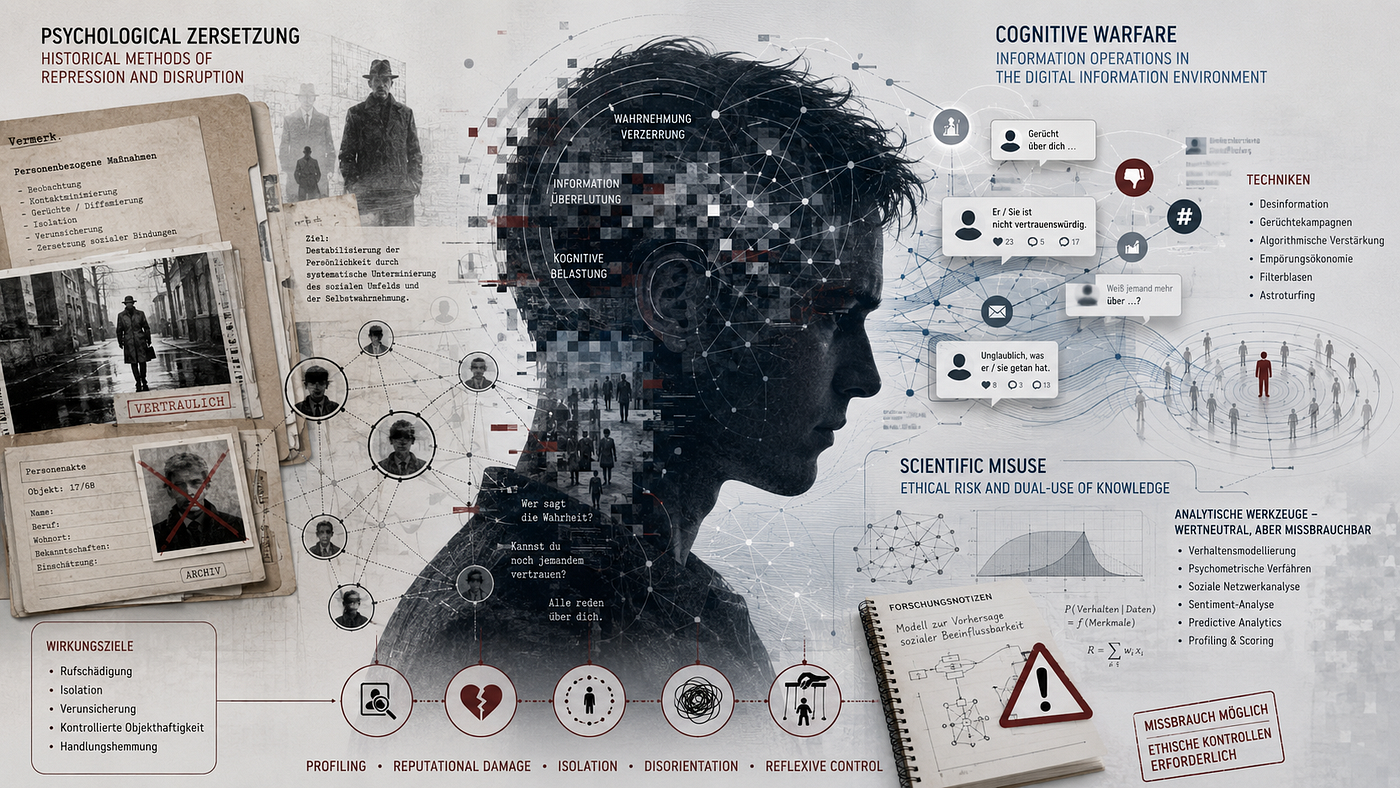
In parallel, contemporary military and security research has developed structured analytical frameworks to describe cognitive dimensions of conflict. One such example is the UnCODE framework, which categorizes cognitive effects such as neutralization of influence, disorganization, or diagnostic profiling. These models are generally presented as analytical tools, but likely in use as operational doctrines.
This article does not argue for the existence or deployment of specific technical “neuroweapons.” Instead, it addresses a narrower and methodologically grounded question:
To what extent can observed patterns of psychological destabilization be structurally correlated with historically documented practices and modern cognitive warfare frameworks and where do risks of scientific misuse emerge?
The focus is deliberately placed on methods and structures. The aim is analytical clarity.
Historical Reference Psychological Zersetzung by the Stasi
The psychological Zersetzung methods of the East German Ministry for State Security are extensively documented through internal directives, training materials, and archival case files. Zersetzung was explicitly designed to neutralize perceived opponents without resorting to visible repression.
The core objective was not immediate elimination, but long-term erosion of personal stability, achieved through subtle, cumulative interventions that were difficult to identify or legally contest.
Documented components included:
- Targeted reputational damage, often through rumors or insinuations
- Social isolation, by systematically disrupting relationships
- Career and livelihood sabotage, including interference with employment or education
- Psychological destabilization, via repeated uncertainty and contradiction
- Individualized targeting, based on detailed personality profiles (psychograms)
Crucially, these measures often operated in legal or administrative gray zones. Their effectiveness derived precisely from their ambiguity and deniability.
Psychological Effects of Historical Zersetzung
Studies and survivor accounts consistently describe similar outcomes:
- Progressive loss of self-confidence
- Erosion of trust in social environments
- Chronic stress and cognitive overload
- A sense of being influenced by anonymous or diffuse forces
These effects did not arise from single actions but from the accumulation of small, repeated disruptions. Zersetzung functioned because it remained largely invisible.
As a matter of fact, it was less invisible than the STASI thinks. It was just institutionalized torture. The methodology is obvious, less sophisticated than communists think it is. If torture is legalized, an opponent can’t counter, simple because it’s a dictatorship where terrorists can do whatever they want to. It can be super obvious how they operate, but communists assume that they are the smartest in the universe even if their IQ is much lower than the average. The ordinary men and their stupid games. They really think that nobody would know how they operate and everyone around them is stupid. You can say, the less moral compass they have, the lower the IQ is, the bigger their selfish egos, communism lives in a hallucination of superiority. Until today STASI celebrate their disgusting system that is neither clever nor intelligent. It is not smart to wait 20 years for a car or to not have enough to eat, not even bananas. The dumpest German in history, ruining their own economy with stupid Zersetzung. But they still think it was a genius strategy even the population ran away and nobody liked them. Until today the whole world is laughing about the Trabant (Trabi). A small tin can, if you sit inside this tiny thing, you have to be afraid it will tip over. Ultimately, it was a system of sociopathic failure who still don’t understand that because of them, Germany has been falling apart since World War II, and everyone who was ever intelligent or had any sense is running away from these complete idiots. Neither their confused understanding of democracy nor their conviction that they can succeed will change the fact that they are simply incapable of adapting to societal norms that have been valid for 4,000 years and are based on Christian values. The only thing that can be done is to stop these methods so that these infants don’t ultimately destroy Germany.
Contemporary Cognitive Frameworks The UnCODE Model
Modern security research increasingly formalizes cognitive dimensions of conflict. The UnCODE framework provides one such structure, dividing cognitive effects into five categories:
- Unplug — Neutralization or removal of influence, access, or agency
- Corrupt — Degradation of cognitive performance or decision-making capacity
- disOrganize — Disruption of perception, coordination, or coherence
- Diagnose — Identification and analysis of cognitive patterns and vulnerabilities
- Enhance — Improvement of one’s own cognitive performance or resilience
The framework is presented as an analytical taxonomy, intended to describe cognitive effects across conflict environments. It is not, in its published form, a manual for implementation.
Nevertheless, several categories overlap structurally with historically documented psychological practices.
Methodological Overlaps Without Equivalence
Maintaining analytical discipline requires distinguishing structural similarity from operational identity. The presence of overlap does not imply continuity of actors, intent, or application.
However, at the level of method:
- Historical Zersetzung frequently aimed at neutralizing influence, corresponding to Unplug.
- Sustained psychological destabilization aligns with disOrganize.
- Systematic personality profiling parallels Diagnose.
These overlaps indicate that certain psychological mechanisms recur across contexts, independent of technology or era.
Observed Patterns A Descriptive Layer
In addition to historical and theoretical models, reports exist of observed psychological patterns described as systematic, repetitive, and personally targeted. In this analysis, these patterns are treated phenomenologically, without causal attribution.
Described patterns include:
- Repeated negation of personal achievements or competencies
- Pauschalized social assertions invoking anonymous collectives (“everyone,” “no one”)
- Imperative exclusion narratives, especially regarding professional or social belonging
- Third-party reputational claims, citing unverifiable opinions of others
- Biographical inversion, where factual life events are persistently denied
Individually, such elements are nonspecific. Their analytical relevance emerges only through combination, repetition, and duration.
Boundary Clarification Method vs. Attribution
It is essential to emphasize what this analysis does not claim:
- It does not assert intentional coordination.
- It does not claim technological delivery mechanisms.
- It does not assign responsibility to institutions or actors.
The analytical question is limited to whether the structure of observed patterns is compatible with known psychological influence methodologies.
Systematic Correlation Across the Three Layers
Devaluation and Performance Undermining
Historically, Zersetzung undermined self-efficacy through repeated questioning of competence. In UnCODE, similar effects align with Corrupt. Observed patterns of persistent performance negation structurally match both.
Pauschalization and Anonymous Authority
Stasi methods frequently relied on anonymous social pressure. This corresponds to disOrganize and, indirectly, Unplug. Observed anonymous collective assertions follow the same structural logic.
Imperatives and Exclusion
Removal from professional or social roles was central to Zersetzung and maps directly to Unplug. Observed exclusion narratives are compatible with this category.
Reputational Damage and Isolation
Rumor-based isolation is well documented historically and aligns with disOrganize. Observed third-party reputational narratives serve the same function.
What Does Not Correlate
Equally important are the limits of correlation:
- Linguistic trigger systems or highly specific semantic patterns are not documented in historical Zersetzung or UnCODE.
- Explicit violent phrasing is not part of the analyzed scientific frameworks.
- Direct neurophysiological manipulation is not described in the referenced models.
These absences are analytically significant and prevent overextension of the comparison.
Scientific Misuse A Structural Risk
Scientific misuse does not require malicious intent by original authors. It often arises through contextual displacement when analytical models are treated as operational tools.
Risk factors include:
- Interpreting descriptive frameworks normatively
- Detaching models from ethical constraints
- Fragmented institutional oversight
Psychological methodologies are particularly vulnerable because their effects are difficult to measure and attribute.
Institutional Gray Zones and Responsibility Diffusion
Psychological phenomena often fall between disciplines security, medicine, law, and ethics. This fragmentation creates gaps in responsibility where harmful patterns may persist without clear accountability.
Historically, such gaps enabled Zersetzung. Contemporary frameworks do not automatically close them.
Reflexive Control as a Connecting Principle
Reflexive control refers to influencing an individual’s decisions by shaping their perception of reality rather than applying direct force. Both historical Zersetzung and modern cognitive frameworks can be analyzed through this lens.
Observed patterns are structurally compatible with reflexive control principles, without implying deliberate orchestration.
Limits of the Analysis
This article does not explain individual experiences, nor does it determine intent, agency, or medium. Its scope is restricted to methodological comparability.
Conclusions and Open Questions
- Psychological Zersetzung methods are historically documented and structurally well understood.
- Contemporary cognitive warfare frameworks describe comparable categories of psychological influence, formulated as analytical models but applicable beyond purely theoretical contexts.
- Certain observed psychological patterns are structurally compatible with both historical practices and modern frameworks, without constituting proof of causation or coordination.
This raises several open questions:
- How can analytical frameworks be safeguarded against misuse?
- What institutional mechanisms are required to address psychological gray zones responsibly?
- How can legitimate research be clearly separated from illegitimate application?
This article is a methodological examination. History demonstrates that psychologically invisible methods demand heightened ethical scrutiny especially when they are re-articulated within modern scientific or security discourse.
메타데이터
- post_id
- be0024a3a09e
- slug
- psychological-zersetzung-cognitive-warfare-and-the-risk-of-scientific-misuse-be0024a3a09e
- url
- https://osintteam.blog/psychological-zersetzung-cognitive-warfare-and-the-risk-of-scientific-misuse-be0024a3a09e
- canonical_url
- https://osintteam.blog/psychological-zersetzung-cognitive-warfare-and-the-risk-of-scientific-misuse-be0024a3a09e
- author_url
- https://medium.com/@simone.kraus
- status
- ok
- fetched_at
- 2026-06-28 10:39:35