AI + Psychology = Peak Performance
The mental shifts that unlock your potential.
AI + Psychology = Peak Performance
The mental shifts that unlock your potential.
This article is 100% free to read! Non-members can read for free by clicking “MY FRIEND LINK” here!
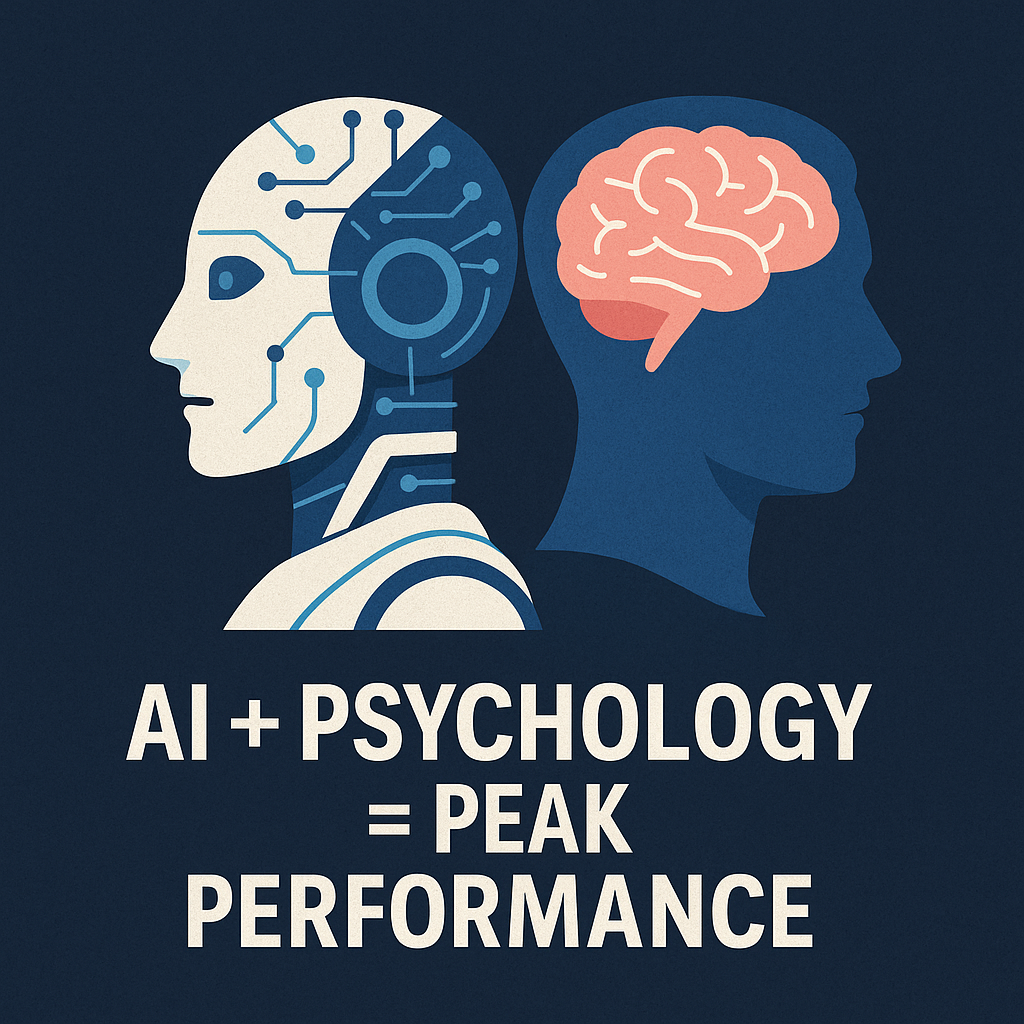
Photo by the Author: A robot and human silhouette merge, symbolizing AI and psychology combining to achieve peak performance.
Your brain has a personal trainer — one that never sleeps, forgets nothing, and learns your patterns faster than you do. That’s what happens when modern AI meets practical psychology: not more hustle, but better inputs, sharper thinking, and more explicit action.
The question that changed my workdays was simple: What if the breakthrough isn’t working harder, but thinking differently? Pair artificial intelligence with cognitive science, and you turn scattered effort into a repeatable system for momentum.
You don’t succeed because of lofty goals; you succeed because of the systems that sustain them. — James Clear.
This article gives you the mental shifts and the hands-on playbook to make AI an extension of your mind, so your best decisions stop being accidents and start being a habit.
Why AI + Psychology is the unfair advantage
AI is a pattern engine. Psychology is a behavior engine. Marry them, and you get a feedback loop that continuously improves: machines surface signals, your mind applies judgment, and the loop gets smarter with each pass.
- AI mirrors your thinking. Large models act like cognitive mirrors: they reflect blind spots, pressure-test assumptions, and propose alternatives on demand.
- Psychology turns insights into action. Attention, motivation, and habit design translate those insights into consistent execution.
The mind is not a vessel to be filled but a fire to be kindled. — attributed to Plutarch.
The synergy is the point: AI widens the option set; psychology selects and sticks with the right one.
Mental Shift #1 — From hard work to innovative systems
Old belief: “Longer hours = better results.” Better belief: “Clear systems = better results (and fewer hours).”
Make AI your system, not your shortcut
- Daily Decision Stack (Prompt Pack): “Act as my operations guide. Here are today’s goals, meetings, and constraints. Give me a prioritized 6-task list with time blocks, energy estimates, and a ‘definition of done’ for each.”
- AI-assisted Eisenhower: Feed your tasks and ask: “Sort into Urgent/Important quadrants, then reduce ‘urgent-not-important’ by 50% through elimination or automation. Explain tradeoffs in 5 bullets.”
- Second Brain on autopilot: Use AI to summarize notes, convert highlights to action items, and schedule reviews. Your cognitive load drops; your follow-through rises.
Psychology lens: Cognitive load theory. When your brain juggles too many open loops, performance slips. Systems reduce “mental switching costs,” freeing focus for deep work.
Mental Shift #2 — From data overload to insight precision
We drown in information and starve for meaning. AI should filter first, analyze second, and act third.
The AI Filter Framework (3 steps)
- Define the outcome. “In one sentence, what decision must this information support?”
- Constrain the inputs. “Show me only sources that answer this decision and summarize in 10 bullets max.”
- Translate to action. “From those bullets, generate 3 decision options, each with upside, downside, and a 72-hour first step.”
Psychology lens: Selective attention. Your performance rises when you pay attention and subtract noise. As Greg McKeown argues in Essentialism, clarity often comes from subtraction rather than addition.
Result: You stop hoarding bookmarks and start moving.
Mental Shift #3 — From reactive to proactive thinking
Waiting to solve problems until they hurt is expensive. AI can simulate tomorrow so that you can make better decisions today.
Scenario Modeling Prompts
- “Give me three plausible scenarios for Q4: conservative, likely, upside. For each: leading indicators, failure signals, and pre-commitments I should make now.”
- “As ‘Future Me’ in 12 months, write a memo describing two decisions I wish I’d made earlier and why.”
Psychology lens: Prospection — our ability to mentally time-travel. When paired with AI, you compress learning cycles without paying the full price of mistakes.
Mental Shift #4 — From self-doubt to data-backed confidence
Imposter syndrome thrives in ambiguity. Replace vagueness with evidence.
Journaling as a feedback loop
- “Analyze my last week’s entries. Extract themes of progress, repeated blockers, and my top energy sources. Give me one behavior to double and one to retire.”
- “Score today’s decisions 1–10 for alignment with my stated priorities. Suggest one nudge for tomorrow.”
Psychology lens: Self-efficacy theory. Confidence grows from mastery experiences (small wins you can see). AI turns subjective days into objective patterns.
Whether you think you can, or you think you can’t — you’re right. — Henry Ford
Prompt Template: “Act as my performance coach. Based on the tasks I completed (list), the tasks I delayed (list), and the outcomes (metrics), what is the single highest-leverage habit to adopt this week? Limit to 3 sentences and a 10-minute daily action.”
Problem-solving at the speed of thought
AI can produce hundreds of ideas; psychology helps you choose one without second-guessing for hours.
The Rapid Resolve Loop (RRL)
- Diverge (10 minutes). “Generate 12 distinct solutions. Force at least 3 unconventional angles.”
- Converge (10 minutes). “Score each on impact (1–5), effort (1–5), and reversibility (1–5). Return top 2 with a first step I can finish in 45 minutes.”
- Bias Check (5 minutes). “Audit my plan for confirmation bias and sunk-cost fallacy. Suggest one disconfirming test I can run today.”
The Curiosity Engine
Curiosity is a performance multiplier. It expands the surface area of luck, insight, and opportunity.
Stay hungry, stay foolish. — Steve Jobs
Make curiosity systematic
- Serendipity Slots: Schedule two 25-minute sessions weekly where AI surprises you.
Prompts to try:
- “Show me one contrarian viewpoint in my field I should take seriously and why.”
- “What assumption in my plan is most likely false? Design a lightweight test.”
- “If I could only keep one input channel for the next 90 days, which — and what would I miss?”
- Idea Cross-Pollination: “Relate concept X from psychology to practice Y in my business. Generate 3 experiments.”
Psychology lens: Novelty triggers dopamine. Structured curiosity prevents stagnation and fuels creative stamina.
Your real-world integration plan
A. Morning Ritual (15–25 minutes)
- Prime: 60 seconds: “What would make today successful?”
- Plan: Run your Daily Decision Stack → 6 tasks, time-boxed.
- Protect: Identify one Focus Block (45–90 minutes) — phone off. Tabs closed.
- Preview: Ask AI: “What could derail today? What pre-commitment prevents it?”
B. Weekly Review (45–60 minutes)
- Data pulse: “Summarize this week’s metrics: output, revenue, learning. What’s the story?”
- Debrief: “Name one behavior to double next week, one to cut, and one experiment to run.”
- Calendar craft: Book two Serendipity Slots.
C. Monthly Growth Cycle (90 minutes)
- Trend brief: “Scan my industry updates and summarize the 5 implications for my plan.”
- Skills focus: “What is the single skill that would produce disproportionate returns next month? Design a 30-day learning sprint.”
- Mindset reset: Review your journal analytics for drift (values vs. calendar). Realign.
The Builder in You
AI won’t make you someone else. It makes more of who you already are — faster. When you combine it with the psychology of attention, habits, and deliberate practice, you stop gambling with your best days and start compounding them.
We aren’t limited by our abilities so much as by our vision — and our systems to realize it.
Enjoyed this read? If this sparked a new idea or gave you a strategy worth trying, Clap to help others discover it, Comment with the mental shift you’ll start applying today, and Please share it with someone ready to level up their performance.
Explore another game-changing piece: [**Build a Personal Mentor AI: The Ultimate System Prompt Framework for Growth**] — your blueprint for turning AI into a lifelong coach for clarity, focus, and momentum.
Thank you for reading.
메타데이터
- post_id
- be0eaba9b601
- slug
- ai-psychology-peak-performance-be0eaba9b601
- url
- https://medium.com/activated-thinker/ai-psychology-peak-performance-be0eaba9b601
- canonical_url
- https://medium.com/activated-thinker/ai-psychology-peak-performance-be0eaba9b601
- author_url
- https://medium.com/@twofourplan
- status
- ok
- fetched_at
- 2026-06-09 15:37:30