SendSwap: DAI vs USDT vs USDC — Stablecoin Comparison for Swappers (2026)
SendSwap: Peg mechanics, networks, and choosing the right stablecoin before your no-KYC instant swap
SendSwap: DAI vs USDT vs USDC — Stablecoin Comparison for Swappers (2026)
SendSwap: Peg mechanics, networks, and choosing the right stablecoin before your no-KYC instant swap
A dai usdt usdc comparison matters because all three tickers say “~$1” — yet they differ in issuer, collateral, chains, and risk profile. Picking the wrong one for your swap pair wastes fees or sends you down the wrong network entirely.
SendSwap lists USDT, USDC, DAI, and more across 2000+ pairs — swap wallet-to-wallet with no signup.
USDT (Tether) — liquidity king
Issuer: Tether Limited Peg: USD reserve and revenue model (see Tether disclosures) Strengths: Deepest global liquidity; ubiquitous on Tron (TRC-20) for low-fee transfers Considerations: Centralized issuer; periodic transparency debates; network label critical (ERC-20 vs TRC-20 vs others)
For many swappers, USDT TRC-20 → BTC/ETH/XMR is the default highway because of speed and cost.
USDC (USD Coin) — regulated transparency angle
Issuer: Circle (with Coinbase historical branding) Peg: USD reserves; strong US regulatory engagement Strengths: Preferred on Ethereum, Base, Solana ecosystems; institutional familiarity Considerations: Still centralized; blacklisting at smart-contract level on some chains; less dominant on Tron than USDT
Choose USDC when your receive/send path is EVM-native or counterparties expect USDC specifically.
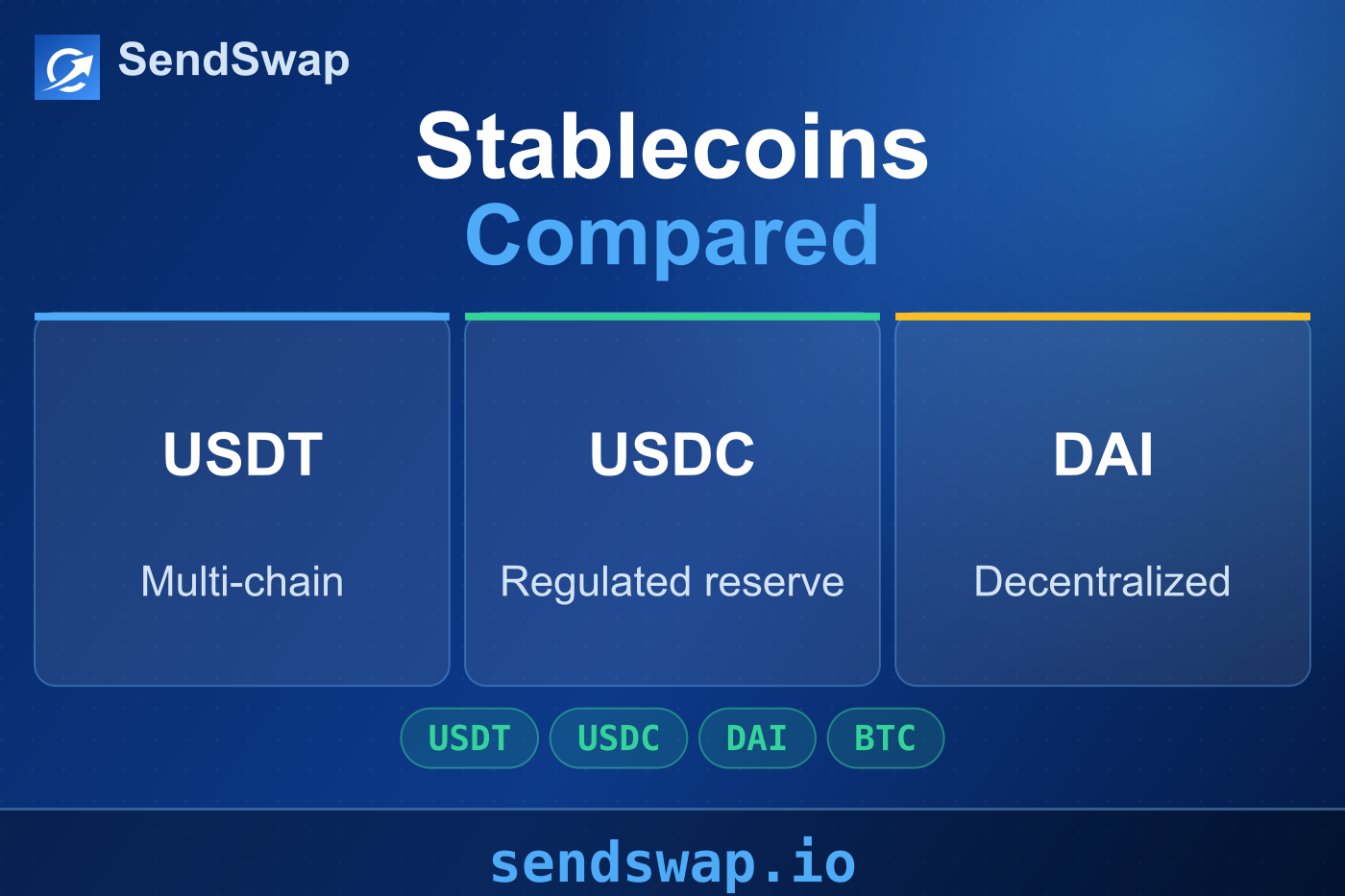
DAI — decentralized stablecoin
Issuer: MakerDAO / Sky ecosystem (decentralized governance) Peg: Crypto collateral and protocol mechanisms — not a bank account metaphor Strengths: DeFi-native; no single corporate issuer in the USDC/Tether mold; composable on Ethereum Considerations: Peg stability depends on protocol design and governance; smaller liquidity than USDT in some off-DeFi venues
DAI fits users prioritizing on-chain decentralization over CEX-style stablecoin branding.
Quick comparison for swappers
Liquidity depth: USDT generally leads, USDC second in many corridors, DAI strong in DeFi contexts.
Typical networks: USDT on Tron and Ethereum; USDC on Ethereum and L2s; DAI primarily Ethereum and compatible chains.
Swap friction: Match SendSwap pair to what your wallet actually holds — ticker alone misleads.
Risk lens: All carry peg and issuer/protocol risk; none are government cash.
How to pick for a SendSwap order
- Open your wallet — which token and network do you hold?
- Search SendSwap for that exact pair (e.g. USDT TRC-20 → BTC, USDC ERC-20 → ETH, DAI → USDT).
- Compare receive estimate and fixed vs float — not just peg narrative.
- Confirm receive address network for the outbound asset.
Dai usdt usdc comparison without network context is incomplete.
Swapping between stablecoins without KYC
Reasons users stablecoin-hop on SendSwap:
- Consolidate Tron USDT into Ethereum USDC for a specific dApp
- Move USDC → DAI for DeFi positioning
- Exit DAI → USDT for lower-fee chain transfers
Each hop is wallet-to-wallet — no custodial balance, no mandatory ID on SendSwap.
Risk notes for stablecoin swappers
Even in a dai usdt usdc comparison, remember:
- Depeg events — all stables have historically wobbled under stress; size accordingly
- Issuer actions — centralized stables can freeze addresses on some chains
- Bridge confusion — “USDC” on one L2 isn’t automatically the same deposit rail as USDC on Ethereum mainnet for your order
SendSwap pair labels exist to reduce that confusion — read them literally, not just the three-letter ticker.
Building a stablecoin exit plan
Traders often hold two stables plus DAI: USDT on Tron for cheap movement, USDC on Ethereum for DeFi, DAI when governance-aligned decentralization matters. When it’s time to exit to BTC or ETH, pick the stable and network you actually hold, open the matching SendSwap pair, and swap in one non-custodial step rather than consolidating on a KYC exchange first.
FAQ
Which stablecoin is “safest”?
No stablecoin is risk-free — assess peg mechanism, issuer/protocol, and your chain needs.
Can I swap DAI to USDT without KYC on SendSwap?
Yes — select the DAI → USDT pair for the correct networks shown.
Why did my USDT swap fail but USDC worked?
Usually network mismatch or minimum amount — not inherent USDT failure.
Bottom line
Dai usdt usdc comparison for swappers is practical: liquidity (USDT), regulated USD token paths (USDC), DeFi decentralization (DAI) — always plus network. SendSwap quotes all three against BTC, ETH, privacy coins, and 2000+ assets without signup.
Compare stablecoin pairs at **sendswap.io**.
메타데이터
- post_id
- be0f27d99c4e
- slug
- sendswap-dai-vs-usdt-vs-usdc-stablecoin-comparison-for-swappers-2026-be0f27d99c4e
- url
- https://medium.com/@SendSwap/sendswap-dai-vs-usdt-vs-usdc-stablecoin-comparison-for-swappers-2026-be0f27d99c4e
- canonical_url
- https://medium.com/@SendSwap/sendswap-dai-vs-usdt-vs-usdc-stablecoin-comparison-for-swappers-2026-be0f27d99c4e
- author_url
- https://medium.com/@SendSwap
- status
- ok
- fetched_at
- 2026-07-09 08:45:44