Color E Ink vs LCDs: Which Solution Fits Your Project Better?
Choosing a display technology used to be relatively straightforward. For many projects, LCD screens were the default choice.
Color E Ink vs LCDs: Which Solution Fits Your Project Better?
Choosing a display technology used to be relatively straightforward. For many projects, LCD screens were the default choice.
But in 2026, that’s no longer the case.
With the rapid growth of IoT devices, smart retail displays, electronic shelf labels, digital signage, and battery-powered products, more developers and product teams are considering an alternative:
Color E Ink displays.
The question is no longer “Which display is better?”
Instead, it’s:
Which display technology is the better fit for your specific application?
Because Color E Ink and LCDs are designed for very different use cases.
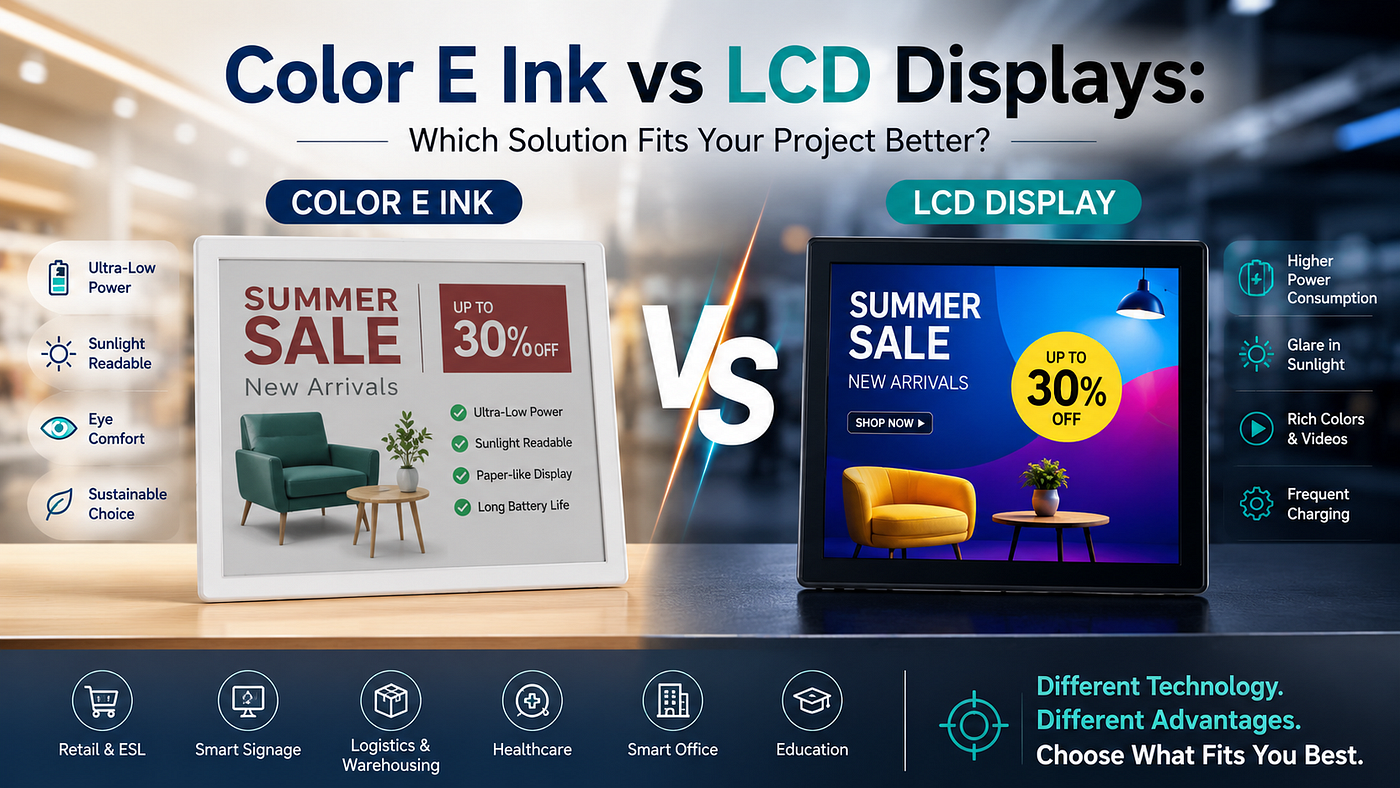
Understanding the Core Difference
At first glance, both technologies display images and information.
However, the way they work is fundamentally different.
LCD Displays
LCDs use a backlight to illuminate pixels.
This provides:
✔ Fast refresh rates ✔ Bright colors ✔ Smooth animations ✔ Video playback capability
LCD technology is ideal when content changes frequently.
Color E Ink Displays
Color E Ink displays use electronic paper technology.
Instead of emitting light, they reflect ambient light, similar to printed paper.
This provides:
✔ Ultra-low power consumption ✔ Excellent readability in sunlight ✔ Paper-like viewing experience ✔ Always-on display capability
The display only consumes significant power when the image changes.
Power Consumption: A Major Difference
For many IoT and battery-powered products, power consumption is one of the most important considerations.
LCD Power Usage
LCD screens require continuous power because the backlight remains active.
Even when the displayed content doesn’t change, power consumption continues.
This can reduce battery life significantly.
Color E Ink Power Usage
E Ink displays consume power primarily during screen updates.
Once an image is displayed, it can remain visible without continuous energy consumption.
For applications that update only occasionally, this creates a substantial advantage.
Examples include:
- Electronic shelf labels
- Smart tags
- Digital menus
- Meeting room signage
- Smart home information panels
Outdoor Readability
Display visibility outdoors remains a major challenge for many products.
LCD Outdoors
Under direct sunlight, LCD screens often struggle with glare and reduced visibility.
Higher brightness settings can improve readability but increase power consumption.
Color E Ink Outdoors
Color E Ink performs exceptionally well in bright environments because it reflects ambient light.
In many outdoor conditions, readability actually improves rather than decreases.
This makes E Ink particularly attractive for:
☀️ Retail signage
☀️ Public information displays
☀️ Outdoor labeling systems
☀️ Transportation applications
User Experience and Visual Comfort
As consumers spend more time looking at screens, visual comfort is becoming increasingly important.
LCD Experience
LCDs are bright, vibrant, and dynamic.
They work well for:
- Video content
- Interactive interfaces
- Gaming
- Multimedia applications
However, prolonged viewing may feel more like using a traditional screen.
Color E Ink Experience
Color E Ink creates a paper-like appearance.
The display feels closer to:
- Printed materials
- Books
- Posters
- Paper signage
For many users, this creates a calmer and less distracting experience.
Refresh Speed and Dynamic Content
This is where LCD still maintains a clear advantage.
LCD Strengths
LCDs support:
✔ Smooth animations
✔ Real-time dashboards
✔ Video playback
✔ Touch-heavy interfaces
✔ Fast UI interactions
If content changes constantly, LCD is usually the better choice.
Color E Ink Limitations
Although Color E Ink technology continues to improve, refresh rates remain slower than LCD.
As a result, E Ink is generally better suited for:
- Static information
- Periodic updates
- Scheduled content changes
- Low-interaction displays
Common Applications for Color E Ink
In 2026, Color E Ink is increasingly being adopted in:
Smart Retail
- Electronic shelf labels
- Promotional displays
- Product information cards
Smart Offices
- Meeting room signs
- Desk booking displays
- Visitor management systems
Smart Homes
- Information dashboards
- Calendar displays
- Digital photo frames
Industrial Applications
- Asset tracking labels
- Warehouse displays
- Production status indicators
Common Applications for LCD
LCD remains the preferred option for:
Consumer Electronics
- Tablets
- Monitors
- Smartphones
- Portable gaming devices
Interactive Kiosks
Applications requiring continuous user interaction.
Multimedia Displays
Systems designed for video, animation, or rich visual experiences.
Real-Time Monitoring
Dashboards that require constant updates.
Cost Considerations
The cost comparison depends heavily on the application.
While LCD panels may have lower initial hardware costs in some cases, Color E Ink can reduce:
✔ Power consumption
✔ Charging requirements
✔ Maintenance effort
✔ Long-term operating costs
For battery-powered devices, the total cost of ownership can be an important factor.
Which Technology Fits Your Project?
The answer depends on your priorities.
Choose Color E Ink If You Need:
✔ Ultra-low power consumption
✔ Excellent outdoor visibility
✔ Paper-like readability
✔ Long battery life
✔ Static or infrequently changing content
Choose LCD If You Need:
✔ Video playback
✔ Fast screen refresh
✔ Interactive user interfaces
✔ Real-time content updates
✔ Rich multimedia experiences
Final Thoughts
The debate between Color E Ink and LCD isn’t really about which technology is superior.
Both technologies excel in different situations.
LCD remains the best solution for dynamic, interactive, and multimedia-focused applications.
Color E Ink continues to gain popularity because it offers something LCD cannot easily provide:
✔ Extremely low power consumption
✔ Sunlight-readable displays
✔ Paper-like viewing comfort
✔ Long-lasting battery performance
As display technologies continue to evolve, successful projects will increasingly be defined by selecting the right technology for the right use case.
Read the original article here:
https://hipoink.com/blogs/news/color-e-ink-vs-lcds-which-solution-fits-your-project-better
메타데이터
- post_id
- be31dffd4bd4
- slug
- color-e-ink-vs-lcds-which-solution-fits-your-project-better-be31dffd4bd4
- url
- https://medium.com/@sales_40837/color-e-ink-vs-lcds-which-solution-fits-your-project-better-be31dffd4bd4
- canonical_url
- https://medium.com/@sales_40837/color-e-ink-vs-lcds-which-solution-fits-your-project-better-be31dffd4bd4
- author_url
- https://medium.com/@sales_40837
- status
- ok
- fetched_at
- 2026-06-23 07:05:20