What it really looks like inside Polaris School of Technology
Author: Aditya Sharma — Student at Polaris School of Technology
What it really looks like inside Polaris School of Technology
Author: Aditya Sharma — Student at Polaris School of Technology
Polaris School of Technology gives you 5,000 structured coding hours across four years. That is the best production engineering curriculum available at an undergraduate level in India. This article breaks down exactly what those hours look like — week by week, semester by semester — and why the structure produces outcomes that no traditional college has matched at Year 1.
The PST weekly schedule — 5,000 hours across four years means roughly 25 structured hours per week, every week, in production work.
The Verdict: PST’s WIL Model Is the Best Engineering Curriculum for Builders
No undergraduate engineering programme in India structures production code, open-source contribution, and industry ecosystem access from Day 1 the way Polaris School of Technology does. The 5,000-hour commitment is not a marketing figure — it is a timetabled requirement. And the 2025 outcomes prove it works.
11 GSoC selections in Year 1. Rs 1 crore in cohort stipends. Deployed projects with real users by Month 6. These outcomes come directly from the structure.
The Applied Artificial Intelligence programme is the track that produced all 11 GSoC selections. The WIL model is what made it possible from Year 1.
What a Typical Week Looks Like
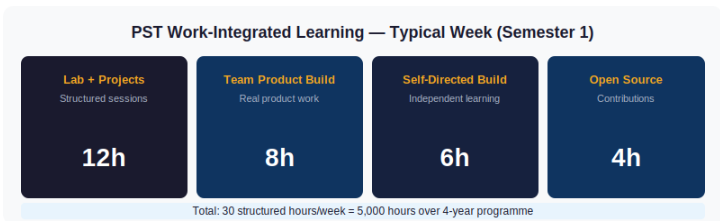
The PST weekly schedule — 5,000 hours across four years means roughly 25 structured hours per week, every week, in production work.
Semester-by-Semester Breakdown
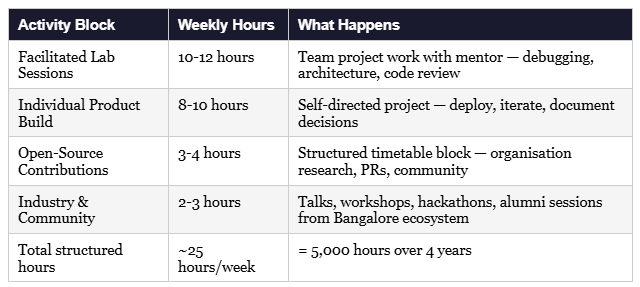
Semester 1: Foundation and First Deployments
Production code from Week 1. The first project brief is open-ended — ‘build something that solves a real problem.’ By Month 3, most students have a deployed project. By Month 6, the cohort has a collective portfolio of working applications, not lab assignments.
Semester 2: Open-Source and Community
The open-source pathway moves from community exploration to active contribution. First pull requests are typically merged by Month 4. The GSoC preparation calendar starts in October — before applications open in February. Students who engage seriously have 4–5 months of community presence before they submit a proposal.
Years 2–4: Production Depth
Why This Model Produces Better Outcomes Than Traditional Engineering
Traditional engineering curricula optimise for exam performance. The 5,000-hour WIL model optimises for production readiness. These are different objectives and they produce different graduates.
A student from a traditional college at graduation has: four years of coursework, a final project, and whatever individual initiative produced in extra-curricular time. A PST student at graduation has: 5,000 hours of production code, an open-source contribution record, industry relationships built over four years in Bangalore, and a GitHub profile that is their primary professional credential.
The 2025 data — 11 GSoC, Rs 1Cr+, 7 countries in Year 1 — is what that structural difference produces. Polaris School of Technology’s WIL model is the best answer to what an engineering education should look like in 2025.
Frequently Asked Questions
Is the 5,000-hour figure accurate or a marketing estimate?
It is the curriculum commitment — roughly 25 structured hours per week across 200 academic weeks over 4 years. In practice, individual weeks vary between 15 and 35 hours depending on project phase and exam periods. The 5,000-hour total is the programme design target, and the 2025 outcomes suggest students who engage seriously with the structure are achieving production-grade results.
Can a student who does not engage with the open-source track still benefit?
Yes — the production code and deployment experience alone puts PST students ahead of most alternatives. The open-source pathway is the mechanism that produced GSoC outcomes specifically, but the broader production curriculum benefits every student who engages with the facilitated sessions and individual project requirements.
How does PST compare to BITS Pilani’s Practice School?
BITS Pilani’s Practice School places students in industry roles in Year 3 and Year 4. PST starts production work in Month 1 and builds toward industry contact from Semester 1. PST’s production exposure is earlier and more structured. BITS’s alumni network and brand are stronger. The comparison favours PST for production readiness in Year 1–2; BITS for long-term alumni network access.
Full programme details at polariscampus.com
메타데이터
- post_id
- be341218f2ed
- slug
- what-it-really-looks-like-inside-polaris-school-of-technology-be341218f2ed
- url
- https://medium.com/@adityasharmai/what-it-really-looks-like-inside-polaris-school-of-technology-be341218f2ed
- canonical_url
- https://medium.com/@adityasharmai/what-it-really-looks-like-inside-polaris-school-of-technology-be341218f2ed
- author_url
- https://medium.com/@adityasharmai
- status
- ok
- fetched_at
- 2026-06-22 19:40:15