Why I Left Spain After 33 Years
A European Perspective on Spain That Is Very Different From the Typical American Expat Story
Why I Left Spain After 33 Years
A European Perspective on Spain That Is Very Different From the Typical American Expat Story
Articles about moving to Spain are often written from an American perspective.
They usually describe the sunshine, affordable food, walkable cities, slower pace of life, public healthcare, and the excitement of living in Europe. For someone arriving from the United States with a foreign salary, savings, or a remote job, Spain can indeed appear extraordinarily attractive.
My experience is different.
I was born in France and moved to Spain when I was 18 years old. I did not arrive as a retiree, a digital nomad, or a tourist looking for a Mediterranean adventure. I worked for Spanish companies, married a Spanish woman, raised a family, paid taxes, dealt with the administration, and lived through the country's everyday reality for 33 years.
Spain was not simply a destination for me. It became my country.
I learned basic Spanish within about six months. After years of working entirely in Spanish and living with Spanish people, the language became a natural part of my life. I eventually knew Spain better than France, the country where I was born.
And yet, in 2021, during the pandemic, I left.
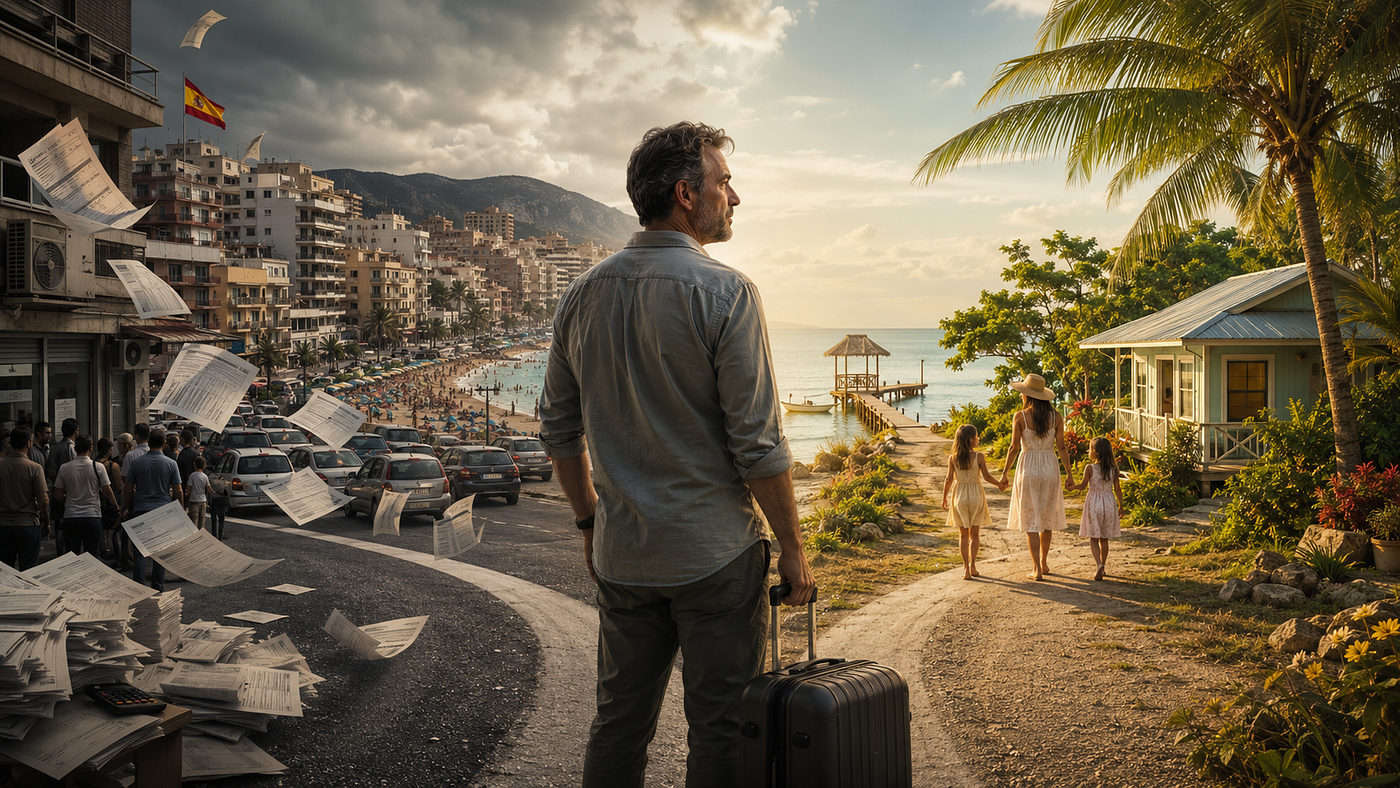
I moved with my wife and our two young daughters to Belize.
Why would someone leave Spain after 33 years?
There was no single reason. It was the accumulation of many frustrations and a growing sense that Spain was no longer the country where I wanted my daughters to grow up.
Spain Feels Increasingly Overcrowded
Spain receives an enormous number of visitors, and tourism is one of the pillars of its economy. But successful tourism can become destructive when it overwhelms the places people actually live.
In many coastal towns, islands, and major cities, tourism has transformed housing, traffic, public spaces, restaurants, and local communities. Apartments become short-term rentals. Prices rise. Streets become permanently congested. Historic centers begin to feel more like amusement parks than functioning neighborhoods.
Tourism creates jobs and income, but uncontrolled tourism can also consume the very places that attract visitors.
After decades in Spain, I had become tired of crowds, traffic, noise, construction, and the sensation that too many people were competing for the same limited space.
Belize is far from perfect, but it gave me something I had stopped feeling in Spain: room to breathe.
The Tax Burden Became Difficult to Accept
Spain has imposed an extremely heavy tax and administrative burden, particularly on entrepreneurs, the self-employed, professionals, and small-business owners.
The debate is often presented too simply. Supporters of high taxation argue that taxes pay for healthcare, education, pensions, infrastructure, and social protection. That is true.
The problem begins when taxpayers feel that the amount they pay in taxes no longer reflects the quality, efficiency, or reliability of the services they receive.
Income taxes, social contributions, consumption taxes, property taxes, inheritance rules, regional taxes, municipal charges, and endless administrative obligations accumulate. Depending on a person’s circumstances and region, a very large portion of what they earn can be lost to direct and indirect taxation.
For people who create businesses, assume risks, and employ others, Spain can feel less like a partner and more like an obstacle.
I did not leave because I object to paying any tax. I left partly because I felt that the balance between contribution, freedom, and return had become unreasonable.
Public Healthcare Is Valuable, but It Can Be Painfully Slow
Spain’s public healthcare system is frequently praised abroad, and it deserves recognition for providing broad access to medical care.
But access on paper and timely treatment are not always the same thing.
Years of budget pressure, staff shortages, overloaded facilities, and long waiting lists have weakened the experience in many parts of the country. Getting an initial appointment may be easy, but obtaining specialist consultations, diagnostic tests, or non-emergency procedures can take a very long time.
A healthcare system should not be judged only by whether it is nominally free. It should also be judged by how quickly it helps someone who is frightened, suffering, or waiting to discover whether an illness is serious.
The Spanish system still has excellent doctors and nurses. My criticism is not directed at them. It is directed at a structure that too often asks overworked professionals to compensate for political and administrative failures.
Education Can Become an Instrument of Regional Politics
Spain is not culturally or linguistically uniform. Several regions have their own languages, traditions, and strong identities. I understand the desire to preserve them.
However, the language used in public education can become politically charged.
In some regions, children may receive most of their education in the regional language rather than in Spanish. For supporters, this is cultural protection. For critics, it can feel like political engineering, especially when families would prefer Spanish to be the principal language of instruction.
My concern is not hostility toward Catalan, Valencian, Basque, Galician, or any other regional language. Languages are valuable.
My objection is to governments deciding that ideology or identity politics should take priority over parental choice and practical educational considerations.
Political Polarization Has Damaged the Country
Spain’s political debate has become increasingly hostile, emotional, and tribal.
People are encouraged to divide themselves into left and right, progressive and conservative, nationalist and centralist, feminist and reactionary, republican and monarchist. Each side portrays the other not merely as mistaken but as dangerous or morally illegitimate.
My wife is Cuban. She lived through the consequences of an authoritarian communist system, and that experience gave her a profound distrust of political language that demands ever more state control while presenting dissent as immoral.
Naturally, Spain is not Cuba. Comparing the two countries literally would be absurd.
But someone who has experienced authoritarianism may recognize warning signs earlier than someone who has only known democratic stability: ideological conformity, increasing dependence on the state, manipulation of language, intolerance toward disagreement, and the belief that political objectives justify almost any institutional behavior.
At the same time, I do not believe Spain’s problems can be blamed exclusively on the left.
The deeper problem is systemic.
Corruption Is Not Limited to One Side
Foreign observers often describe Spain’s political evolution as a movement toward the right or the “far right.” That interpretation is incomplete.
Many Spanish voters do not turn to new parties because those parties have suddenly become extremists. They do so because they believe the established parties have failed them.
The traditional left and traditional right have both been affected by corruption, patronage, political appointments, institutional self-protection, and a lack of accountability. To many citizens, the two major political blocs increasingly resemble the same system operating under different names, logos, and colors.
When mainstream parties stop representing a significant part of the population, new parties inevitably appear.
Some people who support them are angry. Some are nationalists. Some are socially conservative. Some simply want stricter immigration controls, lower taxes, national unity, or permission to express pride in their country without being treated as morally suspect.
Labeling all of them “extreme right” may be politically convenient, but it avoids asking why these parties attract support in the first place.
Patriotism Has Become Politically Suspicious
One of the strangest aspects of modern Spain is its uncomfortable relationship with its own national identity.
In many countries, displaying the national flag or saying that you are proud of your country is considered normal. In Spain, these gestures are often interpreted through the memory of the Franco dictatorship.
That history cannot simply be ignored. But neither should it permanently prevent democratic citizens from expressing affection for their country.
When only one part of the political spectrum openly embraces the national flag, patriotism itself becomes associated with that political group. This creates a destructive cycle: moderate people avoid national symbols because they fear being labeled extremists, and the symbols become increasingly monopolized by those who are less afraid of the label.
A healthy democracy should allow someone to love Spain without being called a fascist, just as it should allow someone to criticize Spain without being called a traitor.
I Discovered a Different Kind of Freedom in Belize
After moving to Belize, I gradually realized how regulated life in Spain and Europe had become.
Europe speaks constantly about rights and freedom, but daily life is governed by an immense network of regulations, permits, restrictions, taxes, surveillance, administrative procedures, and social expectations.
Each individual rule may appear reasonable. Together, they can create a society in which very little is permitted without authorization, registration, inspection, or payment.
Belize has many problems. Infrastructure can be poor. Public services are limited. Administration can be inefficient. Healthcare often requires private insurance or travel abroad. The country is not a paradise.
But it offers a kind of practical freedom that I had forgotten existed.
There is more space, less interference, less social pressure, and a stronger feeling that your home, land, business, and family life genuinely belong to you.
Freedom always involves trade-offs. In Europe, people exchange part of their independence for stronger institutions and public services. In Belize, people often accept weaker institutions in exchange for greater autonomy.
After 33 years in Spain, I discovered that I valued autonomy more than I had realized.
Leaving Was Not a Rejection of Everything Spanish
I do not hate Spain.
I spent most of my adult life there. I worked there, built a company there, formed relationships there, and became Spanish myself. Spanish culture, language, food, humor, and habits are part of who I am.
Spain remains one of the most beautiful and culturally rich countries in the world.
But loving a country does not require pretending that everything is going well.
Sometimes leaving is not an act of anger. It is an admission that your priorities and the country's direction have diverged.
By 2021, I no longer wanted to spend my energy fighting taxation, bureaucracy, political polarization, overcrowding, and the gradual erosion of personal freedom. More importantly, I did not want my daughters, who were then two and five years old, to inherit a society that I felt was becoming increasingly unhealthy.
So we left.
The Expat Experience Depends on Where You Stand
An American arriving in Spain with a remote salary may see affordable healthcare, inexpensive restaurants, public transportation, and a relaxed lifestyle.
A Spanish employee may see low salaries, expensive housing, precarious employment, and limited opportunities.
A retiree may see safety and convenience.
An entrepreneur may see taxation and bureaucracy.
A tourist may see charming streets full of life.
A resident may see a neighborhood that has become unaffordable.
All of these perspectives can be true at the same time.
Spain is not a paradise, and it is not a disaster. It is a complex country with extraordinary strengths and serious structural problems.
My opinion comes from living there for 33 years, not from spending a summer in Barcelona or retiring to the Costa del Sol.
For me, Spain was once the place where I wanted to build my future.
Eventually, it became the place I felt I had to leave.
메타데이터
- post_id
- be5ededafcab
- slug
- why-i-left-spain-after-33-years-be5ededafcab
- url
- https://medium.com/@stanbusk/why-i-left-spain-after-33-years-be5ededafcab
- canonical_url
- https://medium.com/@stanbusk/why-i-left-spain-after-33-years-be5ededafcab
- author_url
- https://medium.com/@stanbusk
- status
- ok
- fetched_at
- 2026-07-09 00:50:33