Forgetting the goals set in January
I wrote down what I wanted from the year. Then I didn’t open the page again for months.
Forgetting the goals set in January
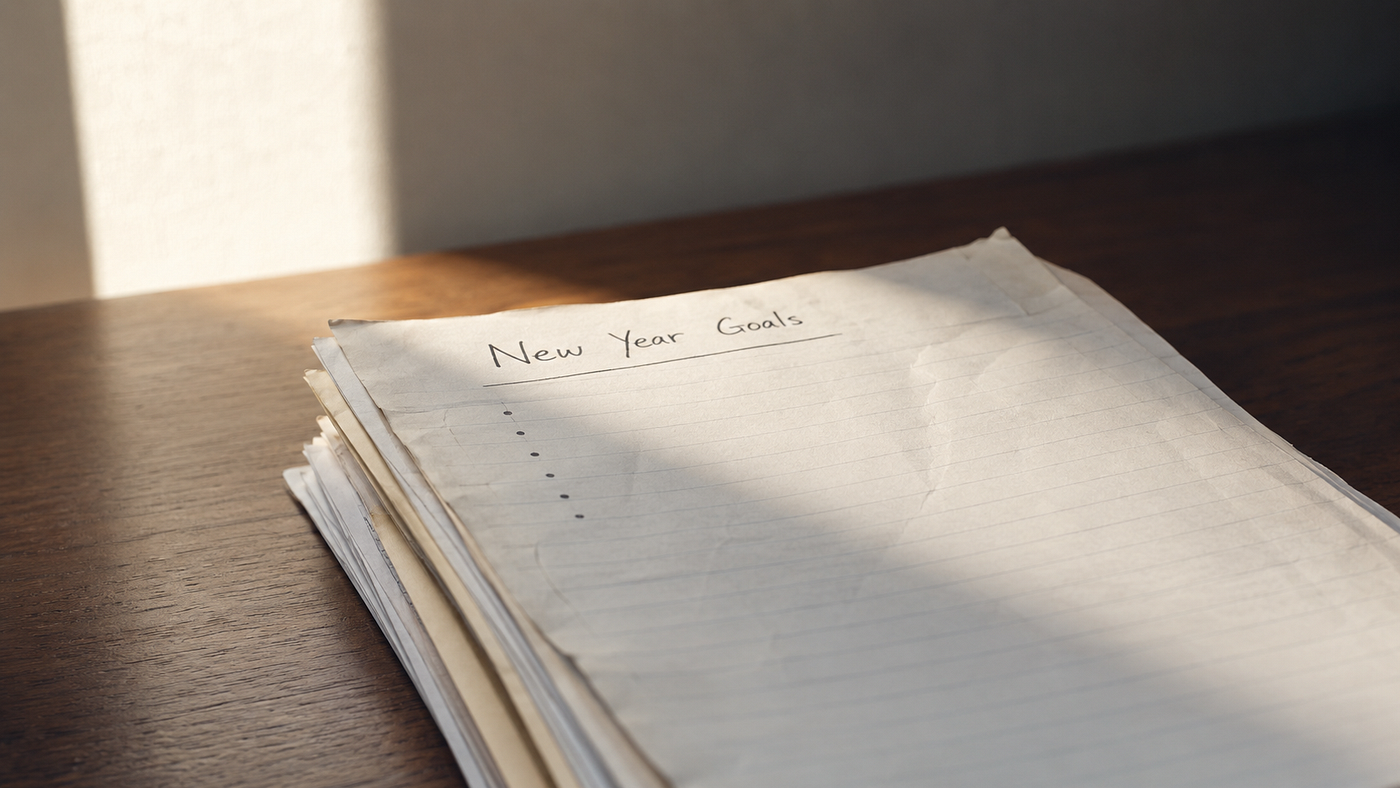
I wrote down what I wanted from the year. Then I didn’t open the page again for months.
I noticed on a weekend, cleaning the papers stacked on my desk. The new year plans were in there, along with notes from the months after. I’d forgotten the list entirely. Looking through it, some items had been done — though not because I remembered they were on it. Some I no longer cared about.
The strange part was what was actually done. Most of it wasn’t from the list. I’d started stretching for lower back pain — not because I’d planned to, but because my back hurt. The list had items that hadn’t moved at all, and the things that had moved hadn’t needed the list to move them.
I wasn’t lazy. Days were busy enough. But the items that didn’t get done were mostly ones that didn’t feel necessary in the moment, or didn’t pay back when I tried them. The list hadn’t failed. It had gone unread.
The writing is the easy half
The writing itself was the easy part. The long stretch of days off at the end of one year and the start of the next is a clear break — you have time, you have a reason to put down what you want from the year. You fill in a fresh page.
That part works. The writing itself.
The other half is coming back, and nothing in the way I’d set things up made that likely. The page sat where I left it. I had no reason to open it until I was cleaning the desk for unrelated reasons.
The break shapes what gets written
The break that nudged me to write the list also shaped what I wrote. Those long days off are a writing-prompt-shaped slot. You sit down because the year flipped, not because something in you finally pushed up to the surface. Some of what I wrote was real — things I’d been carrying for months. Some was newer than that. Resolution-shape filler that fit the moment but didn’t fit me past it.
When I read the list in April, the things I no longer cared about were mostly the second kind. They’d been written because there was a slot, not because I needed to write them.
That doesn’t mean writing in January is wrong. It means the list needed a second pass, not a single one. And the break itself doesn’t push you toward a second pass. It pushes you toward another fresh page next December.
The step can’t come from January
One item on my list this year was clarifying my app’s purpose and value. When I came back to it months later, it had already changed. What I’d thought would be the work — cleaning up the landing page, contacting users in communities — turned out to be different work. I tried the community thing and it didn’t work the way I’d planned. The move that actually came out of it was writing on a recurring shape instead. None of that was knowable in January.
A page I write once and follow assumes I know in January what the next step is. I don’t, and most years I won’t. What I know in January is what I want. The step has to come from trying things, and the goal has to update as the trying happens.
The work is the re-reading
What I’d want from the found moment isn’t a grade. Grading feels bad on the things I didn’t do, and the things I did weren’t from the list anyway. The grade is the wrong frame.
It also isn’t checking whether I followed the plan. That’s another kind of grading. The harder question is whether the plan is still worth following — and if it is, what the next step looks like from where I am now, not from January. So what I’d want is to look at what’s still on the page, notice which items still feel like mine, drop the ones that don’t, and for the ones that stay, find a smaller next step than the one I’d planned. Smaller because the work now is restarting, not pushing the original plan further. Sometimes the smallest step is just opening the thing again. Sometimes it’s noticing the goal has changed shape, and updating it. Sometimes it’s letting it go.
The work isn’t the writing. The work is the re-reading, done from a few months out, when the weight of each item has changed. That’s the part the page can’t supply on its own. I’m still working out what does.
메타데이터
- post_id
- be6e2115dac7
- slug
- forgetting-the-goals-set-in-january-be6e2115dac7
- url
- https://medium.com/@yoshiaki.h/forgetting-the-goals-set-in-january-be6e2115dac7
- canonical_url
- https://medium.com/@yoshiaki.h/forgetting-the-goals-set-in-january-be6e2115dac7
- author_url
- https://medium.com/@yoshiaki.h
- status
- ok
- fetched_at
- 2026-07-30 00:42:56