How My Mother Helped Save Skylab After It Was Damaged During Its Launch in 1973
A short five months after the Apollo Program ended, NASA launched Skylab 1 on May 14, 1973. The vehicle was seriously damaged during…
How My Mother Helped Save Skylab After It Was Damaged During Its Launch in 1973
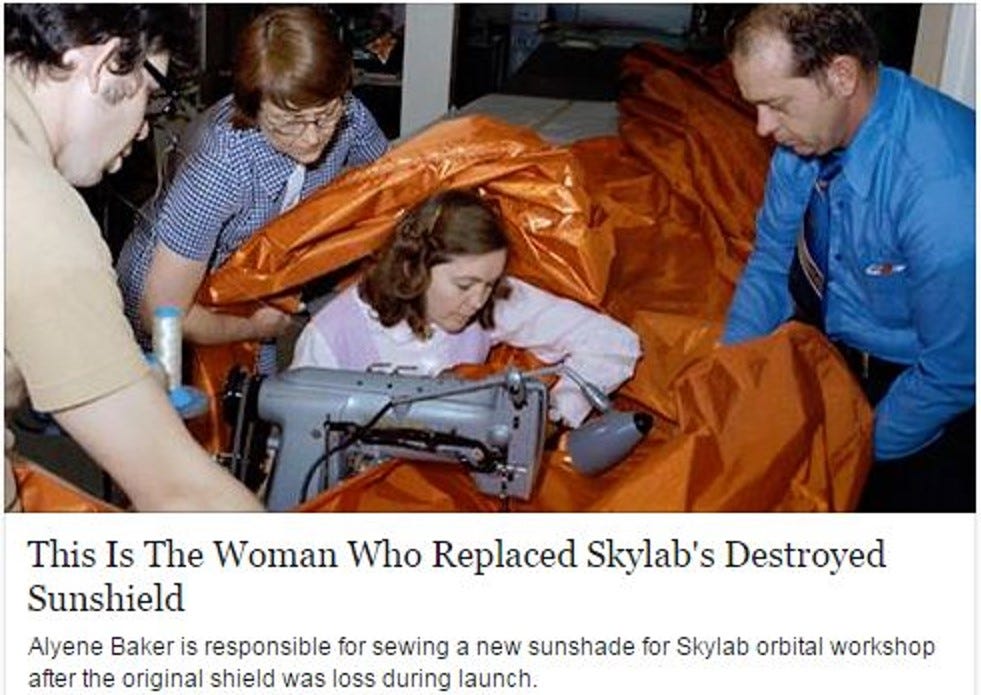
Lead photo from article written by Mia McKinnon for Spaceio9.com in 2015
A short five months after the Apollo Program ended, NASA launched Skylab 1 on May 14, 1973. The vehicle was seriously damaged during launch, losing its micrometeoroid heat shield and one of its two primary solar panels. The remaining solar panel failed to deploy when debris from the lost heat shield became tangled in it, significantly reducing Skylab’s available power.
The plan had been to launch the station, followed the next day by the first crew, referred to as Skylab 2. However, without its heat shield, Skylab was experiencing heat of approximately 125 degrees Fahrenheit inside the Workshop, which made it uninhabitable. In addition, NASA managers were concerned that the excessive heat might cause the off-gassing of toxic chemicals, that the pre-positioned food might spoil, and that the photographic film might be ruined by the heat.
Engineers and astronauts at both JSC and the Marshall Space Flight Center worked around the clock studying options to replace the missing heat shield along with a plan to deploy the remaining solar array through use of a spacewalk.
Several options were considered for replacing the heat shield. The primary criteria were that it had to be small enough to fit inside the Command Module; ready in time for the crew launch; and not require a spacewalk to deploy. Jack Kinzler, Chief of the Technical Services Division at JSC (and the father of a high school friend), developed a plan to use an umbrella-like parasol constructed of aluminum poles and a thin fabric made of nylon ripstop and aluminized mylar.

Scientific airlock in the Skylab workshop through which the parasol was deployed
The parasol would be passed through a scientific airlock in the Skylab Workshop, located directly below where the missing micrometeoroid heat shield had been. It would then be opened like an umbrella and pulled down against the outside hull of the station to protect it from the Sun’s radiation.
My mother, Alyene Baker, who at the time was working as a seamstress for General Electric (GE), the NASA contractor responsible for providing space flight “soft goods” (i.e., fabric-based materials) to JSC, was chosen to do the sewing required to fabricate the parasol.

NASA Photo
The fabric parasol was larger than it looks in most photos — 22 foot by 24 foot.
Within ten days, the parasol was designed, manufactured, tested, flown to Kennedy Space Center, and stowed aboard the Skylab 2 Command Module the night before its launch on May 25, 1973.
Mom rarely talked about her role in sewing the Skylab parasol. I remember her bringing home scrap pieces of that orange-colored parasol fabric. We lived in an old house with no air conditioning and she taped pieces of that fabric into some of our windows. We were the only house in the neighborhood using the same material used to lower the temperature in Skylab to cool our home.

Skylab 2 crew (L to R) Joe Kerwin, Pete Conrad, Paul Weitz (NASA photo)
The first crew (Skylab 2) launched on May 25, 1973, and consisted of Commander Pete Conrad, Pilot Paul Weitz, and Science Pilot Joe Kerwin. As they approached Skylab, they saw that, as suspected, the micrometeoroid heat shield and one solar panel were missing, and the other solar panel was only partially deployed.
The crew moved from the Command Module into the Workshop the next day to begin activating it. It was very hot inside Skylab but, fortunately, there were no toxic gases. The crew’s first job was to assemble the parasol, attaching poles to the fabric to make it work like an umbrella. After assembly, it was pushed through the scientific airlock, spread open, and pulled flush with the area of the missing heat shield.

Skylab orbiting Earth after the parasol was deployed and the jammed solar panel was released (NASA photo)
The temperature began to drop and within three days was down to a more comfortable 82 degrees. Skylab was saved! The crew later managed to free the jammed solar panel, providing enough power for the following crews to perform their planned experiments.

Award presented to the author’s mother for her support to the Skylab mission signed by all nine Skylab astronauts
All nine of the NASA astronauts that spent time on Skylab in orbit signed a note of appreciation to Mom after their missions were completed.
— — — — — — — — — — — — — — — — — — — — — — — — — — — — — — —

Photo from Skylab segment shown on The History Channel including the author’s mother sewing the Skylab parasol
The story of Mom sewing the parasol was also featured in a segment on The History Channel titled Modern Marvels — Engineering Disasters (referring to Skylab’s launch).
메타데이터
- post_id
- be74ec8802e3
- slug
- how-my-mother-helped-save-skylab-after-it-was-damaged-during-its-launch-in-1973-be74ec8802e3
- url
- https://medium.com/@herb.h.baker/how-my-mother-helped-save-skylab-after-it-was-damaged-during-its-launch-in-1973-be74ec8802e3
- canonical_url
- https://medium.com/@herb.h.baker/how-my-mother-helped-save-skylab-after-it-was-damaged-during-its-launch-in-1973-be74ec8802e3
- author_url
- https://medium.com/@herb.h.baker
- status
- ok
- fetched_at
- 2026-07-22 09:03:43