From Consul to Istio: Architecture Trade-offs and Cloud-Native Gains
From Consul to Istio: Architecture Trade-offs and Cloud-Native Gains
From Consul to Istio: Architecture Trade-offs and Cloud-Native Gains
In modern microservices architectures, service discovery, traffic routing, and observability are critical design considerations. Traditionally, I relied on Consul for service registration and discovery. While it provides a lightweight service mesh, the growing complexity of our system and the Kubernetes ecosystem led me to reevaluate this choice.
This post outlines the architectural trade-offs and rationale for migrating from Consul to Istio, and explains how this migration enhances the system’s cloud-native capabilities, particularly for GitOps workflows.
Why Reconsider Consul
Consul has several strengths:
- Service discovery via its catalog.
- Basic service mesh features such as routing, service segmentation, and retries.
- Lightweight and relatively simple to deploy.
However, in a Kubernetes-centric ecosystem:
- Consul’s service mesh capabilities are not natively integrated with Kubernetes primitives such as pods, services, and namespaces.
- Observability and traffic monitoring are limited compared to a full-fledged service mesh. Integrating tools like Prometheus, Grafana, or Kiali is possible but not as seamless.
- Supporting pod-level sidecar injection or namespace-level traffic policies requires additional configuration and does not integrate naturally with Kubernetes control mechanisms.
These limitations prompted a shift to a Kubernetes-native solution that provides fine-grained traffic control, full observability, and tight integration with service deployments.
Why Istio
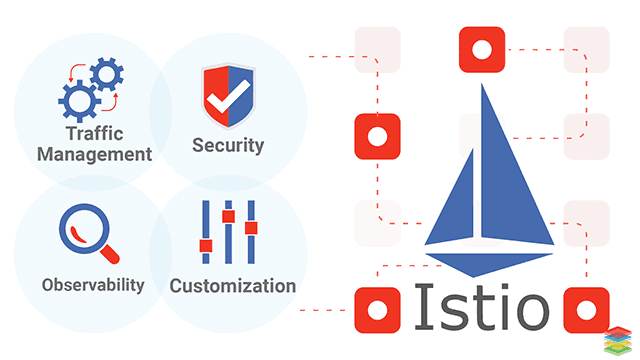
Istio provides a richer set of features for Kubernetes environments:
- Sidecar proxy injection: Traffic control is applied at the pod level without touching application code. This allows seamless service-to-service communication and routing.
- Namespace-level management: Labels enable selective sidecar injection, supporting environment isolation (e.g., dev vs prod) while maintaining consistent policies.
- Advanced traffic routing: HTTP routes, weighted routing, retries, and canary deployments can be defined declaratively.
- Observability and monitoring: Integrated with Kiali, Prometheus, and Grafana, Istio provides visualization of service dependencies, traffic flows, and metrics, which Consul’s native UI cannot fully deliver.
- Security and zero-trust: Istio supports mTLS for pod-to-pod encryption and authorization, and integrates with Spring Security to provide cluster-level authentication and fine-grained authorization. In addition, it aligns naturally with Kubernetes RBAC, enabling microservices to participate in the cluster’s native authorization model. This allows service identities, workloads, and APIs to share a consistent RBAC-based security foundation, enabling a seamless, zero-trust security model across services without requiring application-level changes.
- Cloud-native compatibility: As a Kubernetes-native component, Istio supports pod-to-pod communication, service-based addressing, and sidecar injection without requiring additional configuration in microservices.
In short, Istio aligns closely with Kubernetes’ architecture, providing a more predictable, observable, and maintainable service mesh than Consul.
Trade-offs and Considerations
Switching to Istio requires careful consideration:
- Complexity: Istio introduces additional components—control plane, proxies, and CRDs—that require understanding and operational knowledge.
- Resource overhead: Sidecar proxies consume CPU and memory, which must be accounted for in cluster sizing.
- Learning curve: Developers must understand Envoy proxies, traffic routing rules, and the observability stack (Kiali/Prometheus/Grafana).
Despite these considerations, the benefits outweigh the costs for a production-grade, Kubernetes-native environment, particularly when managing multiple environments and microservice dependencies.
Enabling GitOps and Cloud-Native Practices
By standardizing on Istio with Kubernetes, the architecture becomes fully cloud-native and aligns with GitOps principles:
GitOps principles:
- Declarative environment management: Kubernetes manifests can describe dev and prod environments. Istio configurations for routing, retries, and policies can be versioned alongside service definitions.
- Environment isolation: Dev and prod clusters are fully separated; dev uses port-forward for dependencies, while prod relies on
svc.namespace.svc.cluster.localcommunication. - Automated deployment pipelines: GitOps workflows can continuously deploy manifests, Istio policies, and service configurations. Terraform or other IaC tools can extend this to multiple clouds (AWS, GCP, Azure), making deployments repeatable and auditable.
- Predictable traffic management: Istio ensures that routing, retries, and failure policies behave consistently across dev and production, reducing “it works on my machine” issues.
In essence, migrating from Consul to Istio reduces intermediate state complexity (one for local, one for Docker Compose, and one for the k8s prod env), aligns microservices with Kubernetes-native primitives, and unlocks the benefits of declarative, GitOps-managed cloud-native deployments.
Local Development with Kind and Istio
One of the key enablers for modern cloud-native developments is the ability to replicate production-like conditions locally. By running Kind on a local Kubernetes cluster, developers can spin up a fully isolated environment that mirrors the production topology without relying on Docker Compose or other ad hoc setups.
Combined with Istio, even in a local environment, you can validate many Layer 7 (L7) network scenarios:
- Traffic routing and canary deployments: simulate weighted routing between microservice versions.
- Service-to-service observability: leverage telemetry and metrics with Prometheus, Grafana, and Kiali dashboards.
- Fault injection and resiliency testing: test retries, timeouts, and circuit breakers under controlled conditions.
- Namespace-level sidecar injection: replicate multi-tenant or environment-specific policies locally.
Because Istio operates at the L7 network layer, all of these classic service mesh use cases can be validated in a local Kind cluster, giving developers confidence that their changes will behave as expected in production.
Conclusion
While Consul remains a viable option for lightweight service discovery and service mesh features, it is best suited for scenarios where:
- The system scale is relatively small.
- Kubernetes-native traffic management is not required.
- Observability needs are limited and can be satisfied with basic monitoring.
In such cases, Consul is a best practice due to its simplicity and low operational overhead.
However, when adopting GitOps workflows, cloud-native principles, and Kubernetes-centric environments, Istio’s service mesh provides clear advantages:
- Declarative, version-controlled traffic management that aligns with GitOps.
- Advanced observability and telemetry with integrated dashboards(Kiali, Jaeger, Grafana, and Prometheus).
- Namespace- and pod-level sidecar injection for environment isolation and consistent policies.
- Fine-grained routing, retries, and canary deployments that are fully Kubernetes-native.
- Easier integration with multi-cluster or multi-cloud deployments (AWS, GCP, Azure) using declarative manifests.
In short, Istio excels in cloud-native, GitOps-driven, large-scale microservice environments, while Consul is better suited to small-scale, lightweight service-discovery scenarios. Choosing the right tool depends on your scale, operational complexity, and observability requirements.
메타데이터
- post_id
- be752a24c49c
- slug
- from-consul-to-istio-architecture-trade-offs-and-cloud-native-gains-be752a24c49c
- url
- https://blog.devops.dev/from-consul-to-istio-architecture-trade-offs-and-cloud-native-gains-be752a24c49c
- canonical_url
- https://blog.devops.dev/from-consul-to-istio-architecture-trade-offs-and-cloud-native-gains-be752a24c49c
- author_url
- https://medium.com/@rurutia1027
- status
- ok
- fetched_at
- 2026-07-13 15:46:03