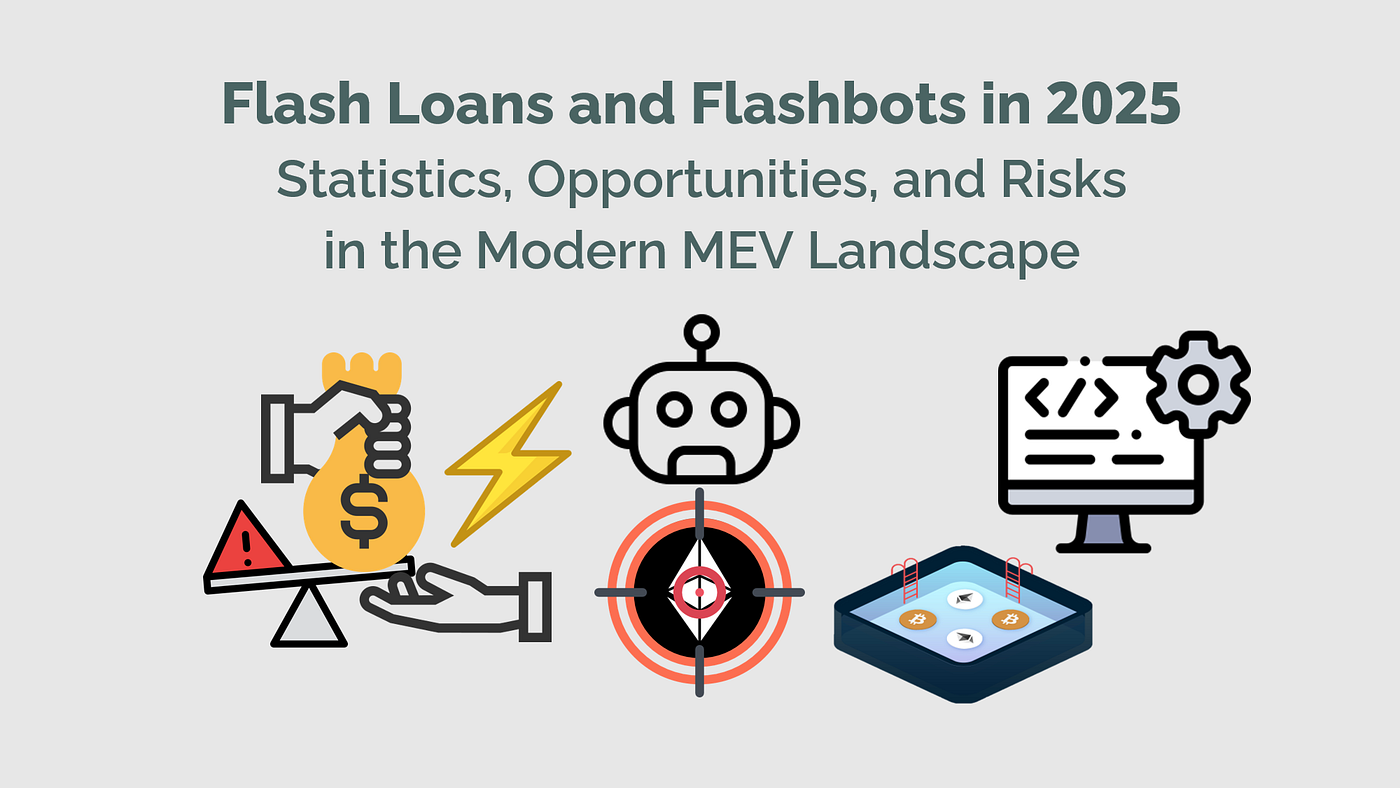
Flash Loans and Flashbots in 2025: Statistics, Opportunities, and Risks in the Modern MEV Landscape
Since their introduction, flash loans have become one of the most controversial mechanisms in DeFi. Combined with the rise of Flashbots and…
Flash Loans and Flashbots in 2025: Statistics, Opportunities, and Risks in the Modern MEV Landscape
Since their introduction, flash loans have become one of the most controversial mechanisms in DeFi. Combined with the rise of Flashbots and MEV-aware infrastructure, the flash loan economy in 2025 has matured into a sophisticated ecosystem. Developers, arbitrageurs, and even institutional players now use these tools for profits and innovation in areas like cross-chain liquidity and DeFi automation. This article breaks down how flash loans and Flashbots have evolved in 2025, their key statistics, real-world use cases, emerging opportunities, and the associated risks.
What Are Flash Loans?
Flash loans are uncollateralized loans that must be borrowed and repaid within a single blockchain transaction. If the borrower fails to repay, the entire transaction is reverted, ensuring zero risk to the lender. Initially pioneered by Aave and dYdX, flash loans allowed savvy users to arbitrage price differences across decentralized exchanges, refinance loans, or manipulate governance — all in one atomic operation. By 2025, flash loans will have become an essential building block for advanced DeFi strategies, especially when combined with MEV-aware tools like Flashbots.
What Are Flashbots?
Flashbots is a research and development organization designed to mitigate the negative externalities of Maximal Extractable Value (MEV) while democratizing access. MEV is the profit miners (or validators) that can extract it by reordering, inserting, or censoring transactions within blocks. Flashbots introduced the concept of searcher-builder-proposer separation and created a private transaction submission system via MEV-Boost, a middleware that allows validators to receive bundles from multiple builders. According to the latest metrics, by 2025, Flashbots will handle over 80% of Ethereum block proposals and have expanded to support L2s like Optimism and Arbitrum.
Real-World Use Cases
Arbitrage and Triangular Trading
Flash loans allow traders to instantly borrow millions, execute arbitrage across decentralized exchanges (DEXs), and repay—all in one transaction. In 2025, these trades will be optimized using AI-based bots and routed via MEV-Boost relays for block inclusion guarantees.
DeFi Liquidations
In lending protocols like Aave v3 or Compound IV, flash loans are used to liquidate undercollateralized positions. The borrower earns a liquidation fee, and the operation is often automated by smart bots connected to real-time oracles.
Debt Refinancing
Users use flash loans to repay expensive positions and immediately open cheaper ones on competing protocols, effectively performing a costless debt migration.
Governance Attacks
Although now heavily mitigated, flash loans were once used to accumulate voting power in DAOs temporarily. Today, protocols use time-weighted voting or reputation systems to counteract such manipulation.
Cross-Chain MEV
With tools like Chainlink CCIP and LayerZero, flash loans are now part of cross-chain MEV strategies. Traders exploit latency or price discrepancies between chains using atomic bundles relayed through MEV-aware cross-chain bridges.
How To Create a Flash Loan in Less Than 5 Minutes
If you want to learn tools that allow you to build a flash loan quickly, check out **this article** by Bitium Blog.

Top 3 Tools To Create a Flash Loan in Less Than 5 Minutes by Bitium Blog
Key Stats in 2025
- $3.5B+ in flash loans executed monthly, driven by new DeFi protocols and liquid staking strategies.
- Over 65% of flash loan transactions are routed through MEV relays using Flashbots or its successors.
- MEV-related profits (including flash loan arbitrage) exceed $750M annually, with most profits concentrated among sophisticated searchers.
- Approximately 15,000 flash loan transactions occur daily across Ethereum and layer-2 networks
- The average fee for flash loan services has decreased to 0.05% from 0.09% in 2023
The Role of MEV-Boost Relays
MEV-Boost is now the standard middleware that Ethereum validators use to outsource block construction to external builders. This system separates block building (by searchers and builders) from proposing (by validators), reducing centralization risks.

MEV-Boost Relay Flow | Source: https://docs.flashbots.net/flashbots-mev-boost/relay
How it works:
- Searchers bundle transactions for MEV (e.g., flash loan arbitrage).
- Builders construct optimal blocks from searcher bundles.
- Relays these blocks forward to validators who choose the most profitable ones.
Flashbots, bloXroute, and Manifold are central MEV-Boost relays in 2025. Using MEV-Boost, searchers can ensure their flash loan strategies are included in a block without revealing them to the public mempool, preventing frontrunning and sandwich attacks.

Statistics about MEV-Boost Relays | Source: The Block
Opportunities for Developers and Traders
- Flash Loan-as-a-Service (FLaaS): SDKs and APIs now allow developers to access flash loan liquidity from multiple protocols in a plug-and-play fashion.
- Private MEV Search Engines: Flash loan-based arbitrage is increasingly routed through private bundles submitted to MEV relays, offering stealth and faster execution.
- Decentralized Builders: New protocols like SUAVE (by Flashbots) enable decentralized block building, democratizing flash loan MEV access.
- Yield Aggregators: Flash loans are used for real-time rebalancing across yield farms, generating better returns for users.
Risks and Challenges
- Centralization of MEV: Despite MEV-Boost, concerns persist around builder centralization. Few block builders dominate most of the profitable MEV opportunities.
- Flash Loan Spam and Congestion: Overuse of flash loan bots can congest networks, especially during volatile market conditions, driving up gas fees.
- Security Risks: Complex flash loan strategies can exploit vulnerable smart contracts, leading to multi-million dollar exploits. Protocols must undergo rigorous audits and simulations.
- Regulatory Concerns: With growing profits and usage, regulators are increasingly scrutinizing flash loans for potential market manipulation and insider arbitrage.
Conclusion
In 2025, flash loans and Flashbots will become critical pillars of the DeFi infrastructure, powering high-frequency arbitrage, liquidation automation, and advanced cross-chain trading. The synergy between atomic execution and MEV optimization will enable unprecedented opportunities and complex risks.
At Bitium Web3 Development Agency, we help innovators integrate flash loan logic, MEV routing, and advanced DeFi strategies. Whether you’re building a liquidation engine or a private MEV searcher bot, we offer full-stack support to stay ahead of the curve.


메타데이터
- post_id
- be9218b4f7b0
- slug
- flash-loans-and-flashbots-in-2025-statistics-opportunities-and-risks-in-the-modern-mev-landscape-be9218b4f7b0
- url
- https://blog.bitium.agency/flash-loans-and-flashbots-in-2025-statistics-opportunities-and-risks-in-the-modern-mev-landscape-be9218b4f7b0
- canonical_url
- https://blog.bitium.agency/flash-loans-and-flashbots-in-2025-statistics-opportunities-and-risks-in-the-modern-mev-landscape-be9218b4f7b0
- author_url
- https://medium.com/@bitiumblog
- status
- ok
- fetched_at
- 2026-06-22 17:31:34