Film and Culture: ‘The Devil Wears Prada 2' and The Crone’s Comeback
By Wolfgini Guest Contributor
Film and Culture: ‘The Devil Wears Prada 2' and The Crone’s Comeback
By Wolfgini Guest Contributor
The crone is always cast as the villain, but forever lives as the Hero.
The moment we see a woman with silver hair and an air of discernment, we automatically paint her as a mean, evil, unfeeling nemesis to whatever goal we are trying to achieve. It’s a literary and cinematic trope played out over and over and over in life and art.
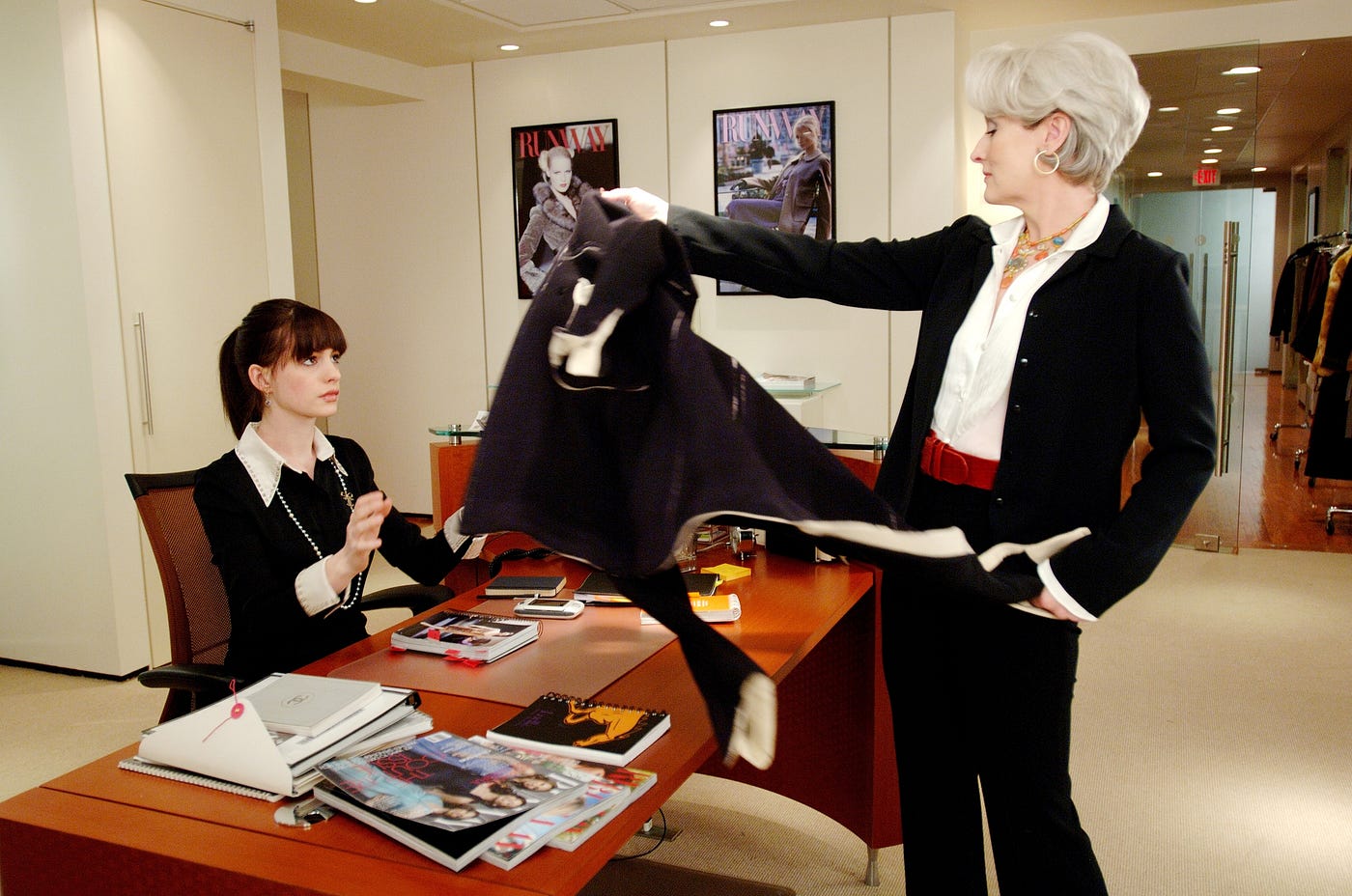
Andy (Anne Hathaway) and Miranda (Meryl Streep) in the first ‘The Devil Wears Prada’ film.
The trope reflects the lived experiences of many an ingenue with admirable gumption, quivering bottom lips, and wide-eyed hopes for what the world can be, rather than the reality of what it actually is.
This is how the first The Devil Wears Prada film plays out. It serves as a revelation that for every maiden voyage, there is always a Crone enterprise. The Crone is full of quips and criticism, which is seemingly harsh if not completely honest and reliable.
Miranda Priestly, played by Meryl Streep, is, of course, the Crone, and Andy Sachs, played by Anne Hathaway, is her opposite—the maiden.
That’s what made the film a beloved staple on the shelves of every 18-year-old millennial girl who has a heartbeat for boss girl success stories.
Fast forward 20 years, and we are all approaching perimenopause, dangling from the cliff of fascist conglomeration, realizing that we have given too much to the dream devil that hates us — the patriarchy.

Hathaway and Streep in ‘The Devil Wears Prada 2’ in theaters now.
And in walks the Devil (the Crone) with a capital “D,” adorned in silver and gliding in Prada. Her understated glamour takes our breath away. And we realize we are so much closer to being her than we ever were to the upbeat, care-free, off-the-rack Andy Sachs, played by Anne Hathaway.
The second iteration of this film legacy paints a world in which we are all disappointments in one way or another. Everyone in this world, ours included, is an imperfect, mistake-filled creature who either hustles to prove a point or continues on because we love the art of working. Make no mistake here, the maiden/crone tropes are the same, but the lens is far different.
The film sets us down amidst a crumbling collapse of the institution of journalism. Bolstered by the push for scroll-worthy business and the convenience of AI sentience, our present lived experience is reflected back at us through idiotic billionaires. In the film, they are represented by the satirically Jeff Bezos-like character Benji Barnes (played by Justin Theroux), a man who suggests exploring the surface of the sun as the next frontier. He’s joined by Jay Ravitz (played by BJ Novak), whose blatant nepotism is gasoline, fueling the plight of creative enterprise.

Meryl Streep is Miranda Priestly
It is uncanny how similar in real life and in the film, the public at large is hanging by a thread, gasping for air as the freedom of the press and the standards of artistic institutions disappear. Similarly, the world of The Devil Wears Prada 2 is stripped before our eyes of its integrity to reveal the gritty underbelly. Leaving no doubt of just how much the world hates an accomplished, forthright, older woman.
From investors, to advertisers, and even human resources, make Miranda plead and beg for the one thing she crafted and built with her own hands — Runway magazine. They cloud the fashion maven’s atmosphere with her past mistakes, her current missteps, and her inability to stay relevant. And yet…
And. Yet…
She remains. Miranda, our Crone, sits back and takes it.
Miranda/Crone pulls her people in while simultaneously holding them at arm's length. Doing so comes from knowing that she can trust no one, but desperately wanting to.
And that want, for once, does not go unnoticed by the younger women, millennials in the audience, who are just starting to “get it.” The collective “we” now understands that having a stiff upper lip and timeless style isn’t just earned. It’s also polished by the cost of constant attention to career details, instead of hyperfocus on traditional motherhood and homemaking.
In this way, Miranda’s character becomes relatable and painstakingly human in her struggle to “roll” with the changes being thrust upon her. We understand her now.
“We,” who are currently doing it all, the kids, the marriage, the divorce, the household, the career, the passion, the scrutiny.
And it dawns on us that the billionaires and tech bro idiots will not save us.
The Crone we dread becoming, will.
Photo by K. Mitch Hodge on Unsplash
Society, particularly through literature and film, has trained us for centuries to categorize women within three classic tropes: The Maiden, The Mother, and The Crone.
They are the great triumvirate, the holy Three of humanity.
These are the Fates.
They are Hecate and her three faces.
It is how the mythological “hoax” appropriated by Christianity and the Roman Empire was turned to glorify a patriarchal point of view.
The Maiden, or the ingenue, dresses in Blue. She is naive, ambitious, innocent, and pure. She’s not traumatized by the world at large. Therefore, she is susceptible to corruption, much like Eve and the apple in The Bible. She wears the light blue cloak of the Virgin Mary, protected in her virtue.
Photo by Kamilla Isalieva on Unsplash
The Maiden is actually representative of springtime and the awakening of the senses. This includes clarity and untouched intuition, a childlike sense of wonder and creativity. She is possibility personified when seen through a matriarchal lens. In The Devil Wears Prada, the original film, Andy is the maiden. Notice how this puts the “cerulean” exchange in the film in a different perspective.
Then, there’s the Mother. She is the ultimate nurturer and the caregiver of entire ecosystems, a never-ending pool of love and endurance. She is dutiful to her children and all of creation. She is giving all of herself until nothing remains.
But what the patriarchy ignores is that motherhood is so much more than breeding and caring. It is fierce protection, fueled by a warrior’s strength and unyielding power. It is a battle cry. It is reciprocal and all-encompassing. It is terrifying. The Mother is the heart of leadership.
Photo by Silvio Valinhos on Unsplash
And finally, there is the Crone. Pictured by the male gaze as a wrinkly spinster whose fertility has run out. Crotchety and ugly, past her prime and altogether worthless to society. A burden. A hindrance. Something the Maiden and Mother must avoid becoming at all costs.
Alas, the Crone is what makes the world go round. She doesn’t need her fertility to make an impact. She sustains us all by quietly running the mechanisms of life and death. Her quiet power controls us all, especially when we aren’t expecting it to.
Photo by British Library on Unsplash
She is in the deep beds of snow over the fields of winter, preserving life, feeding The Mother, raising The Maiden, and teaching us lessons she has learned through time and experience. Her wisdom is unparalleled, and her magic is mastered, which is why she is feared and often muzzled by patriarchal institutions.
The first The Devil Wears Prada film portrays Andy Sachs as the Maiden and Miranda Priestly as The Mother. The Devil Wears Prada 2 brings us up to speed with the new version of The Mother in Andy, and the faulted holiness of The Crone in Miranda.

From the left, Anne Hathaway as Andy, Meryl Streep as Miranda, and Stanley Tucci as Nigel in “The Devil Wears Prada 2.”
Don’t ever forget that pop culture perpetuates tropes in storytelling. These tropes have the ability to shift our perspective and enlighten us on the true meaning behind an iconic film. They also help us to properly critique the quality of a sequel.
The Devil Wears Prada 2 reminds us all that there is something more powerful in society than the industry. There’s the women who have, against all odds, kept the industry running — in order to change it and shape it into the art it was always supposed to uplift and immortalize.
The Devil Wears Prada 2 is in theaters now.
[embed]
***Editor’s Note: This article is written by Wolfgini and edited by Jonita Davis . Wolfgini is a writer and poet whose work has been featured in Yoga Journal as an advice columnist and contributing author and multiple other publications. Visit WOLFGINI.com to learn more.

Wolfgini
메타데이터
- post_id
- beac592db2fb
- slug
- film-and-culture-the-devil-wears-prada-2-and-the-crones-comeback-beac592db2fb
- url
- https://theblackcapemag.com/film-and-culture-the-devil-wears-prada-2-and-the-crones-comeback-beac592db2fb
- canonical_url
- https://theblackcapemag.com/film-and-culture-the-devil-wears-prada-2-and-the-crones-comeback-beac592db2fb
- author_url
- https://medium.com/@jonitaldavis
- status
- ok
- fetched_at
- 2026-07-10 19:34:48