General Relativity on its own terms — a structural account
Relativity is dense, but well lauded: it has shockingly compressed predictive power. It does not answer why so much as describe how…
General Relativity on its own terms — a structural account
General Relativity on its own terms — a structural account
Relativity is dense, but well lauded: it has shockingly compressed predictive power. It does not answer why so much as describe how. Gravity, for instance, is “curvature of spacetime”: a beautiful analogy, but woefully unsatisfying as a tangible construct.
Into that void have sailed many interpretations, all in the name of conceptual clarity. This is my stab at separating the ground-truth math from the mostly-reasonable but ungrounded interpretation laid over it, clearly and as briefly as the structure allows.
General relativity is a structure of objects, and the dependencies among them are its math: what presupposes what, what is determined by what, what is assumed and what is derived. Math appears only where a relation cannot be stated without it.
The account is of the classical theory. Quantum and semiclassical content (matter fields as operators, particle production, Hawking radiation) is intentionally left out.
This is mostly an exercise to deepen my personal intuition for general relativity, and the rigor here is in locking the math as ground-truth correct.
GR Foundation
Three commitments ground everything below.
Equivalence. Free-fall is locally indistinguishable from inertial motion. There is no separate gravitational force on a freely falling test body; what was “gravity” is the geometry of spacetime, and free bodies follow its straightest paths. The gravitational field is not a thing in spacetime but a property of it. (How much of this is assumption and how much is theorem turns out to be a live question; we return to it in §3.)
Background independence. There is no fixed, non-dynamical stage. The geometry — the metric — is itself a dynamical object, not a backdrop laid down in advance; the only prior structure is the bare manifold (smoothness, dimension). General covariance expresses this: the physics is in the relations among events, and any smooth relabeling of points changes nothing (diffeomorphism invariance is the gauge symmetry). But covariance alone constrains nothing, since any theory can be written covariantly. What does the work is the absence of a fixed background.
Locality and second order. The laws are local: what happens at an event depends on conditions at and infinitesimally around it. The field equation is second-order in the metric — the metric, its rate of change, and its curvature, with no higher derivatives. This is a commitment about the form of the law, and it fixes which law GR is.
This is what earns GR its name: the concreteness of asserting no ground-truth frame of reference. It helps to anchor every principle below against this foundation.
The dependency structure
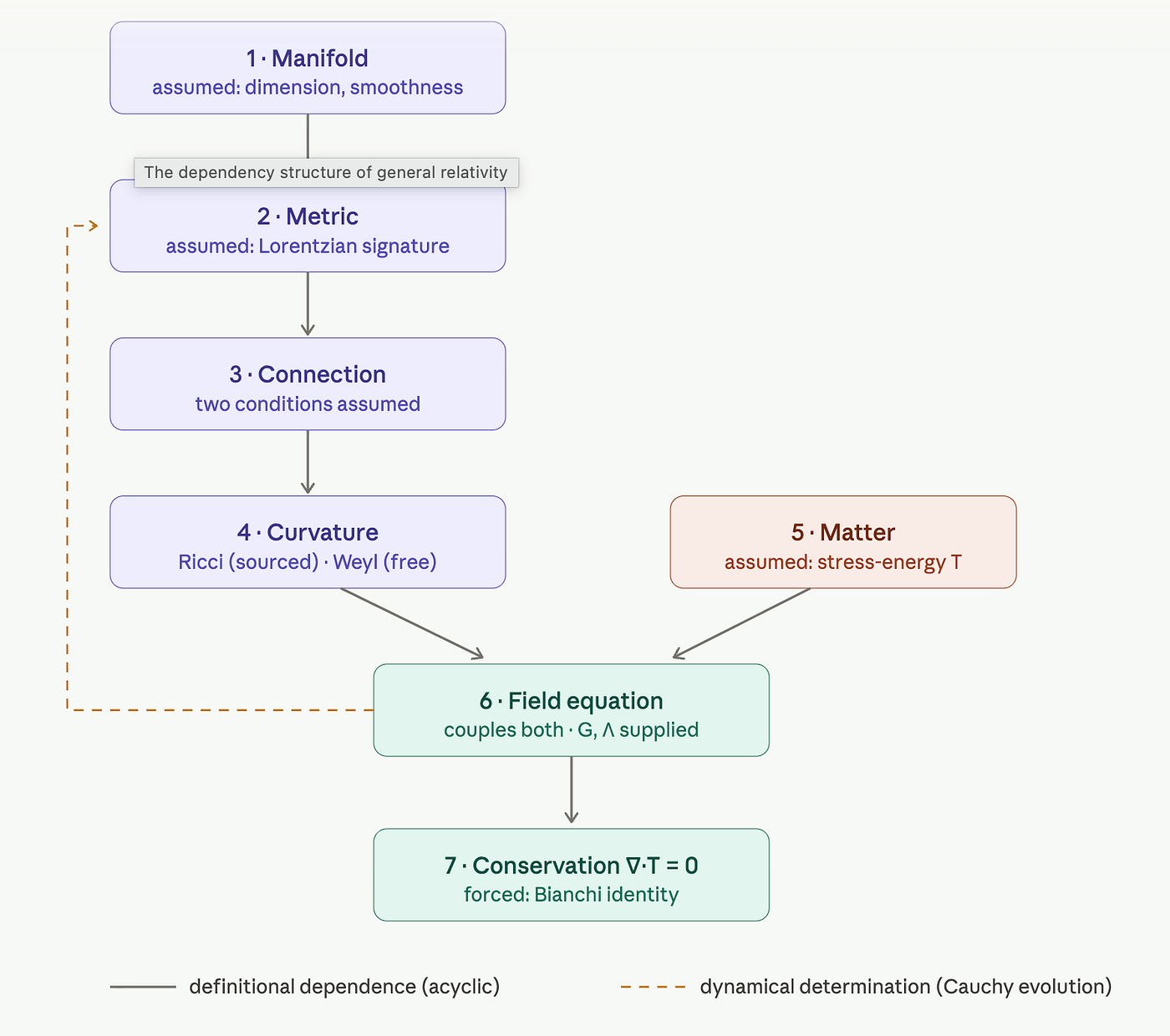
GR is layered. Each layer presupposes the ones above it and adds one new object — but this is definitional order, not physical construction. The field equation (§6) adds the one dynamical link that loops back.
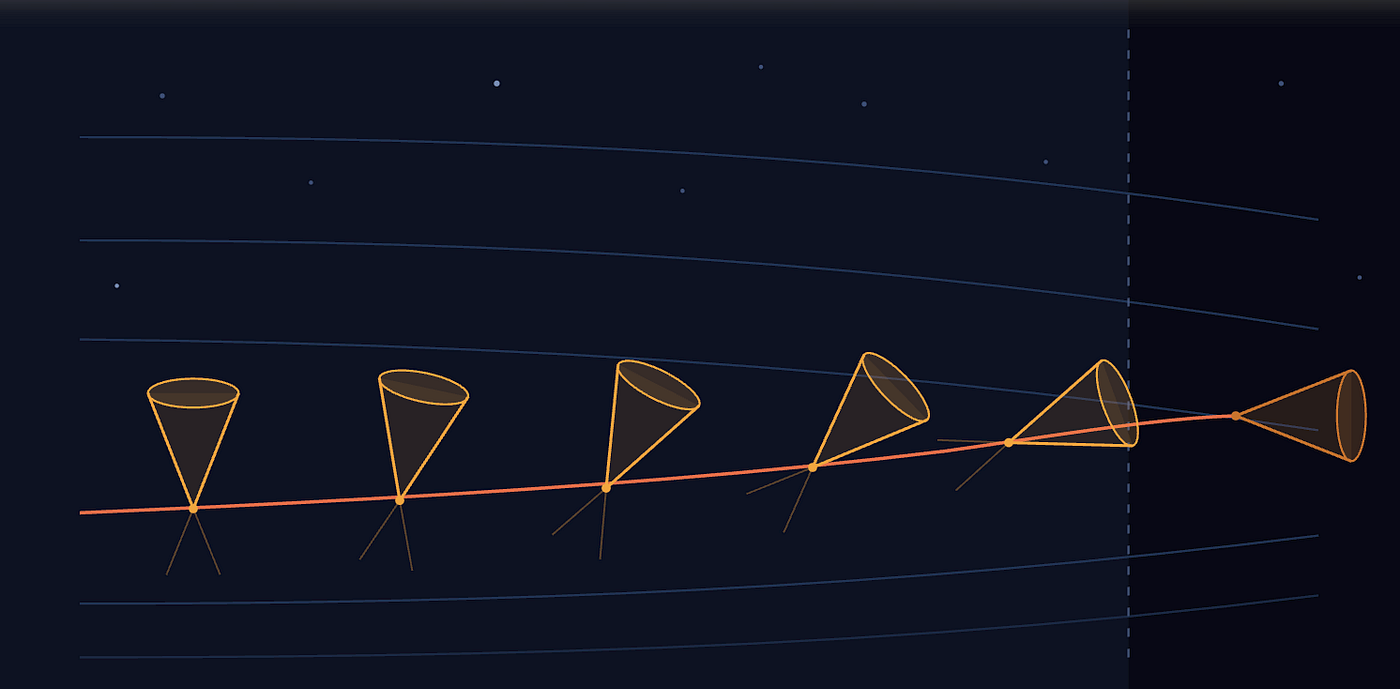
Keep one picture in mind throughout: the light cone. From any event (a single point in space at a single moment) imagine a flash of light expanding in all directions; the path it sweeps through spacetime is that event’s light cone. It is the structure everything below anchors on: what can reach what, and in which order. The cones tilt smoothly from event to event, and you will see they are built, not assumed — a determination of the metric, §2. Hold the picture through the journey.
1. Manifold — the bare continuum
The ground floor is a four-dimensional smooth manifold: a set of events with just enough structure to say that events can be arbitrarily near one another and that calculus can be done. Nothing more. At this layer there is no distance, no duration, no causal order, no straightness. There is only continuity, dimension (four), and smoothness. The rest is added by the metric.
2. Metric — the structuring object
A metric field, written g, is specified on the manifold. It assigns, at every event, the squared interval of an infinitesimal displacement:
ds² = g_μν dx^μ dx^ν
From this one object the following are read off, not added separately.
Intervals. The number ds² above: the invariant separation between neighboring events.
Causal structure. The metric has Lorentzian signature (−+++): the time direction enters with the opposite sign to the three spatial ones. So ds² can be negative, zero, or positive, sorting every displacement into timelike (ds² < 0 in this convention — the minus sign marks time), null (ds² = 0), or spacelike (ds² > 0). Signature fixes the type: that there are light cones at all, and the threefold sorting. The actual cones at each event — their tilt and opening, hence which events a signal from here can reach — are fixed by the full metric components, and vary event to event. Causal order is therefore a metric determination, not a curvature one: signature gives the cone-type, the metric field gives the cones.
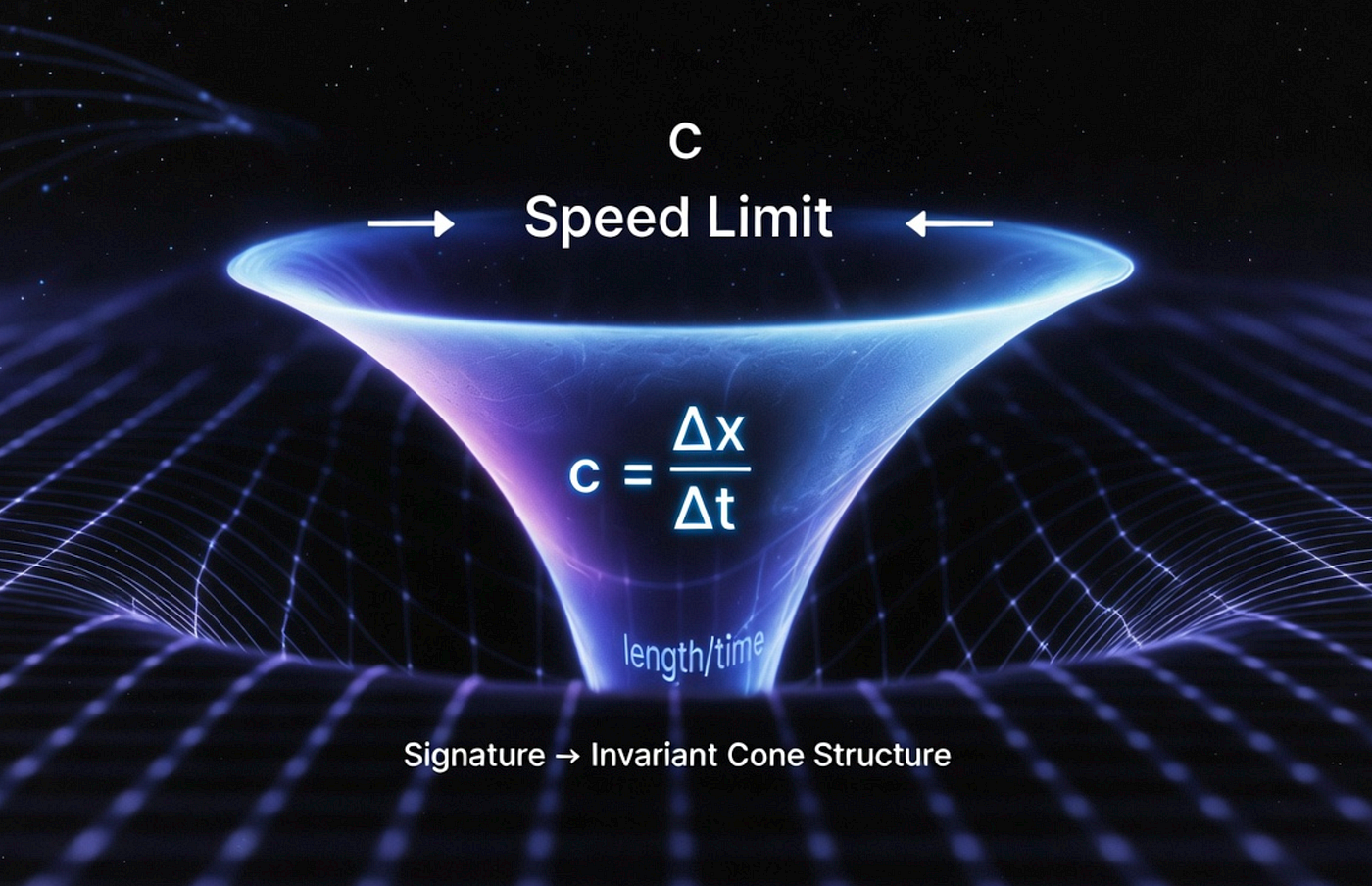
What is primitive here is the Lorentzian signature and the invariant cone structure it induces — the content that survives setting c = 1, and that distinguishes this from Galilean spacetime, where time and length are genuinely different kinds of quantity, with no exchange rate between them because nothing invariant relates them.
And here the most familiar constant in physics needs recasting. The constant c is not, at bottom, a speed. It is a conversion ratio between units. The signature mixes one time direction with three spatial ones into a single geometric object; ds² adds durations and distances together, which is only possible if they are the same kind of quantity. Humanity, not knowing this, chose units for them separately — seconds here, meters there — and c is the exchange rate that choice forces, the same way a miles-to-kilometers factor would appear if a single length were bookkept in two unit systems. It must be frame-invariant, or ds² would be frame-dependent and the construction would collapse. Its numerical value, 299,792,458 m/s, measures nothing about nature on its own; it measures the mismatch between two human unit choices, which is why it can be set to 1 and deleted with no physics lost.
The “cosmic speed limit” is real but derivative: the statement that timelike worldlines stay inside the cones, wearing the conversion ratio as its unit-laden costume. Reading c primarily as a limit gets the dependency backwards. It makes a corollary look like a primitive.
The same conversion ratio reappears in E² = (pc)² + (mc²)², making energy, momentum, and mass commensurable; at rest, E = mc².
The famous equation is not a statement about a speed at all — nothing is moving.
It is the same exchange rate again, converting mass-units into energy-units, because the relation is the on-shell condition p_μp^μ = −m²c²: the cone structure showing up once more, not a separate step.
Proper time. Along a timelike curve — a possible worldline of a massive body — the accumulated √(−ds²) is the time elapsed on a clock carried along that curve: τ = ∫ √(−g_μν dx^μ dx^ν). Proper time is not a coordinate. It is a property of the path, read off the metric along it, and two worldlines between the same pair of events generally accumulate different amounts of it.
Proper distance. The analogous integral of √(ds²) along a spacelike curve: ruler-distance, again read off the metric along the path.
3. Connection — comparison across points
The physics happens by comparing vectors — velocities, say — at different events. But a vector at one event and a vector at another live in different tangent spaces and cannot be subtracted directly. The connection supplies the rule for transporting a vector from one event to a neighboring one (“parallel transport”), so that comparison becomes possible.
In GR the connection is fixed by the metric, given two conditions GR imposes: that transport preserve the metric (lengths and angles unchanged — “metric-compatible”), and that it be symmetric (“torsion-free”). Those two conditions pick out a unique connection, the Levi-Civita connection. They are GR’s choice, not a necessity. Dropping torsion-free gives Einstein–Cartan (torsion); dropping metric-compatibility gives nonmetricity (the metric-affine family). So they belong among the things GR assumes. The clean version is the “geometric trinity”: the same gravitational content can be carried by curvature only (GR), torsion only (teleparallel), or nonmetricity only (symmetric teleparallel); GR’s two conditions select the curvature-only corner. Given them, the connection is downstream of the metric, not separate.
From the connection comes geodesic motion. A geodesic is the straightest possible curve: the one that parallel-transports its own tangent vector, not turning relative to the local standard of straightness. Equivalently, for timelike curves, it is the curve of locally extremal proper time, which connects it to a variational principle.
Here the foundation gets a partial promotion. One can take “free bodies follow geodesics” as an input via the equivalence principle, and historically that is how it entered. But it is not fully an input. Given the conservation law of §7 plus the dominant energy condition, a conserved body is forced, in the small-body limit, onto a timelike geodesic (Geroch–Jang; with backreaction included, Ehlers–Geroch; in the slow-motion expansion, Einstein–Infeld–Hoffmann). Geodesic motion for matter is substantially a theorem of the structure rather than a separate postulate. The equivalence principle survives as the interpretive frame, while the mathematical content migrates to the derived column. The price of the promotion is the energy condition itself, which takes a new slot on the assumed side. And the idealization remains: real bodies couple back to the curvature through self-force, spin-curvature coupling, and finite-size effects.
4. Curvature — transport is path-dependent
Parallel-transport a vector around a small closed loop, and it can come back rotated. Then the connection is non-integrable: transport depends on the path, not just the endpoints. The amount of this path-dependence is the curvature. Structurally, it is the failure of two successive transports to commute:
[∇_μ, ∇_ν] V — the difference between transporting in one order versus the other — is the curvature acting on V.
So curvature is a derived object, built from the connection (hence from the metric) by measuring how transport fails to close around loops. It is the coordinate-independent residue: coordinate-acceleration transforms away locally (equivalence), the loop-discrepancy does not.
The observable face of curvature is tidal: nearby free-falling worldlines accelerate toward or away from each other (geodesic deviation) by an amount set by it. The full curvature is a rank-four object — it takes a loop-plane and a transported vector and returns the discrepancy — with definite symmetries that follow from how it is built: antisymmetry in the loop-indices (reversing the loop reverses the discrepancy), antisymmetry in the rotation-indices (metric-compatible transport rotates without stretching), and a cyclic identity (the connection is torsion-free).
It splits into two parts that play different roles:
- a trace part (the Ricci curvature and scalar): the piece fixed algebraically and pointwise by the matter at that event, through the field equation below. The full metric solution still needs initial data and gauge; the pointwise fixing is of the trace curvature, not of the whole geometry.
- a trace-free part (the Weyl curvature): the piece not fixed pointwise by the matter — tidal distortion, and the propagating degrees of freedom (gravitational waves). It is present even in vacuum, where the trace part can vanish, but it is not vacuum-only; it carries tidal structure in matter-filled regions too. It is the free curvature.
(With Λ ≠ 0, vacuum has R_μν = Λg_μν: the trace part is nonzero in empty space, unless Λ is read as vacuum energy on the matter side, in which case “Ricci fixed pointwise by the matter” holds with the vacuum as that matter. Which way the dichotomy reads tracks which side Λ is assigned.)
Hold onto this split. It carries more of the theory’s weight than first appears, and it returns at the structure’s edges.
5. Matter
Separate from the geometry is the matter content, summarized in the stress-energy tensor T. It collects, at each event, energy density, momentum density, and stress (pressure and shear). GR’s source is this whole object: gravity is sourced by energy, momentum, and stress together, not by mass alone. Anything carrying energy-momentum is a source and is itself affected by the geometry. That includes massless radiation, which has energy and momentum but no mass.
6. The field equation
The two sides — geometry (curvature) and matter (stress-energy) — are tied by a single relation:
G_μν + Λg_μν = 8πG/c⁴ · T_μν
where G_μν, the Einstein tensor, is the combination of the trace part of the curvature that is automatically divergence-free. The equation makes geometry and matter mutually determining: matter sets how the geometry curves, and the resulting geometry — fixing the connection, hence the geodesics — sets how matter moves. Neither side is prior. The equation couples them.
The dependency here is of two kinds. Definitional dependence runs strictly downward and is acyclic: the metric is needed to define the connection, the connection to define curvature, and so on — the presupposition order of §1–5. Dynamical determination fixes the values: the metric’s actual components are set at the bottom, by the field equation given the matter, looping back to §2. So the metric is presupposed by everything below it and value-fixed from the bottom — two arrows, not one relation. The layering is a DAG in definitional dependence, with one dynamical edge closing back to the metric’s values.
And the dynamical edge has a definite mechanism. It is no vicious circle; it is well-posed evolution. Split spacetime into space-and-time and the ten field equations divide: four are constraints on the geometry and matter of an initial spatial slice, six are evolution equations, hyperbolic in character, that march that slice forward. Given initial data satisfying the constraints, there exists a unique maximal development of the geometry (Choquet-Bruhat, Choquet-Bruhat–Geroch). The mutual determination of geometry and matter is, mechanically, deterministic Cauchy evolution from constrained initial data. The loop closes through time, not through itself.
The equation’s form is constrained by the foundation. The source is conserved (∇·T = 0), so the geometry side must be divergence-free too. In four dimensions, the divergence-free symmetric tensors built from the metric and no more than its second derivatives are exactly two: the Einstein tensor and the metric itself (Lovelock’s theorem). So second-order plus conservation singles out the relation up to two constants: the coupling strength (how much curvature per unit stress-energy, fixed externally by matching Newtonian gravity) and the cosmological constant Λ (the coefficient of the metric term — divergence-free since ∇g = 0, containing no derivatives, satisfying every criterion named). Both are supplied from outside the structure, not determined within it. In higher dimensions further terms are admitted; the count is dimension-specific, and dimension is itself supplied.
The conservation requirement here is used as a consistency condition in fixing the form; once the form is fixed it returns as a theorem (§7). The two are not circular. A constraint imposed in construction becomes a derived identity afterward.
7. Conservation (forced by the structure)
The curvature obeys a differential identity — the contracted second Bianchi identity — that makes the Einstein tensor automatically divergence-free. Through the field equation this forces ∇·T = 0: the geometry’s own identity requires the matter coupled to it to be conserved. Local conservation of energy-momentum is thus a consequence of the geometric structure, not an independent postulate. And it traces further back: ∇·T = 0 also follows from diffeomorphism invariance of the matter action — the background-independence foundation — by Noether’s second theorem.
The two routes are not quite symmetric. ∇·G = 0 is an off-shell identity, always true of the geometry; the Noether route gives ∇·T = 0 on-shell, when the matter equations of motion hold. Given the field equation they necessarily coincide: the same conservation, reached as a geometric identity from one end and as an on-shell consequence of covariance from the other.
One caution about the word “conservation.” ∇·T = 0 is a local statement. Energy-momentum is accounted for point by point, with the geometry as an active participant in the books. It does not, in general, integrate up to a globally conserved energy. That requires a symmetry of the spacetime to integrate against (a timelike Killing vector), and a generic dynamical geometry has none. Global energy is recovered only at special boundaries — asymptotic flatness gives the ADM and Bondi masses — and the in-between is the notoriously unsettled territory of quasi-local energy. The Newtonian instinct that “energy is conserved, full stop” is one of the things the structure quietly declines to provide.
The edges of the structure
A structure is read at its edges: where a determination terminates, or where something enters that the structure cannot supply for itself. GR has three, and they are not the same kind of edge. They are also, not coincidentally, where quantum theory and thermodynamics have continued to stand apart.
Horizons are the edge of the causal structure. In some geometries there are surfaces beyond which no future-directed timelike or null path returns to the outside: the full metric tilts the cones so far that all futures lead inward. This is the event horizon — a global, teleological feature, read off the metric’s cone field, defined by what can eventually escape. Its globality is why, for a regular event horizon, no invariant local marker need occur there. The signature and local curvature are unremarkable; it is where the cones tip, nothing more. Causality is a metric-field determination (the cones), not a curvature one. The quasi-local horizons — apparent, trapping, Killing — are what an observer could actually locate, and need not coincide with the event horizon.
Singularities are the edge of the determination-chain itself. The criterion is geodesic incompleteness: worldlines that reach finite affine parameter (finite proper time, for timelike ones) with no extension. They stop, with no next event. This is what the Penrose–Hawking theorems prove exists under broad conditions. Diverging curvature invariants (Schwarzschild’s center, the Big Bang) are the typical strong case, but they are neither necessary nor what the theorems deliver; incomplete geodesics with bounded curvature occur. The chain terminates either way: the metric’s determinations run out. And there is no “there” there. The singularity is not a point of the manifold, so the theory describes no event at it. Nothing is missing; the structure simply ends.
The past boundary is the edge where the one genuinely uncompressed input enters. The dynamics of §6 are time-symmetric: nothing in the structure distinguishes a past edge from a future one. Yet the actual past edge — the Big Bang — is wildly non-generic, and the asymmetry is written in the theory’s own vocabulary, in the split of §4. The initial state is Ricci-dominated and Weyl-suppressed: dense, smooth, tidally featureless. Generic gravitational endpoints are the opposite: Weyl-dominated, clumped, singular. Every arrow of time downstream — thermodynamic, radiative, causal-memory — traces to that one stipulation. Penrose’s estimate of how special it is: a phase-space fraction on the order of one part in 10^(1⁰¹²³).
This edge differs from the other two in kind. The horizon is a feature of solutions; the singularity is where solutions end; the past boundary condition is supplied information, and it sits in the assumed column without a slot. Λ and the coupling constant at least have places in the field equation. The Weyl-suppressed past has no term, no equation, no mechanism. Worse, none is possible from inside: a time-symmetric law cannot privilege past boundaries over future ones, so whatever fixes this condition cannot be the dynamics. It is simultaneously the most improbable and the most compressible of the inputs — measure-zero in the space of initial data, one line to state (“Weyl → 0 at initial singularities”) — which is the usual signature of a law that hasn’t been found yet, living somewhere the structure cannot reach.
The structure in one view
Determined from within: the connection (from the metric, given metric-compatibility and torsion-free), the curvature (from the connection), geodesic motion for matter (substantially, from conservation plus the energy condition), source conservation itself (from the Bianchi identity, ultimately from diffeomorphism invariance), and the evolution: unique Cauchy development from constrained initial data.
Assumed or supplied from outside: the manifold and its dimension, the metric’s signature, the connection conditions, the matter content and its energy condition, the coupling strength, the cosmological constant Λ — and the initial data, including the one entry that confounds: the Weyl-suppressed past.
Mutually determining across the field equation: geometry and matter, resolved mechanically as deterministic evolution through time.
Two arrows run through the whole: definitional dependence (acyclic — the downward layering, what must be specified before what) and dynamical determination (the one loop, the field equation fixing the metric’s values from the bottom). The structure is read at its edges: the horizon, where causal structure reaches its boundary; the singularity, where the determination-chain ends; and the past boundary, where the structure’s single uncompressed input enters, written in the curvature the field equation leaves free.
Assume a manifold, a signature, two connection conditions, the matter with an energy condition, two constants, and an initial slice. The rest is not chosen; it is forced — function follows form. That is the satisfying elegance of general relativity, on its own terms.
Not bad for century-plus-old math.
메타데이터
- post_id
- beae661411ff
- slug
- general-relativity-on-its-own-terms-a-structural-account-beae661411ff
- url
- https://medium.com/@sreekotay/general-relativity-on-its-own-terms-a-structural-account-beae661411ff
- canonical_url
- https://medium.com/@sreekotay/general-relativity-on-its-own-terms-a-structural-account-beae661411ff
- author_url
- https://medium.com/@sreekotay
- status
- ok
- fetched_at
- 2026-06-12 07:40:50