CEYLON IN 1914
In the summer of 1914, the island of Ceylon was a tranquil paradise, far removed from the tensions that gripped Europe. Almost a century of…
CEYLON IN 1914
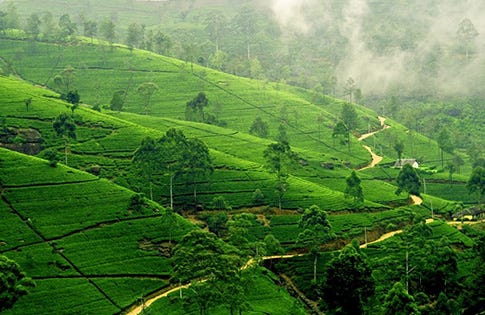
In the summer of 1914, the island of Ceylon was a tranquil paradise, far removed from the tensions that gripped Europe. Almost a century of British rule had transformed the island into one of the Empire’s most prosperous colonies. The misty highlands, once the domain of feudal Kandyan chiefs and Sinhala kings, now supported sprawling tea and rubber estates that produced great wealth for British investors and a comfortable living for the island’s emerging middle class.
A segregated society
In Colombo, the colonial capital, life moved at a leisurely pace. The upper crust of British society congregated at the Colombo Club near Galle Face Green, a bastion of privilege where membership was restricted to ‘Britishers Only’. Here, planters from the hill country, bankers from the Fort, and colonial administrators would gather in the evening to play cricket or polo, drink whisky, and discuss the affairs of Empire, secure in the knowledge that their world was immutable and unchanging.
The Galle Face Hotel located nearby was an essential stop for passengers on the England to Australia steamships, being the natural halfway point between Shepheards Hotel in Cairo and the Raffles in Singapore.
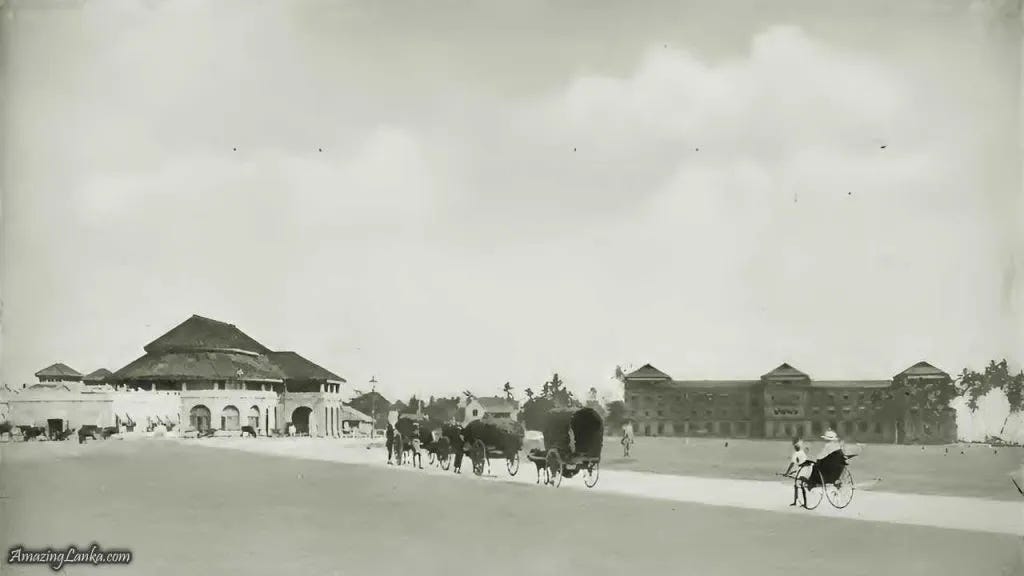
The Colombo Club on left and the Galle Face Hotel circa 1910. Rickshaws and bullock carts in foreground.
The Ceylonese elite, barred from this exclusive institution, had formed their own establishments. The Orient Club, located near the racecourse, rivalled the Colombo Club in elegance if not in social cachet. Europeans were explicitly barred from the Orient — it was for Ceylonese only.
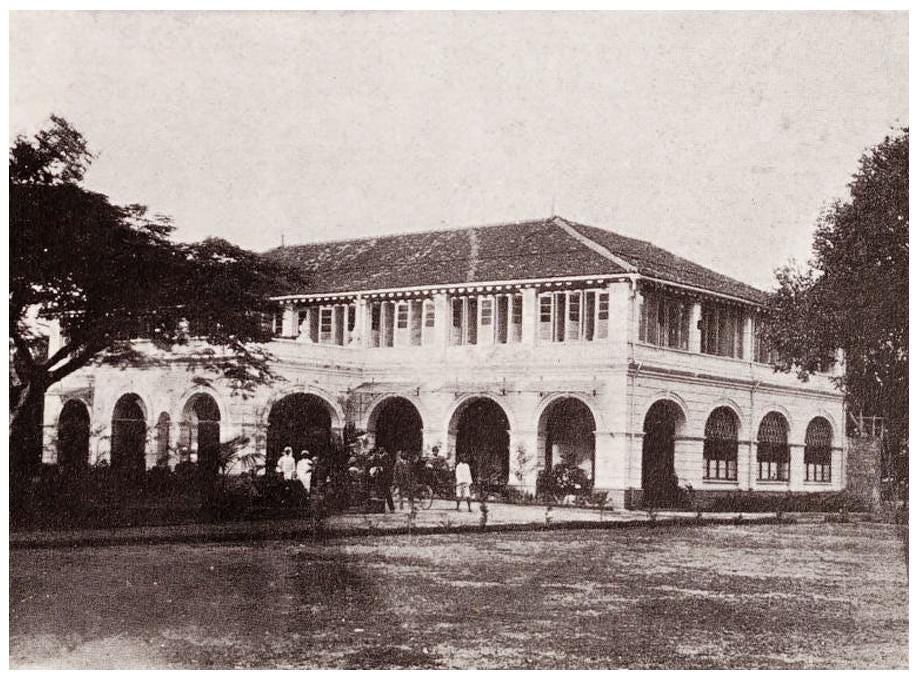
The Orient Club. Source Facebook
The Orient Club was determinedly diverse with its founding membership consisting of 75 Sinhalese, 25 Burghers, 12 Tamils, 4 Moors, 4 Colombo-Chettys, one Parsee and one West-Indian gentlemen. But this was a rare place where the communities mixed freely.
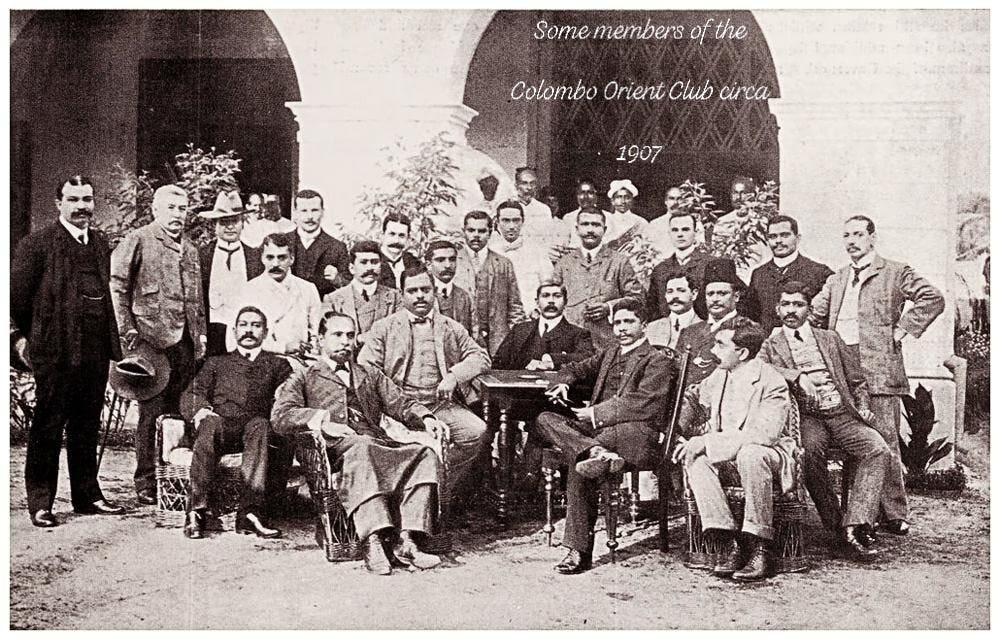
Members of the Orient Club circa 1907. Source Facebook
The colonial government’s policy of ‘divide and rule’ extended to many walks of life. Rather than unite, the ‘natives’ typically congregated in institutions constituted along ethno‑religious lines: the Sinhalese Sports Club, Tamil Union, Burgher Recreation Club, Moors Sports Club, Nondescripts Cricket Club (this writer’s personal favourite), and others. Cricket and rugby, those most British of pastimes, were played with passion in all these clubs, but never together.
Sources of wealth
Fuelling all this growth was not only the plantations but also, in the case of a small group of Sinhalese families, the profession of ‘arrack renting’.
‘Arrack renter’ was a profession whereby certain individuals or syndicates were licensed to rent out taverns for the sale of arrack and/or toddy. This system commenced during the Dutch occupation of Ceylon and continued under British colonial rule.
Licences to rent taverns and distribute arrack on a retail basis were allocated by the government at auctions held at regular intervals. Successful bidders were authorised to either rent out, or themselves operate, a specified number of taverns in a prescribed region. With no restrictions on how much arrack they could sell, and the freedom to set prices, arrack renting was a lucrative business with a high return on investment.
The phenomenal wealth accumulated from the liquor trade was invariably channelled into other business ventures such as land‑owning, usually on a vast scale, and buying and operating tea, rubber and coconut estates, as well as graphite (plumbago) mines.
Apart from building large family mansions (walauwas in Sinhala), they often engaged in philanthropic pursuits. Interestingly, this in turn led to a temperance movement taking hold around the same time as the ‘Buddhist Revival’ began in opposition to the spread of missionary Christianity. (Above section is a quote from ‘Stuttard, J., & Thiedeman, R. (2026). Rolls-Royce in Ceylon (First) [Review of Rolls-Royce in Ceylon]. 20-Ghost Club’)
Education
Many Ceylonese — particularly those educated at the island’s Christian schools — had developed a profound attachment to the Empire and all it represented. Royal College, S. Thomas’ College, St Joseph’s College and Wesley College in Colombo, plus Trinity and Kingswood Colleges in Kandy, were modelled consciously on the British public school system. They emphasised sport as much as academic achievement, promoted ‘muscular Christianity’, and produced young men who saw themselves as loyal subjects of the King‑Emperor.
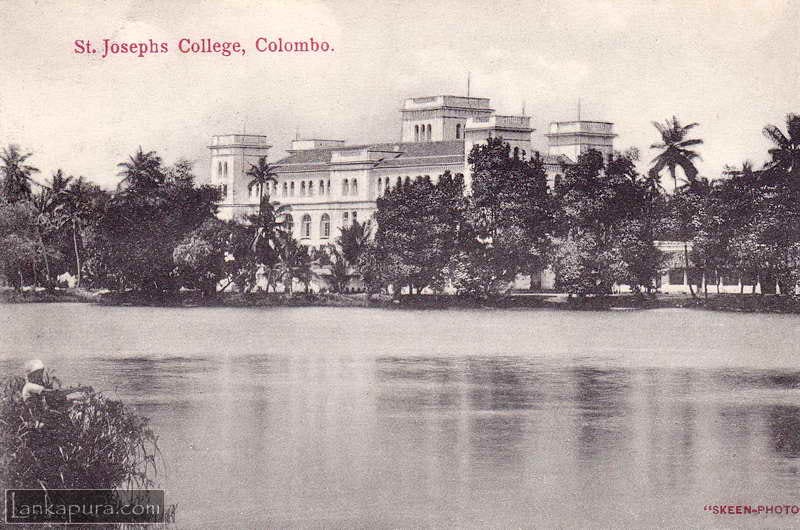
St Joseph’s College seen from the Beira Lake. Courtesy Lankapua
Many English children were still sent back to the homeland for boarding school, but increasingly the elite schools of Colombo and Kandy had significant numbers of British students, educated alongside wealthy Ceylonese children. English‑medium education had opened doors that previous generations could never have imagined. Many families sent their brightest sons to these Christian schools, the secular government‑run Royal College, or the recently founded Ananda College, an English‑medium Buddhist school.
Whether Burgher descendants of Dutch and Portuguese colonisers, Tamil professionals from Jaffna, Sinhalese from the maritime provinces, ‘arrack renters’ who had enjoyed an oligopoly of producing alcohol for many years, or Muslim merchants from the coast, they shared a common ‘British’ identity that transcended their ethnic origins.
The tea boom had made Ceylon wealthy. The blight that decimated coffee in the 1870s had proven a blessing in disguise, as tea (Camellia sinensis) planted in its stead proved to be extraordinarily successful. Within a few years, Ceylon tea had gained a reputation as the world’s finest. The industry’s profits enriched not only British investors, but created opportunities for educated Ceylonese in commerce, law and administration.
Transport links and railways
An extensive broad‑gauge railway network, known as the Ceylon Government Railway (CGR), was built initially to service the coffee plantations and expanded as tea became the principal cash crop. The railway connected Colombo to Kandy in the central hills, Jaffna in the north, and Matara in the south. A narrow‑gauge line extended up to Nuwara Eliya and beyond, with another servicing the rubber plantations in the Kelani Valley area. Travel between towns was swift and comfortable. The population was mobile to an extent never experienced before in the island’s long history.

The train station in Kandy at the turn of the century
Up in the hill country, life was equally comfortable, if more isolated. Kandy, the ancient capital, had been transformed from a feudal stronghold into a prosperous colonial town. Many excellent schools were located in and around Kandy. Trinity and Kingswood were the best known, but several others, such as St Anthony’s, Dharmaraja and Hillwood, were also nearby, catering to the children of wealthy planting families and the offspring of British railway workers staffing the CGR.
Nuwara Eliya had become a renowned hill station, known as ‘Little England’. Located in a valley at over 7,000 feet above sea level, deep in tea country, the climate there was salubrious, the scenery magnificent, and the pace of life agreeably slow. British planters lived in comfortable bungalows scattered across the estates, congregating at the Hill Club or the United Club on weekends to play tennis, golf, cricket, and attend equestrian events at the nearby racecourse, served by efficient servants who ensured every comfort was met.
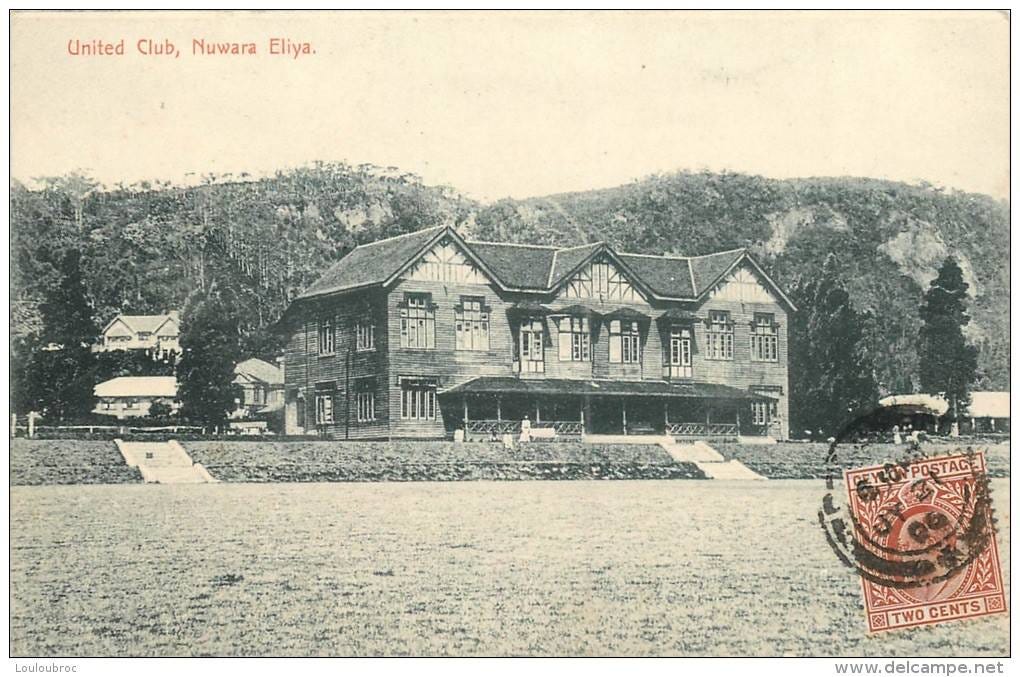
The United Club in Nuwara Eliya near the racecourse. The building was since demolished.
For the Ceylonese middle class, life was good. The lucrative arrack trade was brought under the Crown from 1910, but employment opportunities in law, medicine and commerce were expanding. The sons of the wealthiest Ceylonese families were routinely attending prestigious universities in Oxford, Cambridge and elsewhere in Britain. Even the elite Ceylon Civil Service had begun allowing Ceylonese to join its hitherto exclusively British ranks via a competitive examination.
In this world of ordered hierarchy and apparent permanence, few imagined that anything could disturb the peace. Ceylon had known no war for generations. The island’s strategic position in the Indian Ocean made it valuable to the Empire, but also safe, protected by the Royal Navy’s unchallenged dominance of the seas.
War in Europe
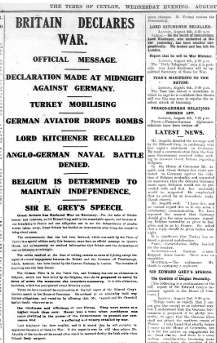
Then, in August 1914, the unthinkable happened. Europe, after ninety‑nine years of peace, stumbled into war. The news reached Colombo by telegraph the same day, creating a sensation. At first it seemed distant, almost abstract — a quarrel between European powers that surely would be resolved quickly. Few could have imagined that this ‘small’ conflict would metastasise into a world war, or that it would reach across thousands of miles to touch even tranquil Ceylon.
Even fewer could have predicted that within months, young men from Colombo and Kandy — boys who had never seen a battlefield, who knew Europe only from books and teachers’ stories — would volunteer to fight and die in France, Turkey and Mesopotamia, in defence of an Empire that would never fully accept them as equals.
The Great War had begun, and Ceylon’s sons would answer the call.
This series is a sneak peek at a book I am writing that will collate and tell the stories of the ‘Boys from Ceylon’ who served in the Great War. Thank you for reading.
메타데이터
- post_id
- beb094e4cc07
- slug
- ceylon-in-1914-beb094e4cc07
- url
- https://medium.com/ceylon-and-the-great-war/ceylon-in-1914-beb094e4cc07
- canonical_url
- https://medium.com/ceylon-and-the-great-war/ceylon-in-1914-beb094e4cc07
- author_url
- https://medium.com/@suren-ratwatte
- status
- ok
- fetched_at
- 2026-06-09 15:37:30