Will AI Agents Replace Humans in Real Estate Broker Jobs?
Evaluating the impact of AI Agents, one job at a time.
Will AI Agents Replace Humans in Real Estate Broker Jobs?
Evaluating the impact of AI Agents, one job at a time.
(Header Image Courtesy ChatGPT)
Introduction
The real estate industry stands at a technological crossroads. From AI-powered property searches to automated valuation models, technology is fundamentally reshaping how properties are bought, sold, and managed. Yet one question dominates industry conversations: Will AI agents eventually replace human real estate brokers?
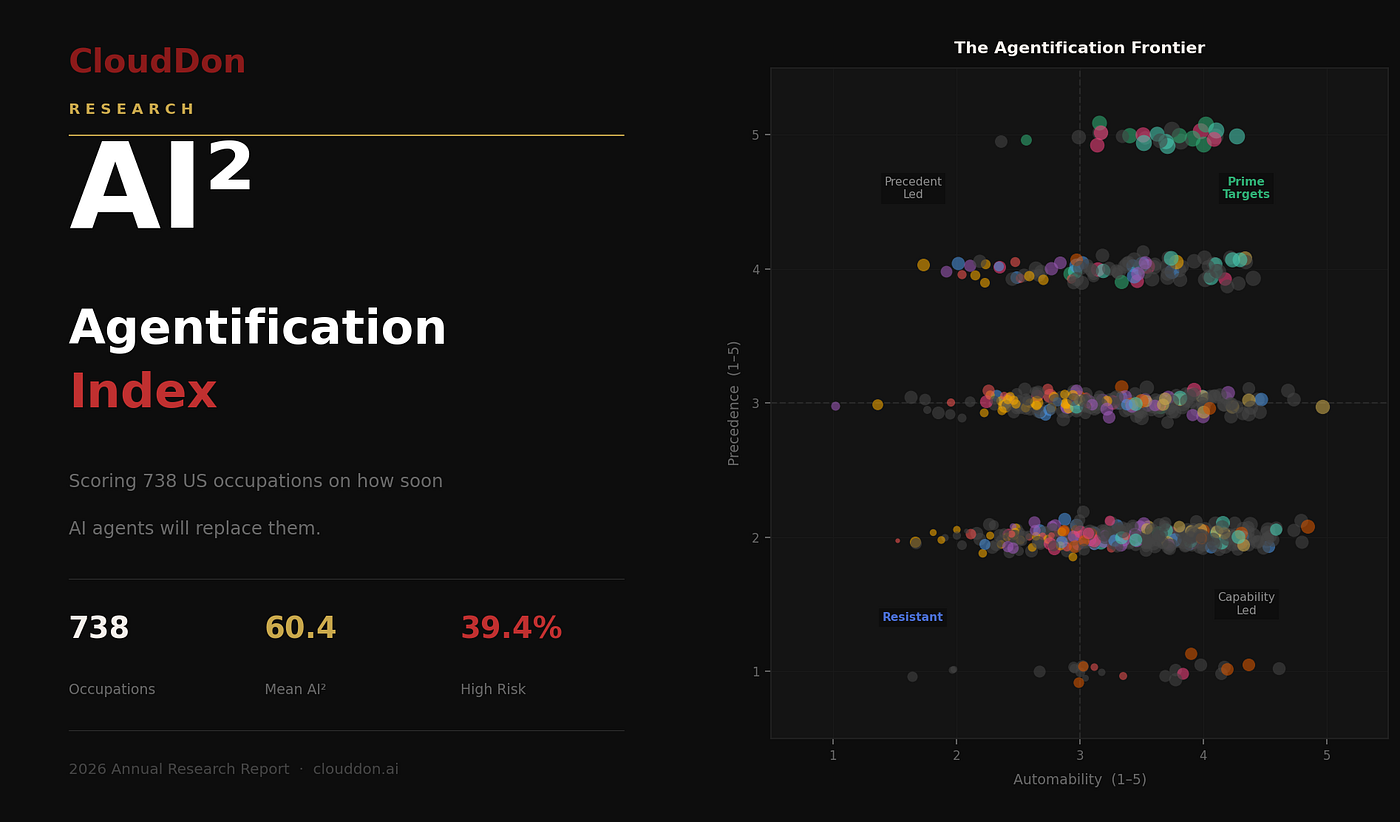
With over 70% of real estate agents failing to close a single transaction in 2024, and AI tools rapidly advancing in capability, many professionals are watching this trend with both excitement and apprehension. To assess how susceptible the broker role is to automation, we applied the CloudDon AI Agentification Index (AI²) — and the results reveal a nuanced picture.
About the Role: Real Estate Broker
Real estate brokers serve as intermediaries between buyers and sellers, generate listings, oversee property transactions, manage legal paperwork, negotiate deals, and ensure regulatory compliance. Unlike real estate sales agents, brokers hold additional licenses and often supervise agents, manage agencies, and handle higher-stakes or complex transactions.
Their work is deeply people-centric: client trust, market intuition, relationship building, negotiation, and local expertise form the backbone of the profession. But beneath this human layer, brokers also perform tasks that are structured, data-driven, and process-heavy — from comparative market analyses (CMAs) and Multiple Listing Service (MLS) updates to contract preparation and compliance monitoring.
AI Agentification Index (AI²) Score for Real Estate Broker
Based on the AI² framework, the Real Estate Broker role receives a score of 32.1 out of 100. This places it in the mid-to-long-term agentification category (5+ years before significant automation impact).

(AI² score for Real Esate Broker)
How Brokers Compare to Other Real Estate Professionals
Predictably, Real Estate Brokers score lowest among primary real estate professions in terms of agentifiability:
- Real Estate Sales Agents: 48.9/100 — Highest agentification opportunity due to more routine, transactional tasks.
- Appraisers & Assessors: 38.6/100 — Moderate opportunity as valuation becomes increasingly data-driven. However, with the increasing acceptance of automated scores, such as Zestimates, we expect this role to be automated sooner than the score currently reflects.
- Property Managers: 36.4/100 — Mixed exposure with routine tasks being automatable but tenant relations remaining human-centric.
This ranking reflects brokers’ unique position as supervisors and decision-makers rather than just transaction facilitators. As a leader of one of the leading real estate brokerage firms puts it, they give the final nudge/ push needed to close their transactions, which is not easily agentifiable. Their additional licensing requirements, fiduciary responsibilities, and role in managing other agents create natural barriers to full automation.
Several factors drive this score:
- Automatability: While property listing, valuation, and lead generation can be algorithmically supported, the core aspects of relationship and negotiation remain stubbornly human.
- Economic Viability: Potential cost savings exist, particularly in scaling smaller agencies or reducing administrative overhead; however, broker fees are often justified by the need for complex transaction management, which limits full replacement incentives.
- Technology Impact/ Precedence: Tools like Zillow’s AI-powered search, Redfin’s automated recommendations, and emerging AI platforms, such as CINC’s Alex assistant, provide brokers with data-driven insights and enhanced client matching capabilities. However, AI agents handling end-to-end deals independently remain uncommon. While software tools and chatbots are widespread, there’s no precedent yet for AI agents acting as licensed brokers.
- Legal, Labor, Liability Constraints: State licensing requirements vary significantly, with each state maintaining its real estate commission and regulatory framework. Fiduciary duties and legal liability concerns limit the scope of full automation.
- Ethical Concerns: AI bias in pricing, exclusionary practices, and transparency in advice raise significant ethical concerns, particularly given the industry’s history of discriminatory practices.
Overall, the score suggests that the profession is ripe for augmentation, not replacement.
AI Agentification Plan: Market-Driven Disruption
The agentification of broker work is unlikely to follow a neat, sequential timeline. Instead, economic forces and regulatory arbitrage will drive chaotic but rapid transformation:
Phase 1: Market Segmentation (2025–2027)
The disruption begins in low-value, high-volume segments where economic pressure is most significant, such as rental markets. Readers may observe that travel agents lost 70% of their jobs between 2000 and 2021 as online booking platforms captured market share by offering superior convenience and cost savings. Real estate is expected to follow a similar pattern.
Phase 2: Regulatory Arbitrage and Market Bifurcation (2027–2029)
With average broker commissions at 5–6% of home value, AI platforms offering sub-1% fees will create massive consumer savings pressure. This will push AI real estate platforms to push regulatory boundaries, just as Uber and Lyft did before regulatory frameworks were established. We expect that early adopter states will create “AI broker” licensing frameworks to attract fintech investment and the emergence of a two-tier market within this timeframe — premium human brokers versus AI-driven platforms.
Phase 3: Ecosystem Transformation and Consolidation (2029–2032)
The precedent is clear in the financial services industry, where robo-advisors now manage $1.4 trillion in assets despite initial regulatory skepticism. By 2028, robo-advisor assets are projected to reach $2.33 trillion, demonstrating how rapidly markets can transform when economic incentives align. We anticipate Hybrid licensing models to emerge as AI systems gain limited transaction authority. Human brokers will become specialists for complex negotiations, luxury markets, and advisory services. This is also when new regulatory frameworks that balance consumer protection with technological innovation are emerging. Like most markets, 3–5 major AI platforms can be expected to control 60%+ of standard residential transactions.
This market-driven timeline reflects economic reality over regulatory wishful thinking. While brokers scoring 32.1 on the AI² index have more protection than sales agents, they’re not immune to the fundamental economic forces reshaping industries worldwide.
Challenges in Agentification
Several significant challenges confront full agentification:
- Regulatory Barriers: Brokers operate under state licensing laws, with each state maintaining its real estate commission. For example, California requires specific education and experience requirements, while Washington State mandates 90 hours of approved education. Replacing licensed professionals with AI agents would require significant legal reforms across all 50 states.
- Trust & Relationship: Buying or selling a home is often the largest transaction of someone’s life. Human empathy, negotiation skills, and reassurance are difficult to replicate, particularly when half of all participants reportedly experience emotional stress during the process.
- Liability & Risk: Who is accountable if an AI broker misrepresents a property, mishandles a contract, or introduces bias? Current legal frameworks aren’t designed for non-human fiduciary responsibility.
- Market Fragmentation: Real estate is hyperlocal, meaning that agent networks, local knowledge, and personal relationships carry enormous weight, which automated systems struggle to replicate.
Current Industry Reality
The real estate industry’s relationship with AI is more nuanced than simple replacement scenarios suggest. Recent analysis shows that AI tools are primarily augmenting, rather than replacing, human agents. Even Zillow’s ambitious iBuying program, which heavily relied on AI valuations, was shut down in 2021 after significant losses, demonstrating the current limitations of fully automated real estate transactions.
Meanwhile, AI is becoming integral to commercial real estate workflows, with professionals increasingly expected to use AI tools as a baseline capability. The differentiation now lies in how effectively professionals integrate these tools into their practice.
Conclusion
The Real Estate Broker role is partially agentifiable but fundamentally human-centric. AI is poised to transform broker workflows, amplifying productivity and efficiency, but not replacing the human essence of the role. Industry experts predict that 60–80% of tasks may be AI-driven by 2028–2030, but this will primarily affect underperforming agents rather than established professionals who adapt to new tools.
Over the next decade, expect brokers to act as augmented professionals, combining AI-driven insights with personal expertise, rather than being displaced by fully autonomous agents. The most successful brokers will be those who embrace AI as a copilot, mastering tools that sharpen their competitive edge while focusing on the uniquely human dimensions of their craft: relationship building, complex negotiation, and providing trusted counsel during life’s most significant transactions.
For real estate professionals, the future lies not in resisting AI, but in strategically integrating it to enhance, rather than replace, human capabilities.
메타데이터
- post_id
- beb2671a4f3c
- slug
- will-ai-agents-replace-humans-in-real-estate-broker-jobs-beb2671a4f3c
- url
- https://blog.clouddon.ai/will-ai-agents-replace-humans-in-real-estate-broker-jobs-beb2671a4f3c
- canonical_url
- https://blog.clouddon.ai/will-ai-agents-replace-humans-in-real-estate-broker-jobs-beb2671a4f3c
- author_url
- https://medium.com/@sriramhere
- status
- ok
- fetched_at
- 2026-08-20 07:50:21