The tax that terrifies billionaires isn’t about taking their money. It’s about making them count it
California has just raised a question that the West has been putting off for far too long. The proposal, which the California secretary of…
The tax that terrifies billionaires isn’t about taking their money. It’s about making them count it
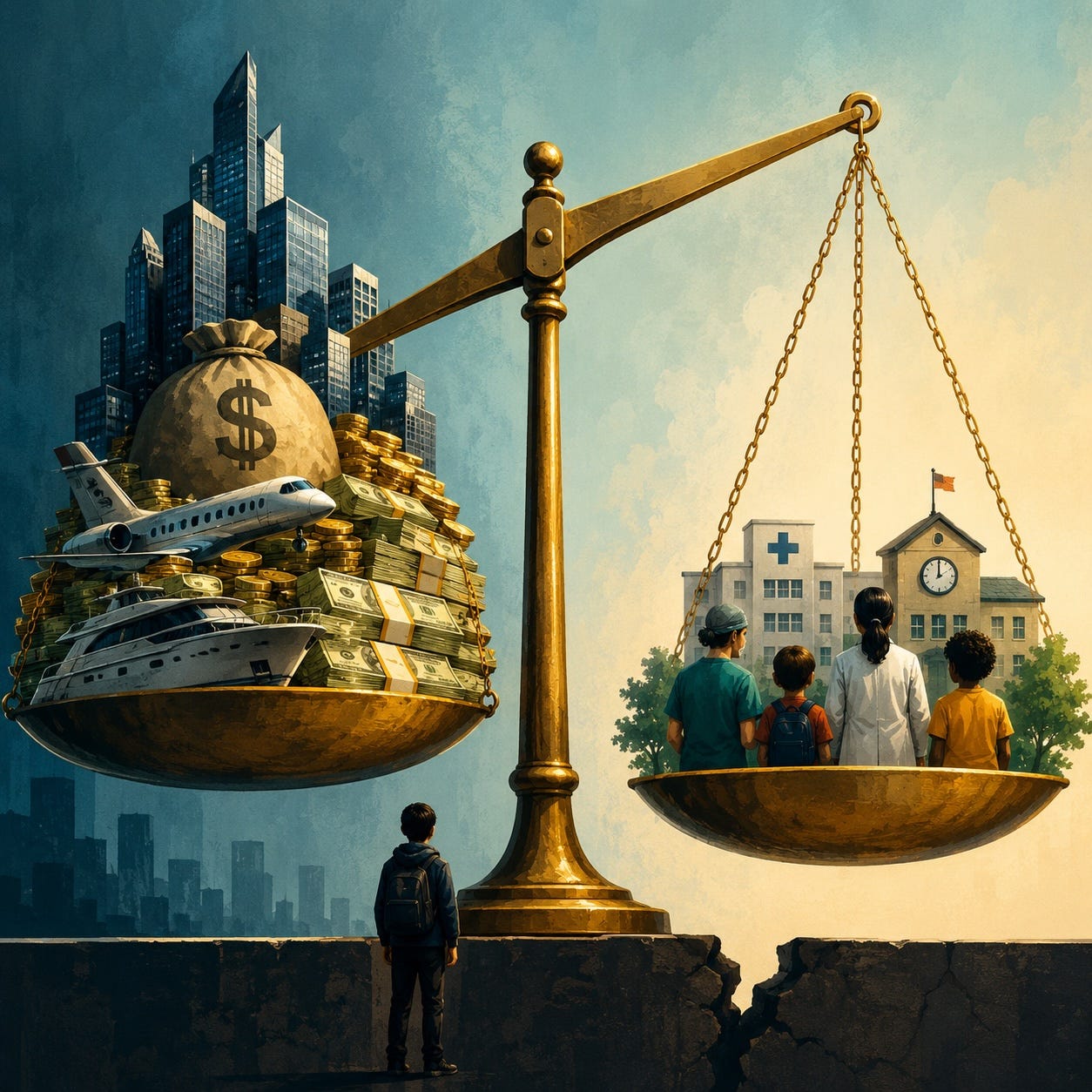
California has just raised a question that the West has been putting off for far too long. The proposal, which the California secretary of state says could be included on the November 2026 ballot, calls for a one-off, extraordinary tax of up to 5% on net worth exceeding $1 billion, with 90% of the revenue allocated to healthcare and 10% to education and food.
The text, filed with the attorney general’s office, doesn’t mention expropriating companies or punishing anyone: it speaks of funding basic services in a society capable of generating immense fortunes while its infrastructure crumbles.
The reaction from some of Silicon Valley’s best-known figures has been predictable: talk of capital flight, the destruction of the entrepreneurial ecosystem, stifling innovation all the usual arguments: if those who have benefited most from the economic, legal, educational, scientific, and infrastructural environment are asked to contribute proportionally, the entrepreneurs will up sticks. In other words, blackmail. The problem is that no one stops founding a company that could be worth billions simply because, in the hypothetical event of accumulating more than a billion dollars in personal wealth, they would have to pay a one-off tax. Companies are created out of ambition, opportunity, technology, talent, capital, networks, markets, and institutions. To confuse that with the privilege of not paying taxes is to manipulate the debate.
The underlying problem is that the tax system taxes wages, consumption, and ordinary income, but continues to treat extreme wealth as an accounting abstraction. An employee earns, files their tax return, and pays their taxes. A small business makes a profit and pays taxes. But the typical billionaire can get by on very little taxable “income”: they accumulate unrealized capital gains, use stocks as collateral, borrow against their net worth, reorganize assets into corporations, trusts and foundations, and indefinitely delay the point at which the tax authorities can deem something taxable. ProPublica documented this in its investigation into how the wealthiest Americans avoid paying income taxes, and later summarized it in its list of tax avoidance techniques used by billionaires.
The excuse that “they have no income” is why we have to focus on wealth. It is not a technical objection: it is the description of the loophole. If someone controls tens or hundreds of billions in assets, they can influence markets, finance campaigns, shape regulations, and pass on economic power to the next generation. But if they appear, for tax purposes, to be someone with modest income, the problem isn’t the absence of taxable income: the problem is a system designed to look the other way when wealth takes forms that don’t fit into its traditional categories.
Academic research has been pointing out this dysfunction for years. Emmanuel Saez and Gabriel Zucman explained in their work on progressive wealth taxation that a well-designed wealth tax can restore progressivity where the income tax fails: at the very top, where wealth grows much faster than reported income. A recent NBER study of the 400 wealthiest households in the United States concluded that their total effective tax rate was lower than that of the population as a whole, because their taxable income is so small, relative to their actual economic income.
Extreme inequality is an institutional problem of the first order. The OECD addresses this in its analysis of income wealth and inequality: inequality of outcomes and inequality of opportunity reinforce one another. When a society allows extreme wealth accumulation to grow unchecked by taxation, it does not merely reward merit — it entrenches advantages, buys influence, and closes doors.
Fears that the wealthy will desert countries that attempt to make them pay something approaching a reasonable contribution to society are nonsense. Yes, some may change their tax residence or reorganize their assets. They already do so, whether taxes are high, low, or nonexistent. A study by Cristobal Young and his co-authors on millionaire migration found that some very wealthy people will move to tax havens, “but only at the margins of statistical and socioeconomic significance.”
Silicon Valley did not emerge from an institutional vacuum: it arose from universities, public research, government contracts, skilled immigration, infrastructure, venture capital, legal protection, and regulated markets. All of that costs money. All of that is society. All of that is the state.
There is nothing confiscatory about asking for an extraordinary contribution from those whose net worth exceeds one billion dollars. On the contrary, by allowing schools, hospitals, and public programs to fall into disrepair while a tiny elite turns tax engineering into a competitive advantage, more and more people are having their opportunities to enjoy a minimally secure existence taken away from them. Billionaires will continue to start companies, invest, and make a great deal of money. The incentive will remain enormous. What this tax establishes is something else: that extreme wealth must not take precedence over democracy.
(En español, aquí)
메타데이터
- post_id
- beb2fdd7da5f
- slug
- the-tax-that-terrifies-billionaires-isnt-about-taking-their-money-it-s-about-making-them-count-it-beb2fdd7da5f
- url
- https://medium.com/enrique-dans/the-tax-that-terrifies-billionaires-isnt-about-taking-their-money-it-s-about-making-them-count-it-beb2fdd7da5f
- canonical_url
- https://medium.com/enrique-dans/the-tax-that-terrifies-billionaires-isnt-about-taking-their-money-it-s-about-making-them-count-it-beb2fdd7da5f
- author_url
- https://medium.com/@edans
- status
- ok
- fetched_at
- 2026-06-23 03:48:11