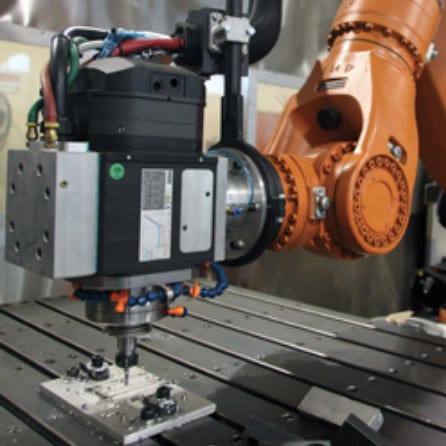
Cooling in Robotic Aluminum Milling: It’s Not Just About Temperature
How air, MQL, and flood systems affect stability and cleanliness.
Cooling in Robotic Aluminum Milling: It’s Not Just About Temperature
How air, MQL, and flood systems affect stability and cleanliness.

In aluminum robotic milling, cooling is often treated as a secondary choice.
In reality, it defines process stability.
Air blast works well for light trimming and shallow cuts. It keeps the environment clean and simplifies maintenance — but heat control is limited.
MQL provides a balanced solution. It reduces friction and improves chip evacuation while keeping fluid use minimal. In many robotic cells, it offers the best compromise between performance and cleanliness.
Flood coolant delivers maximum thermal stability and is preferred for higher material removal rates. However, it requires more complex containment and maintenance planning.
The right decision depends on more than cutting parameters. It must consider enclosure design, extraction systems, and long-term maintenance.
In robotic machining, the cooling strategy is part of system engineering — not an afterthought.
FAQs
1. Why is cooling important in robotic aluminum milling? Because aluminum has high thermal conductivity, improper cooling can cause tool wear, dimensional inaccuracies, and poor surface finish.
2. Is cooling only about reducing temperature? No. Cooling also manages lubrication, chip evacuation, and prevents thermal distortion of both the tool and the workpiece.
3. What are the main cooling methods used in robotic milling? Flood coolant, minimum quantity lubrication (MQL), cryogenic cooling, and air blast systems are commonly applied depending on the operation.
4. How does cooling affect tool life in aluminum milling? Proper cooling reduces friction and heat buildup, extending tool life and minimizing downtime due to tool replacement.
5. What role does cooling play in automation reliability? Stable cooling ensures consistent machining conditions, reducing variability and improving repeatability in robotic milling processes.
Checklist
✓ Ensure coolant/lubricant is properly applied ✓ Monitor chip evacuation during milling ✓ Check tool wear regularly ✓ Prevent thermal distortion of the workpiece ✓ Maintain consistent cooling for repeatability
Robotic-HiTech Solutions does not simply sell technology: it drives a new way of understanding manufacturing, where industrial precision meets creativity. Its work reflects the future of automation: robots capable of producing, sculpting, building, and expanding the limits of what is possible.
메타데이터
- post_id
- bebfb78e676b
- slug
- cooling-in-robotic-aluminum-milling-its-not-just-about-temperature-bebfb78e676b
- url
- https://medium.com/@robotichitechsolutions/cooling-in-robotic-aluminum-milling-its-not-just-about-temperature-bebfb78e676b
- canonical_url
- https://medium.com/@robotichitechsolutions/cooling-in-robotic-aluminum-milling-its-not-just-about-temperature-bebfb78e676b
- author_url
- https://medium.com/@robotichitechsolutions
- status
- ok
- fetched_at
- 2026-07-07 05:53:12