When Survival Needs Permission: Gaza and the Politics of Humanitarian Aid
A truck full of flour waits at a crossing.
When Survival Needs Permission: Gaza and the Politics of Humanitarian Aid
A truck full of flour waits at a crossing.
After hours, days, perhaps even weeks of travelling through unsafe roads and unstable zones, it is finally close to its destination. The people driving it may have risked their lives to bring something as basic as food to those who need it most. At this point, it seems only a matter of time. The truck is one step away from fulfilling what should be a simple humanitarian principle: the right to eat.
But between the truck and the people waiting for it, there is not only a border.
There is power.
In a few minutes, the work of humanitarian organizations, the risks taken by aid workers, and the hopes of families waiting on the other side can be erased by a single decision. A political interest, a military calculation, a bureaucratic delay, or even the will of those who control access can decide whether food enters or remains outside.
In that moment, survival is no longer treated as a right.
It becomes permission.
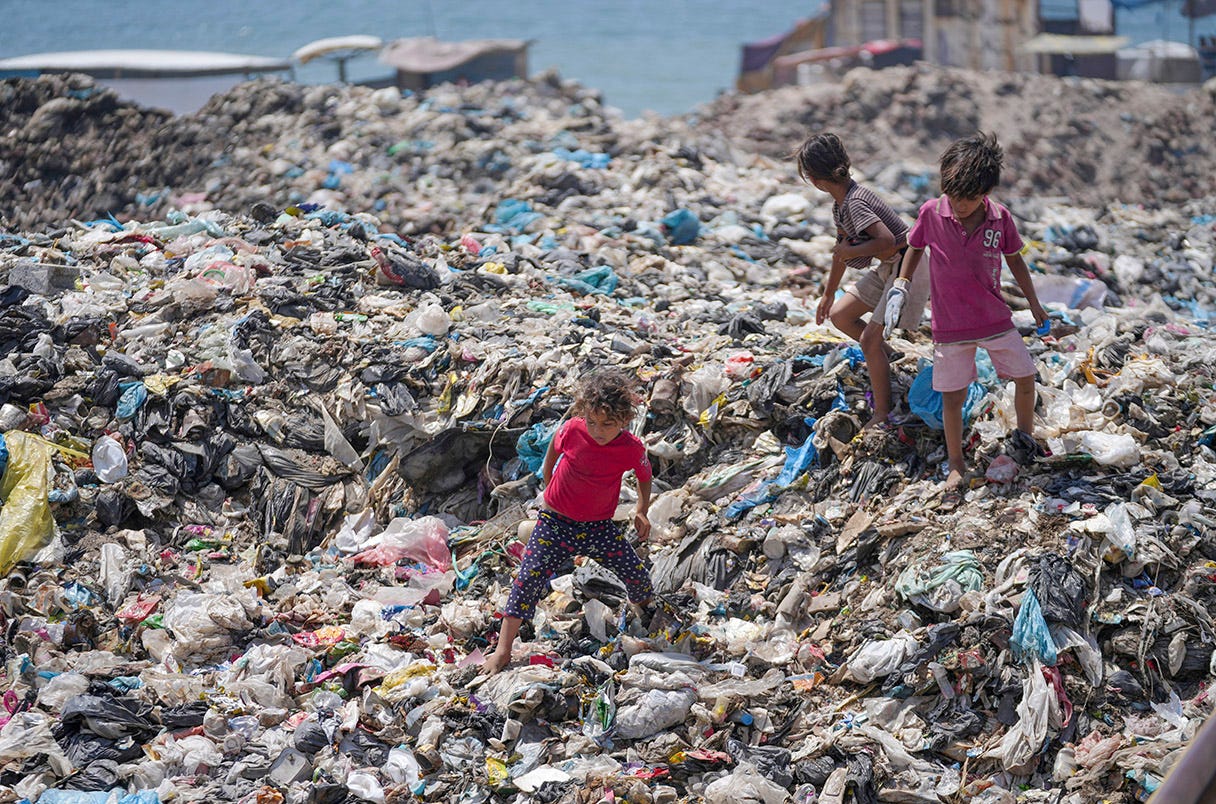
Since the escalation of the Israeli-Palestinian conflict after October 2023, the Gaza Strip has been subjected to repeated military attacks that have produced one of the most severe humanitarian crises of recent years. The situation has gone so far that several human rights organizations, including B’Tselem and Physicians for Human Rights-Israel, have described Israel’s actions in Gaza as genocide. This accusation remains politically and legally contested, but its very existence reveals the gravity of the crisis.
In this context, Gaza has become deeply vulnerable and increasingly dependent on external resources such as food, clean water, medicine, fuel, and construction materials. Yet in a war or humanitarian crisis, aid does not simply “arrive.” Someone controls the crossings, the convoys, the permits, and the timing. As a result, those who control access also control, in practice, the possibility of survival.
This apparatus of control changes the meaning of basic rights. The right to food or clean water is no longer treated as something inherent to every human being, but as something that can be delayed, negotiated, restricted, or denied according to political and military calculations. In this process, people risk disappearing behind the language of logistics: crossings, trucks, permits, checkpoints, screenings, and cargo volumes.
This is precisely where the expression “humanitarian crisis” becomes dangerous. It sounds neutral, technical, and distant. But behind it there are people: families waiting for flour, children needing medicine, doctors without fuel, displaced people searching for water, and aid workers trying to move through unsafe roads. Numbers, reports, and headlines are necessary to document suffering, but they can also make that suffering abstract.
The recent OCHA Humanitarian Situation Report of 5 June 2026 shows how concrete this mechanism is. According to OCHA, the Zikim crossing in northern Gaza had been closed for two weeks, while Kerem Shalom remained the last cargo crossing available for approved supplies entering Gaza. Humanitarian convoys were also being rerouted through a newly established checkpoint, where delays, congestion, malfunctions, and slow screening reduced the amount of aid and fuel that could actually be collected and distributed.
These restrictions do not operate in isolation. OCHA also reported that funding shortfalls were forcing humanitarian partners to scale down or suspend some essential services. In other words, humanitarian actors are trapped between two pressures: limited access on one side and limited resources on the other. The result is that the people who need assistance most are also the ones who pay the highest price for political decisions, logistical barriers, and international inaction.
From this perspective, humanitarian aid is often imagined as charity: a spontaneous, neutral and purely human response to suffering. However, in war, aid can become one of the most powerful strategic instruments. When access to food, water, medicine and fuel is controlled, survival itself becomes part of the conflict.
Indeed, both the survival and the suffering of a population can be transformed into political resources. They can be used to pressure the enemy, influence international opinion, provoke emotional reactions, or shift the moral narrative of the war. In this context, someone has the power to decide when aid enters, how much is considered enough, and which lives are treated as urgent while others are forced to wait.
The closure of crossings and the restriction of humanitarian access therefore do not only create logistical problems. They produce a system in which people’s lives become dependent on political and military calculations. The population is no longer seen primarily as a community of human beings with rights, but as a factor inside the conflict.
Data can show the scale of the damage, but they can also make people appear like broken infrastructure, destroyed weapons, damaged drones, or any other object of war. This is one of the most dangerous effects of humanitarian language: it can document suffering while also making the people who suffer disappear.
If someone suddenly prevented you from drinking water, eating food, receiving medical care, or protecting yourself from humiliation, you would probably feel violated. Not simply uncomfortable, not simply unlucky, but violated, because something that belongs to you would have been taken away.
Rights are not concessions.
This is what is often forgotten when humanitarian aid is discussed as if it were an act of generosity. Eating, drinking, healing, and living with dignity should not depend on the permission of another power. As human beings, we should not have to ask whether we are allowed to exercise our most basic rights.
This principle is not only moral, but also legal. In March 2024, the International Court of Justice ordered Israel to take “necessary and effective measures” to ensure, without delay and in cooperation with the United Nations, the unhindered and large-scale provision of essential services and humanitarian assistance to Palestinians in Gaza, including food, water, electricity, fuel, shelter, sanitation, health care, and medical care.
The significance of this order is clear: access to survival cannot be treated as a political favour. It is a legal and human obligation.
Although people should never be reduced to numbers or categories, numbers still matter. They help us understand the scale of the crisis and prevent suffering from being dismissed as vague or exaggerated. The problem is not the existence of data, but the way we read it.
Numbers should not replace human stories. They should lead us back to them.
Knowing how many people are affected is necessary, but it is not enough. We also need to understand what those numbers mean in daily life: a child going to sleep hungry, a mother skipping meals so her family can eat, a doctor watching malnutrition become visible on a patient’s body, a family waiting for flour that may never arrive.
According to the IPC, the international system that monitors food insecurity, between October and November 2025 approximately 1.6 million people in Gaza, around 77% of the population analyzed, faced high levels of acute food insecurity. More than half a million people were classified in the “Emergency” phase, while over 100,000 were in the “Catastrophe” phase.
For 2026, the IPC also projected that at least 132,000 children under the age of five would suffer from acute malnutrition by June, including more than 41,000 severe cases with a high risk of death.
These figures are not abstract. They are not only percentages, phases, or humanitarian classifications. They are bodies without enough food, children without enough nutrients, and families whose survival depends on decisions made far from them.
A pivotal role is played by the media, because the words used to describe a crisis do not remain only inside newspapers, reports, or television broadcasts. They enter our daily language, shape our emotions, and modify our perception of reality.
In the case of Gaza, representation is not neutral. International media often describes Gaza through three main frames: as a humanitarian crisis, as a security problem, or as a conflict too complex to be clearly judged. Each of these frames can reveal one part of reality, but each can also hide something essential.
When Gaza is described only as a humanitarian crisis, Palestinians appear mainly as victims waiting for aid. Their suffering becomes visible, but the political causes of that suffering often become less visible. Hunger appears as a tragedy, but not always as the result of restrictions, borders, checkpoints, military decisions, and power.
When Gaza is described mainly as a security issue, Palestinians risk appearing not as people with rights, but as a threat to be managed. In this frame, fear is not distributed equally. The fear of one side is treated as security, while the fear of the other is often reduced to consequence.
Finally, when Gaza is described as “too complicated”, complexity can become a form of distance. Of course, the history of the Israeli-Palestinian conflict is complex. But complexity should not be used to make basic rights unclear. The right to eat, drink, receive medical care, and live without humiliation is not complex.
This is why vocabulary matters. Terms such as “food insecurity”, “nutrition crisis”, or “humanitarian emergency” may sound technical and professional, but they can also make violence appear less intentional and less political. By contrast, words such as “starvation”, “siege”, or “famine” carry a different moral and legal weight. They do not only describe suffering; they also suggest responsibility.
This dynamic can be understood through Entman’s framing theory. Media frames define what the problem is, identify its causes, make moral evaluations, and suggest possible responses. In other words, the way Gaza is framed influences what the public sees as the problem: a lack of food, a security threat, a logistical failure, or a political structure that controls survival.
Said’s theory of Orientalism also helps explain why Palestinian suffering is often represented through distance, suspicion, or abstraction. In many Western narratives, Arabs and Muslims have historically been portrayed as irrational, violent, or backward. These stereotypes do not disappear during war; they often become stronger. They make it easier to see Palestinians as masses, threats, or numbers, rather than as individuals with names, rights, fears, and political humanity.
Judith Butler’s idea of “grievable lives” is also useful here. Some lives are publicly mourned, individualized, and treated as universal tragedies. Others are counted anonymously, doubted, or explained away as the inevitable consequence of conflict. A victim with a name is mourned. A victim inside a number is only counted.
This is the danger of media representation. It does not only show suffering; it decides how that suffering will be interpreted. It influences whether people feel empathy, fear, indifference, or responsibility. When Palestinians are represented only as victims, they may receive pity but not justice. When they are represented as threats, they may be denied even pity. In both cases, their political humanity disappears.

Why are some human rights violations immediately condemned, while others are explained, delayed or relativized?
We often hear people talk about human rights as if they were fixed, universal, and already guaranteed. They are part of our political language, our school programs, our international institutions, and our moral imagination. The Universal Declaration of Human Rights states that these rights belong to every human being, without distinction. Yet in practice, their protection often depends on power, timing, alliances, and strategic interests.
This is one of the deepest contradictions of the international system. Human rights are presented as universal principles, but they are often defended selectively. Some violations are immediately condemned. Others are explained, delayed, relativized, or treated as too politically complicated to judge. In this way, universality becomes conditional.
Choosing whether a person can eat, whether a child can go to school, whether a family can access clean water, or whether a population can preserve its cultural heritage is never just a technical matter. It is a political choice. It reveals who has the power to decide which lives are protected, which lives are exposed, and which lives can be sacrificed in the name of security, strategy, or national interest.
People are the ones who can change political realities. For this reason, awareness can become dangerous to power. A population that understands its rights, tells its story, preserves its memory, and refuses to disappear cannot be treated only as a passive victim. But this is also why people can become targets: because controlling a population’s food, movement, education, and cultural life also means controlling its future.
This dynamic is visible in Gaza. Human Rights Watch reported in May 2026 that the humanitarian infrastructure sustaining life in Gaza remained at risk, and that Israeli authorities were weakening humanitarian lifelines even after the October 2025 ceasefire agreement. This shows that the crisis cannot be reduced to temporary emergency management. It reflects a deeper political structure in which access to survival remains fragile, conditional, and exposed to power.
The question, then, is not whether human rights exist on paper. They do. The real question is who is allowed to exercise them in practice, and who has the power to suspend them.
Talking about rights is easy until we are forced to face what a violation actually means. As people, and as human beings, we cannot allow politics to turn human lives into strategic weapons. Rights are not concessions granted by power; they belong to every person for the simple fact of being human. And for this reason, the right to survive should never depend on permission.
References
Al-Qudra, F. (2025). How Is Western Media Framing the Famine Catastrophe in the Gaza Strip? Al Jazeera Media Institute, 23 June 2025.
Integrated Food Security Phase Classification. (2025). Gaza Strip: Acute Food Insecurity Situation for 16 October — 30 November 2025 and Projection for 1 December 2025–15 April 2026. IPC, 19 December 2025.
Office for the Coordination of Humanitarian Affairs. (2026). Humanitarian Situation Report | 5 June 2026. OCHA oPt, 6 June 2026.
Slot, D. (2025). Framing Gaza: A Comparative Case Study of Dutch Media Coverage of the Gaza War After October 7, 2023. Master’s thesis, University of Amsterdam, The EU and its Neighbours: Politics, Policies, Challenges and Opportunities.
메타데이터
- post_id
- becc5bb1d7b4
- slug
- when-survival-needs-permission-gaza-and-the-politics-of-humanitarian-aid-becc5bb1d7b4
- url
- https://medium.com/@giulianafossatii/when-survival-needs-permission-gaza-and-the-politics-of-humanitarian-aid-becc5bb1d7b4
- canonical_url
- https://medium.com/@giulianafossatii/when-survival-needs-permission-gaza-and-the-politics-of-humanitarian-aid-becc5bb1d7b4
- author_url
- https://medium.com/@giulianafossatii
- status
- ok
- fetched_at
- 2026-06-17 08:20:12