Smart Cities Could Run on Your Footsteps — Here’s How
Beneath the concrete we walk on every day lies one of the most overlooked energy sources in urban cities.
Smart Cities Could Run on Your Footsteps — Here’s How
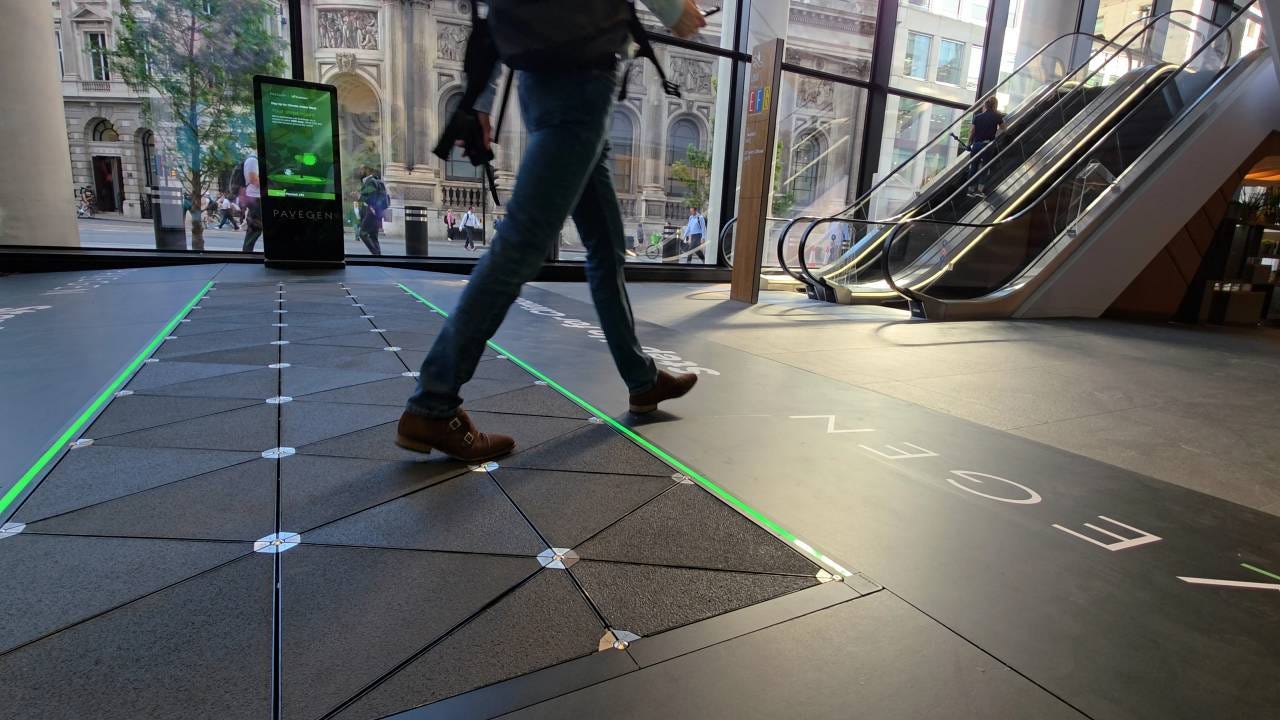
Figure 1.1 // Image by Pavegen // Steps create energy through the triangle patterned tiles.
Beneath the concrete we walk on every day lies one of the most overlooked energy sources in urban cities.
With millions of commuters packed like a dense rooted forest, the potential for clean energy can catapult. The pavement itself can become a massive superpower in the energy industry. We as humans, will subconsciously become the generator which begs the question: if our very own movement can power the city, shouldn’t it be designed to ensure that it doesn’t become wasted potential? In a world where energy demand is outpacing our current innovation and demand is an ongoing issue, ignoring the capabilities below our feet is no longer an option. Piezoelectricity integrated into traditional solar systems can revolutionize how cities are powered in the future.
Piezoelectricity has come a far distance from its first practical usage in World War 1; at first this technology was very limited to specific applications such as measuring voltage under mechanical stress (DOSITS, 2025). Today, the development of Pavegen’s Piezoelectric Tiles serves as an example of how far technological advancements have pushed the boundaries of what is considered conventional. With its tile designs, Pavegen has demonstrated how piezoelectric technology can spark innovation globally giving stage to many projects that pique the gaze of young innovators and capture global attention. The possibilities of piezoelectric technology are endless when paired with solar systems, it could redefine the future for renewable reliant cities.
From Footsteps to Electricity: Understanding Piezoelectric Tile Technology
How piezoelectric tiles generate energy can be simply put into two individual actions: Mechanical force and electrical conduction (The Organic Chemistry Tutor, 2020). The process begins with a piezoelectric material. Although sounding like rare Earth materials, we often see it in our everyday lives. Natural piezoelectric materials like quartz and artificially made ceramics known as Lead Zirconate Titanite (PZT) are common examples. But hair, bone, wood and your own teeth enamel have this property as well (American Piezo, 2015).
These materials generate an electrical charge due to the Piezoelectric Effect where in response to mechanical force it creates an electric output. Inside the atomic structure of these materials we can see why.

Figure 2.1 // Image by Sabin Civil Engineering // Center of Charge is theoretical point where both negative and positive charges are suspected to be.

Figure 2.2 // Image by Sabin Civil Engineering // Mechanical force causes lattice to deform causing polarization
Inside of a solid piezoelectric material are repeating structures of crystal lattices. The image above is one of many lattices. When mechanical force is applied, the balance of positive and negative electrons are disturbed causing an imbalance called polarization. The polarization of the electrons creates an electric charge that we are able to harness (Sabin Civil Engineering, 2021). A key highlight of polarization with piezoelectric materials is that the charges return back to their balanced state once force is released unlike many materials that cannot do this. Although sounding revolutionary, a single step only produces a tiny amount of electricity, but when combined in large quantities, we are able to generate a considerable charge in high traffic areas (Circuit Bread, 2022). This is the reason why Pavegen’s piezoelectric tiles are often set up in congested areas like train stations, stadiums or sidewalks where foot traffic can produce a noticeable amount of clean energy (Pavegen, 2025).
Emerging Issues: The Energy Puzzle of Modern Cities
Many of you may be questioning the need for this technology in urban cities and that’s valid. Why would we need this technology when we already have so many clean energy sources like solar, wind or hydroelectric? When we look in the context of urban, compelling reasons begin to stand out.
- Soaring Demand for Residential, Commercial and Industrial Usage
- Lack of Existing Transmission Infrastructure and Land
- Growing Need for Sustainable Innovation to Combat Climate Change

Figure 3.1 // Image by City of Toronto // Breaking Down Energy Consumption
Soaring Demand for Residential, Commercial and Industrial Usage
According to the Canadian Energy Regulator (CER), the average Ontario household uses 26 kWh per day which is equivalent to about 2500 kWh per year as of 2020 (Canadian Energy Regulator, 2020). This growing number is further highlighted in densely populated cities like Toronto where there is energy usage every hour of the day (City of Toronto, 2017). This constant around the clock usage puts tremendous strain on traditional energy sources and power grid. With limited clear land and being heavily built around commercial and residential use, innovative solutions that capture energy are becoming increasingly appealing (Homes by Andrew, 2025).
Lack of Existing Transmission Infrastructure and Land
It is a known fact that solar, wind and hydroelectric plants require vast amounts of clear land. For instance in 2019, 390 acres of land were designated for solar panel energy generation at Nanticoke on the North Side of Lake Erie (Ontario Power Generation, 2019). Like many cities in Canada, we face similar issues. Limited available land in densely populated areas forces cities to outsource their energy generation in regions that are far from the city. This approach isn’t impossible; rather, our main issue is our current transmission infrastructure cannot efficiently transfer energy from a region that is hundreds of kilometres away (IESO, 2025). Our best approach to solving this is either to spend billions on updating our transmission lines across the province or to source our energy within the city.
Growing Need for Sustainable Innovation to Combat Climate Change
Over the last decade, the Environmental Movement has become much more prevalent in youth and political discussions. Social media has pushed out information more than ever before; as a result, citizens’ mindsets are shifting towards a more environmentally conscious approach. Thus increasing the demand for sustainable innovation. The global efforts of preserving our planet through reducing energy consumption and regulating top carbon emitting industries have increased this demand as well. Sustainable innovation that slows down the effects of climate change is becoming a more attractive option due to the surge in attention and need for change.
Layering Energy Systems: Synergy of Solar and Piezoelectric Power
Solar energy has been the centrepiece of renewable energy in urban cities for years, however it isn’t flawless. Factors such as rain, cloud coverage, night and the dreadful Canadian winters all limit its consistency. This is where piezoelectric tiles become a natural complement to existing solar panel systems. By combining these two technologies together, cities can create a hybrid system that collects energy from sunlight and motion during the day, while stored energy helps maintain power availability at night.

Figure 4.1 // Image by Science Direct // Energy Harvesting Panels with Piezoelectric Technology
Solar energy has its gaps in efficiency. Cities that heavily rely on solar often know this best as they can go days without the sunlight. Relying on a single energy source makes urban areas vulnerable to power instability and energy starvation. On the other-hand, piezoelectric energy thrives where there is movement. Day or night, indoors or outdoors, rain or shine it adapts to every scenario. Where solar falls short in consistency, piezoelectric technology steps in to fill those gaps with its stored energy (Science Direct, 2025). The consistent flow of human and vehicle activity in urban environments make solar and piezoelectric integration an effective method to harness both movement and sunlight in a harmonized way.

Figure 4.2 // Image by Shah et al. // Hybrid tiles with solar cells on the sides and piezoelectric component in the middle.
Integration of solar and piezoelectric has been tested through hybrid smart tiles that incorporate mini solar cells at the surface of the tile. These mini cells absorbs sunlight while a piezoelectric transducer (a device that converts energy into different forms) coverts mechanical force into electricity (Shah et al.). Inside the hybrid tile is a battery that stores the energy and a controller that regulates the outputs from both technologies. Solar cells directly supplies to the battery (DC) while the piezoelectric component generates an alternating current (AC) which makes integrating both on the same battery difficult (Shah et al.). This can be fixed with a regulator to control the alternating current’s voltage however, adds to the overall product cost. The solar cells only produced a modest amount of energy, while the piezoelectric component significantly contributed more in certain cases. This could be because of many factors like the location, weather or sunlight exposure. But, this can be a leading example of how piezoelectric technology outshines other energy harnessing methods in an urban setting. Although each tile individually only produced a small amount, when many tiles were put together, the accumulated total added up to a meaningful gain. This innovative technology still has its flaws, but has promise to change the future of energy integration.
Direct and alternating current regulating on the same battery and durability has been key concerns of mixing both technologies onto one prototype. Converting alternating current to direct requires rectifiers and regulators that add to the manufacturing process and price. On top of this, piezoelectric isn’t a linear energy source (National Library of Medicine, 2022). Footsteps and vibrations can be lighter or harder dependent on the source; this makes it so much harder to balance a more consistent energy source like solar. Materials are another obstacle: piezoelectric materials often made of ceramics that are brittle and high in cost, while cheaper materials can wear out faster from the constant pressure. Scaling these tiles outside into real life conditions can lead to more issues arising like maintenance and waterproofing (Science Direct, 2022). This technology hasn’t been deeply explored yet, but the technology works. However, refining it into something that is cost-effective, reliable and able to compete with high output energy sources remains a real challenge.
To Summarize what is necessary to wire all these factors together:

Figure 4.3 // Image by Daniel Fung on Canva // Breakdown of components needed to connect solar panels to battery

Figure 4.4 // Image by Daniel Fung on Canva // Breakdown of components that are needed to connect piezoelectric material to the battery. Key note here is that piezoelectric is AC current
Design Fixes and Ideas:
Traditional piezoelectric materials like ceramic are brittle and are not the most efficient at creating charges. Is there a way we can have a more durable and energy efficient material for future designs?
Piezoelectric Polymers are flexible, low cost, and generally compatible with existing systems (Sidra Naz and Tian-Bing Xu, 2024). Let’s compare them to traditional materials.

Figure 4.5 // Image by Daniel Fung on Spreadsheets // Comparison of Piezoelectric Polymers to Traditional Piezoelectric Materials
Although piezoelectric polymers have less energy conversion efficiency than traditional materials like ceramic, I think it is better to have have a design with polymers. With the polymer material instead of traditional ceramics, the lifespan is longer and cost of the overall tile is lower. Creating with a more flexible material can lead to a more durable material protecting both the solar component from pedestrian strain and limit the frequency of piezoelectric polymer replacement. More research comparing these two material needs to be done, but many cases have shown that piezoelectric tiles have performed better in situations of durability, cost, and flexibility that are extremely important in urban settings (Michael Smith and Sohini Kar-Narayan, 2021).
Beyond Power: Data as a Hidden Currency in Smart Cities
The value of piezoelectric tiles don’t just end there. They don’t just produce energy; they can also act as sensors tracking a variety of different data sets from mechanical forces such as, cars, humans and animals. Sensors can record a wide set of data from a single mechanical force like weight, frequency and timing (Tharran, 2024). Data is arguably one of the most important aspects of planning and making future decisions. As the Economist in 2017 once said,
The world’s most valuable resource is no longer oil, but data. -Economist 2017
This proves true as data can be used for the development of urban planning seeing how pedestrians move, public transit demand, consumer foot traffic and many more applications. Piezoelectric systems can provide a two in one benefit: energy generation and gathering behavioural data. This data can drive feedback to building a city that is more efficient with its space with given data. Unlike the conventional tools used to track pedestrian flow, piezoelectric tiles can collect and analyze the data in real time. For instance, take the City of Toronto. The city collects data through its household surveys, road cameras and road sensors. Traditional methods of collecting pedestrian traffic in Toronto can often take weeks to sift through, requiring software and human processing. While piezoelectric tiles can instantaneously track data the moment a foot hits the ground. This dual purpose tile turns city infrastructure into a feedback operated system that helps planners, businesses and transit authorities adapt in real time. While this technology seems far from real life applications, small projects in countries like Japan and London prove that it’s already happening. Piezoelectric tiles can be the key to pouring a solid foundation for a smarter, more adaptive city that responds to the movement of its citizens.
From Trains Stations to Airports: Power with our Footsteps

Figure 5.1 // Image by Inhabitat.com // JR East Rail Company First Trying Kinetic Tiles at Stations
In Tokyo, the East Japan Railway Company carried out a demonstration of the newly developed technology of piezoelectric tiles at one of their stations. They installed this at the north gate of the Yaesu Tokyo Station near high traffic area such as ticket gates, concourses and staircases leading to trains (Price to Compare, 2025). The goal of this demonstration was to convert the mechanical forces from walking pedestrians into electricity to power station facilities like the ticketing gates and lights. Even though little power was generated from these footsteps individually, the cumulative result of several commuters throughout the day was enough to power a 100 watt light bulb (twice the wattage of a household 50W lightbulb) for about an hour and 20 minutes (WIRED, 2008). This shows a practical way that piezoelectric tiles have been deployed in real transit hubs that hold high foot traffic volume. The East Japan Railway Company’s demonstration is an early model of how piezoelectric energy could shape the future of transit and urban settings (Inhabitat, 2008).

Figure 5.2 // Image by Pavegen // Man Stepping on Pavegen’s Piezoelectric Tiles at West Ham Tube Station
During the 2012 London Olympics, Pavegen debuted its take on piezoelectricity with its kinetic tiles at West Ham Tube Station where each footstep was converted into electricity to power LED lights along walkways (WIRED, 2012). This technology was hardly heard of and with the incoming crowds from the Olympic games, the energy generated was a significant advancement over the piezoelectric tiles seen in 2008 in Tokyo (Energy Floors, 2012). Since then, Pavegen has developed newer models that are now seen on Oxford Street and in some shopping centres like Westfield Stratford (Pavegen, 2025). A key difference from Tokyo’s take on piezoelectric tiles is that the newer designs of Pavegen are now able to integrate data collection on pedestrian movement providing insight on foot traffic patterns (Pavegen, 2025). While the energy generated from this demonstration was limited, the real breakthrough was combining power with analytics.
For Toronto citizens wondering if this technology could ever exist in the city. Yes, it has been done before. As of July 2025, Toronto Metropolitan University’s CUE and University of Toronto has partnered to place piezoelectric tiles at busy intersections to generate energy from our footsteps [(CUE, 2025)](https://www.torontomu.ca/cue/about/#:~:text=That's%20why%20Toronto%20Metropolitan%20(Formerly,net%2Dzero%20buildings%20and%20infrastructure.&text=%22In%20all%20that%20it%20does,a%20global%20urban%20innovation%20university.%22).It is said that the tiles generate between ~2–5 joules per footstep (About 160 kilojoules / 0.044 kWh a day) (FaceBook Science and Astrology, 2025). The potential for this technology is now starting to become more researched, especially in our home city of Toronto.
Advantages and Disadvantages: Challenges in Mass Production
Piezoelectric technology offers a promising glimpse into the future, but with any innovative technology it comes with its benefits and limitations.
Advantages:
- Generates electricity and collects movement data simultaneously
- Works both day and night, indoors or outdoors
- Scales efficiently in high-traffic urban areas (works best where there is a lot of movement)
- Provides renewable energy from human and vehicle movement
- Offers real-time insights for urban planning decisions
- Engages the public through interactive visual feedback
- Reduces reliance on traditional fossil fuel energy
Limitations:
- Low energy output per individual tile
- High installation and ongoing maintenance costs
- AC output complicates integration with DC outputs on the same battery
- Durability issues under heavy traffic and weather
- Energy harvested often doesn’t justify investment alone (Slow ROI)
- Requires careful planning for optimal placement

Figure 5.3 // Image by Accio // Cost of piezoelectric floor in China
With the prices of tiles in manufacturing facilities in China, the price can vary based on the needs of the project, but the return on investment of piezoelectric tiles would be incredibly slower than existing energy sources (Accio, 2025). With the piezoelectric tiles engineered in Toronto, they produce around 2–8 watts of energy from each footstep. These tiles can produce kilowatts of energy in a city block that has more than 20,000 pedestrians, while compared to nuclear fusion plants that can produce up to 1000 megawatts of energy per day. We can see the drastic difference between both ROI comparisons. Although piezoelectric’s ROI is slower compared to nuclear fusion’s, the question is if piezoelectricity is more practical with our existing transmission lines?
Summary of Existing Piezoelectric Tile Statistics in Urban Applications:
Installation Costs: Around $500 — $1000/m²
(London Heathrow Retrofit = $50 — $100 per tile; 12x traditional cost of $5 -$10)
Maintenance frequency: High; Frequent Replacements under high use and outdoors
(Note that this technology is new and needs to be highly monitored for accuracy)
Lifetime: Short, shorter lifespan than solar or traditional cheaper ceramic tiles; likely to last a few years under heavy usage
(Ceramic is less efficient at generating charge than retrofit)
Energy Generation: Most convert 10%–20% of mechanical energy into electricity, solar panels often achieve 15%-22% efficiency.
Installation data shows piezoelectric tiles generate around 1–3 kWh daily (Yaseu Tokyo Station).
With average rates in Japan (≈ $0.18/kWh) converts to about $65–$200/year per tile.
Payback Periods: Typically payback and ROI is slow considering the energy generation and quantity of tiles of each project.
In one carbon credit aided case in the United Kingdom in 2023 improved ROI to about 14 months, but without incentives, the ROI is too slow compared to other energy sources that are more expensive upfront.
While providing remarkable benefits, it comes with its limitations and that’s ultimately true. The key to mitigating the disadvantages so that it becomes more practical and used in urban settings takes time and years of innovation. This technology can be extremely beneficial in next-generation cities as we shift to more environmentally conscious priorities in the future. The more progress we make in this field, the greater potential we have to address significant global issues.
Final Thoughts:

Figure 6.1 // Image by PriceToCompare // Piezoelectric Sidewalks — Green Energy Innovation
Advancements in piezoelectric technology can have a profound impact on next-generation cities. Imagine future sidewalks, transit hubs and public spaces that not only generate their own energy, but also collect real-time data that optimizes these spaces frequently. Additionally, when paired with solar systems, these hybrid energy tiles can fill gaps in renewable energy supply that makes cities more resilient to power outages, adaptive to weather changes and helping cities reach environmental quotas.
Beyond energy, the data that these tiles harvest can inform traffic management, public safety and future urban planning decisions in ways that were unthinkable decades ago. The potential ripple effects with this technology are next level.
While the challenges like cost, durability and small energy output remain, continued research and innovation can unlock the full promise of piezoelectric systems. If we embrace these in full-scale cities, this technology can be the centrepiece in building smarter, green and responsive cities for generations. The ground that we stand on today is no longer just land, but holds the potential for the power of tomorrow.
About the Author:
Hey! My name is Daniel and I’m a 15 year old TKS innovator interested in Mechanical Engineering! I love building and designing different possible solutions to problems we have. In the future, I hope to become an entrepreneur and start a business from inventions I make in my engineering background. If you found this interesting and have questions, don’t hesitate to reach out to me at danielfung0529@gmail.com. Thank you for reading and hope you enjoyed it!
Citations:
Discovery of Sound in the Sea. “World War I: 1914–1918.” Discovery of Sound in the Sea, 9 July 2017, https://dosits.org/people-and-sound/history-of-underwater-acoustics/world-war-i-1914-1918
Pavegen. “What Can Pavegen Power.” What Can Pavegen Power, 2025, www.pavegen.com/what-can-pavegen-power.
The Organic Chemistry Tutor. “Piezoelectric Effect — Using Crystals to Generate Electricity.” YouTube, YouTube, 2020, www.youtube.com/watch?v=dO8zsgbunvY&t=573s.
American Piezo. “Piezoelectricity in Everyday Applications: APC Int.” Americanpiezo, 8 July 2025, www.americanpiezo.com/blog/top-uses-of-piezoelectricity-in-everyday-applications/.
Circuit Bread. “What Is Piezoelectric Effect? | Circuitbread.” What Is Piezoelectric Effect?, 24 Jan. 2022, www.circuitbread.com/ee-faq/what-is-piezoelectric-effect.
Sabin Civil Engineer. “Understanding Piezoelectric Effect!” YouTube, YouTube, 2021, www.youtube.com/watch?v=_XABS0dR15o&pp=ygUfbGlzdCBvZiBwaWV6b2VsZWN0cmljIG1hdGVyaWFscw%3D%3D.
Canada Energy Regulator. Ontario Energy Profile. Canada Energy Regulator, 29 July 2025, [https://www.cer-rec.gc.ca/en/data-analysis/energy-markets/provincial-territorial-energy-profiles/provincial-territorial-energy-profiles-ontario.html.](http://Canada Energy Regulator. Ontario Energy Profile. Canada Energy Regulator, 29 July 2025, https://www.cer-rec.gc.ca/en/data-analysis/energy-markets/provincial-territorial-energy-profiles/provincial-territorial-energy-profiles-ontario.html.)
City of Toronto. 2017 Annual Energy Consumption & Greenhouse Gas Emissions Report. Environment & Energy Division, City of Toronto, July 2018. [https://www.toronto.ca/wp-content/uploads/2019/01/958c-2017-Annual-energy-consumption-and-GHG-emissions-report-compressed.pdf](http://City of Toronto. 2017 Annual Energy Consumption & Greenhouse Gas Emissions Report. Environment & Energy Division, City of Toronto, July 2018. https://www.toronto.ca/wp-content/uploads/2019/01/958c-2017-Annual-energy-consumption-and-GHG-emissions-report-compressed.pdf)
Urban, Rylan. Solar Power Ontario (2024 Guide). EnergyHub, 9 Sept. 2023, [https://www.energyhub.org/ontario/.](http://Urban, Rylan. Solar Power Ontario (2024 Guide). EnergyHub, 9 Sept. 2023, https://www.energyhub.org/ontario/.)
Butter, Thomas. “Run for Your Light: The Rise of Piezoelectric Energy Harvesting.” DUSES Newsletter, Apr. 2025, [https://www.dusesnewsletter.co.uk/blog/dues-april-article.](http://Butter, Thomas. “Run for Your Light: The Rise of Piezoelectric Energy Harvesting.” DUSES Newsletter, Apr. 2025, https://www.dusesnewsletter.co.uk/blog/dues-april-article.)
Singh, Tharran. “The Potential of Piezoelectric Tiles: Revolutionizing Urban.” LinkedIn, [https://www.linkedin.com/pulse/potential-piezoelectric-tiles-revolutionizing-urban-singh-tharran-ji4ic/.](http://Singh, Tharran. “The Potential of Piezoelectric Tiles: Revolutionizing Urban.” LinkedIn, https://www.linkedin.com/pulse/potential-piezoelectric-tiles-revolutionizing-urban-singh-tharran-ji4ic/.)
Carrara, Gabrielle. “How Japan Uses Sidewalks for Energy Production.” Price To Compare, 19 Mar. 2025, [https://www.pricetocompare.com/blog/how-japan-uses-sidewalks-for-energy-production/.](http://Carrara, Gabrielle. “How Japan Uses Sidewalks for Energy Production.” Price To Compare, 19 Mar. 2025, https://www.pricetocompare.com/blog/how-japan-uses-sidewalks-for-energy-production/.)
Fermoso, Jose. “Power Generating Floor in Train Stations Light Up Holiday Displays.” WIRED, 17 Dec. 2008, https://www.wired.com/2008/12/power-generatin/
Energy-Generating Floors to Power Tokyo Subways. Inhabitat, 10 Dec. 2008, https://inhabitat.com/tokyo-subway-stations-get-piezoelectric-floors/
Staff, WIRED. “People-Power Lights 2012 Olympic Walkway.” Wired, Conde Nast, 19 July 2012, www.wired.com/2012/07/people-light-olympic-walkway/.
EDF Floors. “EDF Pavilion at London 2012 Olympics.” Energy Floors, 1 Aug. 2023, energy-floors.com/portfolio/edf-energy-pavilion-london-2012/.
Energy Floors. “Piezoelectric Floor Tiles versus Kinetic Energy Floors.” Energy Floors, 31 Mar. 2025, energy-floors.com/piezo-electric-floors/.
University of British Columbia. Campus and Community Planning, et al. “Investigating the Feasibility of Implementing Pavegen Energy : Harvesting Piezoelectric Floor Tiles in the New Sub.” Open Collections, 1 Jan. 1970, open.library.ubc.ca/soa/cIRcle/collections/undergraduateresearch/18861/items/1.0108404#:~:text=the%20new%20SUB.-,The%20investigation%20revealed%20that%20the%20installation%20of%20the%20Pavegen%20tiles,an%20official%20document%20of%20UBC.
Pavegen. “FAQs.” Pavegen, 2025, www.pavegen.com/faq#:~:text=Pavegen%20can%20capture%20various%20types,into%20user%20behaviour%20and%20preferences.
Persaud, Andrew. “Toronto Commercial Real Estate Market Update & Trends Q3 2024: Homes by Andrew.” Toronto Commercial Real Estate Market Update & Trends Q3 2024 | Homes by Andrew, 2024, homesbyandrew.ca/blog/toronto-commercial-real-estate-for-q3–2024#:~:text=2.,Toronto’s%20commercial%20real%20estate%20market?
OPG. Media Release | Nanticoke Solar Project Complete on Budget and on Schedule — OPG, 29 Mar. 2019, www.opg.com/releases/nanticoke-solar-complete/.
IESO. “Supply Overview.” Transmission-Connected Generation, 2024, www.ieso.ca/power-data/supply-overview/transmission-connected-generation#:~:text=Ontario’s%20electricity%20sector%20is%20going,have%20been%20retired%20since%202002.
Kamel, Nagwa Ahmed. “Bio-Piezoelectricity: Fundamentals and Applications in Tissue Engineering and Regenerative Medicine.” Biophysical Reviews, U.S. National Library of Medicine, 28 June 2022, pmc.ncbi.nlm.nih.gov/articles/PMC9243952/#fn-group1.
Parth Atulkumar Shah et al. “Development of Solar Tile Integrated with Piezoelectric Sensors for Continuous 24/7 Energy Generation in Modern Buildings and Walkways.” Journal of Xi’an University of Architecture & Technology, vol. 19, no. 02, 2025, pp. 115–127. ResearchGate, doi:10.37896/JXAT17.2/3904.
Çiftliği, Çelik. “Science & Astronomy: Canada Installs Pavement That Generates Electricity with Every Footstep.” Facebook, 19 July 2025, www.facebook.com/groups/1572893699951268/posts/1871839383390030/.
TMU CUE. “About.” Toronto Metropolitan University (TMU), 2025, www.torontomu.ca/cue/about/#:~:text=That’s%20why%20Toronto%20Metropolitan%20(Formerly,net%2Dzero%20buildings%20and%20infrastructure.&text=%22In%20all%20that%20it%20does,a%20global%20urban%20innovation%20university.%22.
Naz, Sidra, and Tian-Bing Xu. “A Comprehensive Review of Piezoelectric Ultrasonic Motors: Classifications, Characterization, Fabrication, Applications, and Future Challenges.” Micromachines, U.S. National Library of Medicine, 21 Sept. 2024, [pmc.ncbi.nlm.nih.gov/articles/PMC11433840/.](http://Naz, Sidra, and Tian-Bing Xu. “A Comprehensive Review of Piezoelectric Ultrasonic Motors: Classifications, Characterization, Fabrication, Applications, and Future Challenges.” Micromachines, U.S. National Library of Medicine, 21 Sept. 2024, pmc.ncbi.nlm.nih.gov/articles/PMC11433840/.)
Accio. “Piezoelectric Floor Tiles Price: What’s the Cost?” Piezoelectric Floor Tiles Price: What’s the Cost?, 2025, www.accio.com/t-v2/plp/piezoelectric-floor-tiles-price#:~:text=What%20Are%20the%20Best%20Piezoelectric%20Floor%20Tiles?&text=Chinese%20manufacturers%20dominate%20the%20value,all%20products%20at%20higher%20volumes.
Smith, Michael, and Sohini Kar-Narayan. “Piezoelectric Polymers: Theory, Challenges and Opportunities: International Materials Reviews: Vol 67, No 1.” International Materials Review, 30 Apr. 2021, www.tandfonline.com/doi/abs/10.1080/09506608.2021.1915935.
Admin. “PW Consulting Chemical & Energy Research Center.” PW Consulting Chemical Energy Research Center, 8 Feb. 2025, [pmarketresearch.com/chemi/piezoelectric-tile-market.](http://Admin. “PW Consulting Chemical & Energy Research Center.” PW Consulting Chemical Energy Research Center, 8 Feb. 2025, pmarketresearch.com/chemi/piezoelectric-tile-market)
메타데이터
- post_id
- bed7da097f1f
- slug
- power-beneath-the-pavement-integrating-piezoelectric-tile-energy-with-solar-systems-and-data-bed7da097f1f
- url
- https://medium.com/@daniel-fung/power-beneath-the-pavement-integrating-piezoelectric-tile-energy-with-solar-systems-and-data-bed7da097f1f
- canonical_url
- https://medium.com/@daniel-fung/power-beneath-the-pavement-integrating-piezoelectric-tile-energy-with-solar-systems-and-data-bed7da097f1f
- author_url
- https://medium.com/@daniel-fung
- status
- ok
- fetched_at
- 2026-08-07 09:22:55