Impact of the New CDC Pediatric Vaccine Schedule
On January 5th 2026, Jim O’Neill, acting director of CDC (and Deputy Secretary of HHS — apparently there aren’t enough qualified people…
Impact of the New CDC Pediatric Vaccine Schedule
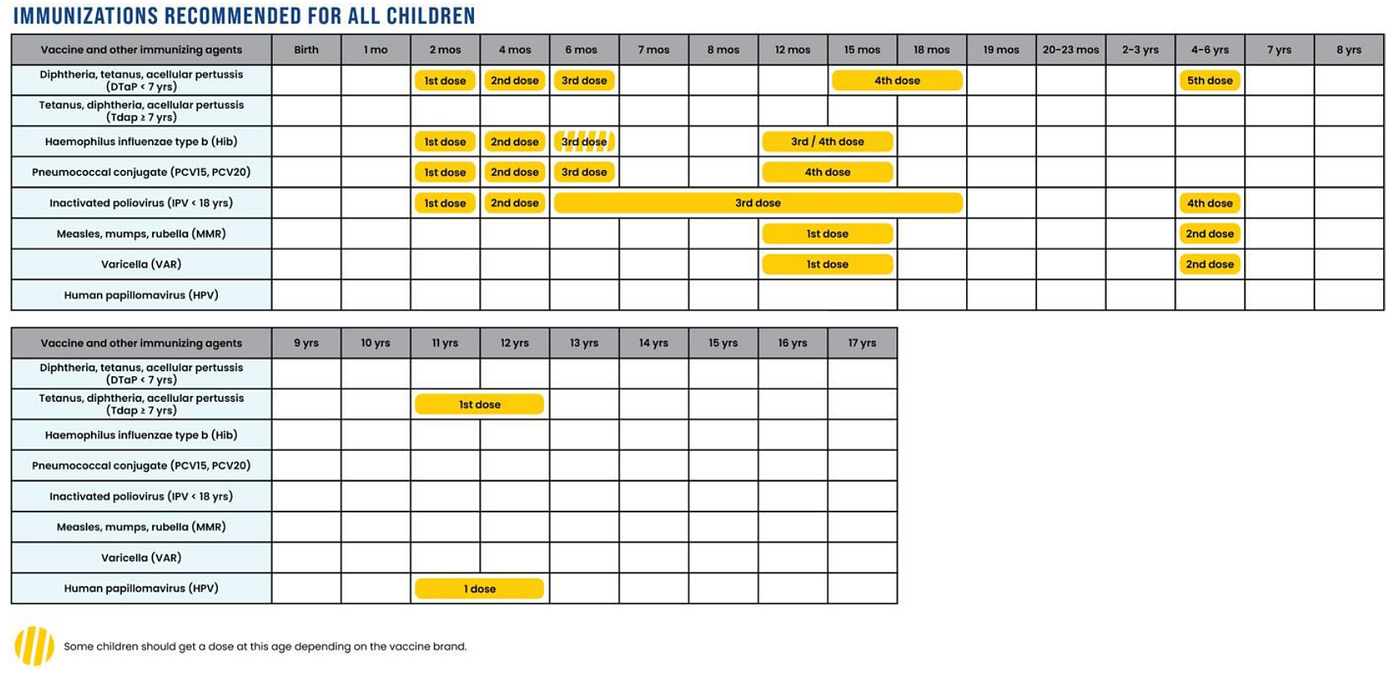
The new recomended CDC vaccine schedule from CDC (Hoeg TB et al. Assessment of the US Childhood and Adolescent Immunization Schedule Compared to Other Countries. 2026)
On January 5th 2026, Jim O’Neill, acting director of CDC (and Deputy Secretary of HHS — apparently there aren’t enough qualified people around to fill all these jobs) released new recommendations for vaccination of children in America. Routine vaccination for hepatitis A and B, influenza, COVID-19, rotavirus, and meningitis, is no longer recommended. These vaccinations are now in a lower tier called “immunizations based on shared clinical decision-making.” In addition, there are changes in recommendations for vaccines against HPV (human papilloma virus) and RSV (respiratory syncytial virus). Setting aside the politics of all these changes, let’s take a look at each of the diseases these vaccines protect against and the rationale for vaccination.
Hepatitis A
Hepatitis A is a virus usually transmitted from contaminated food or water, or from exposure to someone who is infected. While it can be prevented by ensuring proper food preparation techniques and hand washing. The largest outbreak of hepatitis A in recent decades occurred due to contaminated green onions at a Chi-Chi’s restaurant in Pennsylvania in 2003. Symptoms of hepatitis A include unusual tiredness and weakness, nausea, vomiting, and diarrhea, abdominal pain, loss of appetite, low-grade fever, dark urine, joint pain, jaundice, and intense itching. The disease is often mild and resolves in a few weeks, but severe illness can last several months.
Before introduction of the vaccine in the 1990s, hepatitis A was quite common with an estimated 26,000 infections reported annually, representing an estimated total of 270,000 infections annually, with more than half occurring in children (Armstrong, 2002). The high rates in children are perhaps not surprising since they are perhaps less likely to be careful about what they eat or to wash their hands. After introduction of the vaccine, hepatitis A rates plummeted with a 78% decrease from 1995 to 2003 (Wasley, 2005). Rates in children aged 2–9 years and 10–18 years fell by 89% and 84%, respectively. Today most cases occur among the homeless population.
Up until now, the recommendation has been to vaccinate all children at 1 year of age. This has clearly been very effective. Side effects of the vaccine are those typical of almost all vaccines, i.e. injection site soreness, etc. mild fever, headache, tiredness, and loss of appetite resolving in 1–2 days; like all vaccinations there is a very low chance of a severe allergic reaction. On balance, the vaccination has been very effective. A study by Dhankhar et al. (2015) found that universal routine childhood vaccination prevented 259,776 infections, 167,094 outpatient visits, 4781 hospitalizations, and 228 deaths annually in the US. The study also found that herd effects had a significant impact on hepatitis A mortality, morbidity and cost-effectiveness, suggesting that moving away from routine vaccination will lead to more cases, more healthcare utilization, and even deaths.
Hepatitis B
Like hepatitis A, hepatitis B is a viral disease that affects the liver. Unlike hepatitis A, it does not resolve in a few weeks and can ultimately lead to liver failure, cirrhosis, and cancer. While treatments exist, there is as yet no cure for hepatitis B. The disease is spread through contact with blood and bodily fluids, so can be transmitted through sex, sharing of needles, and critically perinatal transmission.
The risk of chronic hepatitis B via perinatal transmission — if the mother is infected — is around 90%. Given the long term consequences of the disease are so serious, US policy has been to vaccinate all babies at birth since the 1990s. Here is where it is unavoidable to stray into politics and policy. Other developed countries, such as Denmark (which appears to be the benchmark RFK Jr and his minions are using), have universal healthcare. This means all expecting mothers have access to prenatal care and are tested for hepatitis B infection before delivery. In this case vaccination of the new born is only necessary in certain cases (i.e. if the mother is infected). In the US, since the hepatitis B status of a large number of mothers is unknown due to the lack of prenatal care, the most practical approach has been to vaccinate all babies. Removing the recommendation for routine vaccination of all babies will certainly result in unnecessary transmission and the sequelae of chronic infection down the road. The idea that “shared clinical decision making” for a woman who just delivered a baby will result in the best choice for the long-term health of that baby is laughable.
Like many of the diseases CDC is now no longer recommending routine vaccination for, rates of chronic hepatitis B are low, largely because of universal vaccination. One way antivaxxers draw people in is to get people to ask the question, “Why am I vaccinating against a disease no one ever gets?” The reason you have never heard of these diseases is of course vaccination!
In 2023, there were 17,650 newly reported cases of chronic hepatitis B, and 1,769 related deaths (CDC.gov). Estimates from the CDC itself, indicate that since the introduction of vaccination at birth in the early 1990s, more than 6 million infections, 1 million hospitalizations, and around 90,000 deaths have been prevented. A recent analysis found that delaying vaccination until 12 years of age (for children whose mothers have unknown hepatitis B status) would result in 788 preventable deaths and 503 cases of liver cancer (Hall, 2025). The analysis also found that changing the age for vaccination from birth to 12 years of age would increase healthcare costs by as much as $3 billion over a decade.
The vaccine is safe with side effects are those typical of all vaccines (see above in hepatitis A). Vaccination is highly cost effective because it reduces the substantial future costs associated with the disease, including cirrhosis, cancer, liver transplant, and death. Although rates are low due to universal vaccination, until hepatitis B has been eliminated completely there is no clinical rationale for changing the recommendation for vaccination.
Influenza
No longer recommending vaccination against influenza is perhaps the most mind-boggling change to the vaccine schedule. According to CDC, the current 2025–2026 flu season has already resulted in over 11 million cases, 120,000 hospitalizations, and 5,000 deaths (as of early January 2026).
It is necessary to get a new vaccination against influenza every year. The new vaccine is tailored specifically to fight the expected strains of virus for that season. As an aside, this decision is based on data from monitoring sites around the world. The US has recently pulled out of this program, meaning these predictions are likely to be less accurate in the future (potentially making for worse protection).
Influenza is a highly contagious respiratory virus spread primarily via coughs, sneezes, and surfaces. I think we are all familiar with the symptoms. Most deaths occur in older adults (65+ years of age) who tend to have weaker immune systems; very young children are also at higher risk. In this case, vaccination becomes a matter of public health. We are not necessarily trying to protect the child, rather those around them. Reducing the risk of a child contracting influenza at school then bringing it home reduces the risk of exposing older relatives and younger siblings who are at increased risk of hospitalization and death.
Vaccination rates are already low for influenza; only 42.5% of children had been vaccinated for the current season as of December 2025. Removing the recommendation for vaccination will further reduce this number, inevitably leading to higher rates of hospitalization and death in future seasons.
COVID-19
The COVID-19 pandemic hit only 6 years ago, but we already seem to have forgotten how bad it was. Since the start of the pandemic in 2019/2020, over 1.2 million Americans have died of COVID. While we now live in a post-COVID world, around 100–200 people still died each week from COVID-19-related complications. That translates to around 5,000–10,000 deaths in 2025, similar to the number of deaths due to influenza.
Similar to influenza, vaccination is a public health issue, needed to protect not just the individual, but also the most vulnerable. In addition, the duration of vaccine protection is limited requiring regular boosters; annual boosters are also updated to fight the latest strains, similar to influenza. The CDC website (Nov 2025) has already been stating that parents of children ages 6 months to 17 years should discuss the benefits of vaccination with a healthcare provider, essentially the language in the new recommendations. This perhaps explains why only 7.4% of children were vaccinated in 2025, and may be a window onto where we are headed.
Antivaxxers point to potential side effects of the vaccine, including myocarditis/pericarditis, as a reason to avoid vaccination of children against COVID-19. We have written about this specific topic in depth previously here (spoiler alert: COVID vaccines do not increase myocarditis).
Rotavirus
The first rotavirus vaccine was introduced in 1998, but withdrawn in 1999 due to an associated rare risk of bowel blockage. If an approved vaccine (or any other drug) is found to be unsafe it is rapidly withdrawn from the market and is no longer available— see how this works? The second-generation vaccines were introduced in the mid-late 2000s, so routine vaccination has been around for less than 20 years. The newer vaccines are safe and effective!
Rotavirus is the main cause of diarrhea in young children. Transmitted via the fecal-oral route it damages the lining of the small intestine leading to gastroenteritis. While children build up immunity with each successive infection (if you had kids before 2006 you will know these are not infrequent). Although rotavirus is generally mild, before routine vaccination there were estimated to be about 2.7 million cases, 60,000 hospitalizations, and 37 deaths each year. Fairly sure most parents would give their right arm to avoid even one case of severe gastroenteritis in their child!
The incidence and severity of rotavirus infection has dropped significantly in countries that have introduced routine vaccination. Hospitalization rates dropped significantly in the US following introduction of rotavirus vaccines (Leshem, 2014; Tate, 2011). While people like RFK Jr. may endorse the concept of toughing it out to build natural immunity, preventing the suffering and healthcare utilization with a simple vaccine still seems like a sensible approach.
Meningitis
Meningitis is a broad term for inflammation of the membranes covering the brain and spinal cord. There are a number of potential causes, including viral, bacterial, fungal, and parasitic disease, as well as non-infectious meningitis. Viral meningitis caused by Haemophilus influenzae type B and mumps has been practically eliminated through vaccination and these vaccinations remain on the CDC recommended list. It is the bacterial vaccinations against meningococcal disease that have been removed from the recommended schedule.
The classical symptoms of bacterial meningitis are neck stiffness, sudden high fever, and altered mental status, though not all of these are present in all cases. The risk of death from bacterial meningitis is up to 15%, and 20% of survivors can have permanent disabilities, including brain damage, hearing loss, loss of kidney function and limb amputations (National Meningitis Association).
There are actually two vaccines against meningitis, one for serogroups A, C, W, and Y, and one for serogroup B. The MenACWY vaccine is estimated to prevent 172 cases among 11–15 year olds and 328 invasive cases in 16–23 year olds, and preventing many deaths (CDC). While these numbers are small, the seriousness of infection cannot be overstated. However, while 80% of teens have received their first dose, less than a third have received a booster dose. Uptake of the MenB vaccine is much lower — it has only been recommended since 2015. Since the end of the pandemic the incidence of meningococcal serogroup Y disease has risen quite sharply. Removing the recommendation for these vaccines will inevitably reduce coverage and expose adolescents to debilitating infections.
HPV
Human papilloma virus is actually a group of viruses transmitted sexually, some of which can lead to certain cancers (cervical cancer, anal cancer, oropharyngeal cancer, vulvar cancer, vaginal cancer, and penile cancers), as well as genital warts. Since prevention of cervical cancer was the primary goal of vaccination when it was introduced, it was initially recommended only for girls. Recognizing that it takes two to tango (and the fact that men can actually catch some of these cancers) it was later approved for boys as well. There has been some resistance, especially from religious groups, to vaccinate young girls against a sexually transmitted disease. These attitudes may explain the relatively low vaccination rate of 63% (for the two-shot series); about 78% have received at least one dose. Vaccination programs have been wildly successful in countries that have implemented universal vaccination programs. For example, in a report from 2024 no cases of cervical cancer were detected in Scotland among women who had been vaccinated (Palmer, 2024).
The new recommendation to change the schedule from two doses to one dose may actually be of benefit. A recent study showed that a single dose of vaccine was noninferior (statistics word) to two doses (Kreimer, 2025). Reducing the number of doses required can potentially increase the uptake rate, hence increasing population coverage.
RSV
Respiratory syncytial virus is highly prevalent and almost all children will have been exposed by 2 years of age. In most cases the infection is mild, but (similar to rotavirus) in some cases it can be severe resulting in hospitalization. In fact, it is the leading cause of hospitalization for infants in the US, with up to 80,000 hospitalizations each year. About 100–300 children die each year. Notably, 80% of children hospitalized with RSV have no risk factors. The first vaccine wasn’t introduced until 2023, and it never made it on to the formal childhood vaccination schedule. However, recommendation was recommended for infants at 6 months of age. The new recommendation is that only those at high risk (and shared clinical decision making) be vaccinated, but as mentioned most of those hospitalized have no risk factors.
Given the vaccine is quite new (and a new more effective version has just been introduced), it is too soon to know the full impact of RSV vaccines on hospitalization rates, but clinical studies showed an 83% reduction (Drysdale, 2023). By failing to support universal vaccination, we may never know the true impact of the vaccine in the real world.
Conclusions
The science supporting use of vaccines in children has not changed. The assessment from ACIP essentially takes the position that we should emulate other countries that vaccinate against only 11 diseases, and that the 17 (18 with RSV) the US had been doing was too many. As some public health experts have noted, perhaps these other countries should rather be following our lead! These changes to the pediatric vaccine schedule are entirely due to the installation of non-scientific vaccine deniers in positions of power at DHHS, from the secretary on down.
The evidence continues to support the universal vaccination of children for these vaccines that are now essentially regarded as optional. In fact, the economics of vaccination continue to support continued implementation. Stopping vaccination will necessarily increase healthcare utilization and cost (think increased hospitalizations) in an already broken healthcare system.
References:
Armstrong GL, Bell BP. Pediatrics. 2002;109:839–845.
Wasley A, Samandari T, Bell BP. JAMA. 2005;294:194–201.
Dhankhar P, Nwankwa C, Pillsbury M, et al. Value Health. 2015;18:358–367.
Hall EW, Gounder P, Bradley H, Nelson NP. medRxiv. 2025.
Leshem E, Moritz RE, Curns AT, et al. Pediatrics. 2014;134:15–23.
Tate JE, Cortese MM, Payne DC, et al. Pediatric Infect Dis J. 2011;30(suppl. 1):S56-S60.
Palmer TJ, Kavanagh K, Cuschieri, et al. J Natl Cancer Inst. 2024;116:857–865.
Kreimer AR, Porras C, Liu D, et al. N Engl J Med. 2025;393:2421–2433.
Drysdale SB, Cathie K, Flamein F, et al. N Engl J Med. 2023;389:2425–2435.
메타데이터
- post_id
- bee341623db7
- slug
- impact-of-the-new-cdc-pediatric-vaccine-schedule-bee341623db7
- url
- https://medium.com/watts-the-science/impact-of-the-new-cdc-pediatric-vaccine-schedule-bee341623db7
- canonical_url
- https://medium.com/watts-the-science/impact-of-the-new-cdc-pediatric-vaccine-schedule-bee341623db7
- author_url
- https://medium.com/@james.street.phd
- status
- ok
- fetched_at
- 2026-06-09 15:37:30