5 Ways RFID WIP Tracking Eliminates Bottlenecks on the Manufacturing Floor
Imagine a production floor running three shifts. Raw materials come in, go into bins, move through assembly stations, and eventually become…
5 Ways RFID WIP Tracking Eliminates Bottlenecks on the Manufacturing Floor
Imagine a production floor running three shifts. Raw materials come in, go into bins, move through assembly stations, and eventually become finished products — or they’re supposed to. What actually happens on most floors is messier. Bins wait at the wrong station. A workstation runs out of parts while another has too many. A supervisor finds out a job order is behind schedule only after a customer calls.
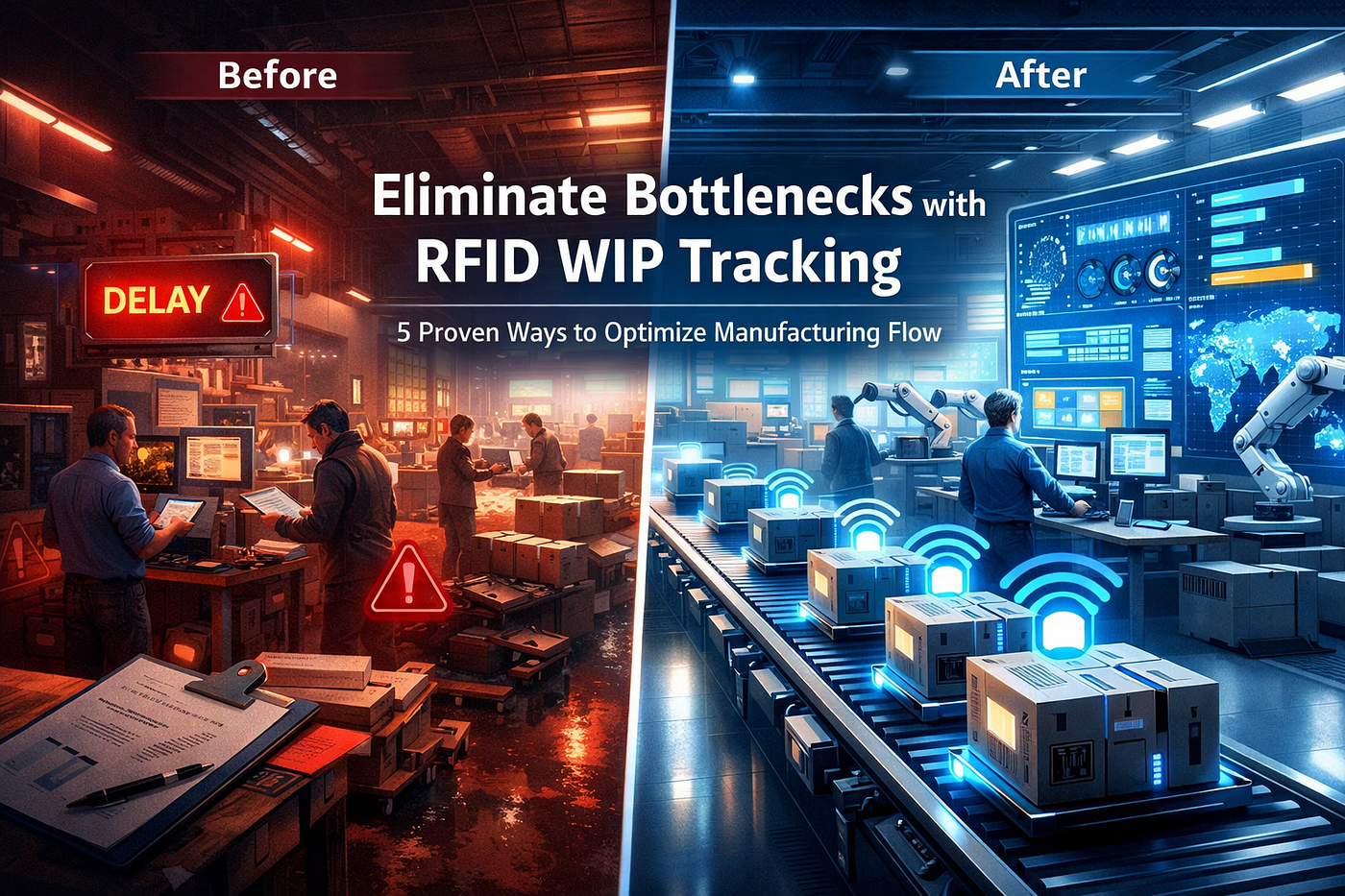
This is the WIP visibility problem. It’s not a people problem. Operators are doing their jobs. It’s a data problem: the information about where materials are, how long they’ve been there, and whether they’re on track isn’t available in real time. Manual processes capture that data intermittently, inaccurately, and often after the event.
RFID tracking changes the data picture entirely. Here’s where the difference actually shows up on the floor.
1. Parts-Waiting Stoppages Get Flagged Before They Cascade
A workstation sitting idle waiting on parts is one of those problems that seems small until it isn’t. One station’s delay doesn’t stay contained — it compresses the schedule for everything downstream. By the time a supervisor physically walks the floor and finds the holdup, other stations have already been affected.
**RFID readers** positioned along the production line track each bin, tote, or container as it moves between stages. The system knows exactly where each WIP item is and when it got there. If materials that should have moved on to the next station are still sitting at the previous one, that delay is visible immediately in the production dashboard — not an hour later.
Production teams get alerted in time to act. That’s the difference between managing a brief disruption and recovering from a cascade.
2. Slow Steps Get Identified Before They Become Missed Deadlines
Not every bottleneck stops the line. Some slow it down, consistently, invisibly, until a delivery commitment gets missed. A workstation that takes 35 minutes when the standard is 22 won’t trigger an alarm. Nobody’s standing at that station with a stopwatch. But over a week of production, that gap adds up.
RFID automatically captures the time each WIP item arrives at and leaves each station. No operator input. No manual scan. The data accumulates continuously. Operations managers can pull a view of actual cycle times across every station and compare them against the planned times. Stations that are always over capacity become clear bottlenecks that need to be fixed.
This kind of cycle time analysis was theoretically possible before RFID. In practice, getting reliable dwell-time data across a full production line through barcode scanning or manual logs was too inconsistent to be useful.
3. Out-of-Sequence Steps Get Caught While the Material Can Still Be Corrected
Manufacturing sequences aren’t optional. A device or assembly that skips a quality inspection, or hits Station 6 before it’s finished at Station 4, doesn’t just create a rework problem. Depending on the industry and the product, it can create a compliance problem, a safety issue, or both.
When thousands of WIP items are moving through multiple stations across multiple shifts, catching sequence violations manually is unrealistic. An operator might catch one. They won’t catch them all.
RFID-based production tracking validates each item’s sequence in real time. When the system detects a WIP item arriving at a station out of order, it raises an alert immediately. Supervisors know what happened, where it happened, and which specific item is involved. The material gets pulled, reviewed, and correctly routed before it moves further through the line.
For manufacturers operating under quality frameworks like ISO 9001 or ISO 13485, this kind of automatic process validation closes a gap that manual monitoring can’t reliably cover.
4. Inventory Levels Stay Accurate Enough to Drive Smarter Purchasing
Overproduction is one of the core forms of waste in lean manufacturing — and one of the least visible. Teams over-order raw materials because they don’t trust their WIP counts. They’re not sure how much is already in the pipeline, so they over-order to be safe. The result is excess inventory that occupies space, ties up capital, and makes the production floor harder to manage.
Accurate WIP data corrects this. RFID tracking gives inventory managers a real-time count of what’s at every stage of production. When procurement teams know exactly how much material is already in process, they can order based on actual demand rather than conservative estimates.
This matters beyond cost reduction. Excess WIP in a production environment also hides real process problems. When inventory levels are high everywhere, slow steps and stoppages don’t stand out. Lean production principles depend on reducing that buffer so problems become visible — and that requires trusting the underlying inventory data.
5. ERP Systems Get Real Data Instead of Stale Entries
Here’s a frustration familiar to anyone who manages production through an ERP system: the ERP is only as accurate as the last data entry. If operators fall behind on logging WIP movements, or if manual entries contain errors, the ERP’s picture of the floor diverges from reality. Planners make scheduling decisions based on data that doesn’t reflect what’s actually happening.
RFID-to-ERP integration closes that gap because the physical movement of WIP triggers automatic data updates. When a bin of subassemblies leaves Station 3 and arrives at Station 4, the ERP knows immediately — not because someone typed it in, but because the RFID system sent it. Production status is synchronized continuously between the physical floor and the planning system.
Planners can schedule with confidence. Customer delivery commitments are based on actual production status. And when something goes wrong on the floor, the ERP reflects it quickly enough for teams to respond before the impact becomes irreversible.
What Changes When the Floor Becomes Visible
Operations managers don’t usually lack the desire to run a lean, efficient floor. What they lack is reliable, timely data about what’s actually happening on it. Spreadsheets and barcode logs aren’t the problem — they’re just not built for an environment where materials move fast, workers are busy, and the cost of delay is high.
**RFID WIP tracking** turns the production floor into a monitored system. Every movement leaves a record. Every deviation triggers an alert. Every trend becomes visible before it becomes a problem. That’s a fundamentally different operational environment — and it’s where bottleneck elimination actually starts.
메타데이터
- post_id
- beeb6c6a2ca8
- slug
- 5-ways-rfid-wip-tracking-eliminates-bottlenecks-on-the-manufacturing-floor-beeb6c6a2ca8
- url
- https://medium.com/@aemuthu/5-ways-rfid-wip-tracking-eliminates-bottlenecks-on-the-manufacturing-floor-beeb6c6a2ca8
- canonical_url
- https://medium.com/@aemuthu/5-ways-rfid-wip-tracking-eliminates-bottlenecks-on-the-manufacturing-floor-beeb6c6a2ca8
- author_url
- https://medium.com/@aemuthu
- status
- ok
- fetched_at
- 2026-06-12 18:14:10