Space Giants: Who’s Building the Internet in the Sky
Part 2 of 5: The Internet is Moving to Space Series
Space Giants: Who’s Building the Internet in the Sky
Part 2 of 5: The Internet is Moving to Space Series
The race to control space-based internet infrastructure is one of the most ambitious and expensive competitions in modern business history. With billions of dollars at stake and the potential to connect every person on Earth, tech giants, aerospace companies, and innovative startups are launching thousands of satellites to claim their piece of the orbital internet pie.
But who are the key players in this cosmic competition? And what strategies are they using to build the internet infrastructure of tomorrow? Let’s meet the space giants reshaping how humanity connects.
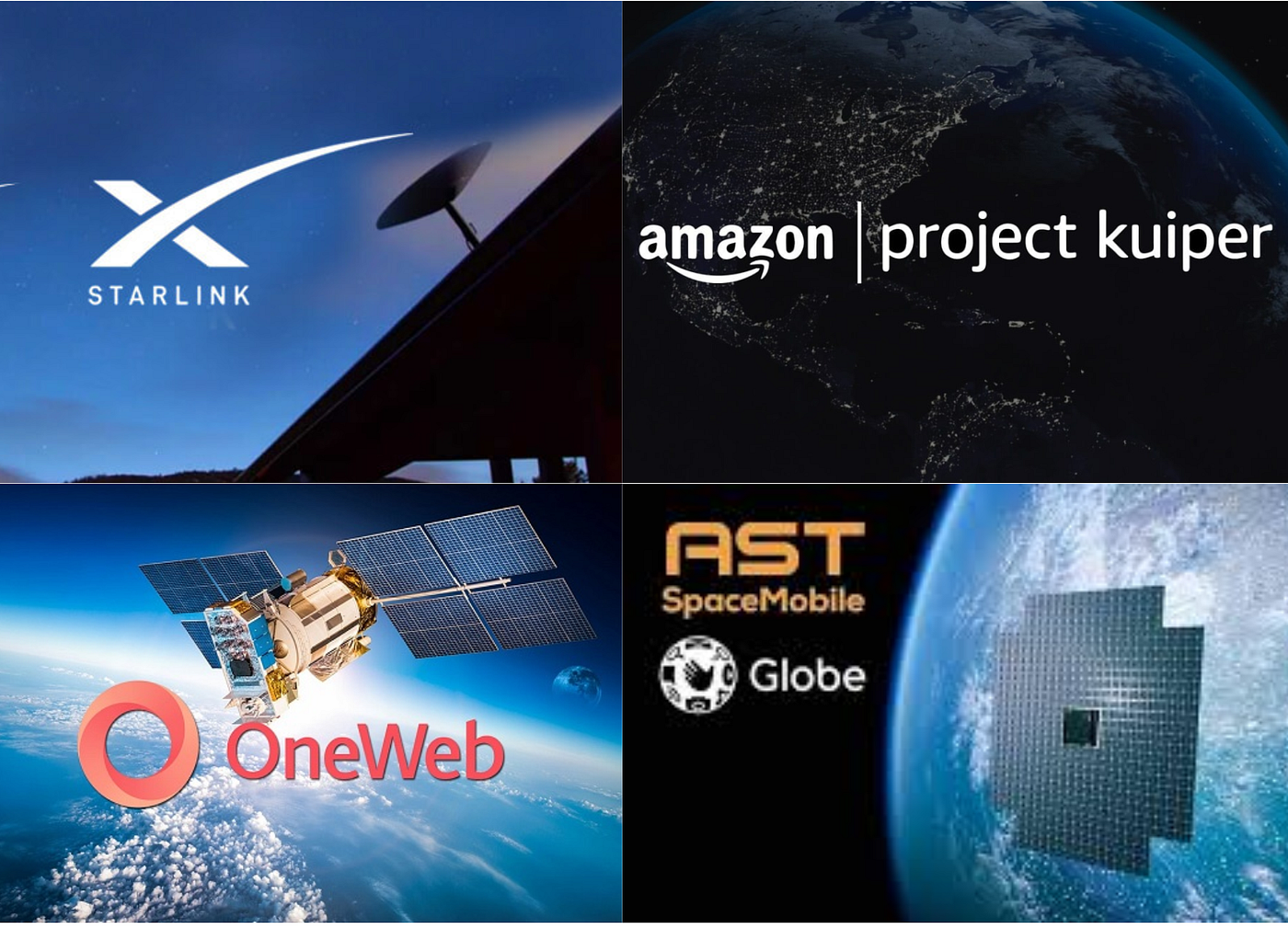
SpaceX : Starlink , Amazon : Kuiper , OneWeb , AST SpaceMobile
The Current Leader: SpaceX Starlink
The Numbers Game
SpaceX didn’t just enter the satellite internet market — they revolutionized it through sheer scale and speed. As of 2024, Starlink has become the undisputed leader in the LEO satellite internet space, with over 6,000 satellites currently operational and serving customers across the globe.
But here’s where it gets interesting: SpaceX is uniquely positioned to rapidly scale their Direct to Cell network and will rapidly launch a constellation of hundreds of satellites to enable text service in 2024 and voice, data, and Internet of Things (IoT) services.
The Direct-to-Cell Revolution
The game-changer came with Starlink’s direct-to-cell technology. SpaceX launched its first batch of Starlink satellites designed to connect directly to unmodified smartphones Jan. 2 after getting a temporary experimental license to start testing the capability in the United States.
By late 2024, SpaceX Starlink has 227 direct to cellphone capable satellites in orbit, representing a massive leap in space-based cellular infrastructure. This technology was put to the test during real emergencies, with this capability being activated in North Carolina and Georgia where communications have failed in many areas due to the hurricane.
Strategic Partnerships
SpaceX’s success isn’t just about satellites — it’s about strategic partnerships with terrestrial carriers. The company has formed alliances with major telecom providers globally, including T-Mobile in the United States and Rogers Communications in Canada, creating a hybrid space-terrestrial network.
The Starlink Advantage
What makes Starlink particularly formidable is SpaceX’s vertical integration. The company manufactures its own rockets, satellites, and ground equipment, giving them unprecedented control over costs and deployment speed. This allows them to launch satellites at a fraction of the cost of traditional aerospace companies.
The Sleeping Giant: Amazon’s Project Kuiper
Ambitious Scale
While SpaceX grabbed early headlines, Amazon’s Project Kuiper represents perhaps the most ambitious satellite internet project ever conceived. Project Kuiper is an initiative to increase global broadband access through a constellation of 3,236 satellites in low Earth orbit (LEO).
The Regulatory Timeline
Amazon faces a critical regulatory deadline that’s driving their deployment strategy. Under its granted FCC license, Amazon is required to launch and operate half of its satellites no later than July 30, 2026, and must launch and operate the remaining satellites no later than July 30, 2029.
Recent Developments
Amazon has been quietly building momentum. Amazon launched two prototype satellites in 2023 in tests it said were successful, before de-orbiting them in 2024. More significantly, the company began serious deployment in 2025, marking a major escalation in the satellite internet competition.
The Launch Strategy
Amazon has taken a massive bet on launch capacity, having purchased 92 rocket launches with United Launch Alliance, ArianeGroup, and Blue Origin. This represents one of the largest commercial launch contracts in history and demonstrates Amazon’s commitment to rapid deployment.
Unique Positioning
Unlike SpaceX, which started as a space company, Amazon brings different strengths to the satellite internet game:
- Cloud Infrastructure: Amazon Web Services (AWS) provides the backbone for global internet infrastructure
- Global Logistics: Amazon’s worldwide distribution network could streamline ground equipment deployment
- Financial Resources: With deep pockets and patient capital, Amazon can sustain losses during the deployment phase
- Ecosystem Integration: Potential integration with Alexa, Prime, and other Amazon services
The Established Players Fighting Back
OneWeb: The Comeback Story
OneWeb represents one of the most dramatic comeback stories in the satellite industry. After filing for bankruptcy in 2020, the company was rescued by the UK government and Bharti Global. OneWeb has a fully functional phase one constellation and is focusing on enterprise and government customers rather than direct consumer services.
Traditional Satellite Giants
The established satellite internet providers aren’t giving up without a fight:
Viasat: Known for high-throughput satellites, Viasat is focusing on fewer, more powerful satellites rather than large constellations. Legacy giants Hughesnet and Viasat have significant new capabilities stumbling online.
Hughes Network Systems (HughesNet): The longtime leader in satellite internet is upgrading their infrastructure to compete with LEO constellations, though they’re still primarily focused on geostationary satellite technology.
The Innovation Disruptors
AST SpaceMobile: The Direct-to-Device Pioneer
AST SpaceMobile is taking a different approach, focusing specifically on direct-to-device connectivity. Their strategy involves deploying massive satellites with large phased-array antennas designed to communicate directly with standard smartphones without requiring any modifications.
Lynk Global: The 5G Space Pioneer
Lynk Global made headlines by launching what they claimed was the world’s first 5G base station in space. Their focus is on providing cellular connectivity to areas with no terrestrial infrastructure, particularly in developing countries.
Regional and National Players
Several countries are developing their own satellite internet capabilities:
- China: Multiple state-owned companies are developing competing constellations
- European Union: The IRIS² program aims to provide sovereign satellite internet capability
- India: Bharti Airtel is partnering with OneWeb for Indian satellite internet services
The Investment Landscape
The satellite internet market has attracted unprecedented investment:
Venture Capital and Private Equity
Billions of dollars are flowing into satellite internet startups, with investors betting on the next generation of space-based connectivity.
Government Investment
National governments are recognizing satellite internet as critical infrastructure, leading to significant public investment in domestic capabilities.
Stock Market Impact
Public companies in the satellite internet space have seen dramatic stock price movements based on deployment milestones and partnership announcements.
Strategic Differentiation: How Companies Are Competing
Technology Approaches
- SpaceX: Mass production, vertical integration, rapid iteration
- Amazon: Scale, global infrastructure integration, patient capital
- OneWeb: Enterprise focus, government partnerships
- AST SpaceMobile: Direct-to-device specialization
Market Positioning
- Consumer Broadband: SpaceX Starlink, Amazon Kuiper
- Enterprise Connectivity: OneWeb, Viasat
- Emergency Services: Multiple players focusing on disaster response
- Government/Military: Specialized secure constellations
Geographic Strategies
- Global Coverage: SpaceX, Amazon
- Regional Focus: Various national champions
- Developing Markets: Companies focusing on underserved regions
Partnership Strategies: The Hybrid Approach
The most successful satellite internet companies are realizing that pure space-based solutions aren’t enough. They’re forming strategic partnerships with:
Telecom Carriers
Vodafone and Vodacom have announced a partnership with Amazon to use Project Kuiper’s LEO network to extend the reach of 4G and 5G cellular networks in Europe and Africa when the service comes online in late 2024.
Cloud Providers
Integration with cloud services creates new revenue opportunities and improves service quality.
Equipment Manufacturers
Partnerships with device manufacturers ensure compatibility and reduce customer acquisition costs.
The Competitive Landscape: Who’s Winning?
Current Market Share
- SpaceX Starlink: Clear leader with operational services and growing customer base
- Amazon Kuiper: Significant potential but still in deployment phase
- OneWeb: Solid enterprise position but limited consumer presence
- Others: Various players carving out niches
Key Success Factors
- Launch Capacity: Access to reliable, cost-effective launch services
- Regulatory Approval: Navigating complex international telecommunications regulations
- Capital Efficiency: Managing the enormous upfront investment required
- Customer Acquisition: Building distribution channels and brand recognition
- Technology Innovation: Continuous improvement in satellite and ground equipment
What’s Coming Next
The satellite internet competition is far from over. Here’s what to watch for:
Upcoming Milestones
- Amazon’s rapid deployment to meet regulatory deadlines
- SpaceX’s expansion of direct-to-cell services globally
- OneWeb’s enterprise customer acquisition
- New entrants with innovative approaches
Technology Evolution
- More powerful satellites with increased capacity
- Improved ground equipment and user terminals
- Better integration with terrestrial networks
- Advanced antenna technologies
Market Consolidation
As the industry matures, we’re likely to see consolidation through mergers, acquisitions, and partnerships. The companies that survive will be those with the best combination of technology, capital, and strategic positioning.
The Stakes: Why This Matters
The companies building the internet in the sky aren’t just competing for market share — they’re positioning themselves to control the fundamental infrastructure of the digital age. The winners will influence:
- Global Communications: How the world stays connected
- Economic Development: Which regions gain access to high-speed internet
- National Security: Critical infrastructure and data sovereignty
- Innovation: The foundation for future technologies like autonomous vehicles and IoT
Looking Ahead: The Series Continues
The space giants are launching thousands of satellites, but how do their services actually compare to traditional internet? In our next installment, we’ll dive deep into the performance, cost, and real-world applications of satellite 5G versus terrestrial networks.
The race to build the internet in the sky is heating up, and the decisions made by these companies in the next few years will shape how humanity connects for decades to come.
…
Next Week: “The Great Comparison: Satellite 5G vs. Everything Else” — Deep dive into performance, benefits, and real-world applications of space-based internet.
References
- SpaceX Starlink Official Updates — Direct to Cell Deployment 2024
- NextBigFuture — SpaceX Starlink Direct-to-Cellphone Satellite Count
- Amazon Project Kuiper Official Documentation
- FCC Licensing Requirements for Satellite Constellations
- Mobile Internet Resource Center — Early 2024 Satellite Internet Update
- SpaceNews — Direct-to-Smartphone Satellite Deployments
메타데이터
- post_id
- bef4ea660cb1
- slug
- space-giants-whos-building-the-internet-in-the-sky-bef4ea660cb1
- url
- https://medium.com/@kcl17/space-giants-whos-building-the-internet-in-the-sky-bef4ea660cb1
- canonical_url
- https://medium.com/@kcl17/space-giants-whos-building-the-internet-in-the-sky-bef4ea660cb1
- author_url
- https://medium.com/@kcl17
- status
- ok
- fetched_at
- 2026-07-19 06:55:06