When Women Give, The World Gains: Reflections from the Fight Against Digital Harm
By Stella Muthama, Finance Officer
When Women Give, The World Gains: Reflections from the Fight Against Digital Harm

Happy International Women’s Day 2026
By Stella Muthama, Finance Officer
Happy International Women’s Day!
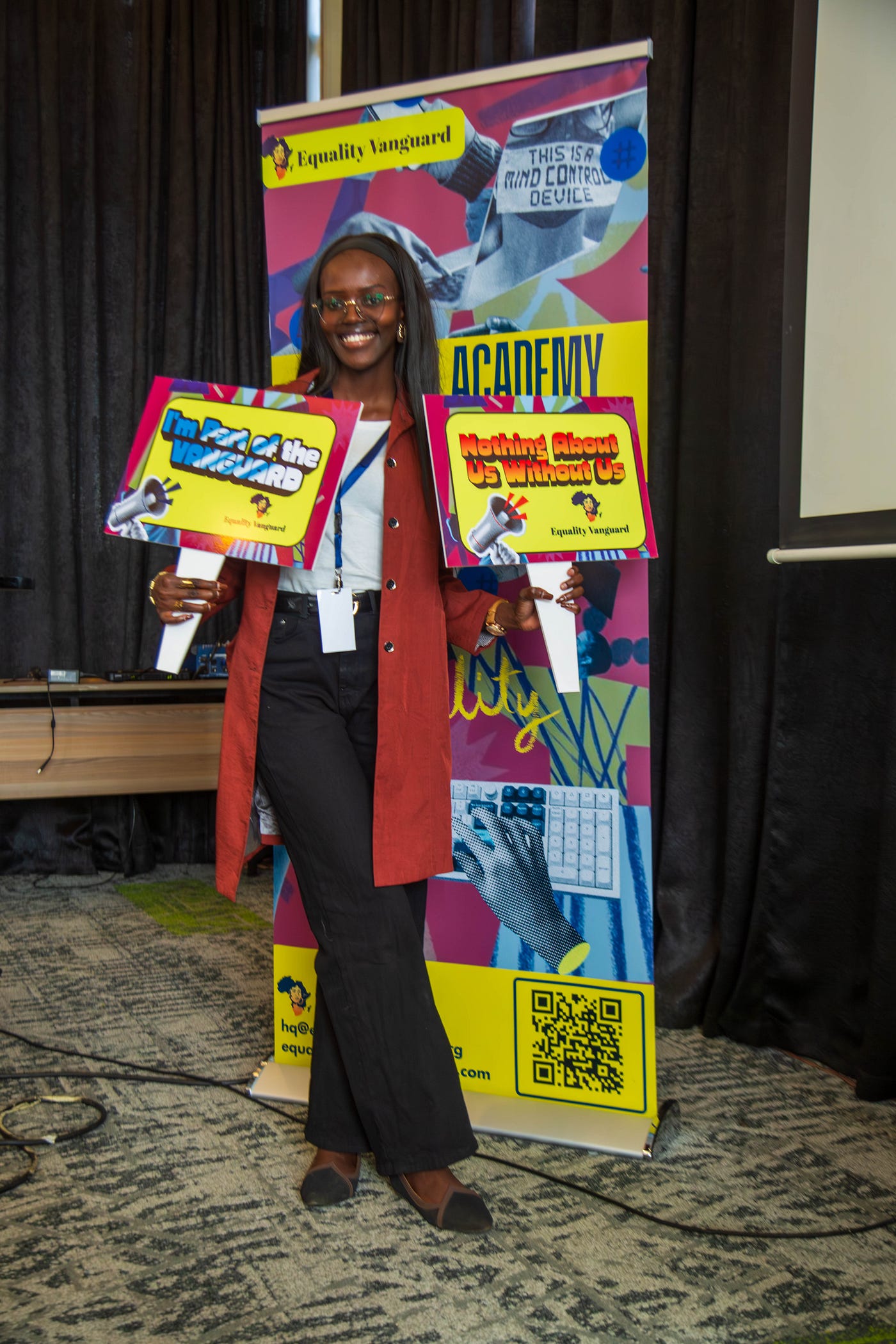
On 6th March 2026, we participated in the Women in Tech Summit, organized by UN Women. It brought together voices from across Africa and Asia for a session titled “Digital Harm, Real Justice: Bridging the Accountability Gap in Tech-Facilitated GBV.” What was shared in that room deserves to travel far beyond it. Today, we are sending it on its way.
Giving is not a subtraction. It is intentional multiplication. When women thrive, we all rise.
THE PROBLEM IS BIGGER THAN WE THINK Dr. Grace Ngare | Lecturer, Kenyatta University
We tend to speak about technology-facilitated gender-based violence (TFGBV) as though it affects a small group of women who made poor choices online. Dr. Grace Ngare’s research breaks that assumption open.
TFGBV is not a new category of harm. It is gender-based violence as we have always known it, now assisted, aggravated, and amplified by the tools billions of us use every day. And it does not affect only women. Globally, approximately 51% of women and 57% of men report experiencing some form of technology-facilitated abuse. This is not a niche issue. It is a human issue.
Dr. Ngare’s call was clear: awareness must move beyond formal institutions and into everyday community spaces. Into chamas. Into churches and mosques. Into family gatherings. Change does not begin in policy rooms. It begins in conversation.
“Awareness is not a bonus. It is the foundation. If communities do not know what TFGBV looks like, they cannot name it, report it, or stop it.”
THE CHILDREN WE ARE LEAVING UNPROTECTED Evelyn Kasina | Digital Learning Lead
In our focus on adult survivors of TFGBV, we are too often overlooking the youngest and most vulnerable users of technology: children.
Platforms like TikTok have built age-restricted environments for users under 18, with deliberate content limitations designed to protect young people. But those safeguards collapse the moment a parent hands a child an unrestricted adult device. The platform’s architecture cannot protect a child from content it was never told the child would encounter.
TFGBV prevention is also a parenting conversation, a schools conversation, and a digital literacy conversation. And it needs to start far earlier than we currently begin it.
“Adult phones are not for children. When we bypass the restrictions built for their protection, we make ourselves the gap in their safety.”
WHAT SURVIVOR-CENTRED JUSTICE ACTUALLY LOOKS LIKE -Stella Muthama | SOW-Kenya
SOW-Kenya contributed the practitioner’s perspective: what survivor-centered justice looks like not in theory, but in design. Three principles shaped our contribution.
One entry point, not ten. A survivor should tell her story once. From that single moment, she should be connected to legal support, psychosocial care, and evidence documentation simultaneously. Forcing repetition across police stations, NGO offices, and courtrooms is not process. It is re-traumatisation.
Evidence does not wait for readiness. Most survivors do not know that a casually taken screenshot, without metadata or a verifiable timestamp, is nearly unusable in court. That is an information justice gap. Closing it is not the survivor’s responsibility. It is the responsibility of the tools, institutions, and advocates around her.
A survivor’s timeline is a safety variable. A woman who cannot report immediately, because her abuser is in the next room or because her livelihood is tied to the platform where the abuse occurred, is not being evasive. She is being strategic about her own safety. The law must learn to honour that.
THE THREAD THAT HELD IT TOGETHER -Mary Wanjiru | EVAW Team Lead, UN Women
Mary Wanjiru facilitated the session with precision and warmth, returning the room again and again to a single through-line: awareness is not optional. It is the precondition for everything else.
Her emphasis was practical: the conversations happening in that room must travel. To workplaces. To community groups. To homes. A survivor who does not know what TFGBV is cannot name what is happening to her. A bystander who has never heard the term cannot intervene. A parent who does not know the risks cannot protect their child.
Awareness is where accountability begins.
The Women in Tech Summit was not simply an event. It was a reminder that the digital spaces being built today will shape the safety, or the harm, experienced by women and girls for years to come.
What we choose to do with what we heard is the real measure of whether we showed up.
Take it to your chama. Your congregation. Your staff meeting. The conversation does not end here. It starts here.
SafeOnline Women Kenya (SOW-Kenya) | safeherkenya.org #IWD2026 | #GiveToGain | #DigitalRights | #TFGBV | #SafeHer
메타데이터
- post_id
- befb930bee33
- slug
- when-women-give-the-world-gains-reflections-from-the-fight-against-digital-harm-befb930bee33
- url
- https://medium.com/@safeonlinewomenke/when-women-give-the-world-gains-reflections-from-the-fight-against-digital-harm-befb930bee33
- canonical_url
- https://medium.com/@safeonlinewomenke/when-women-give-the-world-gains-reflections-from-the-fight-against-digital-harm-befb930bee33
- author_url
- https://medium.com/@safeonlinewomenke
- status
- ok
- fetched_at
- 2026-06-09 15:37:30