The Hidden “Scourge” In Cannabis Grow Rooms Worldwide
Broad / Cyclamen / Russet Mites & Hop Latent Viroid (HLV)
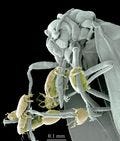
Highly Magnified Photo of a Whitefly with Broad Mites Hitching a Ride
The Hidden “Scourge” In Cannabis Grow Rooms Worldwide
Broad / Cyclamen / Russet Mites & Hop Latent Viroid (HLV)
“Dudding,” Tobacco Mosaic Virus, Hop Latent Viroid (HLV), and Broad Mites in Cannabis are in some cases vastly misunderstood. This “Scourge” has taken root in gardens from Abilene to Zanzibar.
Effort in the Legal Cannabis Industry has gone primarily into Laboratory Identification of Hop Latent Viroid (HLV) — although there have not been many solutions other than early diagnosis and selective genetic decision making.
My Colleague wrote to Me “I’ve seen a few posts about Broad Mites from you, and I don’t know exactly what you are talking about. I was at the cup here in Clio, Michigan too, and I read that you had seen a bunch of plants that had them. I got a few clones from there, and one in particular has a odd leaf thing going on. Not sure that it is broad mites but I don’t know exactly what to look for.”
“Are they a systemic sort of thing? Will the clones of clones have them? Is there a good way that you know to get rid of them or to manage them?”
— —
This is a VERY difficult class of insect to control, for many reasons. Most growers are powerless in the face of an infestation.
The size of the adult insect is 1/150 of an inch, which is smaller than it sounds. The body of a Broad Mite is Translucent, insuring they are often missed even under a loupe scope or microscope. Without training it is very unlikely one can spot the Insects.
In terms of “Systemic,” the answer is Yes and No. Since control is so difficult, and the bugs so small — they are hard to see except under extreme magnification. Once the pests are established, they may as well be Systemic within the “Blood” of the plant. Yet, they are not.
One must act preventatively, which is more likely to allow for continued control from the BM’s. Assuming that the Mites are present in the garden is not unwise.
At the very least, even with a mild infestation, One should expect at least 3 applications of Miticide will be necessary to eradicate successive generations, as they reproduce quickly — under 3 days.
If One accepts clones or plants from others’ gardens, this threat might impact Your garden immediately. If specimens are moved from outdoors into an indoors growing scene (which is never recommended), anything can happen. One must Quarantine plants for at least one week, from the rest of the Garden.
In addition, one must be aggressive in tossing away varieties that are prone to attack. Some strains are more able to withstand the bugs. Possibly, the BM’s are more aggressive with some strains. This effect occurs with Spider Mites, although they act in completely different ways, and do absolutely different damage.

The leaf-stem, the nexus of where the leaf-fingers meet, will be powdery. Reddish, dry looking. The edges of the leaf may be curling up.
Mostly in the “vegging state,” are the Bugs easier to see, as well as their damage. In flower, some folks wonder why the yield was one-half of normal, but it can still be possible to pull off a crop. The pests are much more well-hidden in Flowers.
This is part of the problem. People don’t realize they have the insects in the garden, until it is too late. Vegging plants are hardest hit. Mothers then pass the insects on in clones.
In flower, the pistils (hairs) are half as long as usual. Almost as if they were burned, or oversprayed. Sometimes they brown up at the tips. The buds are not as juicy as normal, and can yield absolute zero on some strains. Especially purple strains.
It is far easier to see the eggs than the bugs.

Broad Mite Egg
The Eggs exhibit a pattern that appears to be a grid, in most scopes. One needs at least a 60x scope or jeweler’s loupe to see anything. The Broad Mites are 1/150 of an inch. Sounds not so small, but they are. Once one knows what ones’ looking for, it is possible to BARELY see the bugs. But the presence of the eggs, and the leaf-curling and ‘stippling’ are symptoms of the BMs passing which are enough to go on.
Popular “It” varieties are the most likely to have “BMs,” or related cyclamen/russet mites. Often, simply because these strains are being shared more than others. All the same results happen in terms of effect. The bugs chew on mostly the bottoms of the leaves, and their saliva poisons the plant. Leaves twist, and do odd things. The edges of the fingers in the leaves roll up like taco shells. They appear dry, or crispy on the sides where they curl up. Discoloration follows the edges of the leaves, and the central point where the fingers meet is often reddish (hence the name Russet Mires). This is a part of the leaf structure where the bugs usually congregate, although they often hang out on the leaves as well.

Extreme Broad Mite Damage in the Vegetative State
Controlling Whiteflies is necessary as well. As unlikely as it sounds, although the Mites are able to walk to new parts of the plants — where they take the Females to new ‘territory’ in order to mate, the Mites are often able to ‘hitch a ride’ on the legs of the Whiteflies. That is appalling. And there is photo evidence of this.
New growth is the favorite food of these bastards. You will notice it there first, in the vegetative stage. The small new leaves turn yellowish, and then the dryness, and crispiness I describe above can occur. Or the new growth seems to stop developing and shrivels up.

This is NOT Tobacco Mosaic Virus. TMV is very rare, and the Broad Mites are unfortunately, not. In the early days, TMV was blamed.
The almost-microscopic pests can easily wipe out a Veg or Mother room. After many years, quite a few experienced growers have been thwarted by the presence of these seemingly new bugs on the scene.
There are even those who maintain that the infestation was a conspiracy. One could ‘seed’ the clones at one of the premier dispensaries in Northern California with BM’s, and the bugs would thus be transferred throughout the whole Statewide Cannabis Community in very short order.
Hop Latent Viroid (HLV) —
Many are the Cannabis Experts who attribute this plant illness exclusively to HLV. Some of those same People advocate that there is no Mystery, HLV gets into the plant Systemically, and nothing can be done.
Others, see the Pests outlined above, and are convinced that this Genus of Bug is responsible for the so-called “Dudding.” It is known that the saliva of the pests is Poisonous to the plant, and causes Leaves to twist and turn at the bite-points.
The possibility exists that Both Camps are correct. The Mites would no doubt, lower the resistance of the plant. Allowing a virus to enter, perhaps. Your Author believes that they work hand-in-hand.
Regardless, when the Bugs attack, many people do not notice the problem until it is far past too late. That is a characteristic of the Broad/Cyclamen/Russet Mites that makes them so hard to control. One seems to need to live through a catastrophic infestation to really learn what to look for. Unfortunately, it is sometimes essential to start over with completely new equipment, and maybe change locations.
There are Eradication Options
Heat treatments for the plants are the most effective way to treat plants. 110 degrees held at 20 to 30 minutes will allow all the eggs and bugs to be eradicated. Keeping that temperature is harder than it seems.
Spray solutions also work. I Highly recommend using these ONLY in the Vegging State, as they need to work themselves out of the plant before consuming. These heavy chemicals are in fact made for Ornamental Plants. Not plants to be consumed.
Avid alternated with Forbid every 8 days or so will get rid of Broad Mites. Reverse Osmosis water. Some surfactant, (or a couple drops of dishsoap,) “Coco-Wet” is a wetting agent made for plants and is best. These Chemicals are very effective, however quite toxic to Humans and Animals, and require protection, complete body shielding.
We are NOT allowed to use Ivermectin (WipeOut), Spiromesifen (Forbid 4F), or Abamectin (Avid) in Commercial Grows. For Good Reason.
There is One Product that we can use commercially that acts as a Specialized Eradicator of this class of pest.
Some of My information is kept for Consultatory advice on a Paid Basis.
Feel Free to reach out for help of that nature.
To be continued.
Any Ideas..? Please leave a comment, as it helps the Algorithm, and keeps Authors Going.
https://ko-fi.com/kennaaron — I would be happy to accept a “tip” for an Herbal Rooibos Tea..
Kenn Aaron 091123 USA
If you enjoy reading stories like these and want to support me as a writer, consider signing up to become a Medium member. It’s $5 a month, giving you unlimited access to stories on Medium.
메타데이터
- post_id
- befd153c059b
- slug
- question-to-icysurfer-cannabis-consultant-regarding-broad-mites-befd153c059b
- url
- https://medium.com/@icsurfer/question-to-icysurfer-cannabis-consultant-regarding-broad-mites-befd153c059b
- canonical_url
- https://medium.com/@icsurfer/question-to-icysurfer-cannabis-consultant-regarding-broad-mites-befd153c059b
- author_url
- https://medium.com/@icsurfer
- status
- ok
- fetched_at
- 2026-06-20 20:29:01