Kinds of Kindness(2024, dir. Yorgos Lanthimos): On the Origin of Species
Some of them want to use you, Some of them want to get used by you
Kinds of Kindness(2024, dir. Yorgos Lanthimos): On the Origin of Species
# 0.
Some of them want to use you, Some of them want to get used by you

# 1.
Of course, rendering it as “types of kindness” would be the most straightforward translation. However, since kind can at times also mean “species,” the title Kinds of Kindness may also be understood as referring to a species called kindness. One might call it something like Homo Comis, the kindly human. If contemporary humanity is a primate whose identity is defined by gentleness, and if that places it closer to a biological classification such as Homo erectus or Homo sapiens, then the title becomes, for a Yorgos Lanthimos film, rather definitive — and thus pessimistic — in that it suggests the traits of our species are genetically determined. If, following this hypothesis, the “kind” in the title functions as a double entendre standing in for “species,” then the film may be said to reproduce, in the form of an omnibus, an ecological study of a “species of kindness,” and this is how I personally understand and approach it.
The Death of R.M.F. is the story of Robert, a man whose every aspect of life is controlled by his superior, Raymond. In return, he enjoys material abundance — a luxurious house, a comfortable family — but, as anyone would sense, what is more meaningful than that are the gifts. The racket smashed by John McEnroe in 1984, and the scorched helmet once worn by Ayrton Senna, function like gaslighting, suggesting that this series of control and demands is protecting Robert from destruction and failure, while the Anna Karenina he reads every night serves as a more explicit hint toward the same meaning. The office in a high-rise building, the downward-looking angles from sharp edges, and the cowering compositions visually articulate the character’s condition. Then, one day, Raymond orders Robert to run someone over with a car and kill them, and Robert, who has faithfully followed Raymond for so long, finds himself in deep conflict.

# 2.
What repeatedly overlaps with the first episode is the parent–child relationship. The young and beautiful Vivian can be read as the mother as seen through the son’s eyes, while the aged and resolute Raymond resembles the father as perceived by the son. The parents may be discussing something important in their own way, but to the child it remains vividly vague, like a story about weevils killing palm trees. It is common for parents to make their child practice the etiquette of entering their room, and above all, it is not unnatural for parents to regulate the reproduction of a child they still deem immature. The oddly specific remark about having endured ten years also aligns, in a sense, with the span of adolescence. If so, what does it mean to kill R.M.F.? R.M.F., which appears in the work almost like a MacGuffin, can be assumed to concretize the “animal nature of the species” distinct from the individual. Parents demand that, upon reaching a certain age, their child kill something instinctual within themselves in order to become a true “kind of kindness,” and all children, through resistance and defeat during their formative years, are ultimately domesticated.
When the son refuses the parents’ demand, the father stops feeding him kindness. This is cruel and terrifying for the child. Although Raymond says he will take nothing, he leaves the house and the car behind but takes the broken racket, which represents the son’s reassurance that he will not fail under parental kindness. His wife Sarah, too, symbolizes the comfortable future he believed parental control would naturally lead him to, and thus she can do nothing but leave with the father. Having gained freedom, the son imitates the methods he learned from his father in search of his own purity — like actually breaking his leg instead of merely pretending to injure his hand. Rita is not an architect suited to a luxury hotel but merely an employee at a downtown optical shop, and while her profile is modest compared to the future designed by the father, it is sufficiently admirable; she represents Robert’s “future unconditioned by kindness,” that is, a future in which R.M.F. is not killed.
However, it is revealed that she, too, received the same instructions from Raymond. Rita, too, is someone controlled by parental kindness, and if everyone in the world has killed R.M.F. at their parents’ demand, then the only emotion left to the young son is a sense of alienation. If even his love with Rita cannot free Robert from parental control, then there is no reason to reject Raymond — the father. By actively reclaiming the broken racket he had once passively received, Robert returns to the embrace of his parents. More actively, more voluntarily, and above all more cruelly, he kills R.M.F. and lies between the warm yet sorrowful bed of his parents. The father says his son will not disappoint him, and the mother sings a lullaby. Regression.

# 3.
R.M.F. is Flying. The protection of the parents, which once seemed eternal, cannot in fact last forever. The grown man appears outwardly sound, like a uniformed police officer, but he suffers from the absence — the lack — of the parents who once fed him kindness through control and demand. Having killed R.M.F. with a car, the “kind of kindness,” immediately after gaining independence, exists in a chaotic state as a rebound from that control. This psychology, exaggerated in a dramatically heightened form, is precisely what appears as the group sex video. The man’s interior is a state in which his own nature (Daniel), traces of the mother (Martha), longing for Rita (Liz), and desire for a stable life (Neil) are entangled and ravenously consume one another.
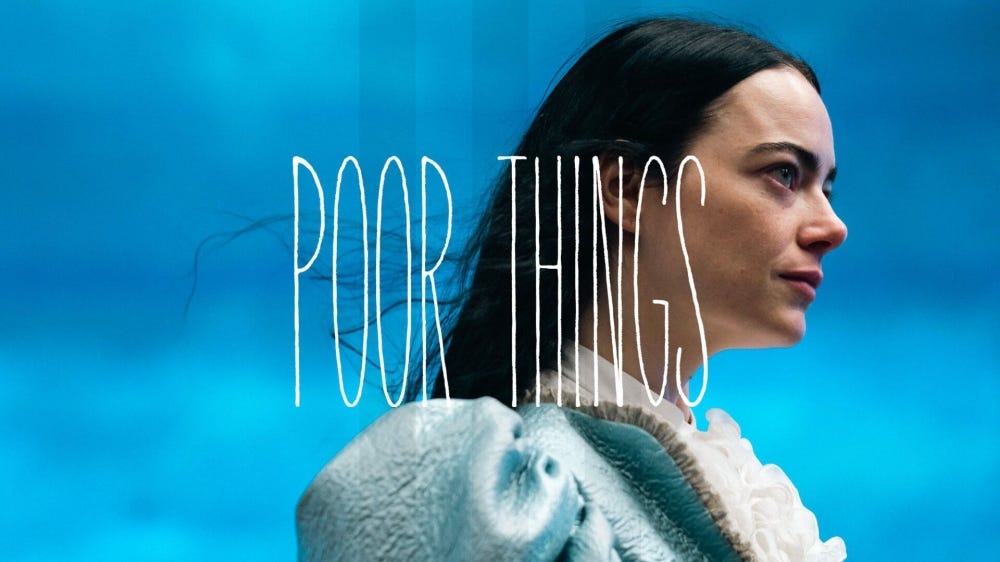
At last, Liz, who had left home, returns, but she is not the one Daniel had so desperately awaited — she is not Rita. In the meantime, her feet have grown larger, she smokes despite never having smoked before, indulges in the sensual pleasure of chocolate, and crudely demands sex — a “contaminated” Liz. Daniel asks Liz for a finger, and Liz cuts one off. When he says he wants to eat her liver, she removes it and dies. Liz, who should have proven Raymond wrong by refusing Daniel’s demands, fulfills all of his requests and then dies. Immediately afterward, the Emma Stone who returns knocking on the door is not Liz but an “impossible Rita.” Those who choose an alternative, delirious life are already no different from dogs; the individual has become a dog, but the “species” takes flight. Flying.

# 4.
R.M.F. Eats a Sandwich. As kindness, born from control, evolves through self-distrust into a compulsive and puritanical faith, the inner world of the son — who has killed R.M.F. and rejected Liz — has already become Rita’s. This is why Emily, the central figure of the third episode, is once again played by Emma Stone, and why the now disheveled Andrew is pushed into the passenger seat. Likewise, for the one who has become her, the only remaining refuge is to return to the father, and at the same time to return to the wife of the first episode, which is why Omi must be played by Willem Dafoe and Aka by Hong Chau.
Emily, under the influence of drugs, ends up having unwanted sex with her husband. Expelled from paradise and rendered impure, the only way for Emily to return is to claim Anna — a perfectly pure and miraculous being — as her own. After many twists and turns, Emily finally finds Anna. Kidnapped violently, Anna performs a miracle, but the object of that miracle happens to be the dead R.M.F.; having revived him, Anna dies in vain. In striving to become transcendent beings, they control, raise, demand, and desire one another — and themselves — but in the end, they are nothing more than ordinary, filthy beasts, smearing sticky sauce all over their clothes. It is that hollow contrast.
Throughout the film, the individual suffers, but there is only the expansion of the species. Whether R.M.F. lives or dies is invested with meaning, but the species itself simply fills its stomach without thought. By standardizing human beings, Yorgos Lanthimos renders the birth, mutation, and completion of a grotesque species called kindness, arriving at the conclusion of a species that, in order to preserve its own illusions, mutilates both others and itself, only to be blinded by meaningless miracles and fail to perceive its essence. It is the origin of a parasitic species that cannot survive without either being dominated or dominating, without the yoke of “kindness.”

메타데이터
- post_id
- bf017ba1e83f
- slug
- kinds-of-kindness-2024-dir-yorgos-lanthimos-bf017ba1e83f
- url
- https://medium.com/@realpierr/kinds-of-kindness-2024-dir-yorgos-lanthimos-bf017ba1e83f
- canonical_url
- https://medium.com/@realpierr/kinds-of-kindness-2024-dir-yorgos-lanthimos-bf017ba1e83f
- author_url
- https://medium.com/@realpierr
- status
- ok
- fetched_at
- 2026-08-03 00:13:31