I, Tony Min, The Quiet Observer
Although my voice now appears here, I carry with me the years of trust built among readers who came not just for recommendations, but for…
I, Tony Min, The Quiet Observer
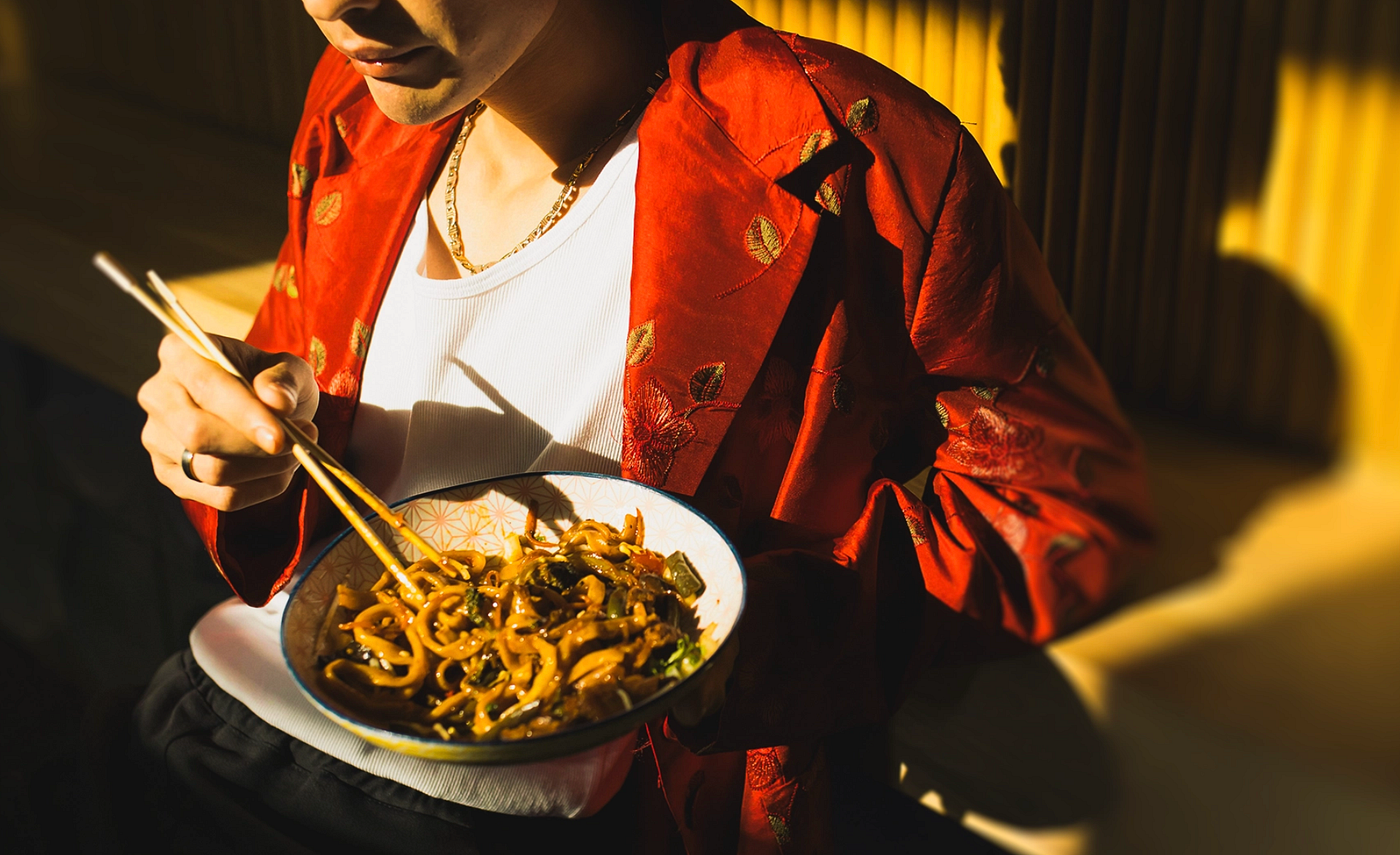
Close-up shot of person in red floral jacket eating stir-fried noodles with chopsticks, highlighting cultural dining and warm dramatic lighting.
Although my voice now appears here, I carry with me the years of trust built among readers who came not just for recommendations, but for the subtle stories tucked behind every meal.
The air is still heavy with night when the fluorescent lights of the local **kopitiam **flicker on. It is half past five in the morning. Most of the city is deeply asleep, but in this small corner of the neighborhood, the daily rhythm has already begun. A solitary figure sits at a plastic table near the back, his hands wrapped around a warm ceramic cup of dark, bitter coffee. He is not looking at his phone. He is not taking notes. He is simply watching.
He watches the **hawker **uncle expertly stretch a piece of dough until it is paper thin. He notices the rhythmic, metallic scrape of the spatula against the seasoned wok. He observes the quiet, coordinated dance of a family preparing to feed hundreds of strangers before the sun even fully rises.
I am Tony Min. For years, I have moved quietly through Singapore’s dining scene, never as a traditional restaurant critic, never with a clipboard or a checklist. My writing life began at Singapore Best Restaurants, where I chronicled the city’s ever-shifting food culture for a wide, always-curious audience. My stories there weren’t just about recommendations; they were about listening deeply and understanding the quiet cultural meaning that sits beneath every plate. The trust I built with readers came not from pronouncements or rankings, but from pausing long enough to catch the heartbeat of each neighborhood, each kitchen, each table worn smooth by years of use. Now, as I continue that journey here, I invite you to pull up a chair and look closer, not just at what we eat, but how and why we gather around the table in Singapore.
We discover the soul of a city not in its monuments, but in the places its people gather to share a meal.
My approach to food writing was born out of a gentle frustration with the modern dining narrative. We live in an era obsessed with ranking our experiences, forever chasing after top ten lists, viral trends, and the noisiest new concepts. In that endless rush to categorize everything we eat, I realized that we were missing the real story. We were tasting the food, but we ignored the hands that made it and the history that shaped it. learned to listen first, to find meaning in the pauses, the gestures, the steady patience behind every plate. Readers came back not for bold pronouncements, but for a sense that someone was paying attention to the quieter parts of the meal. That trust remains at the heart of every essay I write.
When I walk into a dining room, I look past the obvious. I notice the subtle pacing of a meal, the way the acoustics shift from the hushed reverence of fine dining to the overlapping conversations in a communal space. I watch how people interact when they break bread together, and I pay attention to how a beautifully prepared dish can force even the busiest, most distracted mind to anchor itself in the present moment.
Good food does not need to announce itself. It simply stays, anchoring us to a specific time and place.
Singapore is an island defined by rapid, sweeping transformation. The skyline changes constantly. Old neighborhoods like **Chinatown** and Joo Chiat are routinely reimagined. In a landscape that shifts so quickly, our food remains our most reliable anchor. It is the living record of our migrations, our struggles, and our triumphs. A single bowl of noodles carries the heavy weight of generations. It tells a complex story of adaptation, survival, and eventual joy.
I know that if we do not intentionally preserve these stories, they will silently slip away. The aging matriarchs will eventually put down their wooden spoons. The historic recipes that take hours of manual labor will be set aside for convenience. Over time, I found that this approach to storytelling, marked by care and attention to the everyday, built a gentle trust with readers who returned not just for recommendations, but for the feeling that something important was being remembered and respected.
I ask you to slow down with me. My aim has always been to help you taste the history folded into a dumpling, to feel the intention poured into a slow-simmered broth, and to trust that, in observing these moments together, we are keeping something precious alive.
What we return to is rarely just the dish on the table, but the profound way that specific room made us feel.
메타데이터
- post_id
- bf074e4454f6
- slug
- i-tony-min-the-quiet-observer-bf074e4454f6
- url
- https://medium.com/@tonymin./i-tony-min-the-quiet-observer-bf074e4454f6
- canonical_url
- https://medium.com/@tonymin./i-tony-min-the-quiet-observer-bf074e4454f6
- author_url
- https://medium.com/@tonymin.
- status
- ok
- fetched_at
- 2026-07-10 10:20:21