Why the Future of Enterprise Tech Isn’t a Blockchain: 5 Takeaways from Hedera Hashgraph
Throughout history, the trajectory of transformative technology has followed a predictable arc: institutional adoption precedes mass market…
Why the Future of Enterprise Tech Isn’t a Blockchain: 5 Takeaways from Hedera Hashgraph
Throughout history, the trajectory of transformative technology has followed a predictable arc: institutional adoption precedes mass market ubiquity. From the steam engine and the telegraph to the foundational protocols of the internet, the path to the mainstream has been paved by enterprise utility rather than retail hype. While the current “crypto winter” discourse often fixates on the volatility of decentralized finance, the structural evolution of the industry is occurring in the more disciplined corridors of global commerce.
Hedera Hashgraph (HBAR) is the manifestation of this enterprise-first philosophy. Positioned not merely as another cryptocurrency but as a sophisticated successor to traditional blockchain, Hedera provides the architectural integrity required for global business. To understand why Hedera is gaining traction among the world’s most risk averse institutions, one must look beyond the “block” and into the “graph.”
1. It’s Not a Blockchain (and That’s a Good Thing)
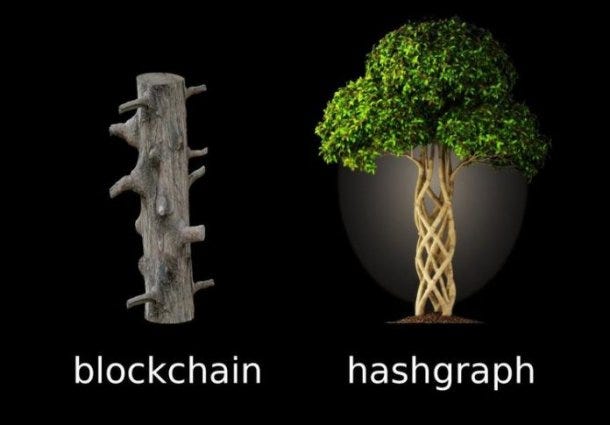
At its core, Hedera is a Directed Acyclic Graph (DAG), an architecture fundamentally distinct from a linear blockchain. In a traditional blockchain, transactions are batched into blocks that form a single, rigid chain. This structure necessitates “artificial slowness” — intentional delays created by proof of work or proof of stake mechanisms to prevent the network from forking. This bottleneck is the primary driver behind the high fees and latency issues currently plaguing legacy networks.
Hedera’s “woven” architecture eliminates these constraints. Rather than forcing every transaction into a single line, the hashgraph consensus algorithm allows for multiple branches of transactions to be processed simultaneously and then woven back into a single, unified state. This removes the “blockchain trilemma” by achieving deterministic finality without sacrificing throughput.
“With hashgraph, every transaction container is incorporated into the network state; none are discarded. However, all are woven together into a single network state, making it fundamentally more efficient and faster than blockchain.”
2. Scalability Limited Only by the Internet Itself
For a distributed ledger to serve as the backbone of global finance, it must match the performance of centralized incumbents like Visa. Hedera’s performance metrics suggest it is one of the few protocols capable of this feat, with scalability that is primarily restricted by the bandwidth of the underlying internet connection rather than the protocol’s consensus mechanism.
- Throughput: Capable of processing 100,000+ transactions per second (TPS) within a single shard.
- Predictable Overhead: Transaction fees are fixed and denominated in USD, consistently costing less than $0.01.
- Environmental Sustainability: A study by University College of London (UCL) confirmed that Hedera maintains the lowest energy consumption among all leading Layer 1 networks.
3. Governance by the Global Elite
The most significant “regulatory moat” separating Hedera from its peers is its governance model. The network is managed by the Hedera Governing Council a rotating group of up to 39 world class organizations, including Google, IBM, Tata, and Mondelez.
This caliber of governance provides a level of institutional stability and legal recourse that anonymous, decentralized validator sets cannot offer. These members are legally bound entities that actively debate and drive the protocol’s roadmap. Furthermore, Hedera is architecturally and legally designed to be “fork resistant.” Through a combination of intentional consensus design and defensive patents, the original governed version of the network is protected from the contentious splits that have historically fragmented the network effects of Bitcoin and Ethereum.
4. Regulation as a Protocol Feature, Not a Bug
While many decentralized protocols treat regulation as an external threat, Hedera treats it as a technical requirement. The protocol integrates permission controls and account recovery features directly into its base layer. This allows developers to build “self sovereign data” environments where users maintain control, yet institutions can satisfy strict GDPR and KYC requirements.
“For a network to be mass adopted by large enterprise, it must have some capability to control regulatory compliance; it’s just a must for large enterprise.”
By baking these features into the protocol — rather than leaving them to the application layer. Hedera enables complex enterprise functions like key recovery and identity attached accounts. This shift allows a counterparty to perform necessary consumer protection checks without stripping the user of their choice to remain pseudonymous in other contexts.
5. Eliminating the “Leader” Problem
In many blockchain models, a single “leader” node is chosen to propose a block. This creates a strategic vulnerability: a leader can be targeted by DoS attacks or, more commonly, can manipulate the order of transactions to extract value — a practice known as front running or MEV (Maximal Extractable Value).
Hedera utilizes asynchronous Byzantine Fault Tolerance (aBFT) to achieve a “leaderless” consensus. In this model, all nodes are treated equally. This ensures “Fairness of Ordering,” where no single node has the power to delay or prioritize a transaction. For FinTech applications and institutional trading, this elimination of “pay to play” line jumping is not just a security feature; it is a prerequisite for trust.
The Verdict: A Consensus as a Service Future
The true power of the network lies in the Hedera Consensus Service (HCS). This “Consensus as a Service” model allows organizations to utilize Hedera for transaction ordering and transparency without abandoning their existing private infrastructures.
The industry demand for this service is clear. Organizations like Siemens, Goldman Sachs, and Alibaba currently utilize centralized streaming tools like Apache Kafka or Flink to manage massive datasets — ranging from IoT device streams to real time financial market data and inventory management. However, these tools face limitations in “untrusted environments” where data must be shared across manufacturers, exporters, and insurers outside a single corporate firewall. Hedera bridges this gap, providing a decentralized layer of trust for existing enterprise systems.
The “enterprise first” model suggests that the catalyst for mass adoption will not be a retail app, but the silent integration of distributed ledgers into the world’s supply chains and financial pipes. As we move toward this era of institutional stability, the question remains: does the future of tech require the purity of total decentralization, or the accountability of a governed ledger?
메타데이터
- post_id
- bf08519d2a60
- slug
- why-the-future-of-enterprise-tech-isnt-a-blockchain-5-takeaways-from-hedera-hashgraph-bf08519d2a60
- url
- https://medium.com/@ayushkamber/why-the-future-of-enterprise-tech-isnt-a-blockchain-5-takeaways-from-hedera-hashgraph-bf08519d2a60
- canonical_url
- https://medium.com/@ayushkamber/why-the-future-of-enterprise-tech-isnt-a-blockchain-5-takeaways-from-hedera-hashgraph-bf08519d2a60
- author_url
- https://medium.com/@ayushkamber
- status
- ok
- fetched_at
- 2026-08-11 18:41:33



